



惯性聚合 高效追踪和阅读你感兴趣的博客、新闻、科技资讯
阅读原文 在惯性聚合中打开

推荐订阅源

C
Check Point Blog
U
Unit 42
Threat Intelligence Blog | Flashpoint
奇客Solidot–传递最新科技情报
奇客Solidot–传递最新科技情报
Martin Fowler
Martin Fowler
L
LangChain Blog
博客园_首页
博客园 - 【当耐特】
Vercel News
Vercel News
I
InfoQ
GbyAI
GbyAI
爱范儿
爱范儿
D
DataBreaches.Net
Blog — PlanetScale
Blog — PlanetScale
B
Blog RSS Feed
A
About on SuperTechFans
Cyber Security Advisories - MS-ISAC
freeCodeCamp Programming Tutorials: Python, JavaScript, Git & More
G
Google Developers Blog
大猫的无限游戏
大猫的无限游戏
Apple Machine Learning Research
F
Fortinet All Blogs
N
Netflix TechBlog - Medium
酷 壳 – CoolShell
酷 壳 – CoolShell
P
Proofpoint News Feed
美团技术团队
V
V2EX
Stack Overflow Blog
Stack Overflow Blog
有赞技术团队
有赞技术团队
Y
Y Combinator Blog
OSCHINA 社区最新新闻
OSCHINA 社区最新新闻
H
Help Net Security
Recent Announcements
Microsoft Azure Blog
D
Docker
宝玉的分享
宝玉的分享
让小产品的独立变现更简单 - ezindie.com
量子位
小众软件
小众软件
J
Java Code Geeks
S
SegmentFault 最新的问题
Engineering at Meta
Engineering at Meta
Google DeepMind News
MongoDB | Blog
MongoDB | Blog
The Cloudflare Blog
Recorded Future
Recorded Future
阮一峰的网络日志
阮一峰的网络日志
T
The Blog of Author Tim Ferriss
MyScale Blog
MyScale Blog
Microsoft Security Blog

Databricks

Why Talent Transformation Is the Missing Focus of Enterprise AI Public Health Intelligence Shouldn't Require a Data Scientist Mean Time to Detect Is a Data Access Problem First-party audience data is the ad sales relationship now Rethinking Distributed Systems for Serverless Performance and Reliability The AI Scaling Gap Hiding in Digital Native Companies 10 trillion samples a day: Scaling beyond traditional monitoring infra at Databricks AI success starts with clean data, not just better models How nOps Rebuilt Their Cloud Optimization Platform on Databricks Lakebase, and Why Other ISVs Should Too Peril Predicts: Precision Payouts for a Volatile World The foundation of AI scalability: one team, one platform, one operating model The Federal Data Paradox: Rich in Data, Poor in Access Driving Budapest Forward: How BKK Uses Databricks to Transform City Mobility LLM Vs AI: A Practical Guide to Differences, Use Cases, and Tools Model Risk Governance Is Not the Same as Risk Intelligence Generative AI for Business: A Complete Strategy and Implementation Guide Data Science vs Data Engineering: Choosing Analysis or Infrastructure AI Applications: Tools, Use Cases, and Platforms MLOps vs DevOps: A Practical Guide for Data Scientists and IT Teams Top Data Warehouse Tools For Modern Data Analytics Unlocking SAP Business Context in Databricks with Semantic Metadata Delta Sharing The marketing activation gap has a fix: Databricks and Stitch partner to turn data infrastructure into marketing performance Alert Fatigue Is a Business Risk Backstage with Lakebase Shipping Faster isn’t Learning Faster Why Your OEE Dashboard Is Lying to You The Turbine That Tried to Tell You It Was Failing Predicting Readmissions Isn't Enough. Acting in Time Is. Clinical Trials Run Longer Than They Have To. That's a Patient Problem Network Quality Is a Revenue Problem, Not a Technical One Shelf Availability Starts with Better Demand Visibility When Predicting the Next Hit Requires More Than Intuition Approximate Answers, Exact Decisions: New Sketch Functions for Analytics Companies Winning with AI Built the Data Layer First Rethinking SQL ETL for modern data platforms Stripe data now available on Databricks via Databricks Marketplace Databricks and Stripe Projects: Infrastructure Built for Agents Agents are ready but your architecture probably isn't Interoperability Between Unity Catalog and Google BigQuery via Catalog Federation Built In, Not Bolted On: What AI-Native Actually Means in Cybersecurity Operationalizing AI for public sector fraud prevention From months to minutes: Building real-time clinical data pipelines with natural language Agentic Data Engineering with Genie Code and Lakeflow Securely send first-party conversion signals with Snapchat Conversions API on Databricks Marketplace How leading tech companies are killing the builder’s tax with Lakebase Inside one of the first production deployments of Lakebase: LangGuard's agentic workflow governance engine The next generation of Databricks Genie Model Risk Management in 2026: A Banker’s Guide to the Revised Interagency Guidance OpenAI GPT-5.5 now available on Databricks, fully-governed through Unity AI Gateway Operational databases: How they work and when to use them Databricks partners with OpenAI on GPT-5.5 Announcing the Public Preview of Lakeflow Designer Are LLM agents good at join order optimization? How conversational analytics removes the BI bottleneck How to transform document activation workflows with Genie and Agent Bricks Beyond the spreadsheet: how Databricks is delivering the modern CFO in Financial Services AI App Development: Guide To Building AI-Powered Apps IoT in Manufacturing: Strategy, Components, Use Cases, and Challenges Stop Hand-Coding Change Data Capture Pipelines Multimodal Data Integration: Production Architectures for Healthcare AI Personalization Strategies for Media Companies A Modern AI Risk Management Framework Introducing the Databricks Excel Add-in for Business Users Real-Time Decisioning for AI Agents: Why you Need a Customer Context Layer First A Practical Guide to LLM Fine Tuning AI Data Transformation Guide for Data Engineers and Data Scientists Concurrency Control in DBMS: How Locking, MVCC and Optimistic Strategies Keep Data Consistent Bridging data science and marketing: Databricks unveils Delta Sharing integration for Adobe Experience Platform and agentic marketing workflows Take Control: Customer-Managed Keys for Lakebase Postgres Get hands on with agents, vibe coding and more at Data+ AI Summit Mercedes-Benz Builds a Cross-Cloud Data Mesh with Delta Sharing and Intelligent Replication, Cutting Costs by 66% What Is a Transactional Database? Introducing Genie Agent Mode Governing coding agent sprawl with Unity AI Gateway Governing Coding Agent Sprawl with Unity AI Gateway What is pgvector? Banks Don’t Have an AI Problem – They Have a Data Platform Problem Open Platform, Unified Pipelines: Why dbt on Databricks is Accelerating Why Your Agents Can’t Read Enterprise Documents — and How to Fix It Building with Databricks Document Intelligence and Lakeflow Databricks on Google Cloud: Innovate Faster. Smarter. Together. Introducing the Databricks Connector for Google Sheets: Real-Time, Governed Lakehouse Data in the Sheets Users Love Unity AI Gateway: How to connect agents to external MCPs securely Expanding agent governance with Unity AI Gateway Agentic reasoning in practice: Making sense of structured and unstructured data Agent Bricks: The Governed Enterprise Agent Platform 8 AI and data trends shaping financial services in 2026 Building real-time product search on Databricks Lovable + Databricks: Build Data-Driven Apps at the Speed of Thought Memory scaling for AI agents Powering clinical research innovation: How TriNetX uses Databricks to accelerate drug development Database Branching in Postgres: Git-Style Workflows with Databricks Lakebase How Zalando built a unified data foundation for AI and analytics on Databricks The next era of the open lakehouse: Apache Iceberg™ v3 in Public Preview on Databricks How FSIs eliminate silos between clients, operations, and finance How MakeMyTrip achieved millisecond personalization at scale with Databricks A multi-agent approach to audience intelligence AiChemy: Next-generation agent with MCP, skills and custom data for drug discovery Accelerate business insights with Lakeflow Connect, now with a Free Tier Unlocking Next-Gen Customer Experiences with Data Intelligence for Marketing
Databricks for Good and Virtue Foundation: Partnering to Connect Medical Volunteers to Critical Health Services in 72 Countries
2026-05-20 · via Databricks

Introduction

Virtue Foundation is a nonprofit focused on global health delivery and creating an efficient marketplace for global philanthropic healthcare. To date, they’ve delivered care to over 50,000 patients with a special focus on Ghana and Mongolia. The backbone of this marketplace is the curation of global healthcare facility data through VF Match, a platform that connects medical professionals to volunteer opportunities in 72 low and low-middle income countries. Databricks for Good has been partnering closely with Virtue Foundation since 2024 to leverage AI to aggregate data across these countries and make it actionable.

An initial proof of concept demonstrated that LLMs could extract structured information from disparate web data sources to create a map of healthcare infrastructure and, most importantly, the gaps in services in under-resourced areas. However, scaling this functionality and moving it into production posed many challenges. Since that first iteration, we’ve built a Databricks-based platform that has transformed the POC into a production-grade system aggregating data from thousands of healthcare facilities and non-profits across the globe.

In this article, we walk through how we improved on our earlier work to further enable Virtue Foundation to match their community of medical volunteers with critical needs in these countries.

Building the Foundation: 72 Countries of Healthcare Data

The core of VF Match is the Foundational Data Refresh (FDR): a comprehensive healthcare facility and nonprofit dataset built from the ground up from various web-based sources. We systematically ingest and refresh data from 72 low and low-middle income countries across the globe.

Two complementary data sources power this refresh:

  • Overture Maps: An open-source geospatial dataset by Meta and Microsoft, providing authoritative locations for healthcare facilities.
  • Bright Data: Industrial web-scraping infrastructure that captures real-time information from across the internet.

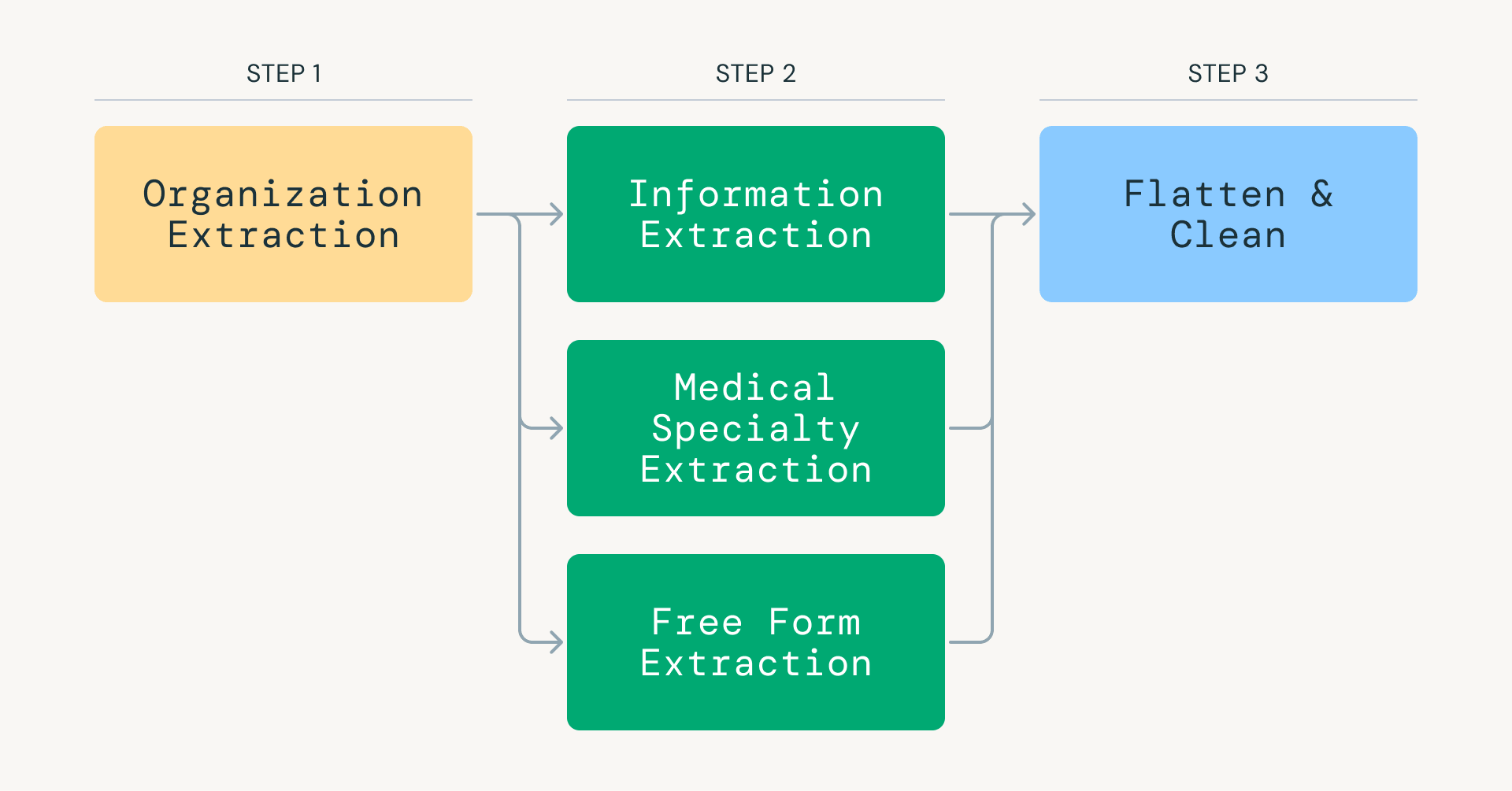
The heart of FDR is an information extraction pipeline powered by OpenAI’s GPT models. Processing more than 25 million web pages through LLMs with production guarantees required rethinking traditional LLM inference pipelines. Rather than attempting one-shot extraction, our pipeline breaks the task into targeted steps: classifying medical relevance, identifying organization type (either a medical facility or NGO), and extracting specialties, equipment, and procedures.
Global Health Impact with the Virtue Foundation-1.
Fig 1: Foundational Data Refresh (FDR) key steps.

This approach dramatically reduces token consumption while focusing each model invocation on a narrow, high-precision task. Databricks and Apache Spark are used to efficiently orchestrate and parallelize the scraped data, distributing workloads across thousands of executors and enabling high-throughput LLM inference.

A number of critical features make this pipeline scalable and ready for production:

  • Extensible data modeling: Data at each step is stored in a star schema, simplifying downstream analytics and improving query performance.
  • Status-based checkpointing: Every record tracks its processing state, enabling pipelines to resume from any point without reprocessing rows with expensive LLM calls.
  • Configurable extraction registry: Each extraction method is controlled by a structured object specifying the system prompt, making extraction logic modular, reproducible, and extensible.
  • Scalable distributed processing: The system processes skewed, multi-terabyte workloads using Spark for parallelism, Photon for performance at scale, and production-grade orchestration.

These guarantees are enforced through Lakeflow Jobs, which orchestrate more than 15 interdependent tasks with conditional branching, parallel execution, and intelligent retry policies. The result is a system that processes healthcare facility data at scale with the precision of medical experts.

Entity Resolution at Scale

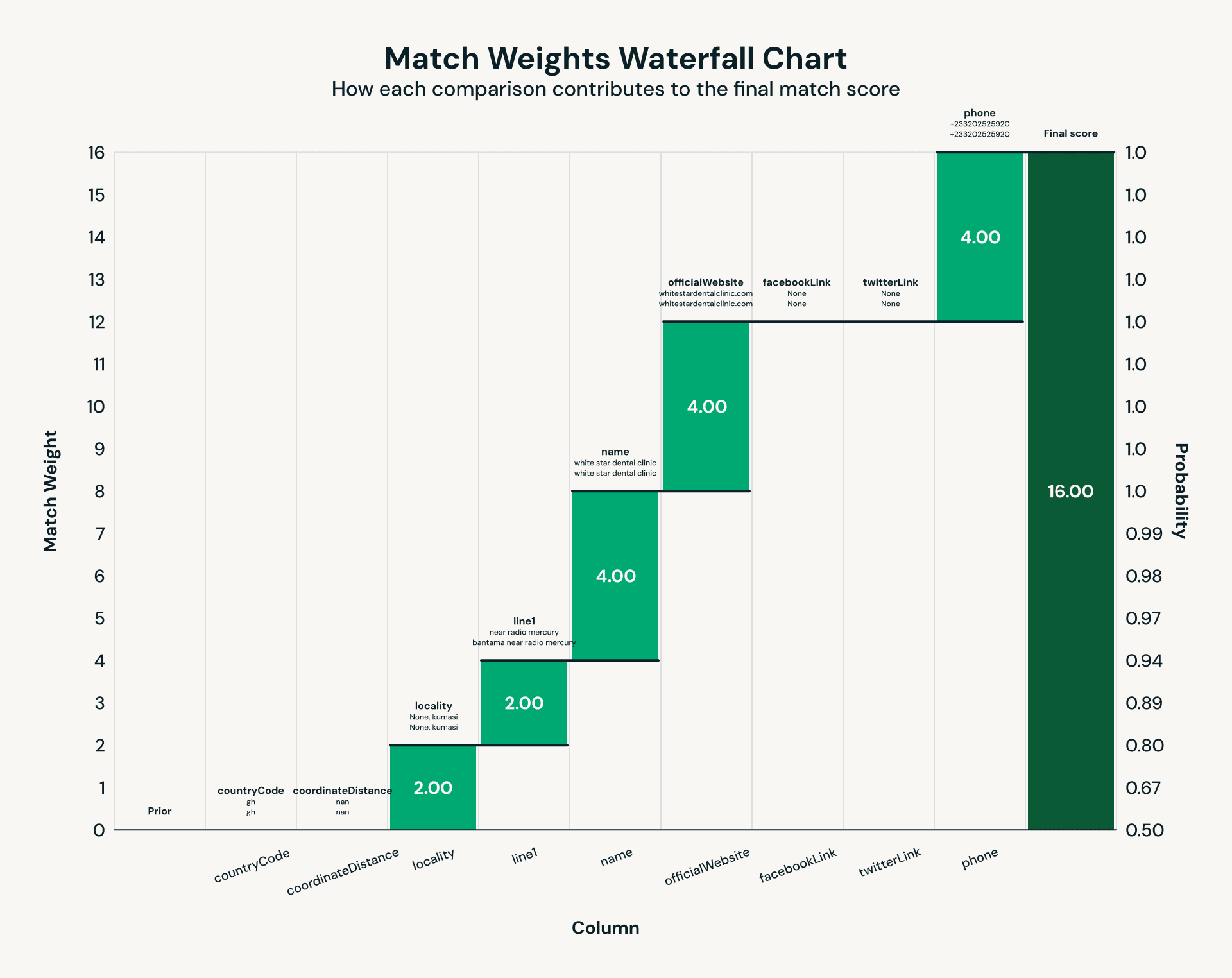
Once the facility and nonprofit data is scraped and extracted using an LLM, a classic challenge emerges: entity resolution. The same facility may appear across multiple data sources with name variations, inconsistent addresses, or missing contact details. Traditional deduplication breaks down in these scenarios due to messy data, so we use Splink, an open source probabilistic record linkage framework. Using the information sourced in our IE step, Splink evaluates match pairs via weighted comparisons across fields like phone number, street address, and more. The result is a unified key per facility, ensuring that end users see one authoritative record for each medical facility and NGO.
Global Health Impact with the Virtue Foundation-1.
Fig 2: Example ruleset for entity resolution via Splink.

Running probabilistic matching across thousands of healthcare facilities and non-profits revealed classic performance bottlenecks that emerge at terabyte scale. The core of record linkage is pairwise comparison, which creates inherently skewed workloads: common comparisons produce massive partitions while most others remain much smaller. Early runs made this painfully clear, with one Spark partition running for 30 minutes while the median completed in 52 seconds – a textbook case of stragglers (the “curse of the last reducer”) degrading job performance. Enabling Photon, Databricks’ vectorized query engine, reduced worst-case data partitions from 30 minutes to approximately 2 minutes: a 15x improvement.

VF Agent: Natural Language Meets Healthcare Data

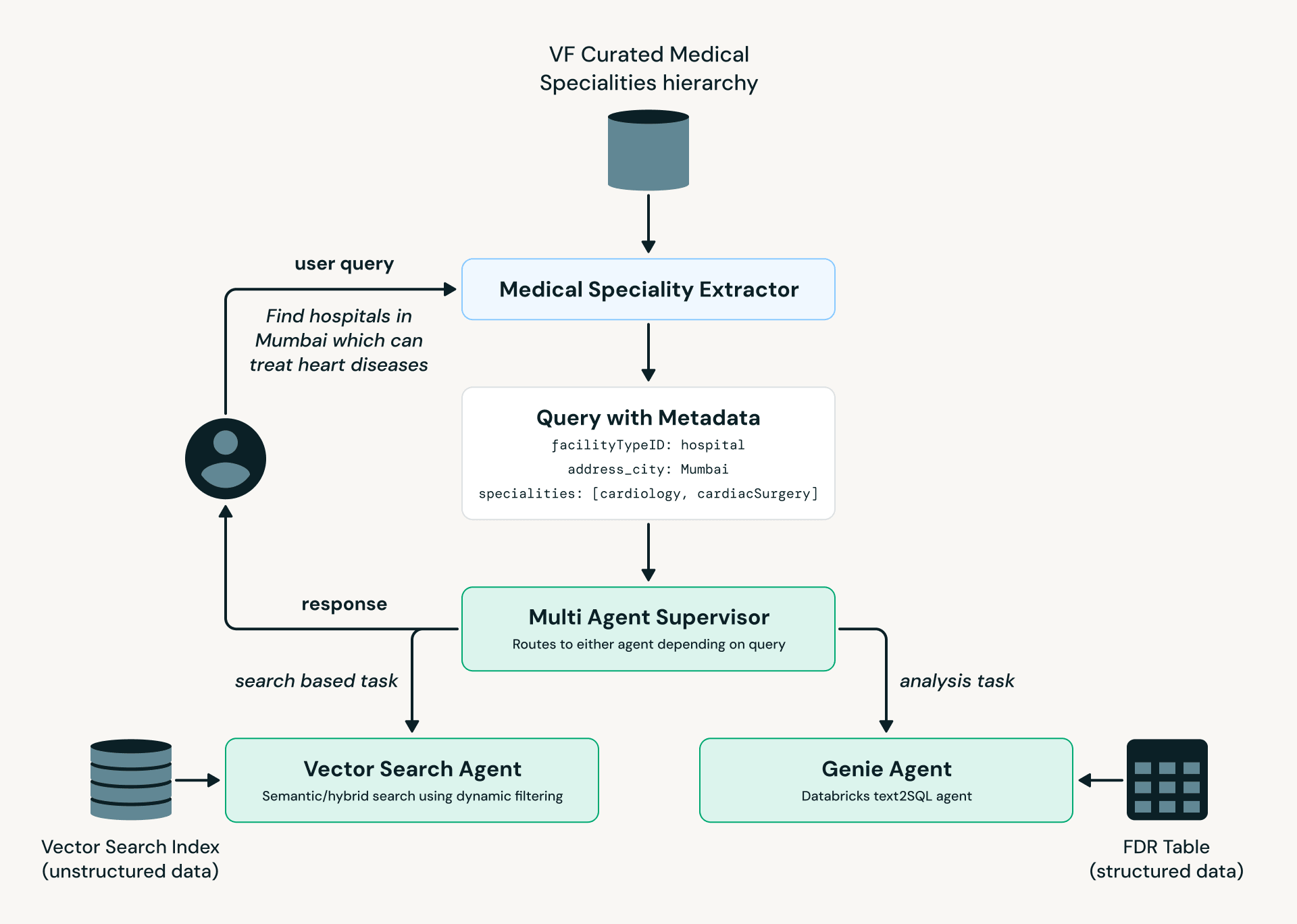
Looking to the future, we have developed a prototype of an agent that enables experts to analyze data using natural language. We use a multi-agent architecture built in LangGraph and leverage Databricks Model Serving, Vector Search, and Genie.
Global Health Impact with the Virtue Foundation-3.
Fig 3: VF Agent: Process Flow Diagram

As illustrated in the diagram above, the Medical Specialty Extractor converts user language into standardized medical terminology, which is then passed to the Multi-Agent Supervisor. Based on the query's intent and complexity, it is routed to either the Vector Search Agent (facility discovery and search) or the Genie Agent (analytical queries against structured data).

Summary

Healthcare professionals can now discover up-to-date opportunities faster, find matches to their medical specialties, and access global data on thousands of facilities worldwide. The Virtue Foundation’s journey from proof of concept to production demonstrates what’s possible when advanced AI systems are paired with a unified data platform.

The final result is a global view of healthcare infrastructure – surfacing where medical volunteers are needed most.

If you would like to learn more about this project please see:

- Databricks x Virtue Foundation Project Overview - YouTube

- UN Bloomberg Interview (YouTube) - around minute 38:00

- Video testimonial: Bright Initiative x Virtue Foundation x Databricks

Please read more about some of our other Databricks for Good projects below: