



惯性聚合 高效追踪和阅读你感兴趣的博客、新闻、科技资讯
阅读原文 在惯性聚合中打开

推荐订阅源

N
Netflix TechBlog - Medium
Spread Privacy
Spread Privacy
Cloudbric
Cloudbric
V
Vulnerabilities – Threatpost
博客园 - 叶小钗
I
Intezer
S
Secure Thoughts
Jina AI
Jina AI
T
Tenable Blog
博客园 - 【当耐特】
WordPress大学
WordPress大学
W
WeLiveSecurity
宝玉的分享
宝玉的分享
Recent Commits to openclaw:main
Google DeepMind News
Schneier on Security
OSCHINA 社区最新新闻
OSCHINA 社区最新新闻
B
Blog RSS Feed
Martin Fowler
Martin Fowler
Hacker News - Newest:
Hacker News - Newest: "LLM"
S
Schneier on Security
cs.CV updates on arXiv.org
IT之家
IT之家
小众软件
小众软件
P
Privacy & Cybersecurity Law Blog
V
Visual Studio Blog
S
Securelist
M
MIT News - Artificial intelligence
H
Help Net Security
Scott Helme
Scott Helme
N
News and Events Feed by Topic
SecWiki News
SecWiki News
Threat Intelligence Blog | Flashpoint
博客园_首页
Microsoft Azure Blog
P
Proofpoint News Feed
博客园 - 司徒正美
Hugging Face - Blog
Hugging Face - Blog
The Cloudflare Blog
T
Tailwind CSS Blog
A
About on SuperTechFans
The Last Watchdog
The Last Watchdog
S
Security @ Cisco Blogs
大猫的无限游戏
大猫的无限游戏
cs.AI updates on arXiv.org
奇客Solidot–传递最新科技情报
奇客Solidot–传递最新科技情报
Apple Machine Learning Research
H
Heimdal Security Blog
T
The Blog of Author Tim Ferriss
Blog — PlanetScale
Blog — PlanetScale

Databricks

How lakebase architecture delivers 5x faster Postgres writes Why Talent Transformation Is the Missing Focus of Enterprise AI Public Health Intelligence Shouldn't Require a Data Scientist Mean Time to Detect Is a Data Access Problem First-party audience data is the ad sales relationship now Rethinking Distributed Systems for Serverless Performance and Reliability The AI Scaling Gap Hiding in Digital Native Companies 10 trillion samples a day: Scaling beyond traditional monitoring infra at Databricks AI success starts with clean data, not just better models How nOps Rebuilt Their Cloud Optimization Platform on Databricks Lakebase, and Why Other ISVs Should Too Peril Predicts: Precision Payouts for a Volatile World The foundation of AI scalability: one team, one platform, one operating model The Federal Data Paradox: Rich in Data, Poor in Access Driving Budapest Forward: How BKK Uses Databricks to Transform City Mobility LLM Vs AI: A Practical Guide to Differences, Use Cases, and Tools Model Risk Governance Is Not the Same as Risk Intelligence Generative AI for Business: A Complete Strategy and Implementation Guide Data Science vs Data Engineering: Choosing Analysis or Infrastructure AI Applications: Tools, Use Cases, and Platforms MLOps vs DevOps: A Practical Guide for Data Scientists and IT Teams Top Data Warehouse Tools For Modern Data Analytics Unlocking SAP Business Context in Databricks with Semantic Metadata Delta Sharing The marketing activation gap has a fix: Databricks and Stitch partner to turn data infrastructure into marketing performance Alert Fatigue Is a Business Risk Backstage with Lakebase Shipping Faster isn’t Learning Faster Why Your OEE Dashboard Is Lying to You The Turbine That Tried to Tell You It Was Failing Predicting Readmissions Isn't Enough. Acting in Time Is. Clinical Trials Run Longer Than They Have To. That's a Patient Problem Network Quality Is a Revenue Problem, Not a Technical One Shelf Availability Starts with Better Demand Visibility When Predicting the Next Hit Requires More Than Intuition Approximate Answers, Exact Decisions: New Sketch Functions for Analytics Companies Winning with AI Built the Data Layer First Rethinking SQL ETL for modern data platforms Stripe data now available on Databricks via Databricks Marketplace Databricks and Stripe Projects: Infrastructure Built for Agents Agents are ready but your architecture probably isn't Interoperability Between Unity Catalog and Google BigQuery via Catalog Federation Built In, Not Bolted On: What AI-Native Actually Means in Cybersecurity Operationalizing AI for public sector fraud prevention From months to minutes: Building real-time clinical data pipelines with natural language Agentic Data Engineering with Genie Code and Lakeflow Securely send first-party conversion signals with Snapchat Conversions API on Databricks Marketplace How leading tech companies are killing the builder’s tax with Lakebase Inside one of the first production deployments of Lakebase: LangGuard's agentic workflow governance engine The next generation of Databricks Genie Model Risk Management in 2026: A Banker’s Guide to the Revised Interagency Guidance OpenAI GPT-5.5 now available on Databricks, fully-governed through Unity AI Gateway Operational databases: How they work and when to use them Databricks partners with OpenAI on GPT-5.5 Announcing the Public Preview of Lakeflow Designer How conversational analytics removes the BI bottleneck How to transform document activation workflows with Genie and Agent Bricks Beyond the spreadsheet: how Databricks is delivering the modern CFO in Financial Services AI App Development: Guide To Building AI-Powered Apps IoT in Manufacturing: Strategy, Components, Use Cases, and Challenges Stop Hand-Coding Change Data Capture Pipelines Multimodal Data Integration: Production Architectures for Healthcare AI Personalization Strategies for Media Companies A Modern AI Risk Management Framework Introducing the Databricks Excel Add-in for Business Users Real-Time Decisioning for AI Agents: Why you Need a Customer Context Layer First A Practical Guide to LLM Fine Tuning AI Data Transformation Guide for Data Engineers and Data Scientists Concurrency Control in DBMS: How Locking, MVCC and Optimistic Strategies Keep Data Consistent Bridging data science and marketing: Databricks unveils Delta Sharing integration for Adobe Experience Platform and agentic marketing workflows Take Control: Customer-Managed Keys for Lakebase Postgres Get hands on with agents, vibe coding and more at Data+ AI Summit Mercedes-Benz Builds a Cross-Cloud Data Mesh with Delta Sharing and Intelligent Replication, Cutting Costs by 66% What Is a Transactional Database? Introducing Genie Agent Mode Governing coding agent sprawl with Unity AI Gateway Governing Coding Agent Sprawl with Unity AI Gateway What is pgvector? Banks Don’t Have an AI Problem – They Have a Data Platform Problem Open Platform, Unified Pipelines: Why dbt on Databricks is Accelerating Why Your Agents Can’t Read Enterprise Documents — and How to Fix It Building with Databricks Document Intelligence and Lakeflow Databricks on Google Cloud: Innovate Faster. Smarter. Together. Introducing the Databricks Connector for Google Sheets: Real-Time, Governed Lakehouse Data in the Sheets Users Love Unity AI Gateway: How to connect agents to external MCPs securely Expanding agent governance with Unity AI Gateway Agentic reasoning in practice: Making sense of structured and unstructured data Agent Bricks: The Governed Enterprise Agent Platform 8 AI and data trends shaping financial services in 2026 Building real-time product search on Databricks Lovable + Databricks: Build Data-Driven Apps at the Speed of Thought Memory scaling for AI agents Powering clinical research innovation: How TriNetX uses Databricks to accelerate drug development Database Branching in Postgres: Git-Style Workflows with Databricks Lakebase How Zalando built a unified data foundation for AI and analytics on Databricks The next era of the open lakehouse: Apache Iceberg™ v3 in Public Preview on Databricks How FSIs eliminate silos between clients, operations, and finance How MakeMyTrip achieved millisecond personalization at scale with Databricks A multi-agent approach to audience intelligence AiChemy: Next-generation agent with MCP, skills and custom data for drug discovery Accelerate business insights with Lakeflow Connect, now with a Free Tier Unlocking Next-Gen Customer Experiences with Data Intelligence for Marketing
Are LLM agents good at join order optimization?
2026-04-23 · via Databricks

Introduction

In the Databricks intelligence platform, we regularly explore and use new AI techniques to improve engine performance and simplify the user experience. Here we present experimental results on applying frontier models to one of the oldest database challenges: join ordering.

This blog is part of a research collaboration with UPenn.

The Problem: Join Ordering

Since their inception, query optimizers in relational databases have struggled to find good join orderings for SQL queries. To illustrate the difficulty of join ordering, consider the following query:

How many movies were produced by Sony and starred Scarlett Johansson?

Suppose we want to execute this query over the following schema:

Table nameTable columns
ActoractorID, actorName, actorDOB, …
CompanycompanyID, companyName, …
StarsactorID, movieID
ProducescompanyID, movieID
MoviemovieID, movieName, movieYear , …

The Actor, Company, and Movie entity tables are connected via the Produces and Stars relationship tables (e.g., via foreign keys). A version of this query in SQL might be:

Logically, we want to perform a simple join operation: Actor ⋈ Stars ⋈ Movie ⋈ Produces ⋈ Company. But physically, since each of these joins are commutative and associative, we have a lot of options. The query optimizer could choose to:

  1. First find all movies starring Scarlett Johansson, then filter out for just the movies produced by Sony,
  2. First find all movies produced by Sony, then filter out those movies starring Scarlett Johansson,
  3. In parallel, compute Sony movies and Scarlett Johansson movies, then take the intersection.

Which plan is optimal depends on the data: if Scarlett Johansson has starred in significantly fewer movies than Sony has produced, the first plan might be optimal. Unfortunately, estimating this quantity is as difficult as executing the query itself (in general). Even worse, there are normally far more than 3 plans to choose from, as the number of possible plans grows exponentially with the number of tables — and analytics queries regularly join 20-30 different tables.

How does join ordering work today? Traditional query optimizers solve this problem with three components: a cardinality estimator designed to quickly guess the size of subqueries (e.g., to guess how many movies Sony has produced), a cost model to compare different potential plans, and a search procedure that navigates the exponentially-large space. Cardinality estimation is especially difficult, and has led to a wide range of research seeking to improve estimation accuracy using a wide range of approaches [A].

All of these solutions add significant complexity to a query optimizer, and require significant engineering effort to integrate, maintain, and productionize. But what if LLM-powered agents, with their abilities to adapt to new domains with prompting, hold the key to solving this decades-old problem?

Agentic join ordering

When query optimizers select a bad join ordering1, human experts can fix it by diagnosing the issue (often a misestimated cardinality), and instructing the query optimizer to choose a different ordering. This process often requires multiple rounds of testing (e.g., executing the query) and manually inspecting the intermediary results.

Query optimizers typically need to pick join orders in a few hundred milliseconds, so integrating an LLM into the hot path of the query optimizer, while potentially promising, is not possible today. But, the iterative and manual process of optimizing the join order for a query, which might take a human expert multiple hours, could potentially be automated with an LLM agent! This agent tries to automate that manual tuning process.

To test this, we developed a prototype query optimization agent. The agent has access to a single tool, which executes a potential join order for a query and returns the runtime of the join order (with a timeout of the original query’s runtime) and the size of each computed subplan (e.g., the EXPLAIN EXTENDED plan).

We let the agent run for 50 iterations, allowing the agent to freely try out different join orders. The agent is free to use these 50 iterations to test out promising plans (“exploitation”), or to explore risky-but-informative alternatives (“exploration”). Afterwards, we collect the best performing join order tested by the agent, which becomes our final result. But how do we know the agent picked a valid join order? To ensure correctness, each tool call generates a join ordering using structured model outputs, which forces the model’s output to match a grammar we specify to only admit valid join reorderings. Note that this differs from prior work [B] that asks the LLM to pick a join order instantly in the “hot path” of the query optimizer; instead, the LLM gets to act like an offline experimenter that tries many candidate plans and learns from the observed outcomes – just like a human tuning a join order by hand!.

To evaluate our agent in DBR, we used the Join Order Benchmark (JOB), a set of queries that were designed to be difficult to optimize. Since the dataset used by JOB, the IMDb dataset, is only around 2GB (and therefore Databricks could process even poor join orderings fairly quickly), we scaled up the dataset by duplicating each row 10 times [C].

We let our agent test 15 join orders (rollouts) per query for all 113 queries in the join order benchmark. We report results on the best join order found for each query. When using a frontier model, the agent was able to improve query latency by a factor of 1.288 (geomean). This outperforms using perfect cardinality estimates (intractable in practice), smaller models, and the recent BayesQO offline optimizer (although BayesQO was designed for PostgreSQL, not Databricks).

The real impressive gains are in the tail of the distribution, with the P90 query latency dropping by 41%. Below, we plot the entire CDF for both the standard Databricks optimizer (”Default”) and our agent (”Agent). Query latencies are normalized to the median latency of the Databricks optimizer (i.e., at 1, the blue line reaches a proportion of 0.5).
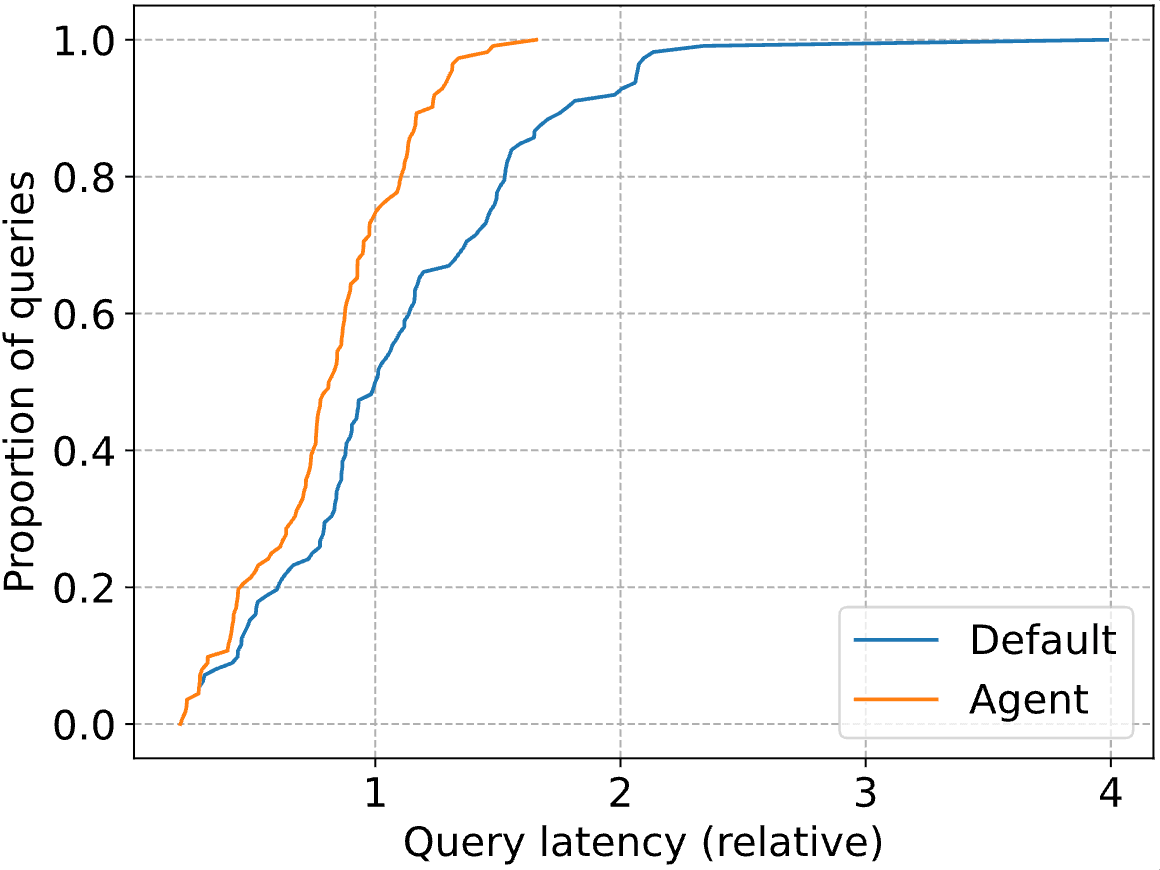
Databricks optimizer

Our agent progressively improves the workload with each tested plan (sometimes called a rollout), creating a simple “anytime algorithm” where larger time budgets can be translated into further query performance. Of course, eventually query performance will stop improving.

One of the largest improvements our agent found was in query 5b, a simple 5-way join which looks for American production companies that released a post-2010 movie on VHS with a note referencing 1994. The Databricks optimizer focused first on finding American VHS production companies (which is indeed selective, producing only 12 rows). The agent finds a plan that first looks for VHS releases referencing 1994, which turns out to be significantly faster. This is because the query uses LIKE predicates to identify VHS releases, which are exceptionally difficult for cardinality estimators.

Our prototype demonstrates the promise of agentic systems autonomously repairing and improving database queries. This exercise raised several questions about agent design in our minds:

  1. What tools should we give the agent? In our current approach, the agent can execute candidate join orders. Why not let the agent issue specific cardinality queries (e.g., compute the size of a particular subplan), or queries to test certain assumptions about the data (e.g., to determine that there were no DVD releases prior to 1995).
  2. When should this agentic optimization be triggered? Surely, a user can flag a problematic query manually for intervention. But could we also proactively apply this optimization to regularly-running queries? How can we determine if a query has “potential” for optimization?
  3. Can we automatically understand improvements? When the agent finds a better join order than the one found by the default optimizer, this join order can be viewed as a proof that the default optimizer is choosing a suboptimal order. If the agent corrects a systematic error in the underlying optimizer, can we discover this and use it to improve the optimizer?

Of course, we are not the only ones thinking about the potential of LLMs for query optimization [D]. At Databricks, we are excited about the possibility of harnessing the generalizability of LLMs to improve data systems themselves.

If you are interested in this topic, see also our followup UCB blog on "How do LLM agents think through SQL join orders?".

Join Us

As we look ahead, we’re excited to keep pushing the boundaries of how AI can shape database optimizations. If you’re passionate about building the next generation of database engines, join us!

1 Databricks use techniques like runtime filters to mitigate the impact of poor join orders. The results presented here include those techniques.

Notes

A. Techniques for cardinality estimation have included, for example, adaptive feedback, deep learning, distribution modeling, database theory, learning theory, and factor decompositions. Prior work has also attempted to entirely replace the traditional query optimizer architecture with deep reinforcement learning, multi-armed bandits, Bayesian optimization, or more advanced join algorithms.

B. RAG-based approaches, for example, have been used to build “LLM in the hot path” systems.

C. While crude, this approach has been used in prior work.

D. Other researchers have proposed RAG-based query repair systems, LLM-powered query rewrite systems, and even entire database systems synthesized by LLMs.