





惯性聚合 高效追踪和阅读你感兴趣的博客、新闻、科技资讯
阅读原文 在惯性聚合中打开

推荐订阅源

WordPress大学
WordPress大学
The Register - Security
Hugging Face - Blog
Hugging Face - Blog
博客园 - 聂微东
GbyAI
GbyAI
Recent Commits to openclaw:main
博客园_首页
D
Docker
S
Security @ Cisco Blogs
K
Kaspersky official blog
爱范儿
爱范儿
Simon Willison's Weblog
TaoSecurity Blog
TaoSecurity Blog
V
V2EX
C
CXSECURITY Database RSS Feed - CXSecurity.com
T
Troy Hunt's Blog
Cloudbric
Cloudbric
博客园 - 三生石上(FineUI控件)
Cyber Security Advisories - MS-ISAC
The Hacker News
The Hacker News
美团技术团队
S
SegmentFault 最新的问题
L
Lohrmann on Cybersecurity
cs.AI updates on arXiv.org
宝玉的分享
宝玉的分享
The Last Watchdog
The Last Watchdog
Y
Y Combinator Blog
M
MIT News - Artificial intelligence
钛媒体:引领未来商业与生活新知
钛媒体:引领未来商业与生活新知
奇客Solidot–传递最新科技情报
奇客Solidot–传递最新科技情报
CTFtime.org: upcoming CTF events
Martin Fowler
Martin Fowler
Google Online Security Blog
K
KPMG report finds enterprise disconnect between AI and its ROI | CIO
C
Cybersecurity and Infrastructure Security Agency CISA
T
Tor Project blog
Vercel News
Vercel News
The Cloudflare Blog
G
Google Developers Blog
T
Threat Research - Cisco Blogs
AI
AI
Stack Overflow Blog
Stack Overflow Blog
I
InfoQ
Scott Helme
Scott Helme
S
Schneier on Security
大猫的无限游戏
大猫的无限游戏
The GitHub Blog
The GitHub Blog
S
Securelist
IT之家
IT之家
Microsoft Azure Blog

Databricks

How lakebase architecture delivers 5x faster Postgres writes Why Talent Transformation Is the Missing Focus of Enterprise AI Public Health Intelligence Shouldn't Require a Data Scientist Mean Time to Detect Is a Data Access Problem First-party audience data is the ad sales relationship now Rethinking Distributed Systems for Serverless Performance and Reliability The AI Scaling Gap Hiding in Digital Native Companies 10 trillion samples a day: Scaling beyond traditional monitoring infra at Databricks AI success starts with clean data, not just better models How nOps Rebuilt Their Cloud Optimization Platform on Databricks Lakebase, and Why Other ISVs Should Too Peril Predicts: Precision Payouts for a Volatile World The foundation of AI scalability: one team, one platform, one operating model The Federal Data Paradox: Rich in Data, Poor in Access Driving Budapest Forward: How BKK Uses Databricks to Transform City Mobility LLM Vs AI: A Practical Guide to Differences, Use Cases, and Tools Model Risk Governance Is Not the Same as Risk Intelligence Generative AI for Business: A Complete Strategy and Implementation Guide Data Science vs Data Engineering: Choosing Analysis or Infrastructure AI Applications: Tools, Use Cases, and Platforms MLOps vs DevOps: A Practical Guide for Data Scientists and IT Teams Top Data Warehouse Tools For Modern Data Analytics Unlocking SAP Business Context in Databricks with Semantic Metadata Delta Sharing The marketing activation gap has a fix: Databricks and Stitch partner to turn data infrastructure into marketing performance Alert Fatigue Is a Business Risk Backstage with Lakebase Shipping Faster isn’t Learning Faster Why Your OEE Dashboard Is Lying to You The Turbine That Tried to Tell You It Was Failing Predicting Readmissions Isn't Enough. Acting in Time Is. Clinical Trials Run Longer Than They Have To. That's a Patient Problem Network Quality Is a Revenue Problem, Not a Technical One Shelf Availability Starts with Better Demand Visibility When Predicting the Next Hit Requires More Than Intuition Companies Winning with AI Built the Data Layer First Rethinking SQL ETL for modern data platforms Stripe data now available on Databricks via Databricks Marketplace Databricks and Stripe Projects: Infrastructure Built for Agents Agents are ready but your architecture probably isn't Interoperability Between Unity Catalog and Google BigQuery via Catalog Federation Built In, Not Bolted On: What AI-Native Actually Means in Cybersecurity Operationalizing AI for public sector fraud prevention From months to minutes: Building real-time clinical data pipelines with natural language Agentic Data Engineering with Genie Code and Lakeflow Securely send first-party conversion signals with Snapchat Conversions API on Databricks Marketplace How leading tech companies are killing the builder’s tax with Lakebase Inside one of the first production deployments of Lakebase: LangGuard's agentic workflow governance engine The next generation of Databricks Genie Model Risk Management in 2026: A Banker’s Guide to the Revised Interagency Guidance OpenAI GPT-5.5 now available on Databricks, fully-governed through Unity AI Gateway Operational databases: How they work and when to use them Databricks partners with OpenAI on GPT-5.5 Announcing the Public Preview of Lakeflow Designer Are LLM agents good at join order optimization? How conversational analytics removes the BI bottleneck How to transform document activation workflows with Genie and Agent Bricks Beyond the spreadsheet: how Databricks is delivering the modern CFO in Financial Services AI App Development: Guide To Building AI-Powered Apps IoT in Manufacturing: Strategy, Components, Use Cases, and Challenges Stop Hand-Coding Change Data Capture Pipelines Multimodal Data Integration: Production Architectures for Healthcare AI Personalization Strategies for Media Companies A Modern AI Risk Management Framework Introducing the Databricks Excel Add-in for Business Users Real-Time Decisioning for AI Agents: Why you Need a Customer Context Layer First A Practical Guide to LLM Fine Tuning AI Data Transformation Guide for Data Engineers and Data Scientists Concurrency Control in DBMS: How Locking, MVCC and Optimistic Strategies Keep Data Consistent Bridging data science and marketing: Databricks unveils Delta Sharing integration for Adobe Experience Platform and agentic marketing workflows Take Control: Customer-Managed Keys for Lakebase Postgres Get hands on with agents, vibe coding and more at Data+ AI Summit Mercedes-Benz Builds a Cross-Cloud Data Mesh with Delta Sharing and Intelligent Replication, Cutting Costs by 66% What Is a Transactional Database? Introducing Genie Agent Mode Governing coding agent sprawl with Unity AI Gateway Governing Coding Agent Sprawl with Unity AI Gateway What is pgvector? Banks Don’t Have an AI Problem – They Have a Data Platform Problem Open Platform, Unified Pipelines: Why dbt on Databricks is Accelerating Why Your Agents Can’t Read Enterprise Documents — and How to Fix It Building with Databricks Document Intelligence and Lakeflow Databricks on Google Cloud: Innovate Faster. Smarter. Together. Introducing the Databricks Connector for Google Sheets: Real-Time, Governed Lakehouse Data in the Sheets Users Love Unity AI Gateway: How to connect agents to external MCPs securely Expanding agent governance with Unity AI Gateway Agentic reasoning in practice: Making sense of structured and unstructured data Agent Bricks: The Governed Enterprise Agent Platform 8 AI and data trends shaping financial services in 2026 Building real-time product search on Databricks Lovable + Databricks: Build Data-Driven Apps at the Speed of Thought Memory scaling for AI agents Powering clinical research innovation: How TriNetX uses Databricks to accelerate drug development Database Branching in Postgres: Git-Style Workflows with Databricks Lakebase How Zalando built a unified data foundation for AI and analytics on Databricks The next era of the open lakehouse: Apache Iceberg™ v3 in Public Preview on Databricks How FSIs eliminate silos between clients, operations, and finance How MakeMyTrip achieved millisecond personalization at scale with Databricks A multi-agent approach to audience intelligence AiChemy: Next-generation agent with MCP, skills and custom data for drug discovery Accelerate business insights with Lakeflow Connect, now with a Free Tier Unlocking Next-Gen Customer Experiences with Data Intelligence for Marketing
Approximate Answers, Exact Decisions: New Sketch Functions for Analytics
2026-04-30 · via Databricks
New Sketch Functions for Analytics
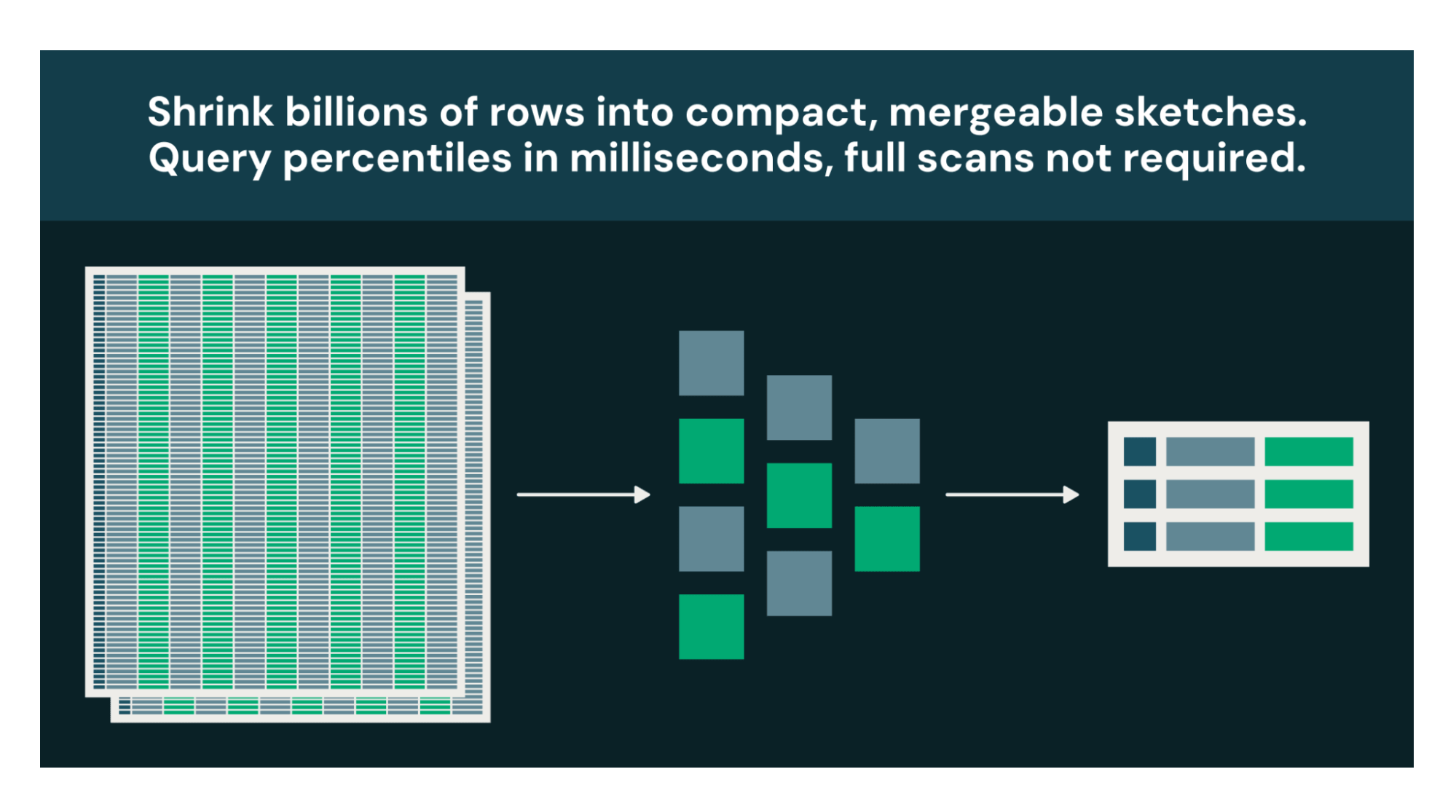
Large-scale datasets compress into compact, mergeable sketches, enabling fast percentile queries and aggregations without scanning raw data.

Many analytical questions are decision-support, not audit. If knowing "~4.7M unique users ±1%" leads to the same decision as "4,712,389 unique users," the approximate answer at a fraction of the cost is strictly better.

Every warehouse has a handful of queries that burn the most compute: percentiles that force global sorts, distinct counts that track every unique value, top-K rankings that reshuffle entire datasets. Databricks now supports four new sketch function families, built on Apache DataSketches, that replace these exact computations with bounded-memory approximations. The tradeoff: 1-2% configurable relative error. The payoff: orders-of-magnitude less compute, plus sketches you can store, merge, and requery without touching raw data.

Percentile calculations in milliseconds, not minutes

When you call PERCENTILE(response_time_ms, 0.99) on a billion-row table, the engine must sort every value globally. A full cluster shuffle could take minutes and consume gigabytes of memory. For a dashboard that refreshes every 5 minutes, you're paying that cost over and over.

KLL sketches are compact and mergeable summaries, built to answer quantile questions. They let you replace this sort while using the same bounded memory, whether you process a thousand values or a trillion. Typical relative error is 1-2% and is configurable, well within the actionable range for latency monitoring, capacity planning, and anomaly detection.

The real advantage is the workflow sketches enable. Build them once during your daily ETL. Store them as columns in Delta tables. When a dashboard needs P50/P90/P99 for any time range, merge the precomputed sketches in milliseconds instead of rescanning raw data. Extract multiple quantiles from a single sketch in one pass with kll_get_quantile_bigint(sketch, ARRAY(0.5, 0.9, 0.99)).

Audience overlap analysis without the compute bill

How many users saw your Super Bowl ad but not your Instagram campaign? Audience overlap analysis is core to marketing measurement. You need to know total reach (users who saw any campaign), overlap (users who saw multiple campaigns), and exclusive reach (users who saw only one campaign). But exact computation requires collecting every user ID into memory and performing set operations across potentially billions of identifiers. At scale, this becomes impractical or impossible.

Theta sketches summarize a set of distinct values in bounded memory and support full set algebra: unions, intersections, and differences. Build a sketch per campaign, then combine them mathematically:

The exact approach would require a UNION to deduplicate, then a JOIN to find overlap, possibly shuffling raw user IDs twice across your cluster. With Theta sketches, you generate compact binary objects measured in kilobytes, and the set operations happen locally in microseconds. This makes daily reach curves, incrementality measurement, and cross-channel deduplication practical.

Real-time leaderboards without reprocessing raw data

What's trending right now? It's a simple question with an expensive exact answer: count every distinct value, store all those counts, shuffle them across your cluster, sort globally. For high-cardinality event streams like search logs or clickstreams, this is a batch job, not a live query.

Approximate top-K sketches track your most frequently occurring items in bounded memory and let you merge across partitions and time windows to extract results instantly. Rare items might be dropped, which is fine, because that’s not what you’re looking for.

With approx_top_k_combine, your "trending this week" dashboard becomes a merge of 168 pre-computed sketches rather than a scan of billions of raw events. For streaming workloads, merge each micro-batch's sketch into a running total and display results in real time. What was once a batch job becomes a live leaderboard. 

Cardinality and revenue attribution in one pass

Counting distinct customers is one query. Summing their revenue is another. Doing both correctly, without double-counting customers who appear in multiple periods, is the challenge.                                                         

Consider a common analytics question: “How many unique customers made a purchase this month, and what was their total revenue by region?” Typically, you would start with a large GROUP BY, deduplicating customer IDs while summing purchases across billions of transactions. And you can't simply add prior results together, customers appearing in both periods get double-counted and their revenue overstated.

Tuple sketches solve this by combining distinct counting and metric aggregation in a single, mergeable structure.

Each sketch maps a distinct customer to its aggregated spend. When you merge across days, customer counts deduplicate automatically and revenue sums accumulate. Exact incremental computation would have you reprocessing from raw data every time the data range changed. 

Getting started with the right sketch

Function Family

Use Cases

KLL Quantile Sketches

Percentiles (P50, P90, P99)

Theta Sketches

Set operations on distinct values

Approximate Top-K

Most frequent items

Tuple Sketches

Distinct counts and metric aggregations

When to use sketches: Dashboards, trend analysis, monitoring, marketing attribution -- any query where approximate answers are acceptable. The larger your dataset, the better. If you’re not sure what sketch to use, ask Genie Code to help you know the right choice.

When to stay exact: Financial auditing, compliance reporting, or any use case where regulatory or business requirements demand precise values.

These four function families turn long-running queries into the cheapest in your warehouse. Build sketches once during ETL, store them in Delta, merge them on read. The raw data is still there when the auditors ask. For everything else, a 1% error margin and a 1000x speedup is a welcome trade-off. 

All functions work in SQL, DataFrame, and Structured Streaming pipelines. Sketches created in Spark are interoperable with other systems in the Apache DataSketches ecosystem. See documentation (1234) for function signatures and examples and get started with sketches today.
 

Special mention to Christopher Boumalhab (cboumalh on GitHub) for implementing and contributing the Theta sketch and Tuple sketch function families in Apache Spark.