



惯性聚合 高效追踪和阅读你感兴趣的博客、新闻、科技资讯
阅读原文 在惯性聚合中打开

推荐订阅源

博客园 - 聂微东
D
Darknet – Hacking Tools, Hacker News & Cyber Security
P
Privacy International News Feed
NISL@THU
NISL@THU
Know Your Adversary
Know Your Adversary
G
GRAHAM CLULEY
The Hacker News
The Hacker News
P
Privacy & Cybersecurity Law Blog
S
Schneier on Security
T
Troy Hunt's Blog
Attack and Defense Labs
S
Secure Thoughts
S
Security Affairs
WordPress大学
WordPress大学
T
Tailwind CSS Blog
博客园 - Franky
T
The Exploit Database - CXSecurity.com
雷峰网
雷峰网
S
SegmentFault 最新的问题
奇客Solidot–传递最新科技情报
奇客Solidot–传递最新科技情报
让小产品的独立变现更简单 - ezindie.com
P
Proofpoint News Feed
S
Securelist
A
Arctic Wolf
C
Cyber Attacks, Cyber Crime and Cyber Security
有赞技术团队
有赞技术团队
爱范儿
爱范儿
Help Net Security
Help Net Security
Apple Machine Learning Research
cs.CV updates on arXiv.org
博客园 - 三生石上(FineUI控件)
C
CERT Recently Published Vulnerability Notes
C
Cisco Blogs
阮一峰的网络日志
阮一峰的网络日志
C
Cybersecurity and Infrastructure Security Agency CISA
Spread Privacy
Spread Privacy
Last Week in AI
Last Week in AI
S
Security @ Cisco Blogs
博客园 - 司徒正美
博客园_首页
Exploit-DB.com RSS Feed
罗磊的独立博客
博客园 - 叶小钗
K
KPMG report finds enterprise disconnect between AI and its ROI | CIO
大猫的无限游戏
大猫的无限游戏
Jina AI
Jina AI
J
Java Code Geeks
T
Threatpost
钛媒体:引领未来商业与生活新知
钛媒体:引领未来商业与生活新知
量子位

Databricks

Why Talent Transformation Is the Missing Focus of Enterprise AI Public Health Intelligence Shouldn't Require a Data Scientist Mean Time to Detect Is a Data Access Problem First-party audience data is the ad sales relationship now Rethinking Distributed Systems for Serverless Performance and Reliability The AI Scaling Gap Hiding in Digital Native Companies 10 trillion samples a day: Scaling beyond traditional monitoring infra at Databricks AI success starts with clean data, not just better models How nOps Rebuilt Their Cloud Optimization Platform on Databricks Lakebase, and Why Other ISVs Should Too Peril Predicts: Precision Payouts for a Volatile World The foundation of AI scalability: one team, one platform, one operating model The Federal Data Paradox: Rich in Data, Poor in Access Driving Budapest Forward: How BKK Uses Databricks to Transform City Mobility LLM Vs AI: A Practical Guide to Differences, Use Cases, and Tools Model Risk Governance Is Not the Same as Risk Intelligence Generative AI for Business: A Complete Strategy and Implementation Guide Data Science vs Data Engineering: Choosing Analysis or Infrastructure AI Applications: Tools, Use Cases, and Platforms MLOps vs DevOps: A Practical Guide for Data Scientists and IT Teams Top Data Warehouse Tools For Modern Data Analytics Unlocking SAP Business Context in Databricks with Semantic Metadata Delta Sharing The marketing activation gap has a fix: Databricks and Stitch partner to turn data infrastructure into marketing performance Alert Fatigue Is a Business Risk Backstage with Lakebase Shipping Faster isn’t Learning Faster Why Your OEE Dashboard Is Lying to You The Turbine That Tried to Tell You It Was Failing Predicting Readmissions Isn't Enough. Acting in Time Is. Clinical Trials Run Longer Than They Have To. That's a Patient Problem Network Quality Is a Revenue Problem, Not a Technical One Shelf Availability Starts with Better Demand Visibility When Predicting the Next Hit Requires More Than Intuition Approximate Answers, Exact Decisions: New Sketch Functions for Analytics Companies Winning with AI Built the Data Layer First Rethinking SQL ETL for modern data platforms Stripe data now available on Databricks via Databricks Marketplace Databricks and Stripe Projects: Infrastructure Built for Agents Agents are ready but your architecture probably isn't Interoperability Between Unity Catalog and Google BigQuery via Catalog Federation Built In, Not Bolted On: What AI-Native Actually Means in Cybersecurity Operationalizing AI for public sector fraud prevention From months to minutes: Building real-time clinical data pipelines with natural language Agentic Data Engineering with Genie Code and Lakeflow Securely send first-party conversion signals with Snapchat Conversions API on Databricks Marketplace How leading tech companies are killing the builder’s tax with Lakebase Inside one of the first production deployments of Lakebase: LangGuard's agentic workflow governance engine The next generation of Databricks Genie Model Risk Management in 2026: A Banker’s Guide to the Revised Interagency Guidance OpenAI GPT-5.5 now available on Databricks, fully-governed through Unity AI Gateway Operational databases: How they work and when to use them Databricks partners with OpenAI on GPT-5.5 Announcing the Public Preview of Lakeflow Designer Are LLM agents good at join order optimization? How conversational analytics removes the BI bottleneck How to transform document activation workflows with Genie and Agent Bricks Beyond the spreadsheet: how Databricks is delivering the modern CFO in Financial Services AI App Development: Guide To Building AI-Powered Apps IoT in Manufacturing: Strategy, Components, Use Cases, and Challenges Stop Hand-Coding Change Data Capture Pipelines Multimodal Data Integration: Production Architectures for Healthcare AI Personalization Strategies for Media Companies A Modern AI Risk Management Framework Introducing the Databricks Excel Add-in for Business Users Real-Time Decisioning for AI Agents: Why you Need a Customer Context Layer First A Practical Guide to LLM Fine Tuning AI Data Transformation Guide for Data Engineers and Data Scientists Concurrency Control in DBMS: How Locking, MVCC and Optimistic Strategies Keep Data Consistent Bridging data science and marketing: Databricks unveils Delta Sharing integration for Adobe Experience Platform and agentic marketing workflows Take Control: Customer-Managed Keys for Lakebase Postgres Get hands on with agents, vibe coding and more at Data+ AI Summit Mercedes-Benz Builds a Cross-Cloud Data Mesh with Delta Sharing and Intelligent Replication, Cutting Costs by 66% What Is a Transactional Database? Introducing Genie Agent Mode Governing coding agent sprawl with Unity AI Gateway Governing Coding Agent Sprawl with Unity AI Gateway What is pgvector? Banks Don’t Have an AI Problem – They Have a Data Platform Problem Open Platform, Unified Pipelines: Why dbt on Databricks is Accelerating Why Your Agents Can’t Read Enterprise Documents — and How to Fix It Building with Databricks Document Intelligence and Lakeflow Databricks on Google Cloud: Innovate Faster. Smarter. Together. Introducing the Databricks Connector for Google Sheets: Real-Time, Governed Lakehouse Data in the Sheets Users Love Unity AI Gateway: How to connect agents to external MCPs securely Expanding agent governance with Unity AI Gateway Agentic reasoning in practice: Making sense of structured and unstructured data Agent Bricks: The Governed Enterprise Agent Platform 8 AI and data trends shaping financial services in 2026 Building real-time product search on Databricks Lovable + Databricks: Build Data-Driven Apps at the Speed of Thought Memory scaling for AI agents Powering clinical research innovation: How TriNetX uses Databricks to accelerate drug development Database Branching in Postgres: Git-Style Workflows with Databricks Lakebase How Zalando built a unified data foundation for AI and analytics on Databricks The next era of the open lakehouse: Apache Iceberg™ v3 in Public Preview on Databricks How FSIs eliminate silos between clients, operations, and finance How MakeMyTrip achieved millisecond personalization at scale with Databricks A multi-agent approach to audience intelligence AiChemy: Next-generation agent with MCP, skills and custom data for drug discovery Accelerate business insights with Lakeflow Connect, now with a Free Tier Unlocking Next-Gen Customer Experiences with Data Intelligence for Marketing
The Convergence of Open Table Formats and Open Catalogs: Catalog Commits is Generally Available
2026-05-12 · via Databricks

Over the last decade, open table formats and open catalogs transformed the modern data stack. Looking ahead, they are co-evolving so organizations have the most open, interoperable, and performant lakehouses. Catalog Commits take a big step forward in unifying the lakehouse by aligning Delta with Iceberg’s catalog-oriented model. With Catalog Commits, catalogs become the system of coordination for Delta tables, brokering table discovery, access, and state across engines.

Today, we are excited to announce the General Availability of Catalog Commits for UC managed tables. This is a major platform upgrade that expands UC managed tables’ interoperability, strengthens UC’s governance capabilities, and unlocks new features including multi-statement, multi-table transactions.

In this blog, we will cover…

  • How Delta and Unity Catalog are co-evolving
  • The problems that Catalog Commits solve 
  • How Catalog Commits work
  • How to enable Catalog Commits on Unity Catalog managed tables 

The evolutions of Delta Lake and Unity Catalog

When Delta Lake was created, the lakehouse first needed reliable transactions on open cloud storage. At the time, catalogs were not designed to coordinate modern data workloads, so Delta made a revolutionary architectural choice: it brought ACID guarantees directly to data lake filesystems. This foundation made the lakehouse possible.

As the lakehouse became the system of record for more teams, engines, and AI workloads, the need for unified governance across these different assets became critical. Unity Catalog provided that missing governance layer: a single place to discover, secure, audit, and coordinate access to data and AI assets across clouds, formats, and engines.

Together, Delta Lake and Unity Catalog formed the foundation of the modern lakehouse. However, they operated side by side - Delta managing transactional state at the storage layer, and Unity Catalog governing access at the catalog layer. This architecture was sufficient early on, but as organizations scaled across more engines and workloads, this design led to new coordination challenges.

Today’s challenges coordinating across tables and catalogs

Delta’s original filesystem-oriented architecture was powerful for bringing transactions to data lakes, but it was not designed for a world where the catalog must consistently coordinate table identity, access, and state across many engines. As organizations place greater demands on their data, the lack of catalog coordination exposed three persistent challenges:

  1. The "split-brain" problem: external engines writing to Delta tables directly in object storage cause catalog metadata, like schemas, to silently diverge from the actual table state.
  2. Multi-engine, multi-agent access sprawl: every engine, tool, and agent can access tables differently, resulting in fragmented table discovery, inconsistent auditing, and no standardized enforcement of row or column-level controls across systems.
  3. Multi-table transaction coordination: open lakehouse architectures historically have not supported atomic writes spanning multiple tables, so organizations were forced to maintain legacy data warehouses specifically for transactional workloads.

Challenge #1: “Split brain” problem – keeping governing catalogs and tables in sync

Today, catalogs are not on the read or write path for Delta engines. So if an engine such as Apache Flink wants to make a schema change to a table by directly writing to the storage layer, the catalog is left unaware of those changes, creating a “split-brain” state where the catalog metadata and the actual table state diverge. This can cause silent metadata drift and downstream pipeline failures.
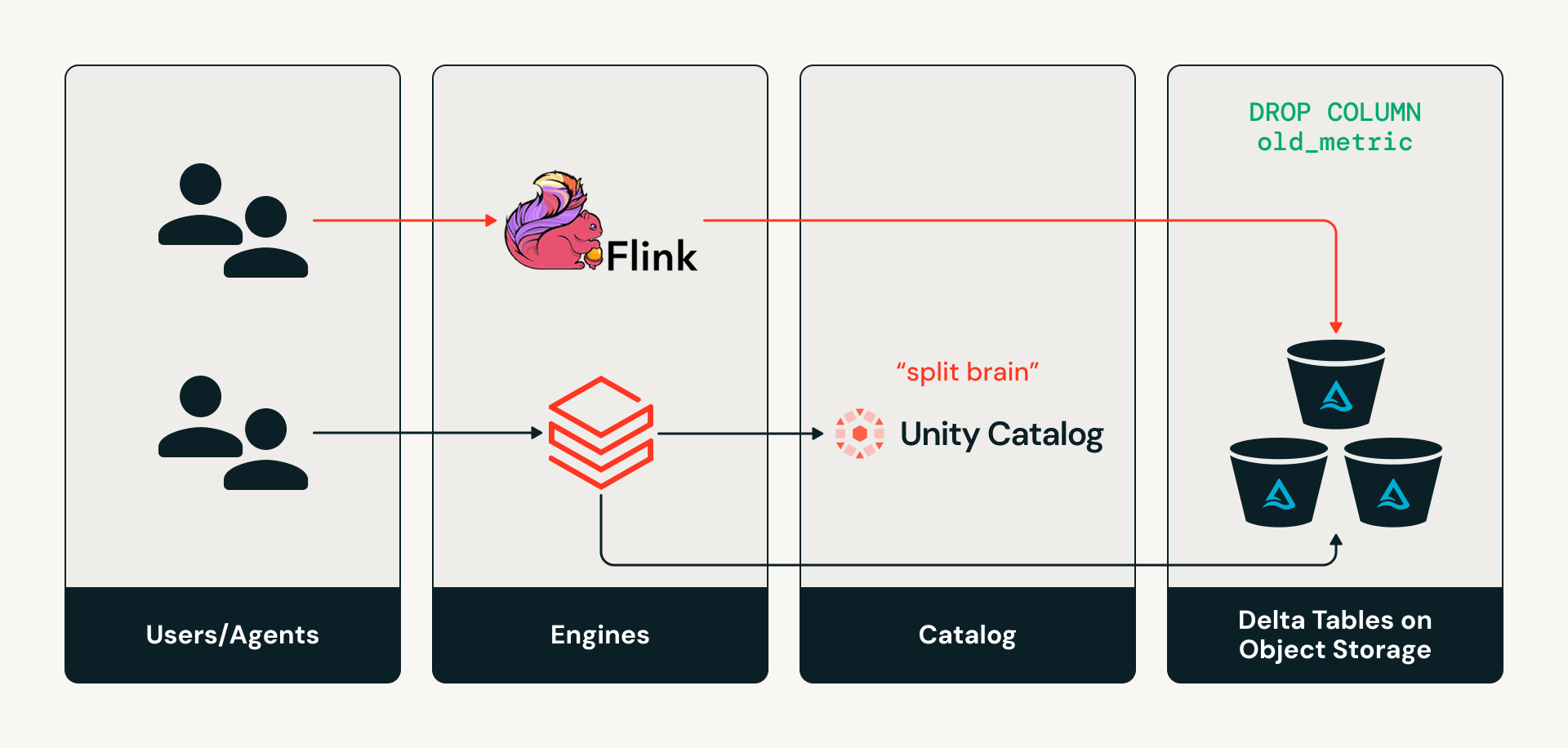
Challenge #1: “Split brain” problem – keeping governing catalogs and tables in sync

Challenge #2: Multi-engine, multi-agent access sprawl

Modern organizations use many engines and tools to analyze data, build pipelines, and power AI. Historically, these systems have accessed data directly from object storage using static paths. This tightly couples workloads to physical storage, making tables difficult to discover. Additionally, because each engine reads Delta tables directly from the storage layer, which usually only supports coarse-grained permissions, it’s very challenging to enforce consistent row/column-level governance across all engines. Likewise, auditing data access remains fragmented because there is no consistent access layer to capture activity across engines, so admins may have an inconsistent view of how data is actually used.

Organizations need a central place for discovering, governing, and auditing their data. This need is becoming even more urgent as AI agents emerge as a primary consumer of enterprise data.

Challenge #3: Coordinating transactions across multiple tables

Data warehousing workloads often require multi-table transactions, such as atomically updating sales and inventory tables so that downstream readers always see a consistent view. However, Delta Lake’s historical filesystem-oriented design limited transactions to individual tables. As a result, even though many organizations want to consolidate on the lakehouse architecture, they’ve had to maintain legacy data warehouses specifically for these workloads.
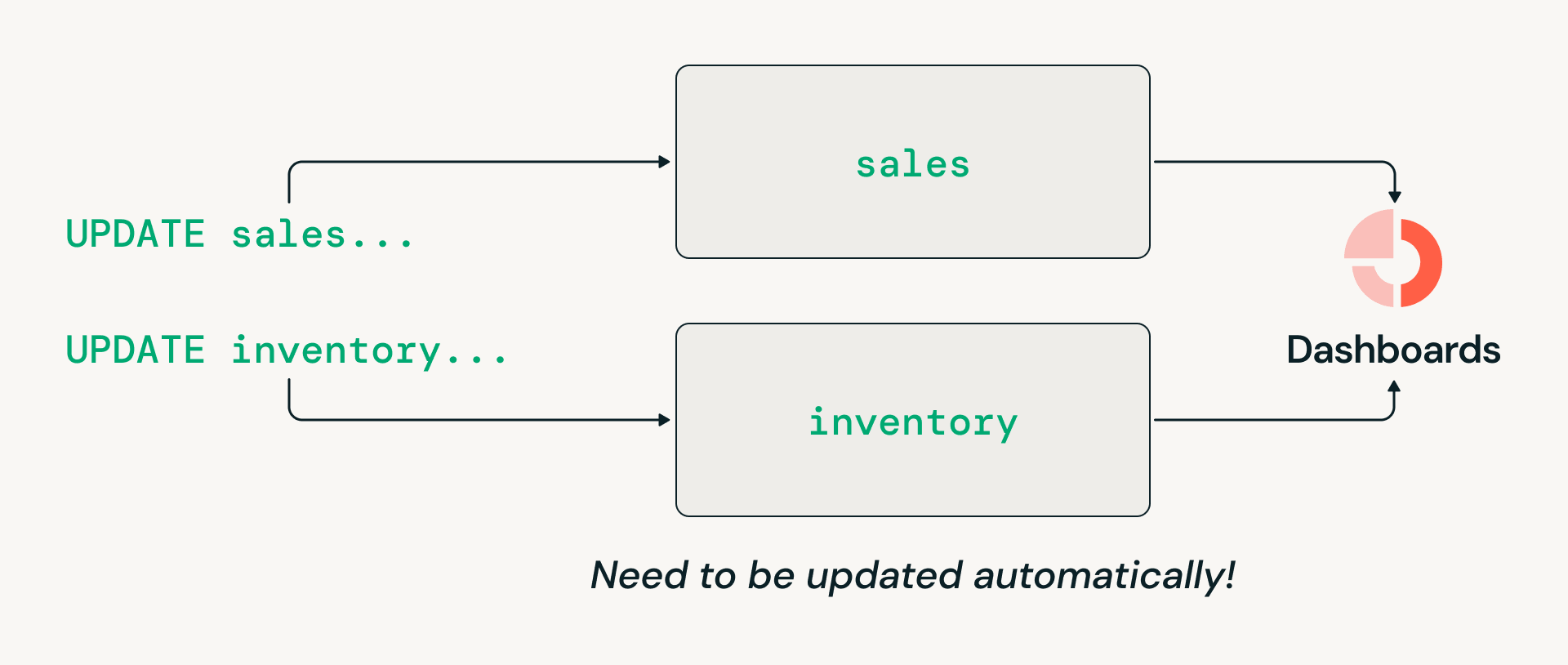
Challenge #3: Coordinating transactions across multiple tables

Catalog Commits is the next evolution of the open lakehouse

Catalog Commits is the open standard for Delta tables to integrate with a catalog, making the catalog responsible for coordinating table access and tracking the latest table state. Now that both Delta and Iceberg are catalog-oriented, customers can rely on their tables having a standardized model of table discovery and governance. To learn more about the Catalog Commits specification, read the Delta protocol and see Unity Catalog’s reference implementation of Catalog Commits.

On Databricks, Catalog Commits can be enabled on UC managed Delta tables. Once enabled, Unity Catalog brokers all table accesses, creating a consistent discovery and authorization model for any engine. This enables organizations to truly centralize governance over their estates.
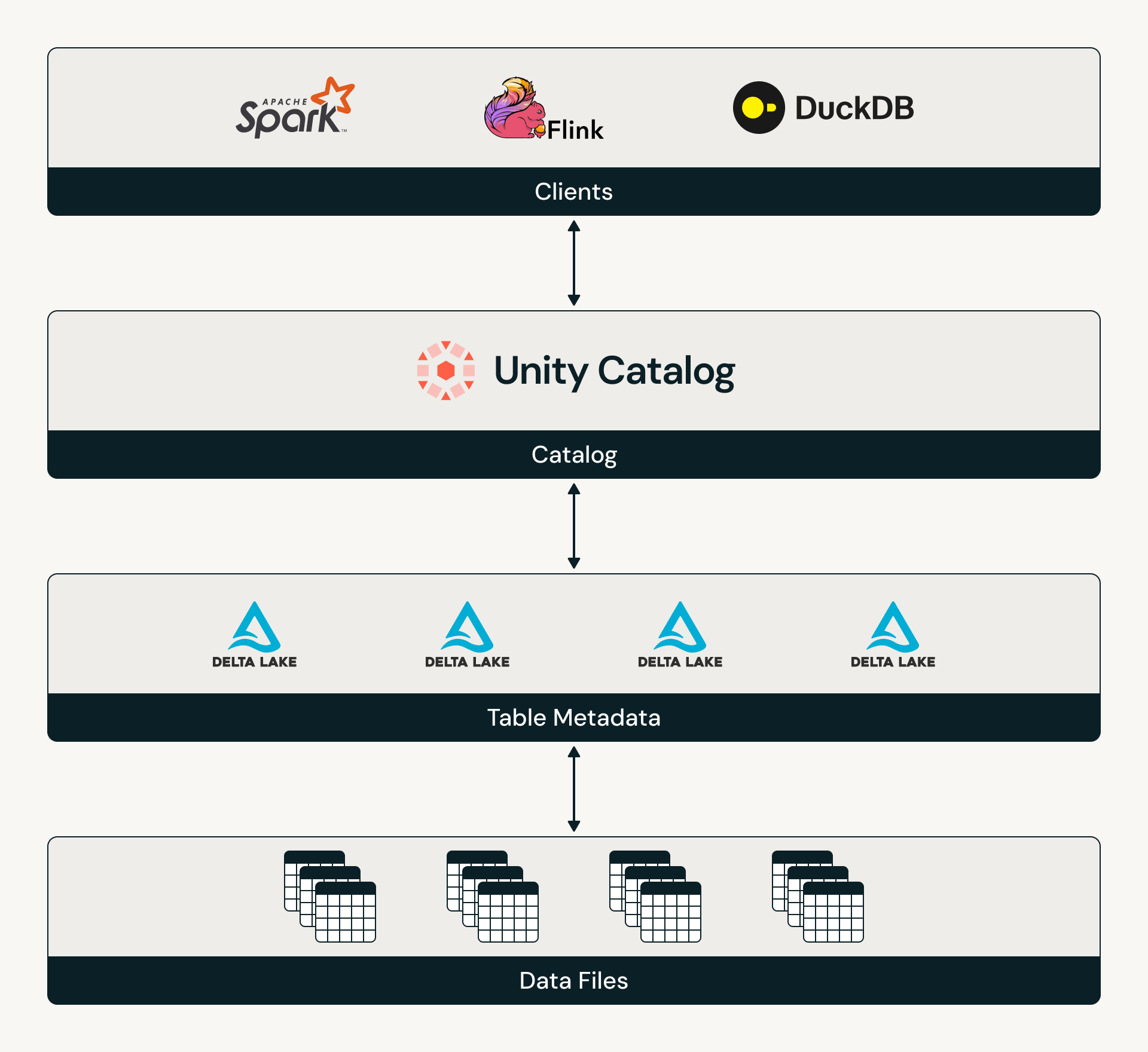
Catalog Commits

Catalog Commits solves longstanding split-brain, multi-engine sprawl, and multi-table coordination challenges. 

1. Eliminating the split-brain problem: Table state and the catalog stay in sync because all engines access tables through the same APIs, eliminating any risk of silent metadata drift.
Unlocks external engines writing to Unity Catalog managed Delta tables

"Historically, streaming data into a governed lakehouse meant reconciling catalog metadata out of band and hoping nothing drifted. Catalog Commits removes that gap entirely. With StreamNative’s native Kafka service - powered by Ursa for Kafka’s diskless, leaderless architecture - data is streamed and committed directly through Unity Catalog, so every record lands as a governed row that’s instantly queryable by any engine."— Sijie Guo, Co-Founder & CEO, StreamNative

2. Solving multi-engine access sprawl: With every engine and agent going through standardized catalog APIs to resolve tables, organizations no longer need to hardcode storage paths or manage coarse filesystem-level permissions.
Unlocks consistent and enhanced governance over all engines

3. Enables traditional warehousing workloads on the lakehouse: The Databricks engine and Unity Catalog can coordinate atomic writes that span multiple tables. This brings multi-table ACID semantics to the lakehouse, unlocking traditional data warehousing workloads.
Unlocks performing multi-table transactions on Databricks

“Transactions, combined with all of the new SQL features like SQL Scripting and Stored Procedures, enable us to confidently migrate our most critical warehousing workloads to Databricks. These workloads underpin essential analytics across our business, and having robust transactional guarantees on the lakehouse is a game-changer.” — Gal Doron, Head of Data, AnyClip

On top of that, enabling Catalog Commits on UC managed tables also unlocks:

  • Holistic auditability: Unity Catalog centralizes table metadata and access policies, allowing teams to inspect permissions and table ownership through a consistent catalog interface rather than relying solely on low-level storage logs.
  • Automated table optimizations: Unity Catalog leverages its visibility into all table accesses to optimally layout organizations’ data for their specific query patterns, via Liquid Clustering and Predictive Optimization.
  • Foundations for better performance: Unity Catalog can directly inform engines of table-level metadata without the engine needing to fetch metadata from cloud storage, removing a major source of metadata latency. 

Together, these capabilities make UC managed tables with Catalog Commits the most open, governed, and performant foundation for the modern lakehouse.

Enable Catalog Commits on your tables today

Catalog Commits on Databricks is Generally Available today! By enabling Catalog Commits on Unity Catalog managed tables, the following features are unlocked:

  1. Upgraded interoperability: External engine writes to UC managed Delta tables
  2. Stronger governance: Unlocks consistent and enhanced governance over all engines
  3. New features: Multi-statement, multi-table transactions

Databricks products that read or write to UC managed tables, from ingestion to gold-level consumption, now support Catalog Commits. These include Streaming Tables, Delta Sharing, Zerobus, Lakeflow Connect, AI Gateway, MLflow, and Lakeflow Job Triggers. Likewise, Catalog Commits is currently supported by engines across the ecosystem including Delta Spark, Delta Flink, Starburst Trino, DuckDB, and StreamNative

It’s also easy for any engine to support Catalog Commits by integrating with Delta Kernel, a shared library of APIs that abstracts away protocol-level details. Delta Kernel makes it easy for connectors to support the latest Delta features with simple version upgrades.

Creating a UC managed Delta table with Catalog Commits enabled is easy. Using Databricks Runtime 16.4+, run:

To upgrade an existing UC managed Delta table to enable Catalog Commits, use Databricks Runtime 18.0+ and run:

Get started with Catalog Commits and join us at the Data and AI Summit to learn more about our work building the open lakehouse!