惯性聚合 高效追踪和阅读你感兴趣的博客、新闻、科技资讯
阅读原文 在惯性聚合中打开

推荐订阅源

Know Your Adversary
Know Your Adversary
WordPress大学
WordPress大学
Y
Y Combinator Blog
钛媒体:引领未来商业与生活新知
钛媒体:引领未来商业与生活新知
奇客Solidot–传递最新科技情报
奇客Solidot–传递最新科技情报
Last Week in AI
Last Week in AI
阮一峰的网络日志
阮一峰的网络日志
G
Google Developers Blog
Cyber Security Advisories - MS-ISAC
F
Fortinet All Blogs
博客园 - 聂微东
freeCodeCamp Programming Tutorials: Python, JavaScript, Git & More
J
Java Code Geeks
Vercel News
Vercel News
N
Netflix TechBlog - Medium
大猫的无限游戏
大猫的无限游戏
MyScale Blog
MyScale Blog
罗磊的独立博客
博客园 - 三生石上(FineUI控件)
酷 壳 – CoolShell
酷 壳 – CoolShell
D
DataBreaches.Net
Hugging Face - Blog
Hugging Face - Blog
M
MIT News - Artificial intelligence
T
The Blog of Author Tim Ferriss
小众软件
小众软件
The GitHub Blog
The GitHub Blog
量子位
V
Visual Studio Blog
博客园_首页
Exploit-DB.com RSS Feed
C
CERT Recently Published Vulnerability Notes
The Cloudflare Blog
Spread Privacy
Spread Privacy
P
Proofpoint News Feed
T
Threat Research - Cisco Blogs
Simon Willison's Weblog
U
Unit 42
博客园 - 叶小钗
Apple Machine Learning Research
NISL@THU
NISL@THU
C
Cisco Blogs
T
Threatpost
Hacker News - Newest:
Hacker News - Newest: "LLM"
S
Secure Thoughts
The Hacker News
The Hacker News
Attack and Defense Labs
IT之家
IT之家
Help Net Security
Help Net Security
G
GRAHAM CLULEY
Jina AI
Jina AI

Databricks

Why Talent Transformation Is the Missing Focus of Enterprise AI Public Health Intelligence Shouldn't Require a Data Scientist Mean Time to Detect Is a Data Access Problem First-party audience data is the ad sales relationship now Rethinking Distributed Systems for Serverless Performance and Reliability The AI Scaling Gap Hiding in Digital Native Companies 10 trillion samples a day: Scaling beyond traditional monitoring infra at Databricks AI success starts with clean data, not just better models How nOps Rebuilt Their Cloud Optimization Platform on Databricks Lakebase, and Why Other ISVs Should Too Peril Predicts: Precision Payouts for a Volatile World The foundation of AI scalability: one team, one platform, one operating model The Federal Data Paradox: Rich in Data, Poor in Access Driving Budapest Forward: How BKK Uses Databricks to Transform City Mobility LLM Vs AI: A Practical Guide to Differences, Use Cases, and Tools Model Risk Governance Is Not the Same as Risk Intelligence Generative AI for Business: A Complete Strategy and Implementation Guide Data Science vs Data Engineering: Choosing Analysis or Infrastructure AI Applications: Tools, Use Cases, and Platforms MLOps vs DevOps: A Practical Guide for Data Scientists and IT Teams Top Data Warehouse Tools For Modern Data Analytics Unlocking SAP Business Context in Databricks with Semantic Metadata Delta Sharing The marketing activation gap has a fix: Databricks and Stitch partner to turn data infrastructure into marketing performance Alert Fatigue Is a Business Risk Backstage with Lakebase Shipping Faster isn’t Learning Faster Why Your OEE Dashboard Is Lying to You The Turbine That Tried to Tell You It Was Failing Predicting Readmissions Isn't Enough. Acting in Time Is. Clinical Trials Run Longer Than They Have To. That's a Patient Problem Network Quality Is a Revenue Problem, Not a Technical One Shelf Availability Starts with Better Demand Visibility When Predicting the Next Hit Requires More Than Intuition Approximate Answers, Exact Decisions: New Sketch Functions for Analytics Companies Winning with AI Built the Data Layer First Rethinking SQL ETL for modern data platforms Stripe data now available on Databricks via Databricks Marketplace Databricks and Stripe Projects: Infrastructure Built for Agents Agents are ready but your architecture probably isn't Interoperability Between Unity Catalog and Google BigQuery via Catalog Federation Built In, Not Bolted On: What AI-Native Actually Means in Cybersecurity Operationalizing AI for public sector fraud prevention From months to minutes: Building real-time clinical data pipelines with natural language Agentic Data Engineering with Genie Code and Lakeflow Securely send first-party conversion signals with Snapchat Conversions API on Databricks Marketplace How leading tech companies are killing the builder’s tax with Lakebase Inside one of the first production deployments of Lakebase: LangGuard's agentic workflow governance engine The next generation of Databricks Genie Model Risk Management in 2026: A Banker’s Guide to the Revised Interagency Guidance OpenAI GPT-5.5 now available on Databricks, fully-governed through Unity AI Gateway Operational databases: How they work and when to use them Databricks partners with OpenAI on GPT-5.5 Announcing the Public Preview of Lakeflow Designer Are LLM agents good at join order optimization? How conversational analytics removes the BI bottleneck How to transform document activation workflows with Genie and Agent Bricks Beyond the spreadsheet: how Databricks is delivering the modern CFO in Financial Services AI App Development: Guide To Building AI-Powered Apps IoT in Manufacturing: Strategy, Components, Use Cases, and Challenges Stop Hand-Coding Change Data Capture Pipelines Multimodal Data Integration: Production Architectures for Healthcare AI Personalization Strategies for Media Companies A Modern AI Risk Management Framework Introducing the Databricks Excel Add-in for Business Users Real-Time Decisioning for AI Agents: Why you Need a Customer Context Layer First A Practical Guide to LLM Fine Tuning AI Data Transformation Guide for Data Engineers and Data Scientists Concurrency Control in DBMS: How Locking, MVCC and Optimistic Strategies Keep Data Consistent Bridging data science and marketing: Databricks unveils Delta Sharing integration for Adobe Experience Platform and agentic marketing workflows Take Control: Customer-Managed Keys for Lakebase Postgres Get hands on with agents, vibe coding and more at Data+ AI Summit Mercedes-Benz Builds a Cross-Cloud Data Mesh with Delta Sharing and Intelligent Replication, Cutting Costs by 66% What Is a Transactional Database? Introducing Genie Agent Mode Governing coding agent sprawl with Unity AI Gateway Governing Coding Agent Sprawl with Unity AI Gateway What is pgvector? Banks Don’t Have an AI Problem – They Have a Data Platform Problem Open Platform, Unified Pipelines: Why dbt on Databricks is Accelerating Why Your Agents Can’t Read Enterprise Documents — and How to Fix It Building with Databricks Document Intelligence and Lakeflow Databricks on Google Cloud: Innovate Faster. Smarter. Together. Introducing the Databricks Connector for Google Sheets: Real-Time, Governed Lakehouse Data in the Sheets Users Love Unity AI Gateway: How to connect agents to external MCPs securely Expanding agent governance with Unity AI Gateway Agentic reasoning in practice: Making sense of structured and unstructured data Agent Bricks: The Governed Enterprise Agent Platform 8 AI and data trends shaping financial services in 2026 Building real-time product search on Databricks Lovable + Databricks: Build Data-Driven Apps at the Speed of Thought Memory scaling for AI agents Powering clinical research innovation: How TriNetX uses Databricks to accelerate drug development Database Branching in Postgres: Git-Style Workflows with Databricks Lakebase How Zalando built a unified data foundation for AI and analytics on Databricks The next era of the open lakehouse: Apache Iceberg™ v3 in Public Preview on Databricks How FSIs eliminate silos between clients, operations, and finance How MakeMyTrip achieved millisecond personalization at scale with Databricks A multi-agent approach to audience intelligence AiChemy: Next-generation agent with MCP, skills and custom data for drug discovery Accelerate business insights with Lakeflow Connect, now with a Free Tier Unlocking Next-Gen Customer Experiences with Data Intelligence for Marketing
Introducing Genie ZeroOps: Put your data and AI operations on autopilot
Bilal Aslam · 2026-06-16 · via Databricks

Data and AI work has always had a maintenance problem. Data pipelines break all the time due to not only code issues but also data problems such as upstream schema changes or late-arriving data. ML models drift, and degrading models keep serving confident, wrong answers long before anything throws an error. The burden of keeping data and AI assets running in production is falling on data teams, and it's only growing. The rise of LLMs and agentic tools has made it faster than ever to build pipelines and ship models. As a result, data teams report spending most of their time fighting fires rather than building.

Agentic operations with Genie ZeroOps

To help data teams with this operational burden, we’ve built Genie ZeroOps: an autonomous background agent that monitors your data and AI assets (such as pipelines, jobs, tables and ML models) and takes action before or when things go wrong. Because it runs inside Databricks, it has secure and easy access to:

  • Full observability: metrics, events, logs, and run history from the platform's observability layer.
  • Data lineage through Unity Catalog: the complete dependency graph of every asset, so it can trace failures to their true root cause.
  • Sandbox environments: Genie ZeroOps shallow clones production data (creating a table clone using metadata without duplicating the underlying data) into an isolated environment, applies permission guardrails and network isolation, and validates a proposed fix against real data without touching production.

Here's the process it runs for every failure:
  1. Detect: Continuous monitoring with access to platform observability, including silent failures that show up in data quality metrics before they throw any errors.
  2. Assess: Unity Catalog lineage gives Genie ZeroOps the full dependency graph. It can trace a failure to a code bug, a schema change three tables upstream, or bad data introduced by another pipeline.
  3. Remediate: Agentic code generation produces the fix, with your development workflow (GitHub PRs, Jira tickets) as context.
  4. Verify: Genie ZeroOps runs a secure sandbox with zero-copy clones of your data, scoped permissions, and network isolation. The proposed fix runs against real data there, never against production, and nothing is applied until you approve it.
     
image2.png
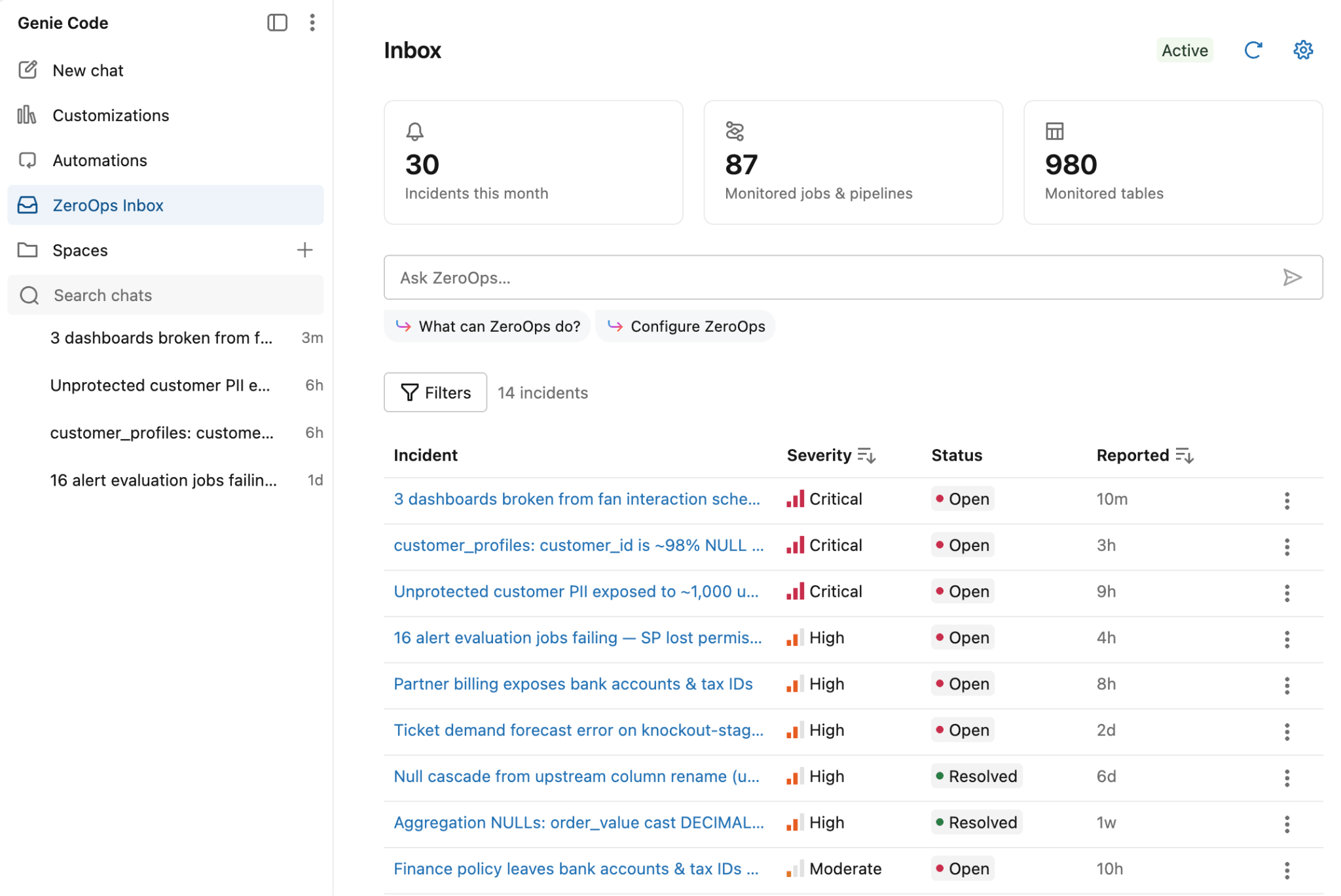
Genie ZeroOps inbox UI showing incidents ordered by severity
image4.png
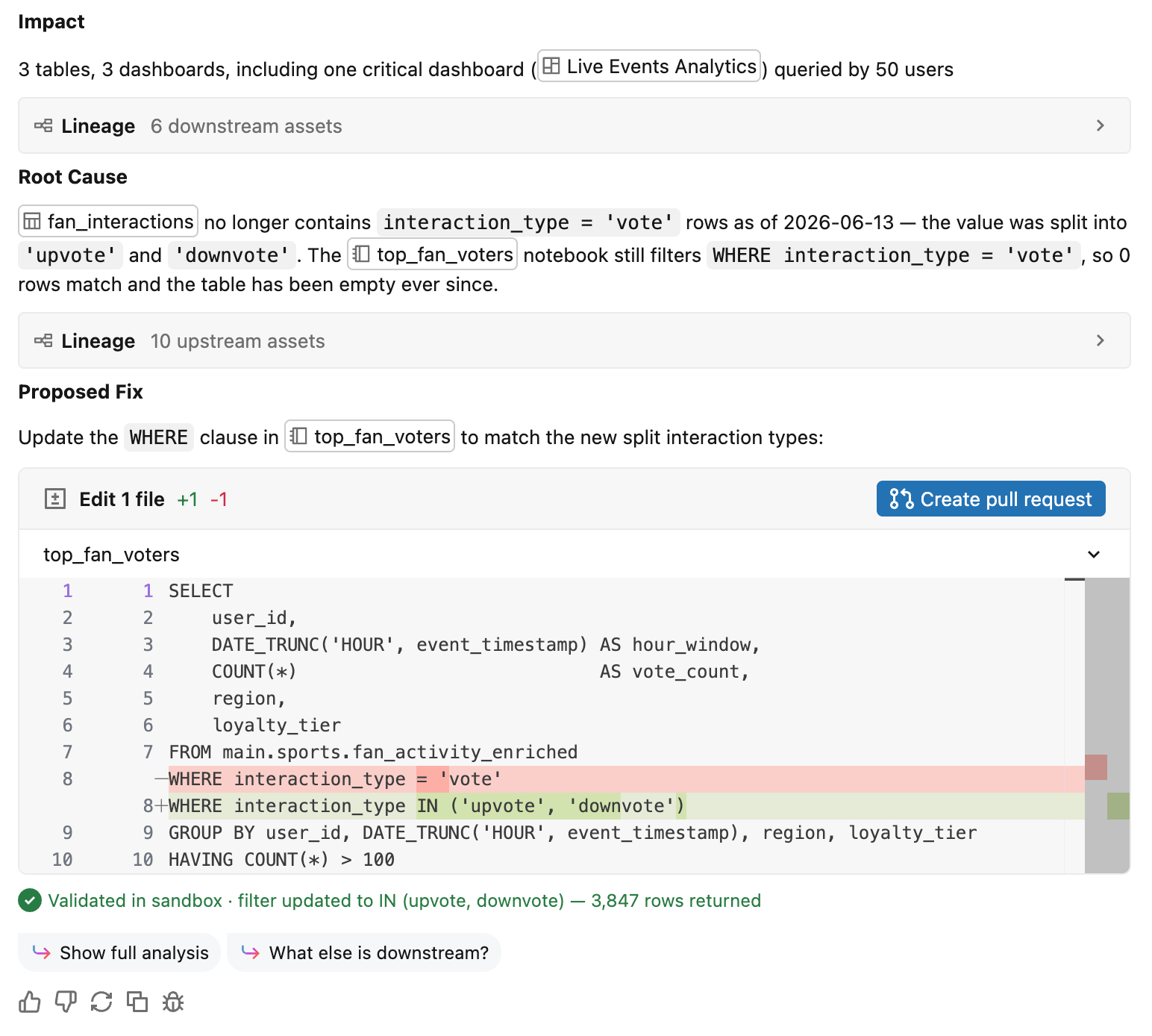
Genie ZeroOps shows you a visualization of imapcted assets and the root cause analysis it performed using lineage data
image1.png
Suggested fixes are provided with an indication of sandbox validation

Why coding agents can't solve data and AI operations

Why do you need a purpose-built agent for data and AI operations? Can’t you use the same coding agent that helps you build software and get the same results? The answer is – “no, not really”. 

Coding agents were built for software engineering, but data engineering and AI are fundamentally different:

  • The context includes data, not just code. Pipeline failures are often caused by schema changes upstream, bad data propagating through a dependency chain, or silent corruption. None of which code alone can tell you about.
  • Failures can be silent and permanent. A data bug can sit quietly in a production table for weeks, poisoning downstream consumers. By the time you find it, the business implications have materialized.
  • Production data is sensitive and governed. Unlike code, it can't be freely copied, shared, or handed to an outside tool.

When something breaks, you need to: detect it, assess root cause, remediate with a fix, and verify it works without side effects.

Examine each step, and you’ll find coding agents typically fall short. For detection, they can lack context, such as telemetry or choke on extremely large context, like Apache Spark™ logs. For assessment, finding the root cause and its impact, they often lack access to lineage data. They also don’t have a purpose-built harness for data and AI work, which makes the process more costly and time-consuming. Coding agents can write code for remediation, but they often lack the context to do it right and can’t fix issues that are data-related. But the step that is most challenging for coding agents is verification.

Verification requires testing code fixes against real production data in an isolated environment. You can't give an external agent access to production data, and even if you did, running code against it risks side effects that can have devastating consequences.

For an agent to safely handle the verify step, it needs to be part of the data platform itself. Genie ZeroOps is part of the Databricks Platform, and that’s what makes it succeed where coding agents fail. 

Machine learning workloads in particular showcase the benefits of a purpose-built agent for operations work.

Genie ZeroOps for machine learning

Production ML introduces some additional challenges to data engineering. A model can have no pipeline errors and still be producing bad predictions, which means keeping pipelines running isn't enough, you need to watch whether the model's outputs are still trustworthy.

When they aren't, Genie ZeroOps diagnoses the cause, builds a corrected candidate, and validates it before it touches live traffic. For a pipeline fix, it validates against a shallow clone of a table. For a model, it trains a candidate on corrected features and evaluates it against the same eval suite and criteria the production model was held to -- not a generic benchmark. It surfaces the candidate only if it's measurably better, and lets you ramp it on live traffic before it takes over.

What makes those fixes trustworthy is context. Genie ZeroOps for ML is built on the same foundation as Genie Code, Genie Ontology and native integration with the Databricks ML stack (Feature Store, MLflow, model serving, notebooks). It knows which features your model uses, how your team evaluates it, and what 'good' means for your business, so it reasons the way your senior ML engineers would. 

You stay in control

You configure which assets Genie ZeroOps monitors and what it's authorized to do. Everything runs under Unity Catalog governance, so it can only access data your own credentials allow. Issues surface in an inbox-style UI, prioritized by severity, each with a root cause analysis and a proposed fix. Nothing gets applied to production without your approval.

The sandbox is the technical trust layer. Shallow cloning means the fix is tested with real data but production is never touched. Scoped permissions and network isolation mean the sandboxed environment can't reach outside its boundaries. What was tested is exactly what gets applied.

This is the value of Genie ZeroOps - it lets you scale your operations safely. It does the heavy lifting while you stay in control.

Genie ZeroOps is coming soon

Genie ZeroOps is entering private preview in the coming weeks, starting with support for jobs, pipelines, tables and ML workloads. Apps, and Lakebase databases are on the roadmap.

Talk to your Databricks account team to request early access. In the meantime, explore other members of the Genie family like Genie One and Genie Code.