
惯性聚合 高效追踪和阅读你感兴趣的博客、新闻、科技资讯
阅读原文 在惯性聚合中打开

推荐订阅源

V
Visual Studio Blog
Project Zero
Project Zero
阮一峰的网络日志
阮一峰的网络日志
博客园 - 【当耐特】
大猫的无限游戏
大猫的无限游戏
The Register - Security
C
Check Point Blog
Attack and Defense Labs
L
LangChain Blog
Simon Willison's Weblog
S
Schneier on Security
Recorded Future
Recorded Future
GbyAI
GbyAI
D
Darknet – Hacking Tools, Hacker News & Cyber Security
Y
Y Combinator Blog
量子位
A
About on SuperTechFans
I
Intezer
T
Threat Research - Cisco Blogs
MongoDB | Blog
MongoDB | Blog
U
Unit 42
C
CERT Recently Published Vulnerability Notes
Scott Helme
Scott Helme
Cisco Talos Blog
Cisco Talos Blog
P
Palo Alto Networks Blog
Threat Intelligence Blog | Flashpoint
Spread Privacy
Spread Privacy
M
MIT News - Artificial intelligence
雷峰网
雷峰网
博客园 - 聂微东
NISL@THU
NISL@THU
The Hacker News
The Hacker News
G
Google Developers Blog
F
Full Disclosure
博客园 - Franky
让小产品的独立变现更简单 - ezindie.com
P
Privacy & Cybersecurity Law Blog
博客园 - 叶小钗
酷 壳 – CoolShell
酷 壳 – CoolShell
T
The Blog of Author Tim Ferriss
Security Latest
Security Latest
T
Tenable Blog
Know Your Adversary
Know Your Adversary
Stack Overflow Blog
Stack Overflow Blog
K
Kaspersky official blog
Blog — PlanetScale
Blog — PlanetScale
博客园 - 司徒正美
C
Cybersecurity and Infrastructure Security Agency CISA
Martin Fowler
Martin Fowler
Schneier on Security

Databricks

Why Talent Transformation Is the Missing Focus of Enterprise AI Public Health Intelligence Shouldn't Require a Data Scientist Mean Time to Detect Is a Data Access Problem First-party audience data is the ad sales relationship now Rethinking Distributed Systems for Serverless Performance and Reliability The AI Scaling Gap Hiding in Digital Native Companies 10 trillion samples a day: Scaling beyond traditional monitoring infra at Databricks AI success starts with clean data, not just better models How nOps Rebuilt Their Cloud Optimization Platform on Databricks Lakebase, and Why Other ISVs Should Too Peril Predicts: Precision Payouts for a Volatile World The foundation of AI scalability: one team, one platform, one operating model The Federal Data Paradox: Rich in Data, Poor in Access Driving Budapest Forward: How BKK Uses Databricks to Transform City Mobility LLM Vs AI: A Practical Guide to Differences, Use Cases, and Tools Model Risk Governance Is Not the Same as Risk Intelligence Generative AI for Business: A Complete Strategy and Implementation Guide Data Science vs Data Engineering: Choosing Analysis or Infrastructure AI Applications: Tools, Use Cases, and Platforms MLOps vs DevOps: A Practical Guide for Data Scientists and IT Teams Top Data Warehouse Tools For Modern Data Analytics Unlocking SAP Business Context in Databricks with Semantic Metadata Delta Sharing The marketing activation gap has a fix: Databricks and Stitch partner to turn data infrastructure into marketing performance Alert Fatigue Is a Business Risk Backstage with Lakebase Shipping Faster isn’t Learning Faster Why Your OEE Dashboard Is Lying to You The Turbine That Tried to Tell You It Was Failing Predicting Readmissions Isn't Enough. Acting in Time Is. Clinical Trials Run Longer Than They Have To. That's a Patient Problem Network Quality Is a Revenue Problem, Not a Technical One Shelf Availability Starts with Better Demand Visibility When Predicting the Next Hit Requires More Than Intuition Approximate Answers, Exact Decisions: New Sketch Functions for Analytics Companies Winning with AI Built the Data Layer First Rethinking SQL ETL for modern data platforms Stripe data now available on Databricks via Databricks Marketplace Databricks and Stripe Projects: Infrastructure Built for Agents Agents are ready but your architecture probably isn't Interoperability Between Unity Catalog and Google BigQuery via Catalog Federation Built In, Not Bolted On: What AI-Native Actually Means in Cybersecurity Operationalizing AI for public sector fraud prevention From months to minutes: Building real-time clinical data pipelines with natural language Agentic Data Engineering with Genie Code and Lakeflow Securely send first-party conversion signals with Snapchat Conversions API on Databricks Marketplace How leading tech companies are killing the builder’s tax with Lakebase Inside one of the first production deployments of Lakebase: LangGuard's agentic workflow governance engine The next generation of Databricks Genie Model Risk Management in 2026: A Banker’s Guide to the Revised Interagency Guidance OpenAI GPT-5.5 now available on Databricks, fully-governed through Unity AI Gateway Operational databases: How they work and when to use them Databricks partners with OpenAI on GPT-5.5 Announcing the Public Preview of Lakeflow Designer Are LLM agents good at join order optimization? How conversational analytics removes the BI bottleneck How to transform document activation workflows with Genie and Agent Bricks Beyond the spreadsheet: how Databricks is delivering the modern CFO in Financial Services AI App Development: Guide To Building AI-Powered Apps IoT in Manufacturing: Strategy, Components, Use Cases, and Challenges Stop Hand-Coding Change Data Capture Pipelines Multimodal Data Integration: Production Architectures for Healthcare AI Personalization Strategies for Media Companies A Modern AI Risk Management Framework Introducing the Databricks Excel Add-in for Business Users Real-Time Decisioning for AI Agents: Why you Need a Customer Context Layer First A Practical Guide to LLM Fine Tuning AI Data Transformation Guide for Data Engineers and Data Scientists Concurrency Control in DBMS: How Locking, MVCC and Optimistic Strategies Keep Data Consistent Bridging data science and marketing: Databricks unveils Delta Sharing integration for Adobe Experience Platform and agentic marketing workflows Take Control: Customer-Managed Keys for Lakebase Postgres Get hands on with agents, vibe coding and more at Data+ AI Summit Mercedes-Benz Builds a Cross-Cloud Data Mesh with Delta Sharing and Intelligent Replication, Cutting Costs by 66% What Is a Transactional Database? Introducing Genie Agent Mode Governing coding agent sprawl with Unity AI Gateway Governing Coding Agent Sprawl with Unity AI Gateway What is pgvector? Banks Don’t Have an AI Problem – They Have a Data Platform Problem Open Platform, Unified Pipelines: Why dbt on Databricks is Accelerating Why Your Agents Can’t Read Enterprise Documents — and How to Fix It Building with Databricks Document Intelligence and Lakeflow Databricks on Google Cloud: Innovate Faster. Smarter. Together. Introducing the Databricks Connector for Google Sheets: Real-Time, Governed Lakehouse Data in the Sheets Users Love Unity AI Gateway: How to connect agents to external MCPs securely Expanding agent governance with Unity AI Gateway Agentic reasoning in practice: Making sense of structured and unstructured data Agent Bricks: The Governed Enterprise Agent Platform 8 AI and data trends shaping financial services in 2026 Building real-time product search on Databricks Lovable + Databricks: Build Data-Driven Apps at the Speed of Thought Memory scaling for AI agents Powering clinical research innovation: How TriNetX uses Databricks to accelerate drug development Database Branching in Postgres: Git-Style Workflows with Databricks Lakebase How Zalando built a unified data foundation for AI and analytics on Databricks The next era of the open lakehouse: Apache Iceberg™ v3 in Public Preview on Databricks How FSIs eliminate silos between clients, operations, and finance How MakeMyTrip achieved millisecond personalization at scale with Databricks A multi-agent approach to audience intelligence AiChemy: Next-generation agent with MCP, skills and custom data for drug discovery Accelerate business insights with Lakeflow Connect, now with a Free Tier Unlocking Next-Gen Customer Experiences with Data Intelligence for Marketing
MCP Marketplace Brings Real-Time Intelligence to Agentic Applications
2026-05-08 · via Databricks

An agentic application is an AI system that knows your business context, reasons autonomously, and takes action based on real-time data and specialized expertise. Agent Bricks, Genie, Apps, and Lakebase give enterprises the tools to build agentic applications at scale. But there's a critical gap: agents built solely on internal data can't truly think.

Consider a loan approval agent. It has access to your bank's loan book, customer history, and credit scores. But it lacks the context that humans instinctively use:

  • Current market conditions and sector trends
  • Real-time creditworthiness signals (updated ratings, outlook changes)
  • Property valuations and equity shifts
  • Competitor activity and economic headwinds

Without this real-time intelligence, agents become knowledge-limited—constrained by historical data, unable to reason about the world as it is now. They can execute workflows, but they can't make informed decisions.

The old solution? Manual research. Analysts pull data from multiple sources, lose context switching between tools, and create bottlenecks. Decisions slow down. Risk increases.

Agents need a way to access live, trusted intelligence while they reason through complex problems. That's where the MCP Marketplace comes in.

The Solution: Real-Time Intelligence for Agentic Applications

The Databricks Marketplace is an open marketplace for data, analytics and AI. It is the central hub for discovering, connecting to, and governing MCP servers and AI-ready data, enabling agents to access external data at scale with minimal friction.
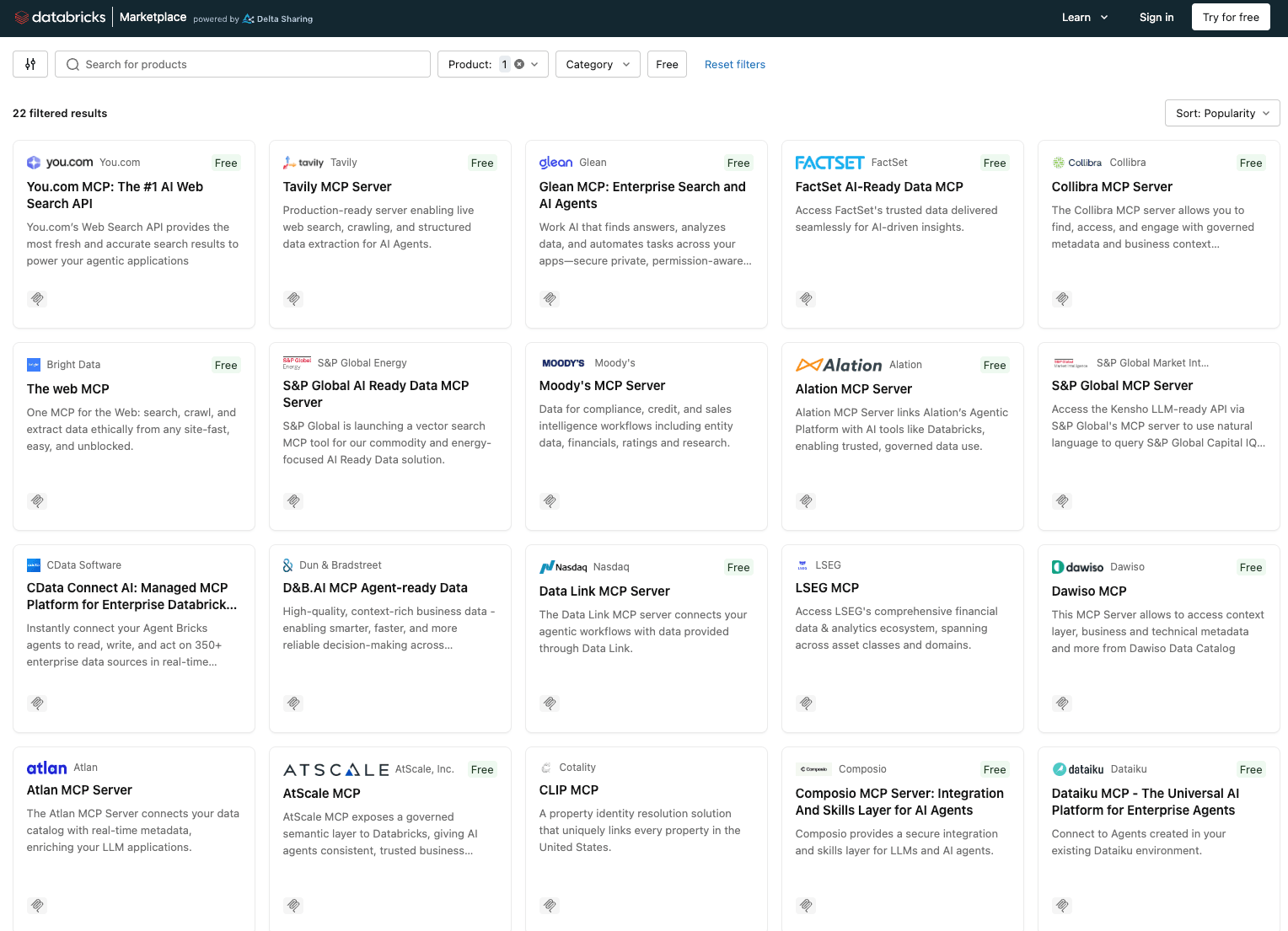
Databricks Marketplace

Let's walk through three domain-specific examples that illustrate how agentic applications use real-time intelligence to solve concrete problems. These three providers represent different types of external intelligence your agents might need:

  • You.com — Real-time web intelligence and market sentiment
  • Moody's — Institutional credit research and entity intelligence
  • Cotality — Real estate and mortgage expertise for lenders

These aren't just data feeds. They're executable intelligence sources that agents can query, evaluate, and act upon, all within a governed, auditable environment. Every connection is authenticated through Unity Catalog, creating a single source of truth for access control and compliance.

By connecting your agentic applications to these MCP servers, you're doing three critical things:

  1. Bridging the knowledge gap. Agentic apps access live data that wasn't in your training set or data warehouse.
  2. Eliminating manual research. Workflows that once required human intervention now run autonomously.
  3. Staying governed. Everything happens inside the Lakehouse, with full lineage and compliance tracking.

How It Works: Three Providers in Action

To illustrate how agentic applications leverage real-time intelligence, here's how these three providers power autonomous decision-making across different use cases:

You.com: Real-Time Web Context and Market Sentiment

The You.com MCP acts as a real-time research arm that can be invoked within your agents to provide the "why" behind internal performance metrics.

  • The gap: Your dashboard shows a 10% regional sales dip in EMEA business. Why?
  • Agent’s action: Your agent calls You.com MCP to retrieve live market news, weather patterns, competitor pricing, and regulatory changes. Your agent synthesizes the context.
  • What agents access: You.com allows agents to pull real-time news, regulatory shifts, and competitor pricing directly into a Databricks Genie conversation to provide instant, grounded research.

This demo illustrates how a supervisor agent uses Genie for internal data warehouse queries and the You.com MCP Server for external web research.

Moody’s: Institutional Credit Research at Scale

Moody’s MCP Server delivers trusted, GenAI-ready intelligence that can be woven into financial applications to accelerate decision-making. By invoking Moody’s curated data ecosystem, including global entity ownership, financial statements, and Moody's Ratings credit ratings and research alongside your bank’s private loan book, you move from manual research to decision-ready intelligence.
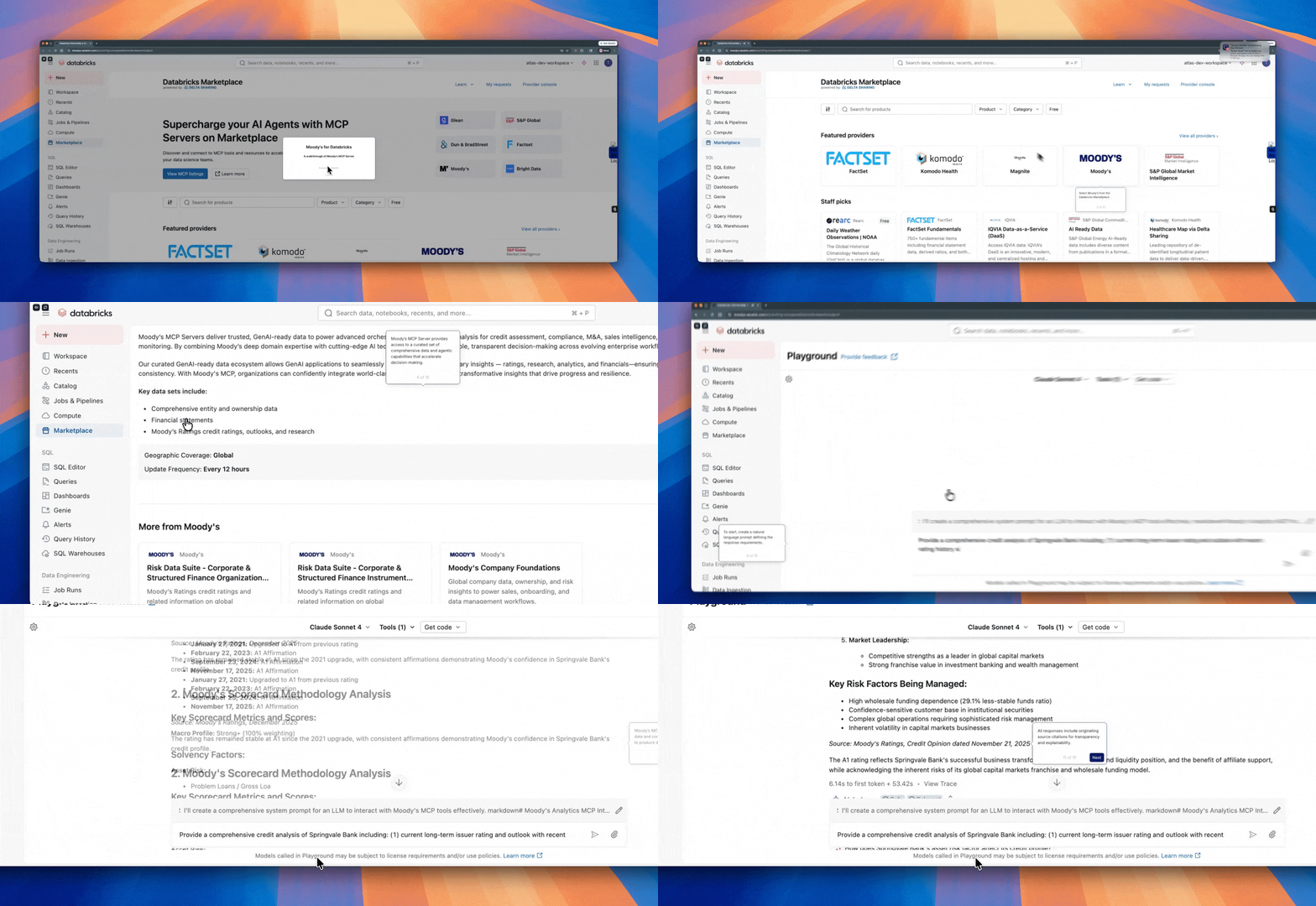
  • The gap: Your loan officer approves applicants based on credit scores alone. They're missing the full picture.
  • Agent’s Action: Moody's provides current Moody's Ratings credit ratings, historical trends, peer benchmarks, and sector outlook. Your agent now compares the applicant against investment-grade peers, identifies hidden risks, and surfaces the rationale to your credit officer in seconds.
  • What agents access: Business users can perform high-level entity searches, access current credit ratings and outlook history dating back to 2000, and retrieve forward-looking sector trajectories to support strategic planning.

A walkthrough of Moody's MCP Server

Click here for the detailed walkthrough of Moody's MCP Server on Databricks

Cotality: The "Property 360" for Mortgage Excellence

The Cotality MCP and AI-Ready datasets provide the missing link for lenders, allowing them to embed real estate universe intelligence directly into their agentic workflows.

  • The gap: Portfolio "leakage" often happens in the dark. Without a clear, unified view across data sources into recapture performance, you don't know if you’re losing a borrower to a new home purchase or a winnable refinance until the payoff request hits your desk.
  • Agent's action: Genie scans your portfolio to resolve property data records and identify exactly where your book is going. By merging internal data with external signals, it distinguishes between move-up buyers and "Refi Shops" poaching your equity, allowing you to strengthen your strategy where it's most winnable.
  • What Agents access: Cotality’s CLIP MCP–powered property resolution, paired with AI‑ready datasets, provides a live window into who is capturing your book and why. Originators can see if a payoff was a new purchase or a refinance, track competitor poaching in real-time, and deploy targeted outreach to stop run-off before it starts.

How Agents Remember: Lakebase as State Engine

Real-time intelligence solves half the problem. But agentic applications need another capability: persistent memory and state.

Here's the challenge: a complex workflow—like a 3-day commercial loan review—involves multiple steps, human handoffs, and decisions. Without a persistent state, agents restart from scratch each time. Context is lost. Progress resets.

That's where Lakebase comes into play. Lakebase is a serverless, stateful database purpose-built for agentic applications. It stores agent state, decisions, and audit trails throughout multi-step workflows.

Why this matters for real-time intelligence: When your agent accesses Moody's data on day one and Cotality data on day two, Lakebase connects those insights and reasons across them. The agent doesn't re-request data; it builds on what it knows. Every decision is logged for compliance—automatically.

Putting It Together: The Commercial Loan Decision Support App

Let’s see how a production-grade agentic application works

  1. Application arrives → Lakebase stores status and metadata
  2. Agent awakens → Retrieves context from Lakebase
  3. Agent queries intelligence:
  4. Agent synthesizes → Combines internal data (your loan book) with external intelligence
  5. Agent surfaces decision → Proposes approval/denial with full reasoning via Genie
  6. Credit officer reviews → One-click approval in your Databricks App
  7. Lakebase logs decision → Complete audit trail (decision, data sources, timestamp, approver) for compliance

Governance throughout: All data accessed, all agent reasoning, all decisions—tracked in Unity Catalog with full lineage.
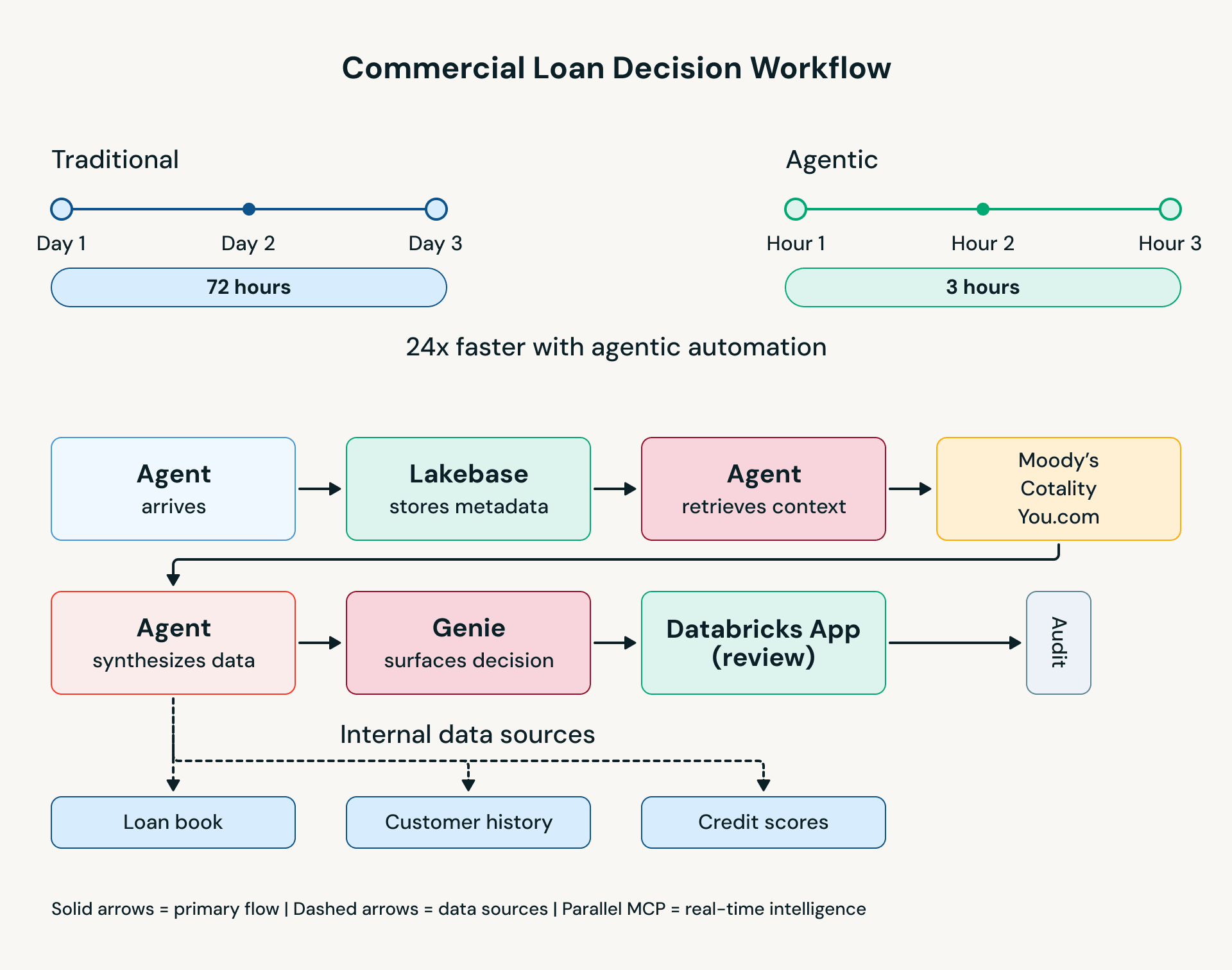
Commercial Loan Decision Workflow

Get Started: Build Smarter Agents Today

The MCP Marketplace is live. Real-time intelligence is now accessible to your agents:

Three providers are ready:

Three next steps:

  1. Explore the Databricks Marketplace to see all available MCP servers
  2. Build your first agent with Agent Bricks, grounded in real-time data
  3. Deploy with Lakebase for memory, governance, and auditability

Agents powered by real-time intelligence don't just execute workflows—they reason, adapt, and make autonomous decisions that drive business results.