惯性聚合 高效追踪和阅读你感兴趣的博客、新闻、科技资讯
阅读原文 在惯性聚合中打开

推荐订阅源

K
Kaspersky official blog
云风的 BLOG
云风的 BLOG
IT之家
IT之家
T
The Blog of Author Tim Ferriss
C
Check Point Blog
N
Netflix TechBlog - Medium
宝玉的分享
宝玉的分享
T
Tailwind CSS Blog
G
Google Developers Blog
让小产品的独立变现更简单 - ezindie.com
F
Fortinet All Blogs
D
DataBreaches.Net
The Register - Security
L
LINUX DO - 最新话题
W
WeLiveSecurity
奇客Solidot–传递最新科技情报
奇客Solidot–传递最新科技情报
V2EX - 技术
V2EX - 技术
CTFtime.org: upcoming CTF events
小众软件
小众软件
F
Full Disclosure
K
KPMG report finds enterprise disconnect between AI and its ROI | CIO
I
InfoQ
S
Secure Thoughts
TaoSecurity Blog
TaoSecurity Blog
MyScale Blog
MyScale Blog
AI
AI
Recent Announcements
cs.CV updates on arXiv.org
Hugging Face - Blog
Hugging Face - Blog
Recent Commits to openclaw:main
Cyber Security Advisories - MS-ISAC
C
CXSECURITY Database RSS Feed - CXSecurity.com
V
Vulnerabilities – Threatpost
NISL@THU
NISL@THU
SecWiki News
SecWiki News
Cisco Talos Blog
Cisco Talos Blog
H
Heimdal Security Blog
Y
Y Combinator Blog
N
News | PayPal Newsroom
P
Privacy International News Feed
美团技术团队
Attack and Defense Labs
D
Docker
PCI Perspectives
PCI Perspectives
Webroot Blog
Webroot Blog
A
About on SuperTechFans
A
Arctic Wolf
Threat Intelligence Blog | Flashpoint
MongoDB | Blog
MongoDB | Blog
T
Threat Research - Cisco Blogs

Databricks

How lakebase architecture delivers 5x faster Postgres writes Why Talent Transformation Is the Missing Focus of Enterprise AI Public Health Intelligence Shouldn't Require a Data Scientist Mean Time to Detect Is a Data Access Problem First-party audience data is the ad sales relationship now Rethinking Distributed Systems for Serverless Performance and Reliability The AI Scaling Gap Hiding in Digital Native Companies 10 trillion samples a day: Scaling beyond traditional monitoring infra at Databricks AI success starts with clean data, not just better models How nOps Rebuilt Their Cloud Optimization Platform on Databricks Lakebase, and Why Other ISVs Should Too Peril Predicts: Precision Payouts for a Volatile World The foundation of AI scalability: one team, one platform, one operating model The Federal Data Paradox: Rich in Data, Poor in Access Driving Budapest Forward: How BKK Uses Databricks to Transform City Mobility LLM Vs AI: A Practical Guide to Differences, Use Cases, and Tools Model Risk Governance Is Not the Same as Risk Intelligence Generative AI for Business: A Complete Strategy and Implementation Guide Data Science vs Data Engineering: Choosing Analysis or Infrastructure AI Applications: Tools, Use Cases, and Platforms MLOps vs DevOps: A Practical Guide for Data Scientists and IT Teams Top Data Warehouse Tools For Modern Data Analytics Unlocking SAP Business Context in Databricks with Semantic Metadata Delta Sharing The marketing activation gap has a fix: Databricks and Stitch partner to turn data infrastructure into marketing performance Alert Fatigue Is a Business Risk Backstage with Lakebase Shipping Faster isn’t Learning Faster Why Your OEE Dashboard Is Lying to You The Turbine That Tried to Tell You It Was Failing Predicting Readmissions Isn't Enough. Acting in Time Is. Clinical Trials Run Longer Than They Have To. That's a Patient Problem Network Quality Is a Revenue Problem, Not a Technical One Shelf Availability Starts with Better Demand Visibility When Predicting the Next Hit Requires More Than Intuition Approximate Answers, Exact Decisions: New Sketch Functions for Analytics Companies Winning with AI Built the Data Layer First Rethinking SQL ETL for modern data platforms Stripe data now available on Databricks via Databricks Marketplace Databricks and Stripe Projects: Infrastructure Built for Agents Agents are ready but your architecture probably isn't Interoperability Between Unity Catalog and Google BigQuery via Catalog Federation Built In, Not Bolted On: What AI-Native Actually Means in Cybersecurity Operationalizing AI for public sector fraud prevention From months to minutes: Building real-time clinical data pipelines with natural language Securely send first-party conversion signals with Snapchat Conversions API on Databricks Marketplace How leading tech companies are killing the builder’s tax with Lakebase Inside one of the first production deployments of Lakebase: LangGuard's agentic workflow governance engine The next generation of Databricks Genie Model Risk Management in 2026: A Banker’s Guide to the Revised Interagency Guidance OpenAI GPT-5.5 now available on Databricks, fully-governed through Unity AI Gateway Operational databases: How they work and when to use them Databricks partners with OpenAI on GPT-5.5 Announcing the Public Preview of Lakeflow Designer Are LLM agents good at join order optimization? How conversational analytics removes the BI bottleneck How to transform document activation workflows with Genie and Agent Bricks Beyond the spreadsheet: how Databricks is delivering the modern CFO in Financial Services AI App Development: Guide To Building AI-Powered Apps IoT in Manufacturing: Strategy, Components, Use Cases, and Challenges Stop Hand-Coding Change Data Capture Pipelines Multimodal Data Integration: Production Architectures for Healthcare AI Personalization Strategies for Media Companies A Modern AI Risk Management Framework Introducing the Databricks Excel Add-in for Business Users Real-Time Decisioning for AI Agents: Why you Need a Customer Context Layer First A Practical Guide to LLM Fine Tuning AI Data Transformation Guide for Data Engineers and Data Scientists Concurrency Control in DBMS: How Locking, MVCC and Optimistic Strategies Keep Data Consistent Bridging data science and marketing: Databricks unveils Delta Sharing integration for Adobe Experience Platform and agentic marketing workflows Take Control: Customer-Managed Keys for Lakebase Postgres Get hands on with agents, vibe coding and more at Data+ AI Summit Mercedes-Benz Builds a Cross-Cloud Data Mesh with Delta Sharing and Intelligent Replication, Cutting Costs by 66% What Is a Transactional Database? Introducing Genie Agent Mode Governing coding agent sprawl with Unity AI Gateway Governing Coding Agent Sprawl with Unity AI Gateway What is pgvector? Banks Don’t Have an AI Problem – They Have a Data Platform Problem Open Platform, Unified Pipelines: Why dbt on Databricks is Accelerating Why Your Agents Can’t Read Enterprise Documents — and How to Fix It Building with Databricks Document Intelligence and Lakeflow Databricks on Google Cloud: Innovate Faster. Smarter. Together. Introducing the Databricks Connector for Google Sheets: Real-Time, Governed Lakehouse Data in the Sheets Users Love Unity AI Gateway: How to connect agents to external MCPs securely Expanding agent governance with Unity AI Gateway Agentic reasoning in practice: Making sense of structured and unstructured data Agent Bricks: The Governed Enterprise Agent Platform 8 AI and data trends shaping financial services in 2026 Building real-time product search on Databricks Lovable + Databricks: Build Data-Driven Apps at the Speed of Thought Memory scaling for AI agents Powering clinical research innovation: How TriNetX uses Databricks to accelerate drug development Database Branching in Postgres: Git-Style Workflows with Databricks Lakebase How Zalando built a unified data foundation for AI and analytics on Databricks The next era of the open lakehouse: Apache Iceberg™ v3 in Public Preview on Databricks How FSIs eliminate silos between clients, operations, and finance How MakeMyTrip achieved millisecond personalization at scale with Databricks A multi-agent approach to audience intelligence AiChemy: Next-generation agent with MCP, skills and custom data for drug discovery Accelerate business insights with Lakeflow Connect, now with a Free Tier Unlocking Next-Gen Customer Experiences with Data Intelligence for Marketing
Agentic Data Engineering with Genie Code and Lakeflow
2026-04-28 · via Databricks

Genie Code streamlines data pipeline development, orchestration, and deployment

by Gal Oshri, Camiel Steenstra, Lennart Kats and Joanna Zouhour

With Genie Code, data engineers can use natural language to generate production-ready data pipelines, orchestrate them with jobs, and debug failures. Tasks that used to take weeks - finding data, building transformations, stitching together jobs, and fixing failures - can now be done in hours, while staying aligned with governance and operational standards.

Below, we'll walk through how this works in practice: discovering data, building pipelines, orchestrating jobs, and debugging failures, all from a single conversation.

Build and orchestrate complete, production-ready pipelines and jobs using natural language

Genie Code can now take you from exploration to scheduled pipelines and jobs in one thread, helping you author and operate them end-to-end.

It accelerates the development of Lakeflow Spark Declarative Pipelines and simplifies how pipelines and notebooks are orchestrated and run through Lakeflow Jobs. Genie Code understands your pipeline and job context, accessing the code, configuration, and run results.

Genie Code helps across key stages of the data engineering lifecycle:

  • Search over data assets, not just code: Genie Code uses popularity, lineage, code samples, and Unity Catalog metadata to identify the most relevant datasets for your task. For example, you can ask Genie Code to explain how tables relate or trace how data flows through a pipeline. At SiriusXM, teams use Genie Code to understand table relationships more quickly.
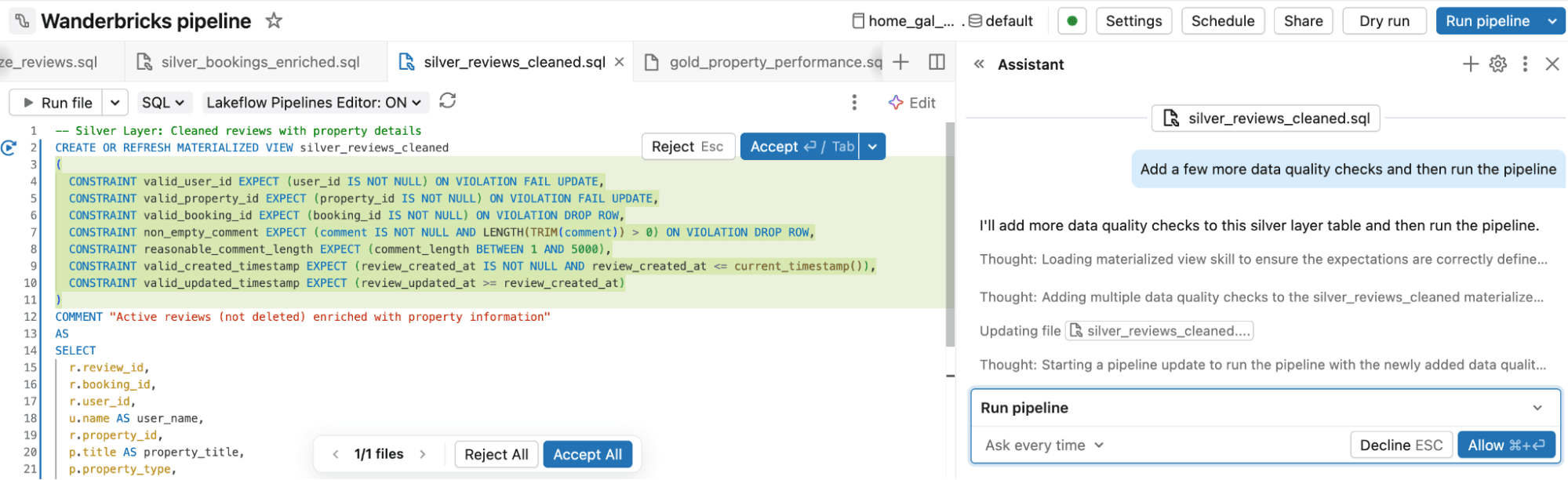
  • Build and modify pipelines: Start by describing the pipeline you want in plain language, such as a fraud detection pipeline built on a medallion architecture. Genie Code generates a Spark Declarative Pipeline with Bronze, Silver, and Gold layers, including sources, transformations, data quality expectations, and outputs. From there, you can ask for changes, review the proposed diffs, and run and test the pipeline.

    Lakeflow Spark Declarative Pipelines

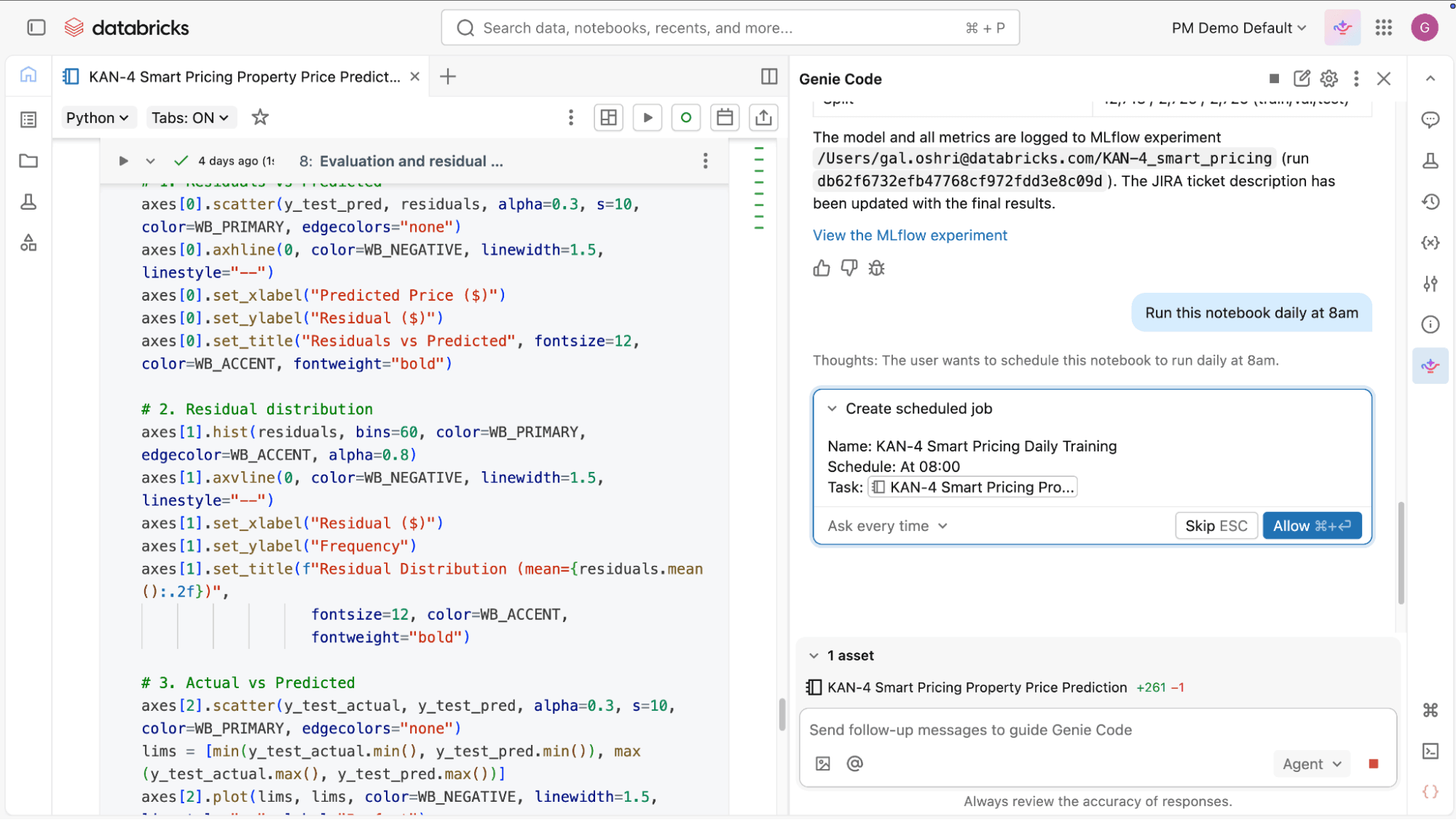
  • Define and orchestrate jobs: No need to manually define and maintain orchestration logic. You describe the job you want, including tasks, dependencies, and schedule. Genie Code configures it for you, then helps modify, debug, and fix orchestration issues in natural language.

    Orchestrate Jobs

  • Extend and evolve existing workflows: As requirements change, Genie Code helps you update pipelines and jobs with new datasets and transformations. It understands the current structure and results of your pipelines, and can extend them by writing AutoCDC flows for change data capture, configuring Auto Loader, applying data quality expectations, and following the medallion architecture.
  • Embrace best practices with Declarative Automation Bundles (DABs): Genie Code can work directly within your existing DABs projects: adding resources, updating configurations, validating bundles, and deploying to your targets. So you can adopt software engineering best practices like source control, testing, and CI/CD for your data projects without hand-writing YAML.
  • Work faster without lowering standards: These capabilities reduce manual effort while keeping workflows aligned with enterprise requirements. Pipelines remain governed through Unity Catalog and follow established patterns for performance and data quality, while jobs inherit consistent configuration for scheduling, retries, and dependencies. Data engineers stay in control, but spend less time on repetitive work.

Monitor, diagnose, and debug pipelines and jobs

  • Understanding and improving pipeline behavior: Genie Code can inspect datasets and pipeline outputs to help you understand a pipeline end-to-end. For example, it can summarize transformations, trace how data flows into downstream tables, and highlight unexpected changes in row counts or schemas.
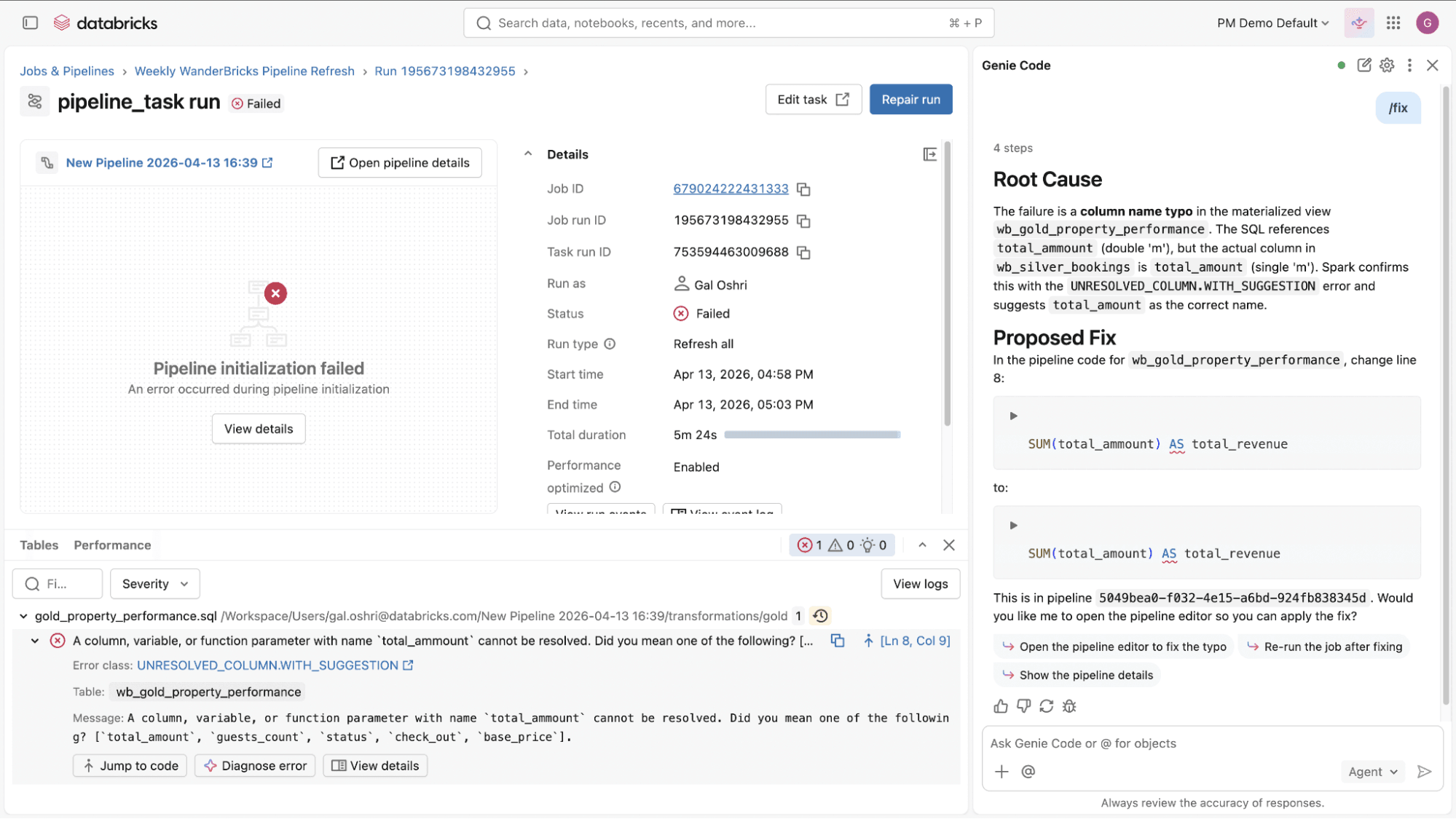
  • Debug and diagnose job and pipeline failures: When a pipeline or job fails, Genie Code helps you work through the issue. It analyzes errors, proposes updates across the relevant files, and shows you the diffs before applying any changes. You can review each update and decide what moves forward. This turns long, manual debug cycles into faster guided iterations.

    Debug Pipelines and Jobs

  • Extend and customize Genie Code: Genie Code is not limited to built-in capabilities. Teams can extend it with custom instructions, agent skills and integrate external systems through MCP servers, allowing Genie Code to operate on domain-specific logic, internal tools, and custom workflows. This ensures Genie Code adapts to your environment and domain knowledge.

What’s next

More capabilities are coming to extend Genie Code across pipelines, jobs, and the broader platform. One exciting feature on the horizon is AI-optimized workloads. In the future, you can allow Genie Code to also run in the background to keep your platform working efficiently, so you can hand off those repetitive and time-consuming tasks. This includes responding to job failures and managing routine upgrades, but also automatically right-sizing cluster use.

Curious to learn more about these updates and best practices? Make sure to register for Data+AI Summit where we have hundreds of sessions covering Genie Code, Lakeflow and much more!

Try Genie Code’s data engineering capabilities

Open Genie Code in agent mode and ask it to help you build or update your pipelines and jobs. Check out the demo for more details .

Review the documentation to learn more.