





Today at Data + AI Summit, we’re announcing Databricks CustomerLake, a new Agentic Customer Data Platform (CDP) natively embedded in Databricks. CustomerLake brings core CDP capabilities, including Customer 360, identity resolution, audience building, campaign automation, activation, and personalization, directly into the lakehouse where customer data, AI models, and governance already reside.
With CustomerLake, marketing and data teams work together on a shared, governed foundation to turn customer data into always-on, 1:1 customer experiences. Instead of relying on manual campaign work and disconnected systems, marketers can deploy agents that continuously analyze behavior, decide, and act, delivering intelligent engagement at enterprise scale without creating new silos, duplicating sensitive data, or adding martech complexity.
Extracting value from customer data remains one of the hardest challenges in marketing. Most enterprises still operate across fragmented identities, stale audiences, and long queues of data requests. Golden customer records can take months to build and unify, and every new martech tool creates another place where sensitive customer data must be copied, secured, and governed.
At the same time, marketing is entering a new era. AI is raising the bar for customer engagement — consumers are beginning to use agents to browse, compare, and make decisions on their behalf in seconds. To keep up, marketers need to engage customers faster, across more channels, and with greater personalization.
For decades, enterprises have invested heavily in customer data infrastructure: data warehouses, data lakes, CDPs, CRMs, marketing automation platforms, identity providers, advertising platforms, and analytics tools. Yet marketers still struggle to answer basic questions quickly:
Which customers are most likely to churn?
Which audience should receive this offer, and in which channel?
Which campaign actually drove incremental impact?
The problem is architecture, not strategy. Existing CDPs help unify customer profiles and activate audiences, but they sit outside of the company’s core Data and AI platform. That creates another system to integrate, govern, and reconcile.
Agentic marketing requires a different foundation. To truly personalize at scale, agents need governed access to customer identity, predictive models, business logic, activation endpoints, and real-time performance signals.
They need context, intelligence, and execution in the same place.
CustomerLake provides that single environment by bringing the CDP into the Databricks lakehouse, unifying governed customer data, AI models, and agents to power always-on, truly 1:1 marketing.
Marketers need to reimagine their entire foundation. Not just the campaigns they run, but also the customers they run them for, which now include agents. With CustomerLake, we're replacing legacy software with an open, Agentic CDP built directly on the Lakehouse. When customer data, AI models, and agents live in one governed platform, marketing stops being a series of campaigns and becomes a continuous loop – agents that constantly analyze, decide, and act on every customer in real time. For the first time, enterprises can deliver true 1:1 experiences at an infinite scale.— Ali Ghodsi, Co-Founder and CEO of Databricks
CustomerLake combines the core capabilities marketers expect from a CDP — including Customer 360, identity resolution, audience building, campaign automation, activation, and personalization — with the governance, scale, and security of the lakehouse.
Because CustomerLake is embedded in Databricks and governed by Unity Catalog, it remains interoperable across the enterprise data estate. Through Lakehouse Federation, teams can access trusted customer data where it resides, whether in Databricks, Snowflake, Google BigQuery, cloud object storage, operational databases, or other enterprise systems.
At the center of CustomerLake are two core agentic capabilities:
CustomerLake brings marketing into the AI era with a new operating model built on three core principles:
CustomerLake is built natively in Databricks, so teams can build and activate customer intelligence on the governed foundation their business already uses, without copying sensitive data into a separate CDP or proprietary application.
That matters because customer engagement depends on more than marketing data alone. A complete customer view spans transactions, behavior, product usage, loyalty, support, commerce, operational signals, and third-party enrichment. In legacy architectures, this context is often incomplete, duplicated, and scattered across systems.
Profile Agents help unify that context into business-ready Customer 360 profiles directly in Databricks. At the core is Agentic Identity Resolution (AIR), a new approach that combines deterministic, probabilistic, and agentic workflows to unify disconnected records into more accurate profiles. Teams can bring existing identity rules, models, and third-party enrichment partners, while Profile Agents help identify edge cases, improve quality over time, and support a continuous feedback loop.
Additionally, for enterprise brands looking to consolidate their martech stack and reduce technology spend, CustomerLake’s specialized, value-aligned consumption model provides a more flexible and cost-effective alternative to traditional software licensing.
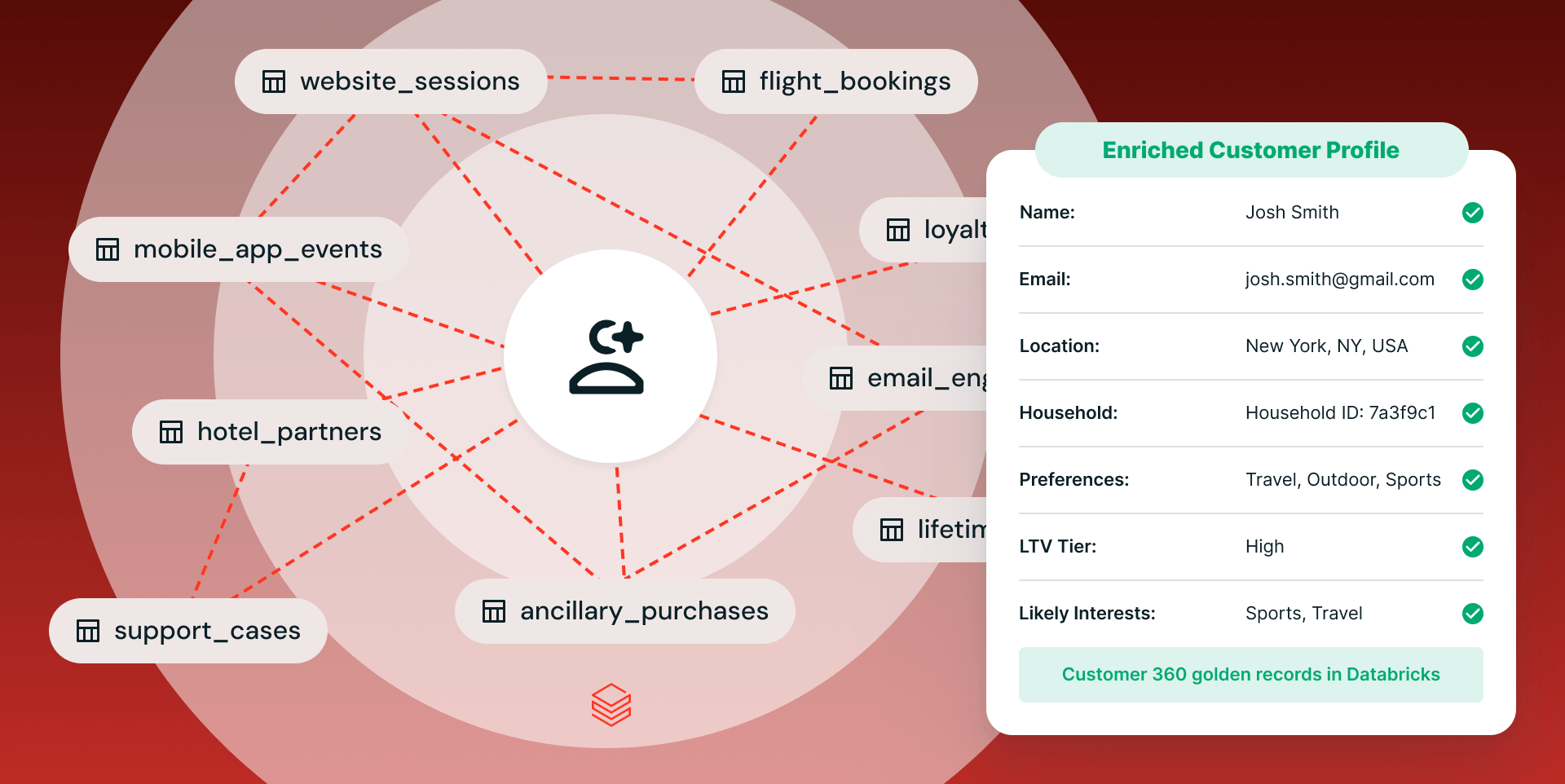
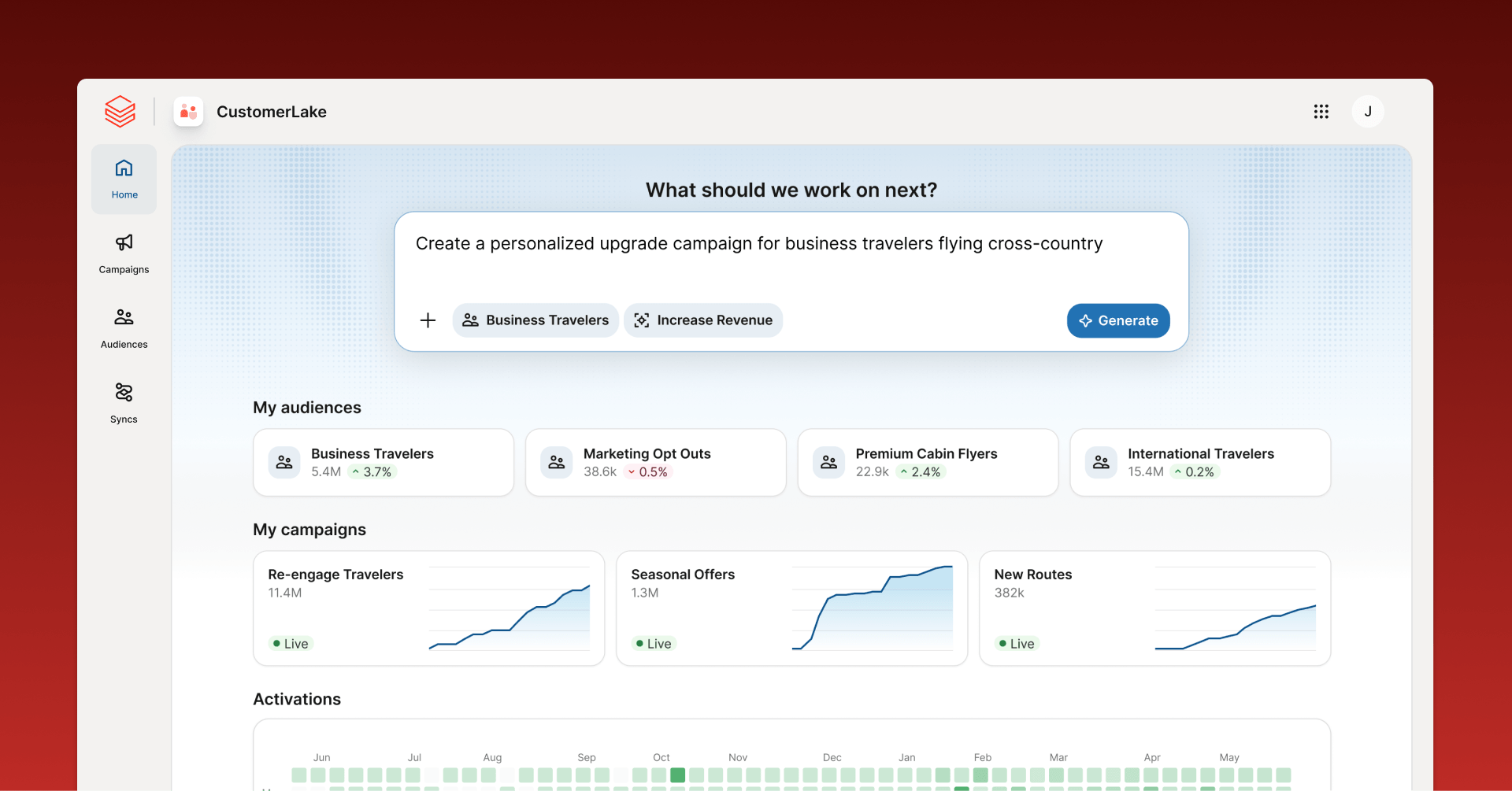
CustomerLake gives marketers agentic interfaces to build audiences, automate campaigns, and personalize experiences using trusted data and models, without waiting on custom data pulls. For data teams, it provides a governed way to serve business use cases while reducing ad hoc requests, redundant pipelines, and fragmented martech infrastructure.
This creates a new collaboration model between marketing and data teams. Data teams can define trusted datasets and models once through Databricks and Unity Catalog. Marketers can then use purpose-built interfaces to ask questions, build segments, and activate audiences faster without working around IT or exporting data into unmanaged tools.
From there, CustomerLake helps marketers turn governed customer context into action. Marketers can leverage agents with full access to the breadth and depth of data in Databricks, including customer attributes, behavioral signals, predictive models, eligibility rules, and operational context, to support segmentation, personalization, and activation across channels.
CustomerLake helps marketers move from static, one-off campaigns to infinity campaigns: continuous, agent-driven engagement loops that analyze customer signals, decide on the next-best action, and act across channels based on real-time customer context and business goals.
Traditional campaigns depend on a series of manual steps: define an objective, request data, build a segment, validate the audience, create a journey, launch to channels, measure performance and repeat. In complex enterprises, that workflow can take weeks or months. It also assumes customers move through fixed paths, when in reality their behavior, needs, eligibility, channel preferences and intent are constantly changing.
CustomerLake reimagines the campaign workflow. Now, marketers start with defining a goal such as increasing revenue, growing loyalty enrollment, or reactivating lapsed customers. Campaign Agents then directly use governed context in Databricks to help identify the right audience, incorporate eligibility or inventory constraints, recommend the next-best offer or channel, activate the campaign across destinations, and optimize or suppress based on performance signals.
Humans still define the strategy, goals, and guardrails. Agents help scale execution, so marketing can operate at the speed of the customer. Instead of launching a campaign once and manually rebuilding it later, marketers can create engagement systems that adapt infinitely as customers and business conditions change.
CustomerLake is built together with the leaders in customer engagement, connecting Databricks to the martech and adtech ecosystem enterprises already rely on. Using native integrations and Reverse ETL, CustomerLake provides bi-directional pipelines to marketing tools, advertising platforms, third-party data providers, identity graphs, and customer engagement channels.
Teams can ingest data from customer engagement systems, enrich and resolve profiles in Databricks, then activate audiences and signals back into the tools marketers use every day. The result is a governed path from customer context to intelligent cross-channel activation.
CustomerLake launches with an open partner ecosystem across identity, activation, measurement and customer experience, including Adobe, Meta (audience and Conversions API), Braze, Acxiom, Epsilon, The Trade Desk, LiveRamp, Iterable, Bloomreach, Snapchat, Magnite, TransUnion, Adstra, Twilio, Integral Ad Science (IAS), and Unity.
CustomerLake is also supported by leading services partners including Accenture, Deloitte, Lovelytics, Slalom, and Stitch, helping enterprises modernize customer data infrastructure, implement high-value marketing use cases, and operationalize governed AI workflows at enterprise scale.
Global enterprises are already building the future of customer engagement on Databricks. From customer intelligence to audience activation and personalization, marketing and data teams are using Databricks as the governed foundation for their most critical customer data. CustomerLake extends that foundation with Agentic CDP capabilities built directly where their customer data, AI models, and business context already live.
At HP, we believe the future of AI-driven customer engagement depends on moving beyond fragmented customer data toward governed customer context. Databricks CustomerLake brings that vision to life, enabling HP to build customer intelligence, personalization, and activation on the data foundation we already trust, rather than creating another place where data must be copied, reconciled, and secured. With CustomerLake, marketing can move faster, operate smarter, and transform with AI using the same trusted customer context as finance, product, sales, and operations.— Kumar Ram, Global Head of Marketing Technology and AI Enablement, HP
At Circle K, our loyalty and marketing teams rely extensively on Databricks to drive customer engagement. CustomerLake is proving to be a major unlock for our architecture because it allows us to build targeted audiences natively in Databricks, activate them seamlessly in Adobe and measure downstream campaign impact without moving our entire data lake into another platform. This gives our teams a faster, more governed path from customer data to campaign execution and fundamentally changes our speed to market.— Jay Malepati, Global Director, Customer and Marketing Data Science, Circle K
At Getnet by Santander, strong merchant relationships are at the core of how we grow. As a global payments business operating across multiple markets, channels, and customer needs, CRM is a strategic growth engine: helping us understand our clients better, engage them more meaningfully, and create more consistent experiences at scale. Databricks CustomerLake will help us advance this ambition by enabling a trusted, actionable Customer 360, bringing together customer intelligence, data, and AI in a governed and interoperable way with our CRM and activation ecosystem. This will empower our business and marketing teams to move faster from insight to action, strengthen customer and merchant relationships, personalize at scale, and build a more connected, data-driven CRM model for the future of Getnet.— Ainhoa Alonso, Chief Data and AI Officer, Getnet By Santander
CustomerLake is now available in Private Preview.
With CustomerLake, Databricks is bringing marketing into the AI era with a new Agentic CDP built directly within the data foundation. By unifying customer data, customer context, and AI agents in one governed platform, CustomerLake helps enterprises move beyond disconnected systems and manual campaigns to always-on, truly 1:1 customer experiences.
To learn more, visit the CustomerLake product page or contact your Databricks account team to discuss how CustomerLake can help your team build the future of AI-native customer engagement.
此内容由惯性聚合(RSS阅读器)自动聚合整理,仅供阅读参考。 原文来自 — 版权归原作者所有。