





惯性聚合 高效追踪和阅读你感兴趣的博客、新闻、科技资讯
阅读原文 在惯性聚合中打开

推荐订阅源

Hugging Face - Blog
Hugging Face - Blog
宝玉的分享
宝玉的分享
G
Google Developers Blog
T
Tailwind CSS Blog
奇客Solidot–传递最新科技情报
奇客Solidot–传递最新科技情报
V
V2EX
V
Visual Studio Blog
博客园 - Franky
S
SegmentFault 最新的问题
Jina AI
Jina AI
爱范儿
爱范儿
The Cloudflare Blog
酷 壳 – CoolShell
酷 壳 – CoolShell
D
DataBreaches.Net
C
Check Point Blog
月光博客
月光博客
P
Proofpoint News Feed
T
The Blog of Author Tim Ferriss
罗磊的独立博客
H
Hackread – Cybersecurity News, Data Breaches, AI and More
MongoDB | Blog
MongoDB | Blog
The GitHub Blog
The GitHub Blog
Y
Y Combinator Blog
Martin Fowler
Martin Fowler

Databricks

Why Talent Transformation Is the Missing Focus of Enterprise AI Public Health Intelligence Shouldn't Require a Data Scientist Mean Time to Detect Is a Data Access Problem First-party audience data is the ad sales relationship now Rethinking Distributed Systems for Serverless Performance and Reliability The AI Scaling Gap Hiding in Digital Native Companies 10 trillion samples a day: Scaling beyond traditional monitoring infra at Databricks AI success starts with clean data, not just better models How nOps Rebuilt Their Cloud Optimization Platform on Databricks Lakebase, and Why Other ISVs Should Too Peril Predicts: Precision Payouts for a Volatile World The foundation of AI scalability: one team, one platform, one operating model The Federal Data Paradox: Rich in Data, Poor in Access Driving Budapest Forward: How BKK Uses Databricks to Transform City Mobility LLM Vs AI: A Practical Guide to Differences, Use Cases, and Tools Model Risk Governance Is Not the Same as Risk Intelligence Generative AI for Business: A Complete Strategy and Implementation Guide Data Science vs Data Engineering: Choosing Analysis or Infrastructure AI Applications: Tools, Use Cases, and Platforms MLOps vs DevOps: A Practical Guide for Data Scientists and IT Teams Top Data Warehouse Tools For Modern Data Analytics Unlocking SAP Business Context in Databricks with Semantic Metadata Delta Sharing The marketing activation gap has a fix: Databricks and Stitch partner to turn data infrastructure into marketing performance Alert Fatigue Is a Business Risk Backstage with Lakebase Shipping Faster isn’t Learning Faster Why Your OEE Dashboard Is Lying to You The Turbine That Tried to Tell You It Was Failing Predicting Readmissions Isn't Enough. Acting in Time Is. Clinical Trials Run Longer Than They Have To. That's a Patient Problem Network Quality Is a Revenue Problem, Not a Technical One
Introducing OpenSharing SecureConnect
Huey Han · 2026-06-17 · via Databricks

Databricks-managed proxy for storage access, eliminating the need for per-recipient networking configuration for sharing

by Huey Han, William Chau and Harish Gaur

OpenSharing makes it simple to share live data across organizations — but when provider storage sits behind a private network, such as for highly sensitive or regulated data sharing, the networking complexity compounds. Providers must manually allowlist each recipient's IP addresses or cloud VPCs/VNets on their storage firewall. Recipients must open egress rules to the provider's storage. Both sides exchange low-level network identifiers manually, over email and Slack. Cloud infrastructure administrators become bottlenecks, and onboarding a single new recipient can take weeks. For providers sharing with dozens or hundreds of recipients, this doesn't scale and forces providers to either compromise on security in favor of simplicity, or move their data out of their own storage to a staging area — neither of which are optimal.

Introducing OpenSharing SecureConnect

OpenSharing SecureConnect is a Databricks-managed proxy that routes storage access on behalf of recipients. The setup is one-time: providers allowlist Databricks's network endpoints on their storage and enable SecureConnect. From that point forward, no per-recipient firewall changes are needed. The data remains in the provider’s storage bucket, with live data sharing directly from the source — without recipients directly connecting to the storage bucket itself. Optionally, data providers can leverage NCC (Network Connectivity Configuration) for private link connectivity between the proxy and provider storage.
 

"The introduction of SecureConnect has allowed us to simplify and harden the serving of data products. Whether our customers are running a governed discovery and access programme or operating a multi-party data exchange, they can move faster and serve their consumers without compromising on control." — Sebastian Drave, Director of Customer Solutions and Innovation, Harbr Data
How it works:

Provider (one-time setup):

  1. Configure storage access: Configure your storage to allow access from Databricks Serverless Data Plane.
  2. Enable SecureConnect: Enable SecureConnect for a metastore. Databricks will then route storage access to SecureConnect for new recipients.

SecureConnect Provider Setup

  1. Optional) Migrate pre-existing recipients: For backward compatibility, pre-existing recipients will continue using direct storage access by default. You can migrate them to SecureConnect individually with a toggle.
  2. (Optional) Private link connectivity to storage: Configure OpenSharing NCC to add private link connectivity between the Databricks-managed proxy and your storage.

 Recipient:

  1. Serverless recipients: Zero configuration — when a data provider enables SecureConnect, storage access from serverless recipients automatically routes through SecureConnect.
  2. Classic and open recipients: Allowlist Databricks's stable inbound IPs, which are publicly available in Databricks documentation.

Key capabilities:

  • One-time setup for data provider regardless of recipient count
  • Minimal configuration for data recipients, including zero configuration for serverless recipients
  • Optional private connectivity to provider storage with NCC
  • Mutual TLS for enhanced security for data recipients
  • Works for data sharing across different regions and clouds 
  • Works with both customer-managed storage and Databricks Default Storage

Hear more from Amadeus at Data + AI Summit 2026 in this session: "OpenSharing SecureConnect: Simplify Network Configuration for External Data Collaboration."

Getting started

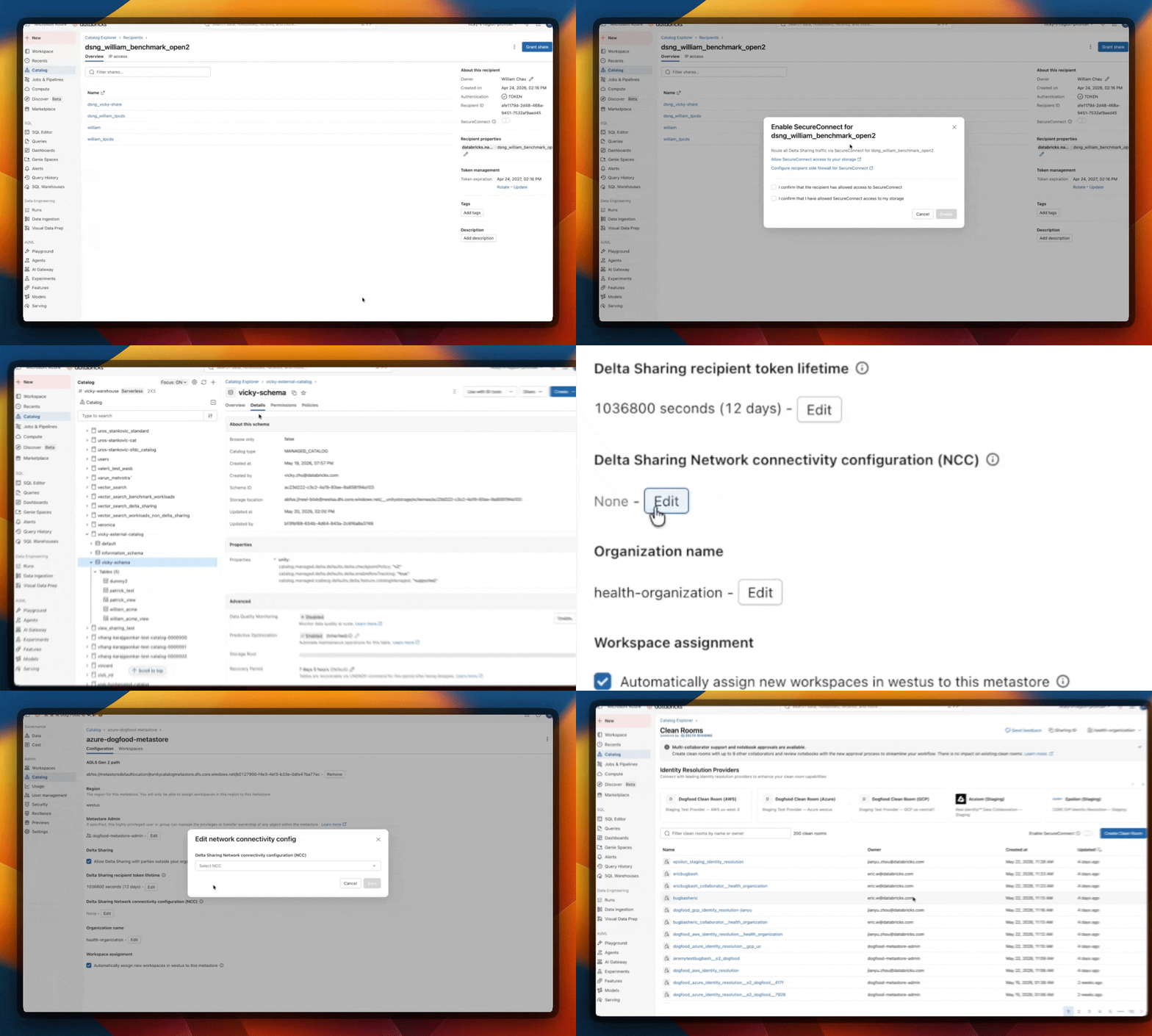
Open Sharing SecureConnect is available in Public Preview. To enable it:

  1. Navigate to your Databricks workspace and open the Open Sharing settings.
  2. Follow the one-time SecureConnect setup.
  3. Share data with recipients — no additional network configuration required.

For full documentation, visit the Open Sharing SecureConnect docs.