

惯性聚合 高效追踪和阅读你感兴趣的博客、新闻、科技资讯
阅读原文 在惯性聚合中打开

推荐订阅源

云风的 BLOG
云风的 BLOG
P
Privacy International News Feed
Vercel News
Vercel News
Threat Intelligence Blog | Flashpoint
博客园 - 叶小钗
F
Fortinet All Blogs
Security Archives - TechRepublic
L
LINUX DO - 最新话题
AWS News Blog
AWS News Blog
Engineering at Meta
Engineering at Meta
Attack and Defense Labs
Recent Announcements
Recent Commits to openclaw:main
PCI Perspectives
PCI Perspectives
Cloudbric
Cloudbric
AI
AI
cs.CL updates on arXiv.org
IT之家
IT之家
Exploit-DB.com RSS Feed
J
Java Code Geeks
M
MIT News - Artificial intelligence
Cisco Talos Blog
Cisco Talos Blog
V2EX - 技术
V2EX - 技术
Webroot Blog
Webroot Blog
Microsoft Security Blog
Cyberwarzone
Cyberwarzone
博客园 - 聂微东
G
Google Developers Blog
W
WeLiveSecurity
罗磊的独立博客
P
Privacy & Cybersecurity Law Blog
阮一峰的网络日志
阮一峰的网络日志
A
About on SuperTechFans
WordPress大学
WordPress大学
The GitHub Blog
The GitHub Blog
T
Tailwind CSS Blog
V
Visual Studio Blog
Application and Cybersecurity Blog
H
Hackread – Cybersecurity News, Data Breaches, AI and More
S
Secure Thoughts
Apple Machine Learning Research
Hugging Face - Blog
Hugging Face - Blog
Google DeepMind News
雷峰网
雷峰网
cs.AI updates on arXiv.org
F
Full Disclosure
Blog — PlanetScale
Blog — PlanetScale
The Last Watchdog
The Last Watchdog
P
Proofpoint News Feed

Databricks

Why Talent Transformation Is the Missing Focus of Enterprise AI Public Health Intelligence Shouldn't Require a Data Scientist Mean Time to Detect Is a Data Access Problem First-party audience data is the ad sales relationship now Rethinking Distributed Systems for Serverless Performance and Reliability The AI Scaling Gap Hiding in Digital Native Companies 10 trillion samples a day: Scaling beyond traditional monitoring infra at Databricks AI success starts with clean data, not just better models How nOps Rebuilt Their Cloud Optimization Platform on Databricks Lakebase, and Why Other ISVs Should Too Peril Predicts: Precision Payouts for a Volatile World The foundation of AI scalability: one team, one platform, one operating model The Federal Data Paradox: Rich in Data, Poor in Access Driving Budapest Forward: How BKK Uses Databricks to Transform City Mobility LLM Vs AI: A Practical Guide to Differences, Use Cases, and Tools Model Risk Governance Is Not the Same as Risk Intelligence Generative AI for Business: A Complete Strategy and Implementation Guide Data Science vs Data Engineering: Choosing Analysis or Infrastructure AI Applications: Tools, Use Cases, and Platforms MLOps vs DevOps: A Practical Guide for Data Scientists and IT Teams Top Data Warehouse Tools For Modern Data Analytics Unlocking SAP Business Context in Databricks with Semantic Metadata Delta Sharing The marketing activation gap has a fix: Databricks and Stitch partner to turn data infrastructure into marketing performance Alert Fatigue Is a Business Risk Backstage with Lakebase Shipping Faster isn’t Learning Faster Why Your OEE Dashboard Is Lying to You The Turbine That Tried to Tell You It Was Failing Predicting Readmissions Isn't Enough. Acting in Time Is. Clinical Trials Run Longer Than They Have To. That's a Patient Problem Network Quality Is a Revenue Problem, Not a Technical One Shelf Availability Starts with Better Demand Visibility When Predicting the Next Hit Requires More Than Intuition Approximate Answers, Exact Decisions: New Sketch Functions for Analytics Companies Winning with AI Built the Data Layer First Rethinking SQL ETL for modern data platforms Stripe data now available on Databricks via Databricks Marketplace Databricks and Stripe Projects: Infrastructure Built for Agents Agents are ready but your architecture probably isn't Interoperability Between Unity Catalog and Google BigQuery via Catalog Federation Built In, Not Bolted On: What AI-Native Actually Means in Cybersecurity Operationalizing AI for public sector fraud prevention From months to minutes: Building real-time clinical data pipelines with natural language Agentic Data Engineering with Genie Code and Lakeflow Securely send first-party conversion signals with Snapchat Conversions API on Databricks Marketplace How leading tech companies are killing the builder’s tax with Lakebase Inside one of the first production deployments of Lakebase: LangGuard's agentic workflow governance engine The next generation of Databricks Genie Model Risk Management in 2026: A Banker’s Guide to the Revised Interagency Guidance OpenAI GPT-5.5 now available on Databricks, fully-governed through Unity AI Gateway Operational databases: How they work and when to use them Databricks partners with OpenAI on GPT-5.5 Announcing the Public Preview of Lakeflow Designer Are LLM agents good at join order optimization? How conversational analytics removes the BI bottleneck How to transform document activation workflows with Genie and Agent Bricks Beyond the spreadsheet: how Databricks is delivering the modern CFO in Financial Services AI App Development: Guide To Building AI-Powered Apps IoT in Manufacturing: Strategy, Components, Use Cases, and Challenges Stop Hand-Coding Change Data Capture Pipelines Multimodal Data Integration: Production Architectures for Healthcare AI Personalization Strategies for Media Companies A Modern AI Risk Management Framework Introducing the Databricks Excel Add-in for Business Users Real-Time Decisioning for AI Agents: Why you Need a Customer Context Layer First A Practical Guide to LLM Fine Tuning AI Data Transformation Guide for Data Engineers and Data Scientists Concurrency Control in DBMS: How Locking, MVCC and Optimistic Strategies Keep Data Consistent Bridging data science and marketing: Databricks unveils Delta Sharing integration for Adobe Experience Platform and agentic marketing workflows Take Control: Customer-Managed Keys for Lakebase Postgres Get hands on with agents, vibe coding and more at Data+ AI Summit Mercedes-Benz Builds a Cross-Cloud Data Mesh with Delta Sharing and Intelligent Replication, Cutting Costs by 66% What Is a Transactional Database? Introducing Genie Agent Mode Governing coding agent sprawl with Unity AI Gateway Governing Coding Agent Sprawl with Unity AI Gateway What is pgvector? Banks Don’t Have an AI Problem – They Have a Data Platform Problem Open Platform, Unified Pipelines: Why dbt on Databricks is Accelerating Why Your Agents Can’t Read Enterprise Documents — and How to Fix It Building with Databricks Document Intelligence and Lakeflow Databricks on Google Cloud: Innovate Faster. Smarter. Together. Introducing the Databricks Connector for Google Sheets: Real-Time, Governed Lakehouse Data in the Sheets Users Love Unity AI Gateway: How to connect agents to external MCPs securely Expanding agent governance with Unity AI Gateway Agentic reasoning in practice: Making sense of structured and unstructured data Agent Bricks: The Governed Enterprise Agent Platform 8 AI and data trends shaping financial services in 2026 Building real-time product search on Databricks Lovable + Databricks: Build Data-Driven Apps at the Speed of Thought Memory scaling for AI agents Powering clinical research innovation: How TriNetX uses Databricks to accelerate drug development Database Branching in Postgres: Git-Style Workflows with Databricks Lakebase How Zalando built a unified data foundation for AI and analytics on Databricks The next era of the open lakehouse: Apache Iceberg™ v3 in Public Preview on Databricks How FSIs eliminate silos between clients, operations, and finance How MakeMyTrip achieved millisecond personalization at scale with Databricks A multi-agent approach to audience intelligence AiChemy: Next-generation agent with MCP, skills and custom data for drug discovery Accelerate business insights with Lakeflow Connect, now with a Free Tier Unlocking Next-Gen Customer Experiences with Data Intelligence for Marketing
Databricks positioned highest in execution and furthest in vision for the second consecutive year in Gartner Magic Quadrant
Craig Wiley · 2026-06-24 · via Databricks

Enterprises are rapidly deploying agentic applications at scale, from back-office micro apps that automate routine tasks to agents that power customer experiences across industries and departments. But general-purpose foundation models, disconnected from enterprise data and lacking centralized governance controls, can't deliver the accuracy, compliance, or business context these agents and applications demand. Equally critical, they introduce risk: uncontrolled model and data access, inconsistent policies, lack of observability, and fragmented audit trails.

We believe Gartner's decision to reclassify this category from "Data Science and Machine Learning" to "AI Platforms for Data Science and Machine Learning" confirms our longstanding view: AI is no longer a peripheral experiment — it's the operating model of the modern enterprise, grounded in business context.
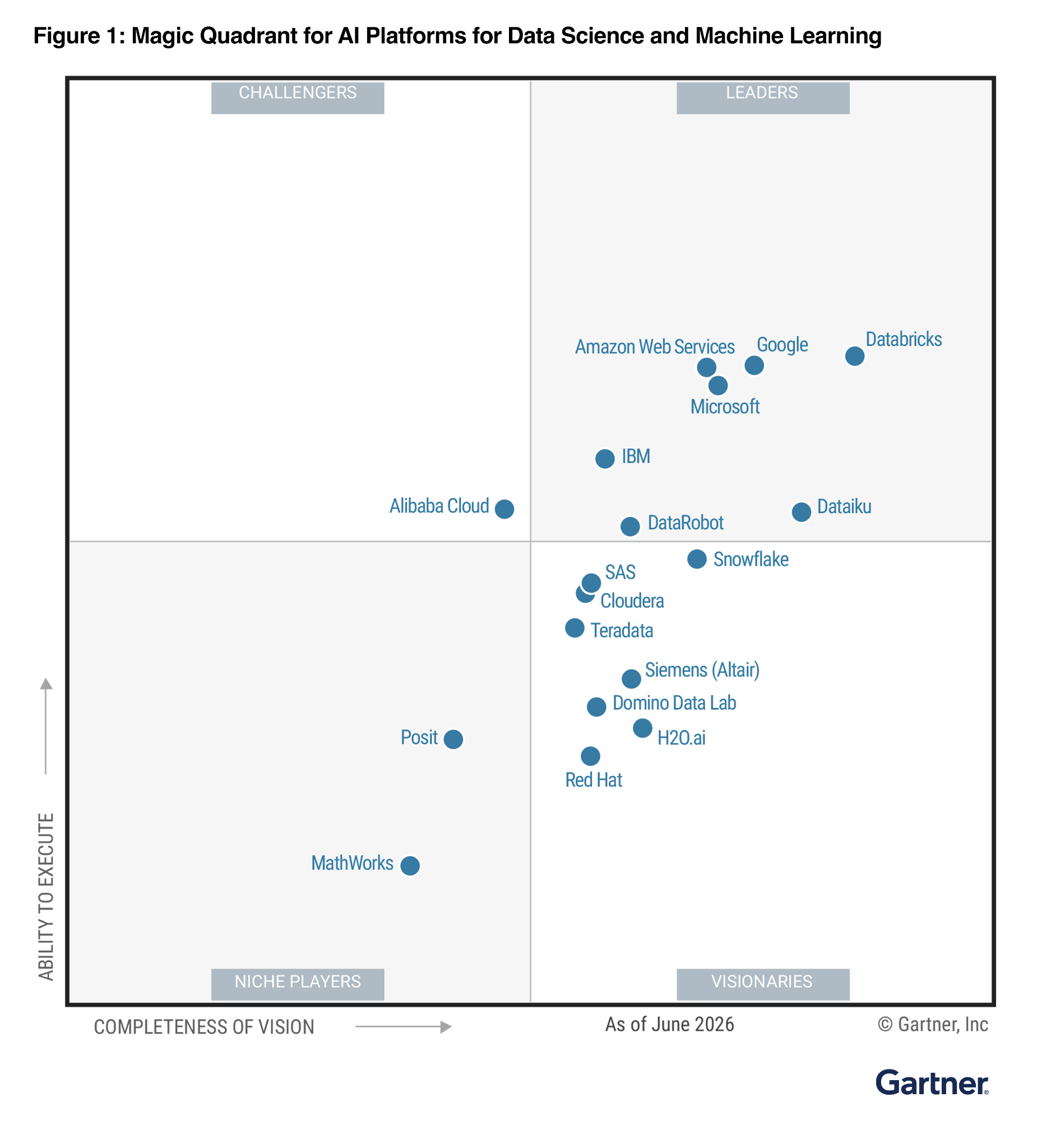
image1.png

Download a complimentary copy of the report here

The strategy: build, orchestrate, and govern agentic applications on a unified platform

We believe our position as a Leader in this category is rooted in a singular philosophy: you cannot have an AI strategy without a data strategy — and you cannot scale either without a governance strategy. While many vendors stitch together separate products for data, models, agents, and governance, Databricks delivers one unified platform.

That means one copy of your data, one governance layer across data and AI, and one consistent way to build, monitor, and control agents in production. By unifying the lakehouse, Lakebase, Agent Bricks, and Unity Catalog, we give every team, from developers to business users, a single place to turn enterprise data into trusted, compliant, production-grade agents and applications. With Unity AI Gateway, organizations gain centralized policy enforcement, model access controls, usage tracking, cost management, and real-time guardrails across every request and response.

Core innovations for the agentic era

1. Agentic AI that reasons on your data

Agents are only as useful as the data and context they can reason over. With Agent Bricks, teams build production-ready custom agents that are automatically optimized for cost and quality, grounded in governed enterprise data in the Databricks lakehouse and backed by Lakebase, our serverless, Postgres-compatible operational store for agent state and applications. Agents retrieve the right information, interpret business semantics consistently, and act with the accuracy and reliability enterprises require. YipitData used this approach to scale unstructured data intelligence, achieving a 20x increase in company coverage and 92–95% tagging accuracy out of the box.

Business users can get trusted insights and take agentic actions through Databricks Genie One and Genie Agents, powered by Genie Ontology which provides business context, grounded in your data. easyJet is using this flexibility to reimagine airline retailing on top of Lakebase, Agent Bricks, and Apps.

2. Open and flexible by design

Builders need the freedom to move fast without getting locked in. Databricks natively serves every frontier model (OpenAI, Anthropic, Google) and leading open source models (Meta, Qwen, DeepSeek, etc.), so teams can swap models without renegotiating contracts or rewriting applications. Developers vibe code with their preferred AI coding agents such as Cursor or Replit, as well as the new meta-harness Omnigent. They can connect to governed lakebases, and ship agentic apps in days with Databricks Apps.

3. Unified governance across data, models, agents, and apps

Innovation without governance doesn't scale. Unity Catalog and Unity AI Gateway provide end-to-end governance across every data asset, model, agent, MCP server, app, and tool hosted on Databricks and externally — in a single system of record. End-to-end permissions ensure nothing accesses more than it is allowed to, whether it's a frontier model or an autonomous agent embedded in a customer-facing app. Block uses Unity Catalog to unify its AI and data estate across business units, and Novo Nordisk has attributed $157M+ in net new value to governed, AI-driven clinical trial optimization.

What's next

We believe this recognition validates what we see playing out across every industry: the gap is widening between unified, governed Data and AI platforms and the fragmented stacks that slowed the first wave of enterprise AI. As agentic applications move from experiment to business-critical, they require unified data, AI, and governance. We invite you to join us on this journey as we continue to transform how the world builds, governs, and scales intelligence.

[Read the full 2026 Gartner® Magic Quadrant™ for Data Science and AI Platforms report]

Gartner, Magic Quadrant for AI Platforms Data Science and Machine Learning Platforms, Yogesh Bhatt, Afraz Jaffri, Diarmuid Curran, June 22, 2026.

GARTNER is a registered trademark and service mark of Gartner, Inc. and/or its affiliates in the U.S. and internationally, and MAGIC QUADRANT is a registered trademark of Gartner, Inc. and/or its affiliates and are used herein with permission. All rights reserved.

Gartner does not endorse any vendor, product or service depicted in its research publications, and does not advise technology users to select only those vendors with the highest ratings or other designation. Gartner research publications consist of the opinions of Gartner’s research organization and should not be construed as statements of fact. Gartner disclaims all warranties, expressed or implied, with respect to this research, including any warranties of merchantability or fitness for a particular purpose.

This graphic was published by Gartner, Inc. as part of a larger research document and should be evaluated in the context of the entire document. The Gartner document is available upon request from Databricks.