




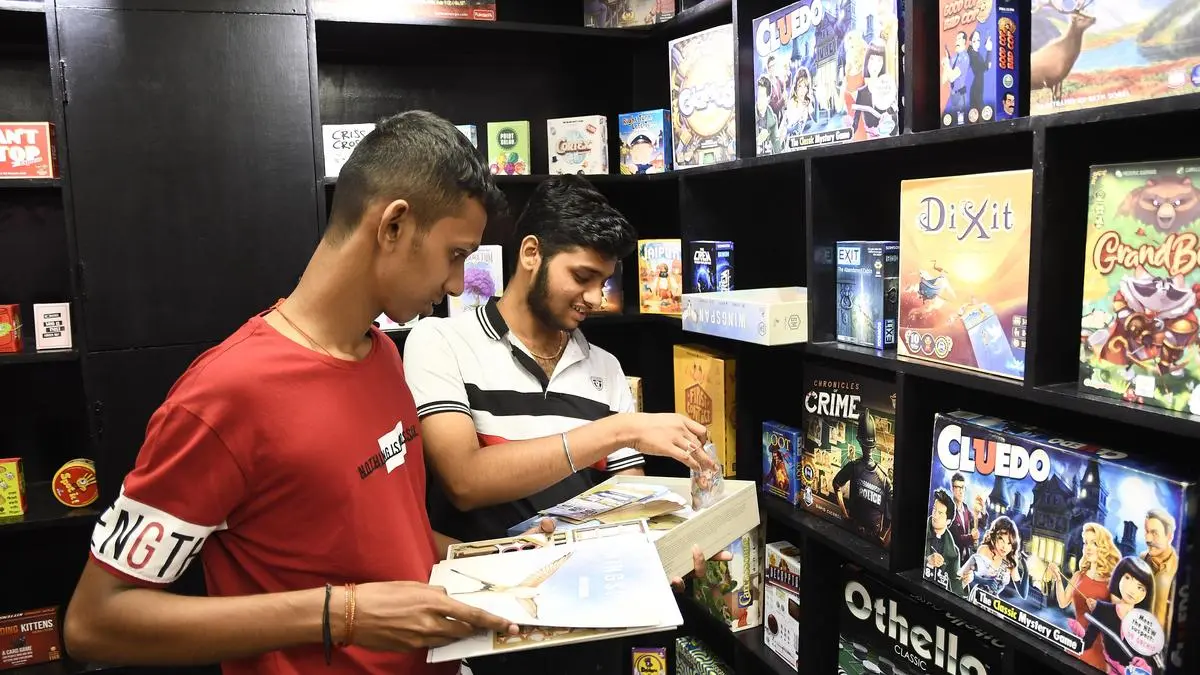
GATHER AROUND. Board games have their digital-native fans | Photo Credit: VELANKANNI RAJ B
Earlier this month, I was speaking to a young man in his 20s about his interests outside work. He told me that the pastime that mattered most to him was playing board games. This surprised me because he is a digitally savvy, AI-native sort of guy. And yet, on weekends he heads to a board games cafe.
I asked him why, and this was his reply: “When I play board games, which require strategic thinking, I am doing something productive. Also, I am engaging with other people and friends. We keep chatting as we play.”
Let me talk about another interaction that surprised me. One Saturday evening, I was walking on a busy road in Bengaluru when two young women stopped to say ‘hello’. They knew me from a lecture I had delivered recently. I asked them what they were doing in that part of town.
One of them replied, “We have just attended a meeting of our book club.” Two young women, Saturday evening, and a book club? Why, I wanted to know. “When we discuss a new book together, we get so many nice thoughts and ideas. We feel much better too. And we also get to know so many more people!” she replied.
Both these encounters set me thinking. Our cities have many digital gaming parlours. We have apps that can stream into our bedrooms all the shows we may want to see. We have social media platforms with limitless content. And yet, it is the likes of board games and book clubs that are becoming sexy once again, especially to a sizeable segment of 20-somethings. Clearly, the times they are a-changin’.
I explored further and discovered other popular Gen-Z hobbies across India. These include running-and-breakfast clubs, supper clubs, which are also described as social mixers, baking cakes, and crafts such as embroidery and knitting. Some of these are pastimes we associate with our grandmothers, but they are back with a vengeance, trending among youngsters!
What are the fundamental reasons underlying this phenomenon? Here is my initial hypothesis.
Young people (and older too) are confronted with digital screens everywhere — mobile phones, laptop computers, connected televisions, et al. They are also drawn into endless and addictive doomscrolling on social media. Among many Gen-Zers, there is a strong urge to break away from digital addiction. Pastimes such as knitting or baking, which occupy many hours at a time, are a good way to keep mobile phones aside for long durations.
There is a strong desire among youngsters to connect with real people. Social media mostly offers superficial connection on the back of likes and comments, and overuse tends to make one lonely and depressed. For a generation that has grown up in this digi-gloomy environment, pastimes that involve sitting together with other people and talking to each other, such as book clubs or board games, offer great human connection. In fact, you meet not just friends but also other people at these places, which can potentially pave the way for new friendships.
Board games of strategy can develop your intellect. Reading a good book and talking about it in a book club leads to a sense of fulfilment. Baking a lovely cake or knitting a nice sweater can bring about a feeling of accomplishment. All these pastimes provide a sense of purpose to youngsters, and make them happy. Contrast this with doomscrolling or passive viewing of digital shows, which may provide momentary entertainment but rarely any sustained purpose.
Many of these pastimes progress slowly and are not instantaneous. They require incredible focus. For instance, knitting a sweater may take days. Even a board game can take a few hours to play out. Many youngsters see these as useful counterpoints to a world full of distractions. They feel good when they can focus, and these pastimes help them do so quite naturally. Think of them as almost meditative in their appeal.
I expect that, over the next few years, we will see many more new products and services catering to these fundamental needs. Digital natives, such as Gen-Z, will be the core audience. But I suspect that these offerings will cater to many of us in the earlier generations too.
(With inputs from Piyush Rai, a young professional)
(Harish Bhat is an avid marketer and bestselling author)
Published on May 4, 2026
此内容由惯性聚合(RSS阅读器)自动聚合整理,仅供阅读参考。 原文来自 — 版权归原作者所有。