




惯性聚合 高效追踪和阅读你感兴趣的博客、新闻、科技资讯
阅读原文 在惯性聚合中打开

推荐订阅源

J
Java Code Geeks
Martin Fowler
Martin Fowler
MongoDB | Blog
MongoDB | Blog
博客园 - Franky
Cyber Security Advisories - MS-ISAC
Microsoft Security Blog
H
Hackread – Cybersecurity News, Data Breaches, AI and More
博客园_首页
腾讯CDC
D
Docker
The Cloudflare Blog
量子位
爱范儿
爱范儿
L
LangChain Blog
博客园 - 三生石上(FineUI控件)
博客园 - 司徒正美
aimingoo的专栏
aimingoo的专栏
Blog — PlanetScale
Blog — PlanetScale
Jina AI
Jina AI
Apple Machine Learning Research
Hugging Face - Blog
Hugging Face - Blog
博客园 - 聂微东
Vercel News
Vercel News
MyScale Blog
MyScale Blog

Hackread – Cybersecurity News, Data Breaches, AI and More

Operation Endgame Disrupts StealC, Amadey and SocGholish Malware Networks New GhostShell Hacking Group Targets Ukraine’s Drone Defense Sector Best Crypto Payment Solutions for E-Commerce Businesses Internet Society Foundation Opens Global Call for Common Good Cyber Fund to Strengthen Cybersecurity LastPass Confirms Customer Data Breach After Klue OAuth Token Theft ‘Cordyceps’ CI/CD Flaw Exposes Microsoft, Google, Apache Repos to Pipeline Hijacking The Rise of AI-Powered Academic Fraud: Beyond Traditional Plagiarism New CryptoBandits Malware Uses USB Drives and Tor to Steal Crypto The Evolution of iGaming Fraud: What Security Teams Should Expect in 2027 2 Scattered Spider-Linked Hackers Plead Guilty Over £39M TfL Cyberattack Beats Studio Buds Flaw Could Let Nearby Attackers Eavesdrop on Users Texas Parks and Wildlife Data Breach Affects Over 3M License Customers Threat Hunting Beyond Alerts: Finding the Activity Detection Misses Scammers Use Fake GitHub Stars, VirusTotal Reviews to Spread Crypto Clipper Salesforce Disables Klue Integration After OAuth Token Theft Hits Customer Data MDR Provider Comparison: Time to Discover and Respond to Threats Meteor 3.0 Migration Helped Rocket.Chat Move Off End-of-Life Node.js Runtime Gcore Helps Ucom Safeguard Public Live Broadcast Infrastructure During Armenia’s Parliamentary Elections Nintendo America Employee Data Exposed After Shadowbyt3$ Targets TinyPulse eFAQ Publishes Investigation Into Alleged Scam Activity and Coordinated Reputation Attacks FIFA World Cup 2026: Hackers Target Football Fans With Fake Tickets Sites MacBook Neo vs Windows Laptops for Cybersecurity Tasks Operation Endgame Disrupts SocGholish Malware Infrastructure What Businesses Should Know Before Migrating Their CMS DragonForce Ransomware Abused Microsoft Teams to Hide Malware Activity Agentjacking: Researchers Show How One Fake Bug Report Can Hijack AI Coding Agents FortiBleed Attack Exposes Fortinet Firewall Credentials in 194 Countries SpyCloud Report Finds Phishing Attacks Surge as Employee Data Is Exposed at 86% of Fortune 100 Companies 152 Chrome Live Wallpaper Extensions Hid Ad Tracking and Fake Search Clicks Heimdal Survey: Executives Four Times More Confident About AI Risk Than the Teams Managing It
Fake npm Packages Impersonate PostCSS Tool to Steal Chrom...
Deeba Ahmed · 2026-06-24 · via Hackread – Cybersecurity News, Data Breaches, AI and More

Cybersecurity research firm JFrog reveals a new technique in its latest report that cybercriminals are using to target software developers, tricking them into downloading remote access trojans (RATs). This operation relies on an attack method called package impersonation, in which malicious packages are uploaded as trusted utilities to attract developers.

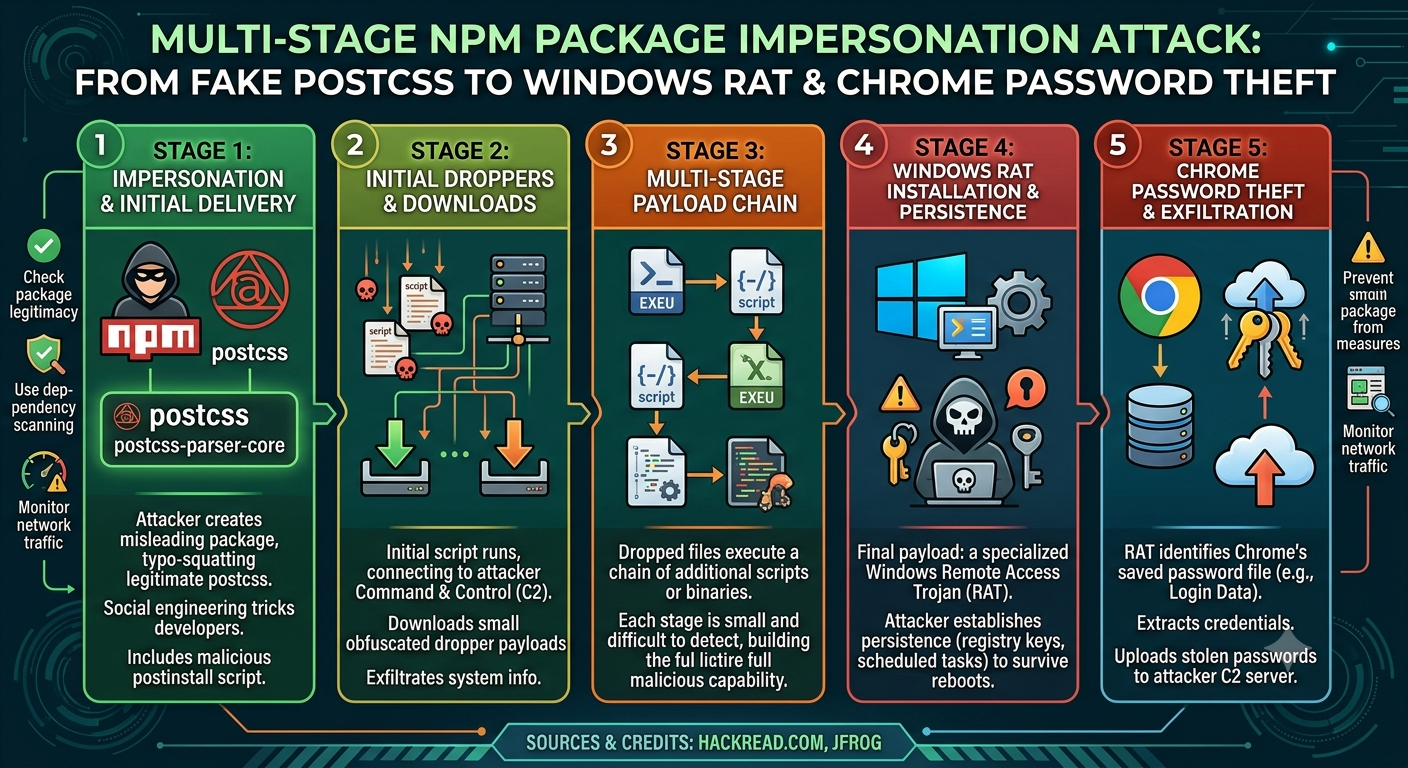
According to JFrog’s investigation, attackers have uploaded three connected malicious packages onto the npm registry to get developers to install them by mistake. The primary fake package is named postcss-minify-selector-parser. It looks almost identical to postcss-selector-parser, a highly popular legitimate utility with over 150 million weekly downloads.

Because the fake tool shares similar keywords and lists the genuine package as a dependency, it easily bypasses basic code reviews. JFrog found that an npm user named abdrizak published this code along with two other interconnected packages: postcss-minify-selector and aes-decode-runner-pro.

The Multi-Stage Infection

When a developer imports the fake package, the code immediately reads an encrypted text block inside a defaults file rather than running normal parsing functions. The package decodes this block using AES-256-GCM decryption, which runs a JavaScript dropper that saves and executes a PowerShell script named settings.ps1.

This PowerShell script downloads a file from nvidiadriver.net, a domain built to look like an official graphics driver site. The downloaded ZIP archive, disguised as a Windows patch, unpacks inside the local temporary directory.

A VBScript file named update.vbs then boots up a hidden Python environment and runs compiled extension modules like audiodriver.pyd and command.pyd, and this launches a Remote Access Trojan (RAT), which then connects to a C2 server.
Fake npm Packages Impersonate PostCSS Tool to Steal Chrome Passwords

Stealing Saved Data

The Trojan sets up permanent access on the computer via the Windows Registry run key under HKCU\Software\Microsoft\Windows\CurrentVersion\Run. It checks if it is running inside a virtual machine setup to evade security analysts, executes background shell commands, and handles direct file transfers.

The primary target of the attack is Google Chrome. A module named auto.pyd searches for saved login databases and Chrome profile paths. It contains specific functions to bypass newer Chrome app-bound encryption rules to extract stored usernames and passwords directly.

JFrog recommends that developers remove these three packages, search their system temporary folders for files named winPatch, .store, or .host, and change all passwords stored in their web browsers.

“This case shows how a small parser-like package can hide a multi-stage Windows payload while appearing related to legitimate build tooling with massive weekly usage. For defenders, the important lesson is to treat lookalike build dependencies as potential delivery mechanisms, not just harmless naming noise,” researchers conclude.