






sklearn.datasets.make_classificationsklearn.datasets.make_classification(n_samples=100, n_features=20, *, n_informative=2, n_redundant=2, n_repeated=0, n_classes=2, n_clusters_per_class=2, weights=None, flip_y=0.01, class_sep=1.0, hypercube=True, shift=0.0, scale=1.0, shuffle=True, random_state=None)
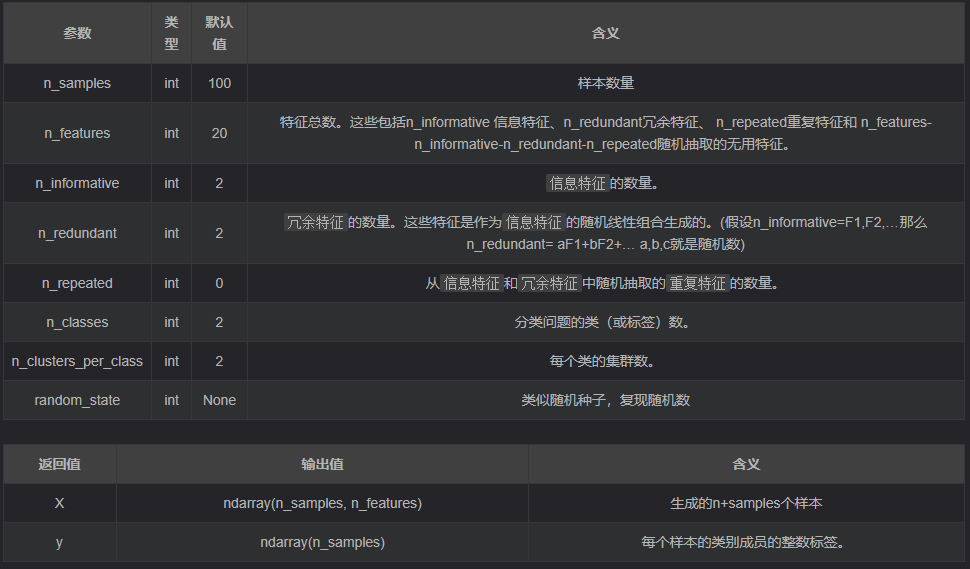
生成一个随机的 n nn 类分类问题。
在不打乱的情况下,X按以下顺序水平堆叠特征:主要n_informative特征,然后n_redundant 是信息特征的线性组合,然后是n_repeated 重复,随机抽取信息和冗余特征的替换。其余特征充满随机噪声。因此,无需改组,所有有用的特征都包含在列中 。X[:, :n_informative + n_redundant + n_repeated]
from sklearn.datasets import make_classification

X, y = make_classification(n_samples=6, n_classes=2, n_features=5, n_informative=5,n_redundant=0,n_clusters_per_class=1)
display(X,y)

"""
n_samples=6 - 6行6个数据
n_classes=2 - 结果分为2类即二分类
n_features=5 - 5个特征
n_informative=5 - 5个全部有效的特征
n_redundant=0 - 冗余特征为0
n_clusters_per_class=1 - 每一个类别聚为一个簇

array([[ 1.10885456, -1.97464085,  2.14372944, -0.08241471, -2.60173628],
       [ 0.98456921, -4.67257395, -0.10161149,  0.52329866,  2.0178222 ],
       [-2.92441307, -2.20249011,  0.12827954,  1.90711152,  0.24340137],
       [ 0.14524134, -1.42685331,  1.92731161, -0.72915701,  1.3529692 ],
       [-0.09694719, -0.28604481, -2.62609999, -0.46131174,  0.72515074],
       [ 0.25540393, -2.64589841, -2.05721611,  0.53203936,  0.34273113]])

array([0, 1, 1, 0, 1, 0])
"""
同时参考这链接中的不平衡数据部分,以及代码部分的crossvalidate()
from sklearn.ensemble import RandomForestClassifier
from sklearn.model_selection import cross_validate

classifier = RandomForestClassifier()

scores = cross_validate(
    classifier, X, y, cv=10,
    scoring=['accuracy', 'precision', 'recall', 'f1','r2', 'neg_mean_squared_error']
)

scores = pd.DataFrame(scores)
scores.mean()

#output
fit_time                       0.296672
score_time                     0.011580
test_accuracy                  0.911000
test_precision                 0.920261
test_recall                    0.904000
test_f1                        0.910236
test_r2                        0.644000
test_neg_mean_squared_error   -0.089000
dtype: float64
此内容由惯性聚合(RSS阅读器)自动聚合整理,仅供阅读参考。 原文来自 — 版权归原作者所有。