





Sign up to see the future, today
Can’t-miss innovations from the bleeding edge of science and tech
Prevailing models of physics dictate that when an extremely massive star runs out of nuclear fuel, it collapses in on itself, leaving behind a black hole that prevents anything, even light, from escaping.
Or maybe not, a pair of physicists are proposing. Instead, Goethe University physics researchers Daniel Jampolski and Luciano Rezzolla suggest in a new study published in the journal Physical Review D, the demise of a large star can lead to something even stranger: a tiny, nascent universe that’s loaded with dark energy pushing outward, preventing the star from collapsing entirely.
“The Big Bang of the emerging universe can unfold once the star has already collapsed almost to the point of becoming a black hole,” explained Jampolski in a statement about the paper.
It’s a mind-bending theory that builds out an alternative path for gigantic dying stars. Instead of crumpling up into black hole of infinite density, the idea is that the star collapses almost all the way — but then reaches equilibrium as its dark energy pushes back against the final stage of collapse, like a brick preventing a garage door from shutting entirely.
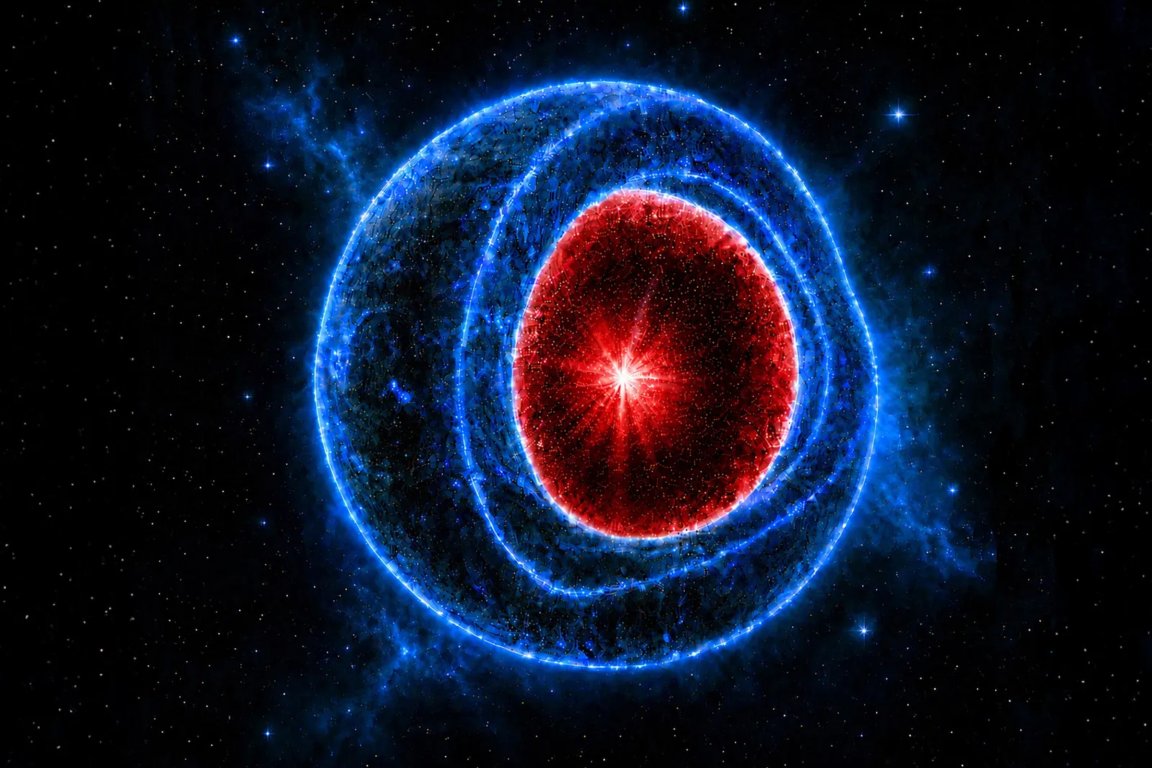
Specifically, the new universe would exist at the core of a previously proposed class of objects called “gravastars,” which were already understood to contain a core made up of dark energy, the hypothetical cosmic force that scientists estimate accounts for around 68 percent of the total energy-mass content of the known universe.
The conditions as a gravastar comes into being, Jampolsi and Rezzolla suggest, are not unlike the ones present during the Big Bang, the moment at which our own universe seemingly sprang into existence billions of years ago.
The force from the dark energy would provides enough outward pressure to stabilize the gravastar, according to their model, stopping it from further collapsing. With sufficient dark energy, these gravitational forces can be equalized, resulting in a stable gravastar. This same type of outward pressure drives our own universe’s expansion, according to current models.
The researchers stressed that their theory surrounding the formation of stable gravastars doesn’t necessarily refute the existence of black holes completely.
“Looking for alternatives to black holes should not suggest a skepticism towards black holes, which still represent the most natural and simplest solution to the fate of gravitational collapse,” Rezzolla argued in the statement.
“However, as scientists in general, and as theoretical physicists in particular, it is essential to maintain an unbiased approach towards what we do not know and hence explore both the accepted wisdom and the more exotic interpretations,” he added. “History teaches us that it is not unusual for the latter to become the former.”
More on black holes: Scientists Discover Fearsome Wind That Destroys Entire Galaxies