










Sign up to see the future, today
Can’t-miss innovations from the bleeding edge of science and tech
Spending prolonged periods of time in the microgravity of space can wreak havoc on our bodies. Scientists have found that astronauts can suffer from everything from accelerated bone loss and spinal health issues to swelling of the optical nerve that results in blurry vision. Some studies have even found space can alter astronauts’ DNA in ways that are still largely unknown.
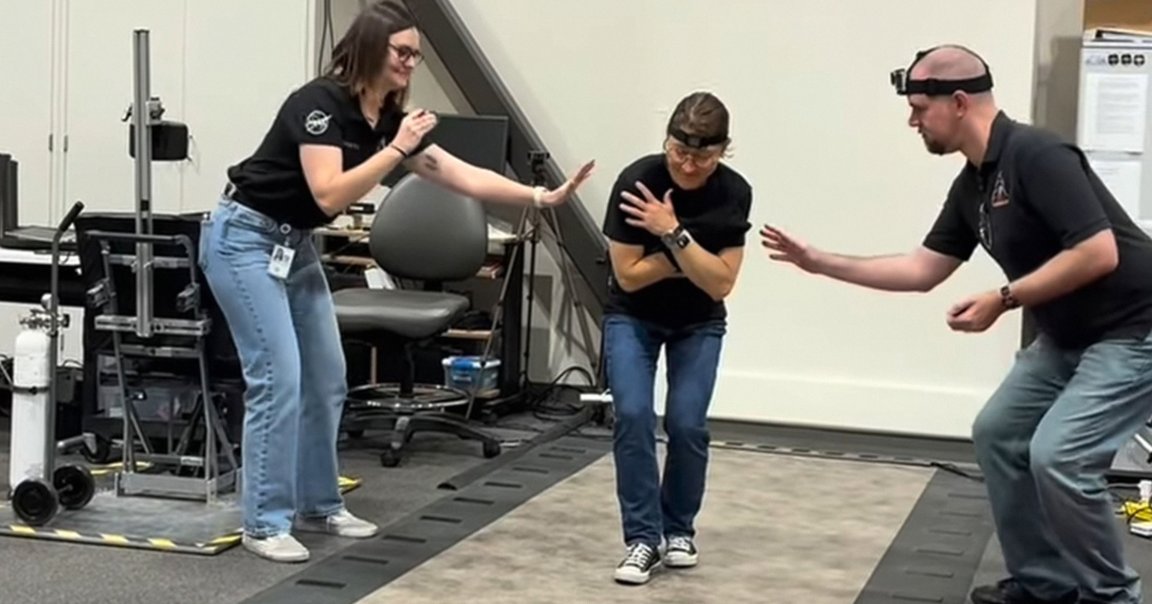
At a high level, returning to our home planet can also throw space travelers’ sense of balance completely out of whack. As NASA astronaut Christina Koch — who traveled around the Moon and back alongside her fellow crew members earlier this month — demonstrated in a recent video, getting used to Earth’s gravity again isn’t exactly easy.
The clip she shared on Instagram roughly a week after splashing down in the Pacific Ocean shows her visibly struggling to put one front in front of the other while her eyes are closed.
“Guess I’ll be waiting a minute to surf again,” she wrote in the caption.
Her stumbling is the result of the brain no longer being able to rely on the vestibular system within the inner ear for knowing which way is up and which is down. In other words, Koch likely would’ve fared much better with her eyes open.
“When people live in microgravity, the systems in our body that have evolved to tell our brains how we’re moving, the vestibular organs, don’t work correctly,” Koch explained. “Our brains learn to ignore those signals and so when we first get back to gravity, we are heavily reliant on our eyes to orient ourselves visually.”
“A tandem walk with eyes closed can be quite the challenge!” she admitted. “Learning about this can help inform how we treat vertigo, concussions and other neuro-vestibular conditions on Earth.”
Koch is no stranger to spending prolonged periods of time in space. While this month’s Artemis 2 mission took place over just ten days, the NASA astronaut has previously spent almost a year on board the International Space Station.
While astronauts spend significant portions of their time in space exercising to stave off the detrimental effects microgravity has on their physical health, we have yet to find an effective way to help them restore their sense of balance once they’re Earthside — other than Father Time, that is.
“With eyes closed, it was almost impossible to walk in a straight line,” European Space Agency astronaut Andreas Mogensen told NASA after his journey to the ISS last year.
“I felt wobbly for the first two days,” added fellow crew member NASA astronaut Jasmin Moghbeli. “My neck was very tired from holding up my head.”
In short, stumbling over your own two feet with your eyes closed seems like a small price to pay considering Koch’s spectacular journey around the Moon, which provided some genuinely breathtaking views.
More on Artemis 2: Guess What This Creepy Underwater Thing Is That Was Photographed by US Navy Divers for NASA