









Sign up to see the future, today
Can’t-miss innovations from the bleeding edge of science and tech
It may look like the underwater remains of a church that’s been submerged for hundreds of years following a dam break, or a tunnel boring machine that just broke through a mound of rubble.
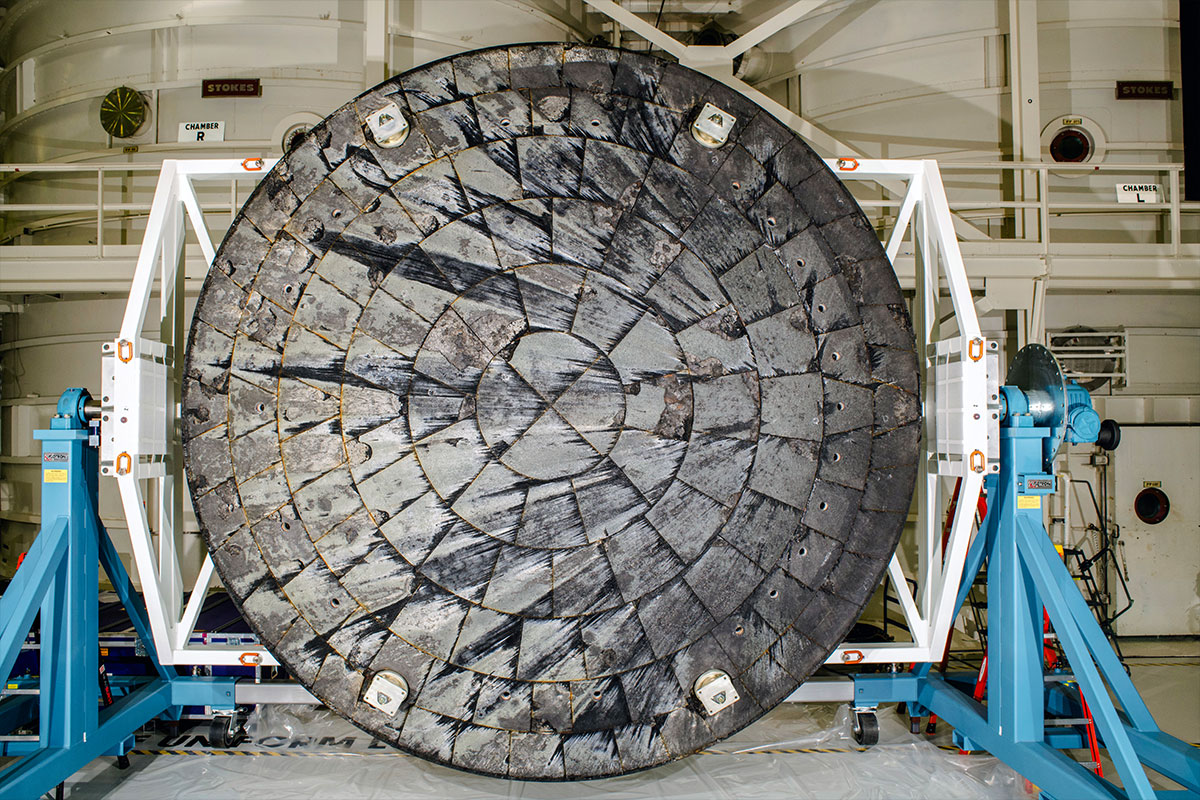
But if those were your guesses, you’d be sorely mistaken. An intriguing photo taken by US Navy divers and shared by NASA on Monday shows the charred heat shield of the space agency’s Artemis 2 Orion capsule, right after it took a plunge in the Pacific Ocean upon landing on April 10.
While the subsequent post flight analysis may drag on for quite some time, it’s an intriguing first glimpse at one of the more controversial aspects of NASA’s triumphant crewed return to the Moon. The tiled heat shield is designed to keep astronauts safe as their spacecraft slams into the Earth’s atmosphere at over 23,000 mph, a maneuver that causes it to heat up to thousands of degrees Fahrenheit.

During NASA’s inaugural 2022 Artemis 1 mission, which saw the Orion spacecraft travel around the Moon and back without a crew on board, the heat shield endured major damage upon reentry, including cracking and pieces of charred remains breaking off.
For comparison, the photo embedded below shows the significant damage the heat shield received following the Artemis 1 mission in 2022.
Ahead of the mission’s launch, several experts warned that flying the same design, albeit with an adjusted trajectory to minimize the amount of heat build-up, could put the crew of the Artemis 2 mission in danger. (The Artemis 2 heat shield was installed on the Orion capsule even before NASA launched Artemis 1.)
However, early impressions suggest the heat shield appears to have done a tremendous job in keeping the four astronauts safe this month. In other words, NASA’s plans to adjust the reentry path may have paid off, which bodes well for future Artemis missions, including Artemis 4, the first planned mission to the lunar surface, tentatively scheduled for 2028.
According to NASA, “the crew and spacecraft were safeguarded by Orion’s thermal protection system as they traveled nearly 35 times the speed of sound during reentry.”
“Initial inspections of the system found it performed as expected, with no unusual conditions identified,” the agency noted. “Diver imagery of the spacecraft’s heat shield initially taken after splashdown and further inspections on the recovery ship found the char loss behavior observed on Artemis I was significantly reduced, both in terms of quantity and size.”
Even reflective tape, designed to control vehicle temperatures in space, survived reentry in “numerous locations,” NASA noted.
The entire crew module will be returned to NASA’s Kennedy Space Center before the end of the month for “additional examination of the heat shield.” It will then be taken to the Marshall Space Flight Center for further testing, including “sample extraction and internal x-ray scans.”
Beyond the heat shield, NASA also noted that it would be carefully examining the capsule’s space toilet — which turned out to be a major pain point throughout the astronauts’ ten-day adventure around the Moon after frozen urine clogged up the commode’s vent lines.
“Teams will work to identify root cause and initiate corrective action for Artemis 3,” NASA vowed.
More on the heat shield: Space Scientists Wince as Astronauts’ Lives Depend on Artemis 2’s Controversial Heat Shield During Plunge Back to Earth