

惯性聚合 高效追踪和阅读你感兴趣的博客、新闻、科技资讯
阅读原文 在惯性聚合中打开

推荐订阅源

Last Week in AI
Last Week in AI
D
DataBreaches.Net
腾讯CDC
Recent Announcements
有赞技术团队
有赞技术团队
A
About on SuperTechFans
Cyber Security Advisories - MS-ISAC
Google DeepMind News
Microsoft Security Blog
云风的 BLOG
云风的 BLOG
罗磊的独立博客
月光博客
月光博客
MyScale Blog
MyScale Blog
U
Unit 42
Martin Fowler
Martin Fowler
Stack Overflow Blog
Stack Overflow Blog
T
Tailwind CSS Blog
Engineering at Meta
Engineering at Meta
N
Netflix TechBlog - Medium
G
Google Developers Blog
博客园 - 【当耐特】
D
Docker
I
InfoQ
雷峰网
雷峰网

Futurism

SpaceX Stock Has Officially Fallen All the Way Down to the Low $170s SpaceX Stock Had Quite a Bad Night Wall Street Terrified That SpaceX Investors Will Dump Their Stocks SpaceX Stock Now in Rapid Decline SpaceX Stock Has Now Started to Fall Scientists Propose That Entire Universes Can Form Inside Collapsing Stars NASA Loads Moon Rocket onto Giant Trump-Branded Train Eighty Residents Sue SpaceX, Saying Elon Musk’s Constant Rocket Launches Are Literally Destroying Their Homes SpaceX’s IPO Shows That We Aren’t Even Close to Peak AI Bubble The More Data We See About SpaceX’s IPO, the More We’re Wincing Scientists Discover Fearsome Wind That Destroys Entire Galaxies NASA’s Next Moon Mission Is a Rube Goldberg Machine of Corporate Failure Points Scientists Release Results After Scanning 3I/ATLAS for Alien Signals The Math on SpaceX’s IPO Is Virtually Impossible Astronomers Say Star Self-Destructed So Catastrophically That It Left Behind No Trace of Its Existence Catholic Church Boots Exorcist After He Said UFOs Are Demons NASA’s James Webb Discovers That 3I/ATLAS Let One Rip as It Passed Through Solar System Scientists Find Chunk of Lost Planet in Desert It’s Possible That SpaceX Could Collapse Spectacularly ISS Astronauts Ordered to Enter Evacuation Mode SpaceX Is Massively Overvalued Ahead of Its IPO, Analysts Find Paper Claims the “Asteroid” Japan’s Probe Is Approaching Is Actually a Derelict Spacecraft Trump Shovels $4 Billion Directly to Elon Musk, Who Spent a Fortune Getting Him Elected Scientists Say They’ve Cracked Mystery Behind a Dozen Strange Signals From Deep Space Scientists Spot What Appears to Be a Ring-Shaped “Planet Factory” Deep Out in Space Scientists Say They’ve Found Fungi That Turn Dead Martian Soil Into Fertile Cropland The Blue Moon Is Fake. You Are Being Deceived Jeff Bezos’ Rocket Explodes Into Mushroom Cloud, Dealing Massive Blow to NASA’s Moon Plans Elon Musk Furious at Starlink Being Used for American Suicide Drones NASA Releases Sweeping Plans for Moon Base
The Moon Astronauts Brought Along USB Stick-Sized Living ...
2026-04-03 · via Futurism

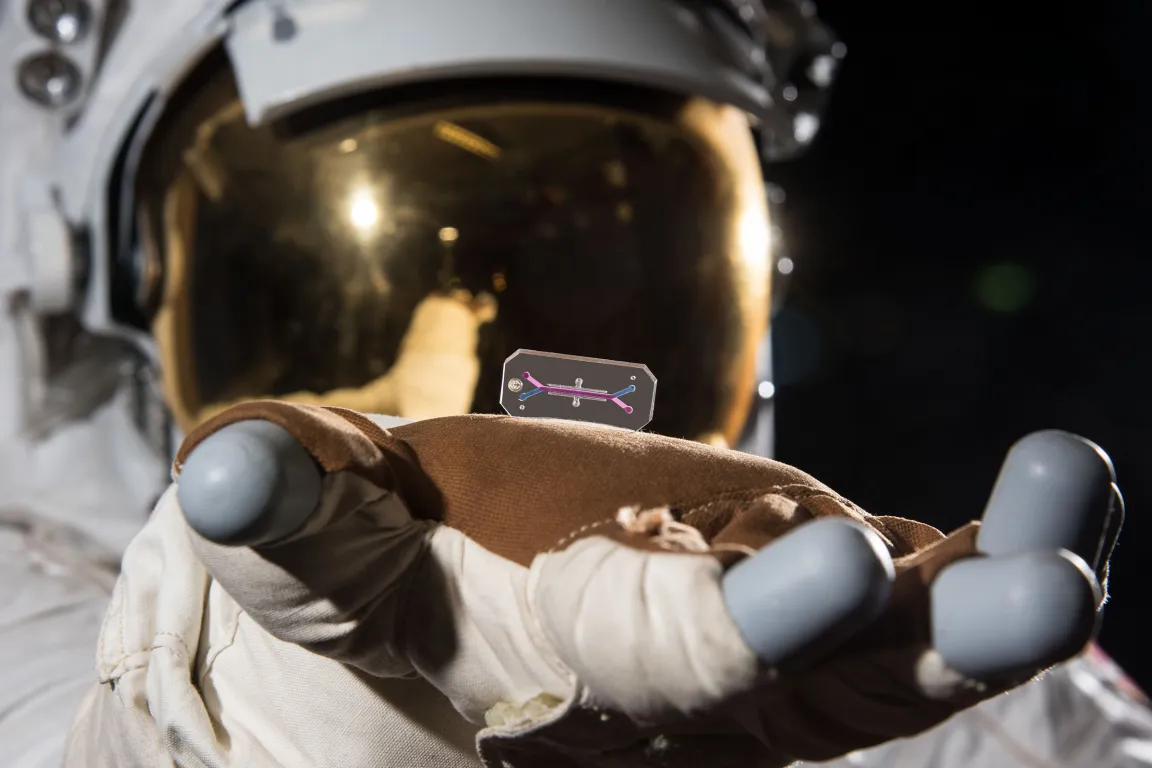
An astronaut wearing a white spacesuit and gold-tinted helmet visor is holding a small, rectangular transparent chip with colored lines and dots on it, resting on the gloved hand. The background is dark, suggesting space.

Josh Valcarcel / NASA

Sign up to see the future, today

Can’t-miss innovations from the bleeding edge of science and tech

Beyond their snazzy flight suits and mango peach smoothies, the crew of NASA’s Artemis II mission is packing something unusual: living mini-organs grown from their own bones.

That bizarre cargo is traveling alongside astronauts Reid Wiseman, Victor Glover, Christina Koch, and Jeremy Hansen, whose 10-day journey will take them around the back side of the Moon and then home again, in the process traveling farther from the Earth than any previous humans.

According to space publication Supercluster, the astronauts are carrying “completely functional” organ chips: organelles composed of bone marrow made from each astronauts’ cells.

In a highly complicated space mission, the justification for taking these organ chips is actually pretty straightforward. In leaving the protection of the Earth’s atmosphere, the four travelers expose themselves to heaps of solar and cosmic radiation. That radiation environment will present a unique window into the kind of dangers future astronauts will face in the dark reaches of space, so researchers are taking as many samples as they can get.

Mini organs aren’t new — scientists have been messing around with them since 2013 — but the decision to map them to their human counterparts in a space mission is.

“This is the first time we’re going to have crew with their matched organ chips,” David Chou, principal investigator of the chip experiment told SC. Having the humans and their micro organs side by side on the same voyage, he says, will enable scientists to compare the two biological materials against each other.

By using bone marrow cells — which are particularly vulnerable to radiation — to produce the chips, researchers are “maximizing the chance that we’ll see biologic differences, as opposed to modeling the skin or something else,” Chuo said.

For good measure, NASA also kicked duplicates of the astronauts’ organ chips up to the International Space Station, in order to compare deep space radiation with low earth orbit radiation over the same period. While they may seem small — and they are, at about the size of a USB stick — data provided by the chips could offer a major leap in our understanding of how the human body reacts to deep space, and at minimal cost, not to mention risk to human beings.

“Being able to understand how a broader representation of the public would respond to spaceflight is something you could do with organ chips much more cost-effectively,” Chou told SC. “You can make hundreds of these and send them up.”

More on NASA: Scientists Investigating Whether Object NASA Is Approaching Is Core of Destroyed Planet