


惯性聚合 高效追踪和阅读你感兴趣的博客、新闻、科技资讯
阅读原文 在惯性聚合中打开

推荐订阅源

钛媒体:引领未来商业与生活新知
钛媒体:引领未来商业与生活新知
Apple Machine Learning Research
T
Tailwind CSS Blog
月光博客
月光博客
爱范儿
爱范儿
有赞技术团队
有赞技术团队
OSCHINA 社区最新新闻
OSCHINA 社区最新新闻
aimingoo的专栏
aimingoo的专栏
GbyAI
GbyAI
腾讯CDC
The Cloudflare Blog
人人都是产品经理
人人都是产品经理
MongoDB | Blog
MongoDB | Blog
Microsoft Azure Blog
IT之家
IT之家
Cyber Security Advisories - MS-ISAC
云风的 BLOG
云风的 BLOG
U
Unit 42
博客园 - 三生石上(FineUI控件)
A
About on SuperTechFans
N
Netflix TechBlog - Medium
Google DeepMind News
雷峰网
雷峰网
L
LangChain Blog

Futurism

SpaceX Stock Has Officially Fallen All the Way Down to the Low $170s SpaceX Stock Had Quite a Bad Night Wall Street Terrified That SpaceX Investors Will Dump Their Stocks SpaceX Stock Now in Rapid Decline SpaceX Stock Has Now Started to Fall Scientists Propose That Entire Universes Can Form Inside Collapsing Stars NASA Loads Moon Rocket onto Giant Trump-Branded Train Eighty Residents Sue SpaceX, Saying Elon Musk’s Constant Rocket Launches Are Literally Destroying Their Homes SpaceX’s IPO Shows That We Aren’t Even Close to Peak AI Bubble The More Data We See About SpaceX’s IPO, the More We’re Wincing Scientists Discover Fearsome Wind That Destroys Entire Galaxies NASA’s Next Moon Mission Is a Rube Goldberg Machine of Corporate Failure Points Scientists Release Results After Scanning 3I/ATLAS for Alien Signals The Math on SpaceX’s IPO Is Virtually Impossible Astronomers Say Star Self-Destructed So Catastrophically That It Left Behind No Trace of Its Existence Catholic Church Boots Exorcist After He Said UFOs Are Demons NASA’s James Webb Discovers That 3I/ATLAS Let One Rip as It Passed Through Solar System Scientists Find Chunk of Lost Planet in Desert It’s Possible That SpaceX Could Collapse Spectacularly ISS Astronauts Ordered to Enter Evacuation Mode SpaceX Is Massively Overvalued Ahead of Its IPO, Analysts Find Paper Claims the “Asteroid” Japan’s Probe Is Approaching Is Actually a Derelict Spacecraft Trump Shovels $4 Billion Directly to Elon Musk, Who Spent a Fortune Getting Him Elected Scientists Say They’ve Cracked Mystery Behind a Dozen Strange Signals From Deep Space Scientists Spot What Appears to Be a Ring-Shaped “Planet Factory” Deep Out in Space Scientists Say They’ve Found Fungi That Turn Dead Martian Soil Into Fertile Cropland The Blue Moon Is Fake. You Are Being Deceived Jeff Bezos’ Rocket Explodes Into Mushroom Cloud, Dealing Massive Blow to NASA’s Moon Plans Elon Musk Furious at Starlink Being Used for American Suicide Drones NASA Releases Sweeping Plans for Moon Base
Astronomers Found Something Strange In Giant “Forbidden” ...
2026-04-05 · via Futurism

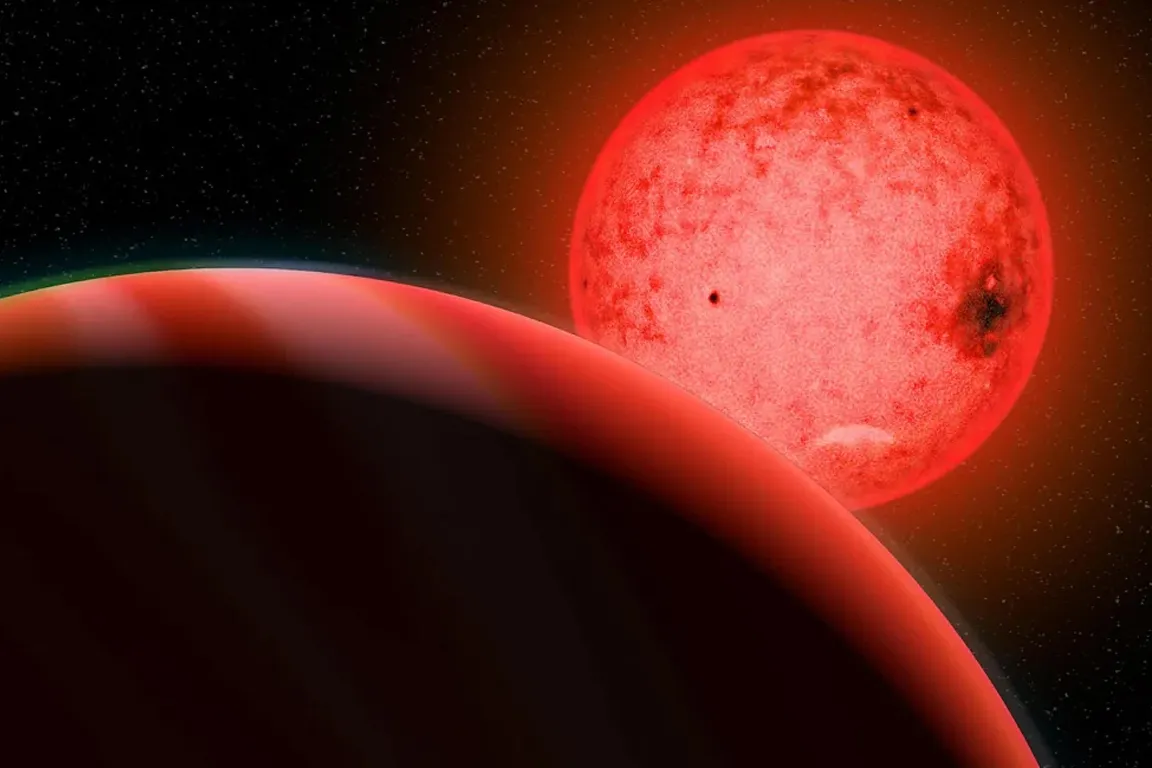
A large red planet with a smooth surface and faint bands is in the foreground, partially shadowed. Behind it is a bright red star with visible sunspots and a glowing aura, set against a backdrop of a star-filled space.

Katherine Cain / Carnegie Institution for Science

Sign up to see the future, today

Can’t-miss innovations from the bleeding edge of science and tech

Three years ago, Carnegie University astronomers examining a small star called a red dwarf found something unexpected: a Jupiter-sized gas giant. 

In a star system like our own, this would be unremarkable. But at nearly a quarter the size of its host star, the exoplanet, TOI 5205b, was — in the literal sense — impossibly large. It blocked seven percent of the star’s light whenever it passed in front of it, forming one of the largest exoplanet transits on record. It was so physics-defying that the astronomers dubbed it “forbidden”; existing gas planet formation models couldn’t explain how a puny red dwarf, which is only forty percent of the mass of the Sun, could be capable of giving birth to it.

Now, the astronomers got a second look with the James Webb Space Telescope to peer into its atmosphere. And their findings, published in a new study in The Astronomical Journal, reveal even more unusual aspects of the oversized world. 

The main curiosity is that its atmosphere has a lower concentration of heavy elements relative to hydrogen than gas giants in our own solar system (Jupiter and Saturn), suggesting something different about its formation.

Compared to its host star, the forbidden world also a lower metallicity, a term that describes the abundance of elements heavier than hydrogen and helium.

“These findings have implications for our understanding of the giant planet formation process that occurs early in a star’s lifespan,” lead author and Carnegie astronomer Anjali Piette said in a statement about the work.

The prevailing theory on planet formation is that they’re conceived in a spinning disk of gas and dust that surrounds a star, which itself forms after the star forms from the collapse of a vast and dense nebula. The disk is the leftover material of its birth, eventually becoming the star’s cosmic companions.

Over time, pockets inside this so-called protoplanetary disk will condense to form rocky planets, or the rocky core that will eventually become an even larger gas giant. Most models suggest that these cores need to be around ten Earth masses to possess the gravity to start rapidly condensing gas around itself. But with a red dwarf like the one TOI 5205b orbits, there shouldn’t have been enough of this material to form the initial core.

The astronomers haven’t found anything to reconcile this discrepancy yet, but the unusually low metallicity is giving them much to chew over. It suggests that the planet’s “heavy elements migrated inward during formation and now its interior and atmosphere are not mixing,” coauthor Shubham Kanodia from Carnegie Science said in the statement. “These results suggest a very carbon-rich, oxygen-poor planet atmosphere.”

More on space: Scientists Spot Two Planets That Collided, Resulting in Carnage That Will Send Prickles Through Your Scalp