惯性聚合 高效追踪和阅读你感兴趣的博客、新闻、科技资讯
阅读原文 在惯性聚合中打开

推荐订阅源

N
News and Events Feed by Topic
酷 壳 – CoolShell
酷 壳 – CoolShell
G
Google Developers Blog
N
Netflix TechBlog - Medium
Recorded Future
Recorded Future
S
Securelist
cs.CL updates on arXiv.org
Scott Helme
Scott Helme
C
Check Point Blog
量子位
月光博客
月光博客
Last Week in AI
Last Week in AI
C
Cisco Blogs
G
GRAHAM CLULEY
B
Blog RSS Feed
K
Kaspersky official blog
爱范儿
爱范儿
J
Java Code Geeks
I
Intezer
aimingoo的专栏
aimingoo的专栏
WordPress大学
WordPress大学
云风的 BLOG
云风的 BLOG
C
CXSECURITY Database RSS Feed - CXSecurity.com
H
Hackread – Cybersecurity News, Data Breaches, AI and More
博客园 - 三生石上(FineUI控件)
罗磊的独立博客
Threat Intelligence Blog | Flashpoint
MongoDB | Blog
MongoDB | Blog
T
Threat Research - Cisco Blogs
N
News | PayPal Newsroom
Exploit-DB.com RSS Feed
Security Latest
Security Latest
T
Tailwind CSS Blog
人人都是产品经理
人人都是产品经理
P
Privacy International News Feed
The Cloudflare Blog
H
Heimdal Security Blog
宝玉的分享
宝玉的分享
freeCodeCamp Programming Tutorials: Python, JavaScript, Git & More
腾讯CDC
GbyAI
GbyAI
V
Visual Studio Blog
Recent Commits to openclaw:main
博客园 - 聂微东
T
Tenable Blog
The Register - Security
AI
AI
C
Cybersecurity and Infrastructure Security Agency CISA
S
Schneier on Security
L
LangChain Blog

博客园 - WUST许志伟

课题组学习南京大学陈贵海教授“自演进异构融合的边缘智能计算”的专题学术报告 课题组学习北京大学许进教授“求解NP完全问题专用机——探针计算机”的专题学术报告 课题组参加中国仿真学会资源规划仿真与决策专业委员会成立大会 江西财经大学段琦琦博士来演化计算与人工智能课题组开展学术交流与访问 本课题组举办学术交流活动:安徽大学田野教授作专题报告 Gary Yen教授在BICTA2025做主旨汇报并访问本课题组 【倒计时10天】第20届国际生物启发式计算:理论与应用会议(BIC-TA 2025)将于2025年11月7-9日在武汉召开! Ishibuchi教授与Lie Meng Pang博士受邀于本课题组开展学术交流与指导 武汉科技大学人工智能与演化计算实验室许志伟课题组参加IEEE CEC 2025 武汉科技大学人工智能与演化计算实验室许志伟课题组参加第八届智能优化与调度学术会议 武汉科技大学人工智能与演化计算实验室许志伟课题组参加2025中国膜计算论坛 论文研读-ClusteringGA研读与实现 论文研读-元启发式算法的平移、缩放和旋转不变变异算子的设计原则 连续邮资问题-分支限界法求解 TSP问题-分支限界法求解 最大团问题-分支限界法求解 背包问题-分支限界法求解 回溯法解决图着色问题 回溯法求解简单组合优化问题 以简单组合优化为例讨论计算复杂性 从组合优化问题建模到贪心法求解以简单调度为例 基于MOA*的多目标路径规划问题之我见 一种单目标A*算法设计与实现
【CFP】IEEE iCaMaL 2026 Special Session “AI-Driven Systems for Next-Generation Industrial Automation”
WUST许志伟 · 2026-03-31 · via 博客园 - WUST许志伟

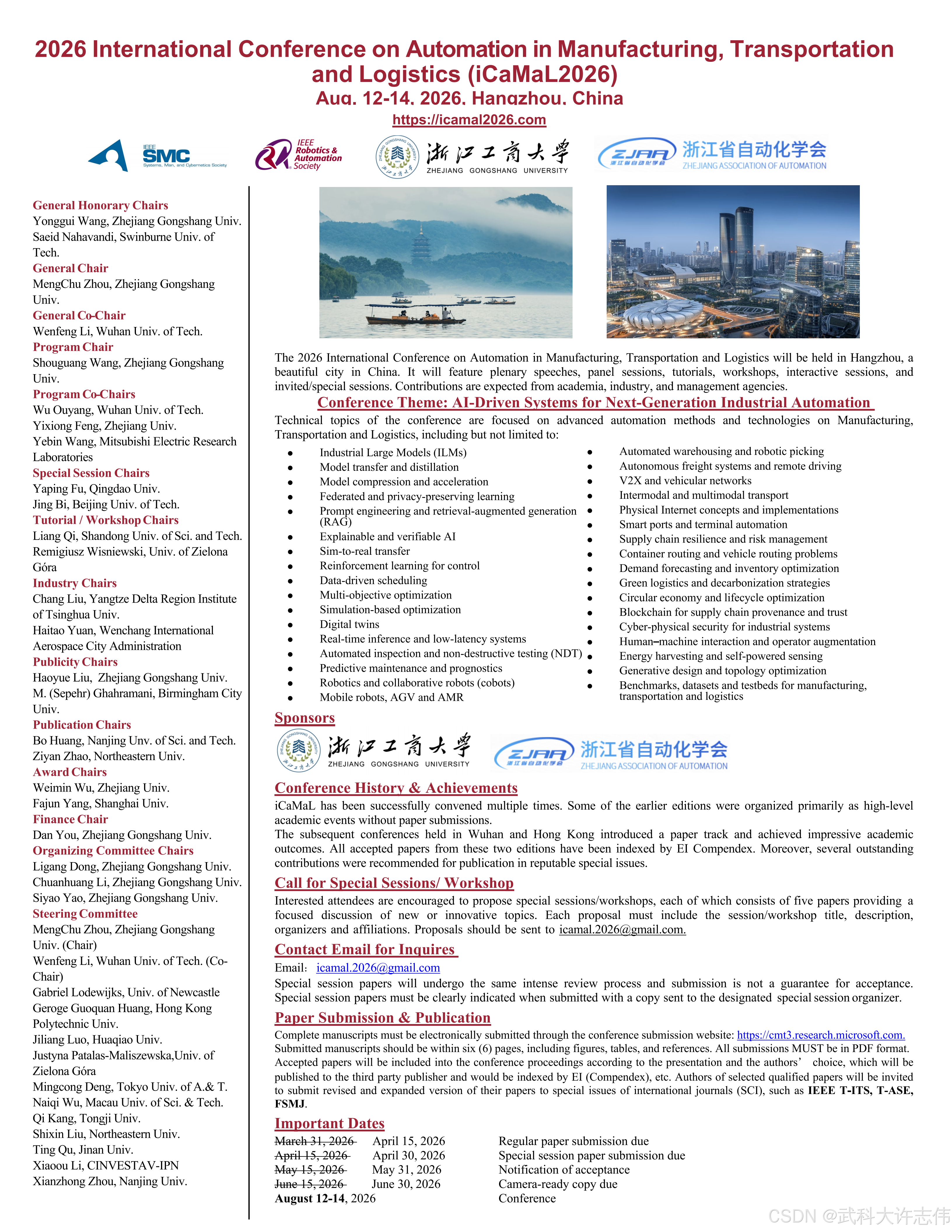
我们在IEEE iCaMaL 2026上组织了Special Session “AI-Driven Systems for Next-Generation Industrial Automation”详见: https://www.icamal2026.com/index/page.html?id=1887#ss7 ,所有的录用论文会被EI检索,部分优秀论文将被推荐至IEEE-TITS、IEEE-TASE、FSMJ,其中IEEE TASE的特刊已经被批准,详情请见 https://www.ieee-ras.org/publications/t-ase/special-issues-t-ase/ ,欢迎各位专家学者赐稿~

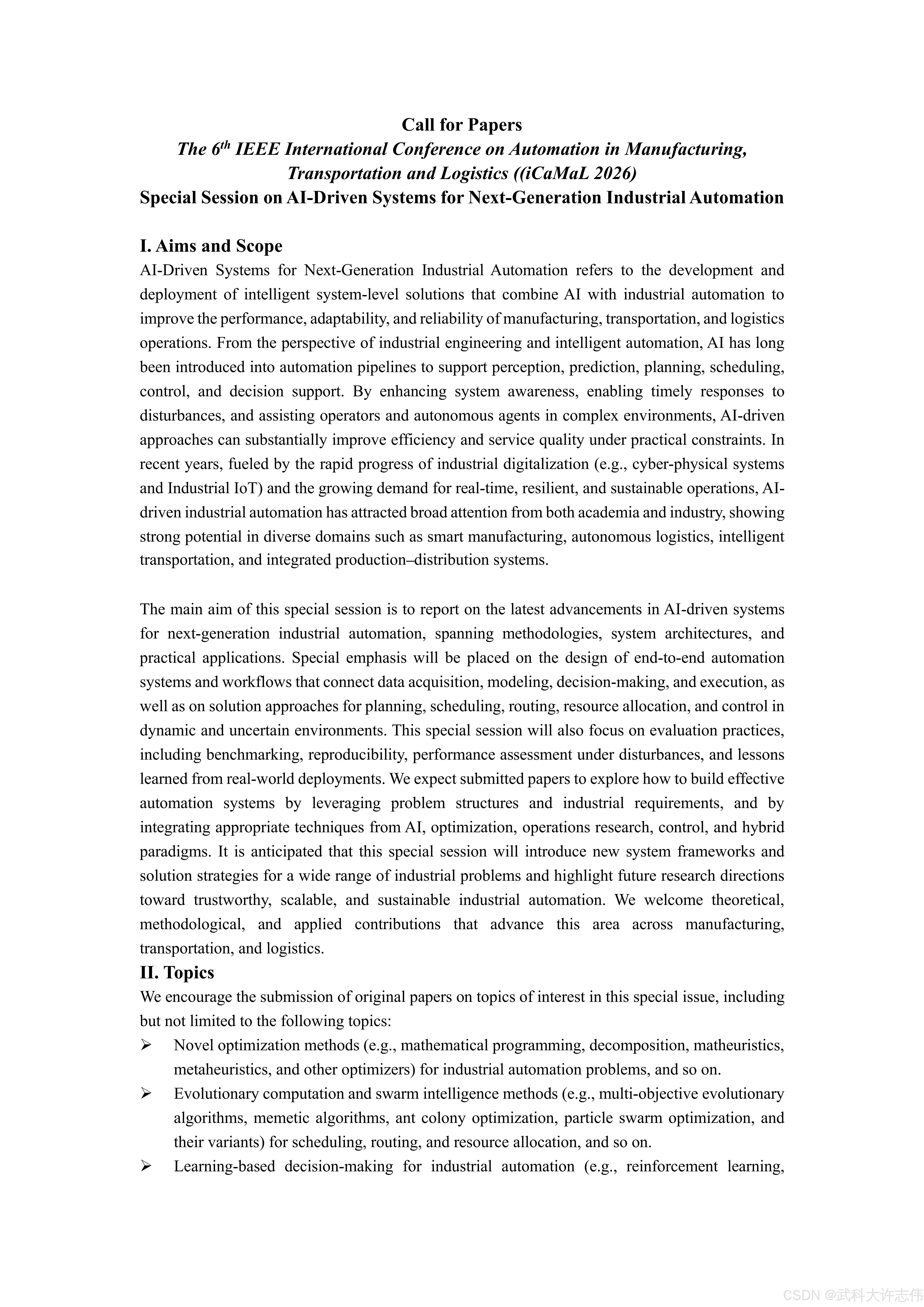
Call for Papers

The 6th IEEE International Conference on Automation in Manufacturing, Transportation and Logistics ((iCaMaL 2026)
Special Session on AI-Driven Systems for Next-Generation Industrial Automation

I. Aims and Scope

AI-Driven Systems for Next-Generation Industrial Automation refers to the development and deployment of intelligent system-level solutions that combine AI with industrial automation to improve the performance, adaptability, and reliability of manufacturing, transportation, and logistics operations. From the perspective of industrial engineering and intelligent automation, AI has long been introduced into automation pipelines to support perception, prediction, planning, scheduling, control, and decision support. By enhancing system awareness, enabling timely responses to disturbances, and assisting operators and autonomous agents in complex environments, AI-driven approaches can substantially improve efficiency and service quality under practical constraints. In recent years, fueled by the rapid progress of industrial digitalization (e.g., cyber-physical systems and Industrial IoT) and the growing demand for real-time, resilient, and sustainable operations, AI-driven industrial automation has attracted broad attention from both academia and industry, showing strong potential in diverse domains such as smart manufacturing, autonomous logistics, intelligent transportation, and integrated production–distribution systems.

The main aim of this special session is to report on the latest advancements in AI-driven systems for next-generation industrial automation, spanning methodologies, system architectures, and practical applications. Special emphasis will be placed on the design of end-to-end automation systems and workflows that connect data acquisition, modeling, decision-making, and execution, as well as on solution approaches for planning, scheduling, routing, resource allocation, and control in dynamic and uncertain environments. This special session will also focus on evaluation practices, including benchmarking, reproducibility, performance assessment under disturbances, and lessons learned from real-world deployments. We expect submitted papers to explore how to build effective automation systems by leveraging problem structures and industrial requirements, and by integrating appropriate techniques from AI, optimization, operations research, control, and hybrid paradigms. It is anticipated that this special session will introduce new system frameworks and solution strategies for a wide range of industrial problems and highlight future research directions toward trustworthy, scalable, and sustainable industrial automation. We welcome theoretical, methodological, and applied contributions that advance this area across manufacturing, transportation, and logistics.

II. Topics

We encourage the submission of original papers on topics of interest in this special issue, including but not limited to the following topics:

  • Novel optimization methods (e.g., mathematical programming, decomposition, matheuristics, metaheuristics, and other optimizers) for industrial automation problems, and so on.
  • Evolutionary computation and swarm intelligence methods (e.g., multi-objective evolutionary algorithms, memetic algorithms, ant colony optimization, particle swarm optimization, and their variants) for scheduling, routing, and resource allocation, and so on.
  • Learning-based decision-making for industrial automation (e.g., reinforcement learning, predictive modeling, learning-augmented optimization, transfer and generalization across scenarios), and so on.
  • Multi-objective and many-objective optimization, preference-based optimization, and decision support for industrial operations, and so on.
  • Robust, stochastic, and risk-aware optimization under uncertainty, disruptions, and time-varying environments, and so on.
  • Real-time and online optimization (e.g., rolling-horizon strategies, rescheduling, dispatching, dynamic routing), and so on.
  • Hybrid frameworks integrating artificial intelligence, optimization, simulation, and control for next-generation industrial automation, and so on.
  • Applications and case studies in manufacturing, transportation, and logistics (e.g., smart manufacturing scheduling, vehicle routing with time windows and related variants, fleet and warehouse operations, integrated production inventory distribution, emergency logistics, green and sustainable automation), and so on.
  • Benchmarking, theoretical and empirical analysis, and performance assessment for automation-oriented optimization methods, and so on.

III. Submissions

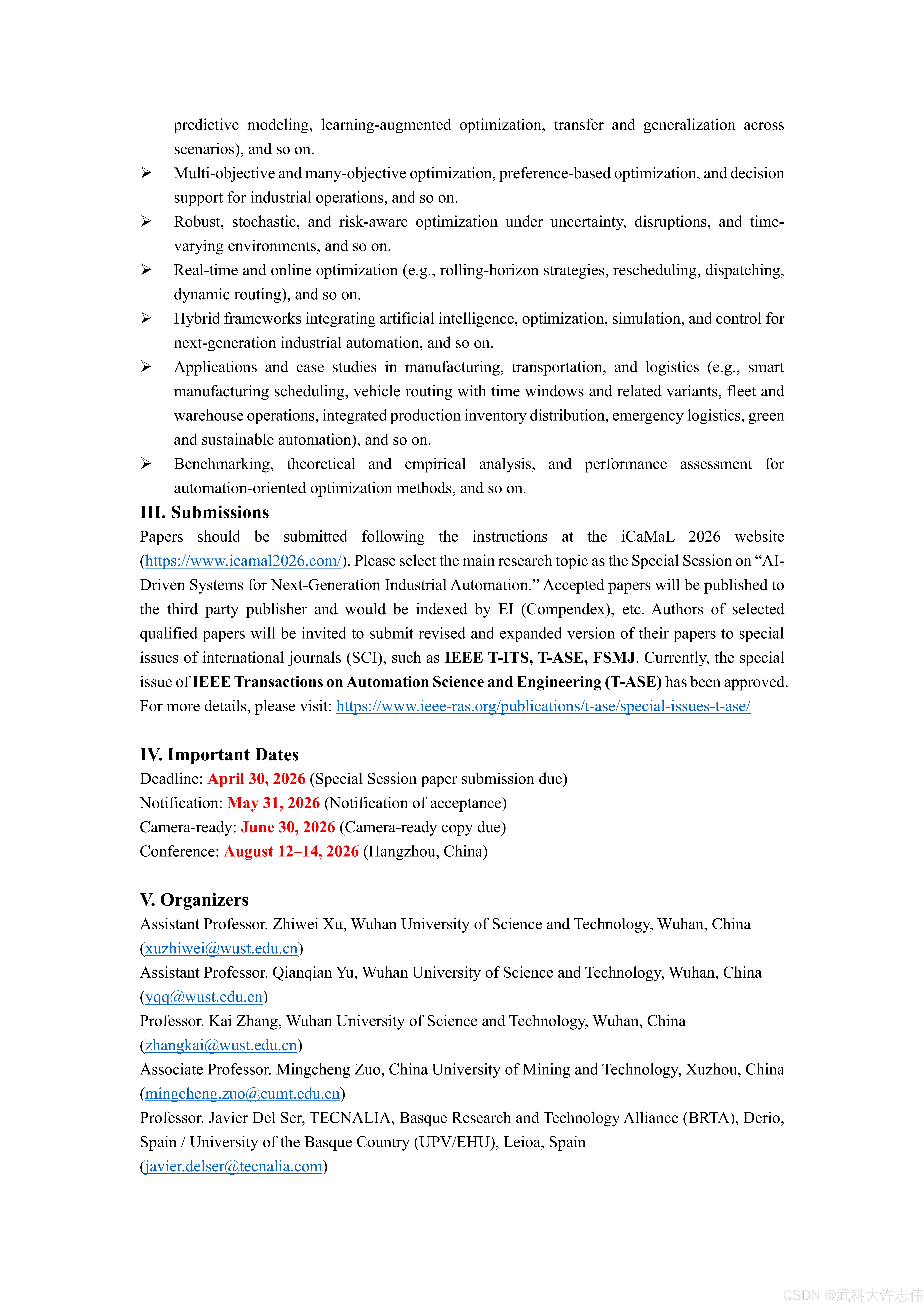
Papers should be submitted following the instructions at the iCaMaL 2026 website (https://www.icamal2026.com/). Please select the main research topic as the Special Session on “AI-Driven Systems for Next-Generation Industrial Automation.” Accepted papers will be published to the third party publisher and would be indexed by EI (Compendex), etc. Authors of selected qualified papers will be invited to submit revised and expanded version of their papers to special issues of international journals (SCI), such as IEEE T-ITS, T-ASE, FSMJ. Currently, the special issue of IEEE Transactions on Automation Science and Engineering (T-ASE) has been approved. For more details, please visit: https://www.ieee-ras.org/publications/t-ase/special-issues-t-ase/
IV. Important Dates

  • Deadline: April 30, 2026 (Special Session paper submission due)
  • Notification: May 31, 2026 (Notification of acceptance)
  • Camera-ready: June 30, 2026 (Camera-ready copy due)
  • Conference: August 12–14, 2026 (Hangzhou, China)

V. Organizers

  • Assistant Professor. Zhiwei Xu, Wuhan University of Science and Technology, Wuhan, China (xuzhiwei@wust.edu.cn)
  • Assistant Professor. Qianqian Yu, Wuhan University of Science and Technology, Wuhan, China (yqq@wust.edu.cn)
  • Professor. Kai Zhang, Wuhan University of Science and Technology, Wuhan, China (zhangkai@wust.edu.cn)
  • Associate Professor. Mingcheng Zuo, China University of Mining and Technology, Xuzhou, China (mingcheng.zuo@cumt.edu.cn)
  • Professor. Javier Del Ser, TECNALIA, Basque Research and Technology Alliance (BRTA), Derio, Spain / University of the Basque Country (UPV/EHU), Leioa, Spain (javier.delser@tecnalia.com)

在这里插入图片描述
在这里插入图片描述
在这里插入图片描述