



惯性聚合 高效追踪和阅读你感兴趣的博客、新闻、科技资讯
阅读原文 在惯性聚合中打开

推荐订阅源

Attack and Defense Labs
Cyber Security Advisories - MS-ISAC
Recent Announcements
博客园 - 【当耐特】
博客园 - 三生石上(FineUI控件)
量子位
aimingoo的专栏
aimingoo的专栏
V
V2EX
Vercel News
Vercel News
B
Blog
M
MIT News - Artificial intelligence
OSCHINA 社区最新新闻
OSCHINA 社区最新新闻
The Cloudflare Blog
H
Hackread – Cybersecurity News, Data Breaches, AI and More
cs.AI updates on arXiv.org
Hacker News: Ask HN
Hacker News: Ask HN
TaoSecurity Blog
TaoSecurity Blog
N
News and Events Feed by Topic
D
DataBreaches.Net
Blog — PlanetScale
Blog — PlanetScale
S
Secure Thoughts
U
Unit 42
博客园 - 叶小钗
cs.CV updates on arXiv.org
Hacker News - Newest:
Hacker News - Newest: "LLM"
N
News | PayPal Newsroom
Help Net Security
Help Net Security
S
Security Affairs
Microsoft Security Blog
W
WeLiveSecurity
博客园 - Franky
Forbes - Security
Forbes - Security
Microsoft Azure Blog
博客园_首页
Schneier on Security
I
InfoQ
B
Blog RSS Feed
大猫的无限游戏
大猫的无限游戏
A
About on SuperTechFans
Webroot Blog
Webroot Blog
AWS News Blog
AWS News Blog
Last Week in AI
Last Week in AI
Security Archives - TechRepublic
C
CERT Recently Published Vulnerability Notes
N
News and Events Feed by Topic
阮一峰的网络日志
阮一峰的网络日志
L
Lohrmann on Cybersecurity
SecWiki News
SecWiki News
Recent Commits to openclaw:main
J
Java Code Geeks

World Economic Forum

What happened at the MC14 WTO meeting in Yaoundé How giving gorillas digital wallets can help finance nature Why is leadership a strategic investment for philanthropy? Counting the many costs of the global mental health burden What we learned from the 2026 World Bank Spring Meetings Crop protection is at risk. How innovation can help Here's a playbook for boards on how to govern agentic AI Why connected data makes AI decision-ready for sustainability 3 ways better data practices are reshaping financial supervision What technology convergence looks like in practice 7 reasons the old order broke — and how it might be repaired How governments can make agentic AI re  ? Current and future uses of RNA, including mRNA vaccines Real-time deepfakes are rewriting the rules of child safety Electrification trend ‘unmistakeable’ – and more energy stories From smallpox to the common cold: A brief history of vaccines Saudi Arabia's new AI-powered sustainability platform could unlock $20 billion by 2030 Here are 6 ways that climate change is affecting sports around the world This crisis could be an opportunity for the energy transition Middle East war: 6 ways countries are responding to the historic energy shock Nature can teach us about leadership and building resilience How did the Strait of Hormuz become so important, and will it stay that way? Yes/Cities: Helping global cities become more resilient, sustainable and prosperous Healthy ageing in APAC: The role of the influenza vaccine Risk management, renewables and a rocky road ahead: Spring Meetings takeaways Japan in a world of rising middle powers EU plans to offset Iran war's energy impact, and other climate and nature news 3 cities leading on green investment for economic growth The coffee industry is making the case for climate insurance The ocean is now a subprime asset, so we need a sustainable blue economy 5 leaders on today’s growth dilemmas and how to navigate them What helps purpose-driven, early-stage start-ups scale? Why trust is key to the EU's Empowering Consumers Directive The $3 trillion maintenance gap is burning money and the planet 5 things to know before interacting with digital assets Frontiers Planet Prize: 25 solutions for planetary crises How the Iran war is disrupting India's steel production What's needed for growth in the new economy? Why we need a humanitarian truce is Sudan Freedom of expression under attack: How do we protect the media? Why companies – and nations – should create an AI culture Anthropic’s Mythos moment: how frontier AI is redefining cybersecurity Discover this week's must-read finance stories 'Godfather of AI' Yoshua Bengio on why AI can behave unpredictably (and what needs to change) Everyone talks about critical thinking. Here's how schools should actually teach it The top international trade stories to know this month The big chart: How oil prices have reacted to world events since the 1980s Why AI needs digital public infrastructure to deliver for citizens What AI in education needs next: Lessons from youth leaders across five countries How to scale clean hydrogen to meet energy security needs Meet the Young Global Leaders Class of 2026 Ventures with blue carbon solutions for coastal restoration How peer-led reskilling is helping bridge the skills gap in East Africa China's lessons on the energy sector’s nature-positive transition Here's how Japan's green materials sector is thriving The Strait of Hormuz crisis: Rewriting the future of AI Systemic risk is the hidden tax on growth. Here's how insurance can help build economic resilience Earth Day: What is it, when is it and why is it important? The Rayner plot: What it tells us about the future of jobs This is why we’ll feel the economic effects of this war for a while How energy and finance leaders are approaching climate investment in 2026 How quantum technologies are being tested to strengthen energy systems How to think about ‘safe’ withdrawal rates in a changing global economy Is collective cyber defence the future of port security? Learnings from a Dutch initiative Cyberattacks target US infrastructure, and other cybersecurity news Rethinking workplace energy: Why our assumptions can lead to burnout What could an international panel to tackle inequality achieve? Why climate action matters for healthy longevity Workforce health is the bedrock of global supply chains. Here's how to protect it Southeast Asia may be a distinct region but its risks affect each country differently 5 ways to grow a business mindset in international development How companies can finally cut Scope 3 emissions Here's how to get the $7 trillion AI hardware buildout right Leaders are moving from systems of record to systems of work G7 One Health Summit launches global diagnostics initiative, and other health stories What stopping war-risk insurance in the Strait of Hormuz tells us Why leaders must transform cyber resilience measurement AI can help create comparability and scale impact investing What's in store for the future of multilateralism? Why food waste is a $540 billion opportunity hiding in plain sight What Afghanistan can teach us about strategic foresight This is how we use generative AI on Forum Stories How cities are turning urban complexity into coherent climate plans How non-profits and governments use data to drive real system change How demographics, not AI, will redefine the labour market Three lessons on the energy transition in an age of crisis NFL players: Why financial literacy is a game-changer for student-athletes 3 ways Africa can maximize the value of its critical minerals and finance its future What leaders are saying about the new geopolitics of energy The financial system is rebooting. Stakeholders must adapt Cancer care innovation is reshaping resilience in Japan The hidden struggle of employed youth in Africa How markets and missions are becoming allies for impact What’s changing in frontier tech – from geopolitics to AI and energy Why stablecoins are quickly becoming a geopolitical issue How public-private collaboration can help close the global gender gap It’s time to start treating AI infrastructure as critical infrastructure 5 effective choices to turn workplace well-being into a competitive advantage How to strengthen collaboration to tackle infectious disease Why the AI economy can’t rely on a single digital Suez
Surging AI needs and geopolitical supply shocks renew attention on nuclear energy
Maciej Kolac · 2026-04-21 · via World Economic Forum
  • Crises like the Strait of Hormuz blockage have repeatedly hit global energy markets in recent decades.
  • Nuclear energy is often cited as a source of firm, low-carbon power that could complement intermittent renewables.
  • Interest in nuclear energy has increased in a number of countries; roughly 60 nuclear power reactors are under construction worldwide.

AI, data centres and a more volatile geopolitical environment are increasing demand for electricity that is reliable, secure and clean. In that context, nuclear energy is receiving renewed attention in policy and industry discussions.

Ongoing turmoil in energy markets related to the war in Iran and the closing of the Strait of Hormuz has not only elevated energy prices across the board, but also renewed debate about energy security and supply resilience.

Proponents of nuclear energy argue that it can offer important energy-security advantages. It can provide dispatchable power with round-the-clock availability and in some markets may reduce reliance on imported fuels. Moreover, nuclear plants may be less exposed to day-to-day fuel delivery risk because they typically refuel every 18 to 24 months and additional fuel that can last several additional years can generally be stored on-site.

In Europe, Poland is moving ahead with its first nuclear plant and even Germany seems to be reconsidering its opposition to this source of energy. In Asia, China keeps building at speed and scale, while India is reinvigorating its nuclear programme. In the US, the White House aims for 5 gigawatts of power upgrades at existing reactors and the start of construction on 10 new large reactors by 2030.

What's the relationship between AI, data centres and nuclear power?

The growth in AI and data centres has strengthened interest in power sources that provide reliable, 24/7 low-carbon electricity, including nuclear.

Major technology companies are committing tens of billions of dollars to new AI infrastructure. For example, OpenAI and Oracle are developing 4.5 gigawatts of additional data centre capacity in the US. Google has announced a $40 billion investment in three new Texas data centre campuses, and Amazon plans an additional $15 billion in Northern Indiana on top of an earlier $11 billion project there.

The result is soaring electricity demand. According to an IEA analysis, global data centre electricity consumption reached about 415 terawatt-hours (TWh) in 2024 and is projected to rise to around 945 TWh by 2030. Nuclear is one of the key technologies that can help meeting this demand.
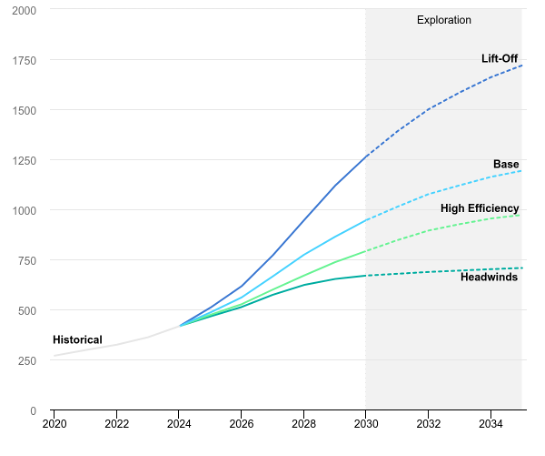
Global data centre electricity consumption by sensitivity case, 2020-2035

Global data centre electricity consumption by sensitivity case, 2020-2035 Image: International Energy Agency

Financing renewed nuclear investment

The IEA says 63 reactors are currently under construction worldwide, and over the last five years decisions have been taken to extend the operating lifetimes of more than 60 others.

While a number of innovative reactor designs are moving forward, large pressurized water reactors (PWR) continue to dominate today’s nuclear fleet and near-term build plans. Most reactors under construction, on order and planned are also large PWRs. For example, the US government plans to spend $80 billion to build 10 AP1000 large-scale nuclear reactors.

For years, one of the main constraints of new nuclear projects has been cost, especially major overruns and delays. Some analysts argue this may now be starting to change as projects move away from one-off designs towards repetition, standardization, modularization and stronger supply chains.

Building multiple reactors of the same type with the same delivery teams could reduce costs and construction times through learning effects, although the extent of those gains remains uncertain and context-specific. Some believe that getting about seven reactors of the same type will drive down construction costs and timeframes so each additional new reactor will cost about the same as the seventh and take about the same amount of time to deploy.

The US Department of Energy estimates that advanced construction technologies could reduce the construction costs of building new reactors by more than 10% and significantly lower the scheduling risks associated with them.

A major roadblock to new nuclear construction has been the huge capital outlays required of utilities, and in some markets their regulators’ reluctance to finance plants through ratepayers. But for AI hyperscalers with market capitalizations in the trillions of dollars and relatively easy access to credit, financing nuclear is far less of an issue. In fact, a lack of sufficient, reliable electricity could materially constrain their expansion plans.

The role of Small Modular Reactors

There has been much discussion of innovative advanced reactor companies offering “behind-the-meter” solutions, with small reactors co-located with data centres and other industrial facilities.

SMRs (Small Modular Reactors) using modular construction methods are intended to be smaller, simpler and quicker to build than conventional large-scale plants. They may also be better suited to set up in remote areas that lack grid infrastructure, and many designs include passive safety features. Some can utilize spent fuel from existing power plants.

Some companies have already signed contracts to deploy reactors alongside data centres and chemical plants,. At the same time, many of these designs have not reached maturity level for deployment.

SMRs (Small Modular Reactors) using modular construction methods promise to be smaller, simpler and quicker to build than conventional large-scale plants. They’re also easier to set up in remote areas that lack grid infrastructure, and often have enhanced safety features. Some can utilize spent fuel from existing power plants and provide a sustainable solution to the issue of waste.

Some companies have already signed contracts to deploy reactors alongside data centres and chemical plants, and there will likely be many more such agreements. At the same time, these designs are still not yet at techno-economical maturity level for deployment.

One thing to watch in this space is the US Department of Energy’s pilot programme, which aims to move at least three advanced reactor concepts towards criticality by July 4, 2026, the country’s 250th anniversary.

Loading...

What to watch next in nuclear energy

Growing needs and shifting energy markets are contributing to renewed interest in the nuclear energy. Restarted, extended and new reactors over the next decade will continue to deliver power into the grid. If more nuclear plants are built using repeatable designs and delivery models, costs may fall and deployment should accelerate. With time, small reactors may eventually be deployed at some data centre and industrial sites, although timelines remain uncertain.

At the same time, no single technology will solve the energy crisis on its own; it will take a mix of solutions, including nuclear, renewables, energy storage, clean fuels and others.

Countries will follow different paths at different speeds. Ensuring a durable and inclusive transformation requires alignment between ambition, finance and delivery – guided by market signals, grounded in local realities and supported by international cooperation.