





Large Language Models (LLMs) have made many tasks easier like making chatbots, language translation, text summarization, and many more. In the past, we used to write models for different tasks, and then there was always the issue of their performance. Now, we can do most of the tasks easily with the help of LLMs. However, LLMs do have some limitations when they are applied to real-world use cases. They lack specific or up-to-date information leading to a phenomenon called hallucination (opens new window)where the model generates incorrect or un-predictable results.
Vector databases (opens new window)proved to be very helpful in mitigating the hallucination issue in LLMs by providing a database of domain-specific data that the models can reference. This reduces the instances of inaccurate or nonsensical responses.
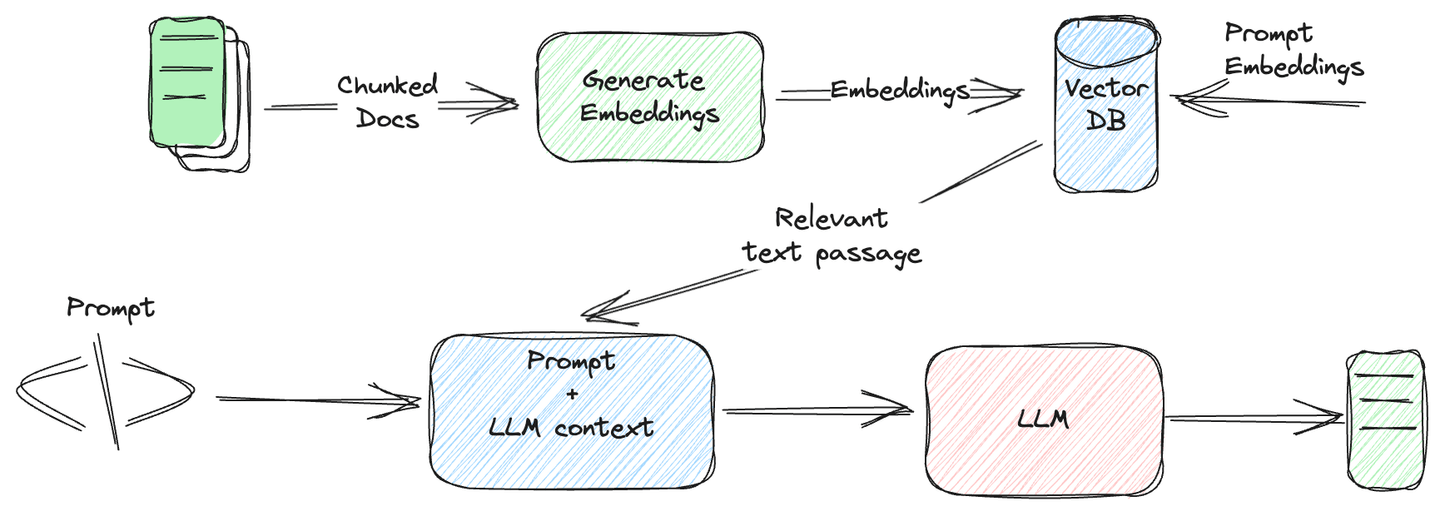
In this blog post, we are going to see how the integration of vector databases with SQL has made life easier for businesses. We will discuss some of the limitations of traditional databases and what led to this new integration, SQL vector database. At the end of the blog, we will see how these databases work and Why MyScale (opens new window)could be your first choice while selecting vector databases.
A SQL vector database is a specialized type of database that combines the capabilities of traditional SQL databases with the abilities of a vector database. Providing you the ability to efficiently store and query high-dimensional vectors with the help of SQL.
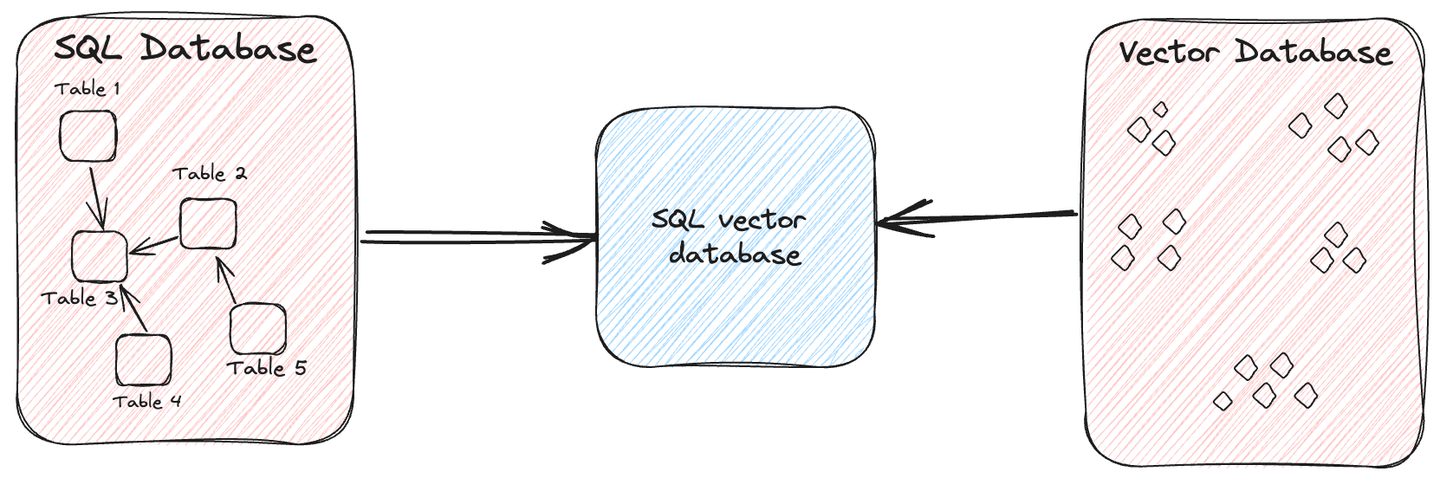
In simple terms, it's like a regular database that you can use to store both structured data and unstructured data, but with an added capability to perform rapid queries across various data types, including images, video, audio, and text. The mechanism behind this efficiency lies in the creation of vectors for the data, facilitating the swift identification of similar entries.
Now, let's try to understand the core concepts of SQL vector databases that would help to get the reason why we need SQL vector database.
SQL vector databases introduced some innovative concepts that significantly enhance data retrieval and analysis, especially in the context of unstructured and high-dimensional data. Let’s explore a few of them:
Note:
The goal of the vector indexing is to optimize search speed and accuracy when performing operations like similarity search for approximate nearest neighbors across high-dimensional vectors.
So, here comes a question into mind: Why do we need SQL vector databases? Traditional databases like MySQL, PostgreSQL, and Oracle have been working well for ages and have all the necessary features to keep the data organized. They have quick indexing methods, make sure you get the exact data you need without any trouble. Why do we need a SQL vector database?
No doubt, traditional databases are great but they do have some limitations when the data becomes huge and unstructured. Let's take a look:
To address these challenges, the development of SQL vector databases emerged, presenting a superior alternative to traditional databases.
Boost Your AI App Efficiency now
Sign up for free to benefit from 150+ QPS with 5,000,000 vectors
Combining SQL with Vectors brings a lot of benefits, among which several advantages stand out for their significant impact:
The integration of SQL and vector databases involves storing and indexing high-dimensional vectors in a way that can be efficiently queried using SQL. This process involves certain steps.
Note:
In this project, we employ MyScale, a SQL-based vector database for the initial implementation. However different SQL vector databases may work in different ways.
Firstly, you need to set up a database that supports both SQL and vector operations. Some modern databases have built-in support for vectors, while others can be extended with custom data types and functions.
In this example, we create a products table with a 1536D vector column that stores the high-dimensional vectors.
When inserting data, you would store both the structured attributes and the vector representations of the unstructured data.
In this SQL statement, we insert a new product record along with its vector.
Note:
To get the vector representation of the unstructured data, you can use models like GPT-4, and BERT.
The next step is to create vector indexes. It's the technique that defines how fast the database applies the similarity search. Many vector databases use specialized indexing techniques such as KD-trees, R-trees, or inverted index structures to optimize these operations.
Here, we create a MSTG index, which is suitable for indexing multidimensional data.
Note:
The MSTG algorithm is created by MyScale team which has surpassed all the mainstream vector search indexes (in terms of performance and cost-efficiency) used by many vector databases (opens new window).
To query the data, you just combine traditional SQL queries with vector operations. For instance, if you want to find products similar to a query vector, you can use the vector distance function.
This query finds the distance between the vector representations of the vector column and the query_vector . Then, it orders the results in ascending order with respect to distance.
Join Our Newsletter
This is where MyScale comes into play as a solution that combines relational databases and vector databases. Built on the open-source SQL database ClickHouse, MyScale allows running advanced vector queries directly with standard SQL syntax. This eradicates the hassle of integrating separate relational and vector databases. Unlike other vector databases like Pinecone, Milvus and Qdrant, MyScale provides a single SQL interface for vector search. It allows the storage of scalar and vector data, all within a single database. Now you can get lightning-fast vector results directly with familiar SQL.
It is widely assumed that relational databases cannot provide performance that matches that of vector databases. MyScale breaks this myth. In head-to-head comparisons, MyScale not only significantly outperforms pgvector (opens new window) in terms of search accuracy and query processing speed, but also shows a significant edge over specialized vector databases like Pinecone (opens new window), especially in cost-effectiveness and index building times. This outstanding performance, combined with the simplicity of SQL, makes MyScale the first choice for the businesses.
If you have more questions or are interested in our offering, don't hesitate to contact us Discord (opens new window) or follow MyScale on Twitter (opens new window).
此内容由惯性聚合(RSS阅读器)自动聚合整理,仅供阅读参考。 原文来自 — 版权归原作者所有。