


惯性聚合 高效追踪和阅读你感兴趣的博客、新闻、科技资讯
阅读原文 在惯性聚合中打开

推荐订阅源

让小产品的独立变现更简单 - ezindie.com
人人都是产品经理
人人都是产品经理
OSCHINA 社区最新新闻
OSCHINA 社区最新新闻
T
The Exploit Database - CXSecurity.com
N
News and Events Feed by Topic
Latest news
Latest news
cs.CL updates on arXiv.org
C
CXSECURITY Database RSS Feed - CXSecurity.com
IT之家
IT之家
V
V2EX
WordPress大学
WordPress大学
Apple Machine Learning Research
Cisco Talos Blog
Cisco Talos Blog
K
Kaspersky official blog
钛媒体:引领未来商业与生活新知
钛媒体:引领未来商业与生活新知
freeCodeCamp Programming Tutorials: Python, JavaScript, Git & More
S
SegmentFault 最新的问题
小众软件
小众软件
A
Arctic Wolf
酷 壳 – CoolShell
酷 壳 – CoolShell
腾讯CDC
宝玉的分享
宝玉的分享
Last Week in AI
Last Week in AI
G
GRAHAM CLULEY
罗磊的独立博客
T
Tor Project blog
C
Cisco Blogs
美团技术团队
博客园 - Franky
月光博客
月光博客
博客园 - 三生石上(FineUI控件)
T
Threat Research - Cisco Blogs
Cyberwarzone
Cyberwarzone
Threat Intelligence Blog | Flashpoint
有赞技术团队
有赞技术团队
奇客Solidot–传递最新科技情报
奇客Solidot–传递最新科技情报
Security Latest
Security Latest
博客园 - 司徒正美
Hugging Face - Blog
Hugging Face - Blog
Spread Privacy
Spread Privacy
J
Java Code Geeks
C
CERT Recently Published Vulnerability Notes
大猫的无限游戏
大猫的无限游戏
S
Securelist
The Cloudflare Blog
博客园 - 叶小钗
D
Darknet – Hacking Tools, Hacker News & Cyber Security
阮一峰的网络日志
阮一峰的网络日志
雷峰网
雷峰网
Project Zero
Project Zero

Ubuntu blog

Tracing a memory leak bug in PID 1 and contributing an upstream fix: a Linux support story | Ubuntu MAAS installation: bare metal provisioning is easier than ever | Ubuntu Januscape vulnerability CVE-2026-53359 mitigations available | Ubuntu Managing Ubuntu on bare metal at scale Ubuntu Server: a platform made for enterprise scale | Ubuntu Building an open source chain of trust: new research uncovers key blockers and ways forward | Ubuntu Beyond safety and security: Why automotive open source demands dependability  | Ubuntu DirtyClone Linux kernel local privilege escalation vulnerability fixes available | Ubuntu pedit COW kernel local privilege escalation vulnerability mitigations | Ubuntu Canonical becomes Gold Sponsor of Trifecta Tech Foundation | Ubuntu Challenges designers face in open source (and how to fix them) | Ubuntu Hunting a 16-year-old SQLite bug with TLA+: is dqlite affected? | Ubuntu Canonical announces live kernel patching for Arm64 | Ubuntu How to use RISC-V custom instructions with Ubuntu | Ubuntu Ubuntu Summit 26.04: connected by open source | Ubuntu So you need to add microcontrollers to your fleet: now what? | Ubuntu Validating real-world skills through Canonical Academy | Ubuntu Virtualized Android comes to Anbox Cloud | Ubuntu Template: Streamlining open source design contributions | Ubuntu Beyond Mythos: responding to a new threat landscape | Ubuntu A look into Ubuntu Core 26: Building a local AI inference appliance in a virtual machine | Ubuntu A decade of Ubuntu on IBM Z and IBM LinuxONE | Ubuntu AI at the edge: simplifying infrastructure with Cisco and Canonical | Ubuntu The next era of telco clouds: get open infrastructure choice with Sylva and Canonical Kubernetes | Ubuntu What is RDMA over Converged Ethernet (RoCE)? | Ubuntu Beyond tokens per watt – using Ubuntu 26.04 LTS for AI | Ubuntu A look into Ubuntu Core 26: Deploying AI models on Renesas RZ/V series for production | Ubuntu RISC-V profiles – why is RVA23 significant? | Ubuntu AI with AMD ROCm on Ubuntu: your questions answered | Ubuntu Ubuntu and Ubuntu Pro on Azure Cobalt 200 VMs | Ubuntu What is InfiniBand? | Ubuntu How Canonical Support solves hard Linux performance bugs  – even in 12-year old code | Ubuntu Securing AI agent workflows on Ubuntu with the new NVIDIA OpenShell snap | Ubuntu Canonical announces optimized Ubuntu images for TPU virtual machines by Google Cloud | Ubuntu VMware hypervisor deployment using MAAS | Ubuntu Migrating from Apache Spark 3 to Spark 4 | Ubuntu Introducing Workshop: launch sandboxed development environments on Ubuntu with a single command | Ubuntu Run agentic workloads on Arm and Ubuntu | Ubuntu Decoding design: How design and engineering thrive together in open source | Ubuntu Developing web apps with local LLM inference | Ubuntu PinTheft Linux kernel vulnerability mitigation | Ubuntu Canonical announces fully Managed Kubeflow AI operations platform on the Microsoft Azure Marketplace | Ubuntu A look into Ubuntu Core 26: Cloud-powered edge computing with AWS IoT Greengrass and Azure IoT Edge | Ubuntu CVE-2026-46333 (ssh-keysign-pwn) Linux kernel vulnerability mitigations | Ubuntu Finding the blind spot: How Canonical hunts logic flaws with AI | Ubuntu Fragnesia Linux kernel local privilege escalation vulnerability mitigations | Ubuntu Rethinking BYOD security: protecting data without trusting devices | Ubuntu Dirty Frag Linux kernel local privilege escalation vulnerability mitigations | Ubuntu Three weeks to go: A sneak peek of the Ubuntu Summit 26.04 experience | Ubuntu How to use Ubuntu on Windows | Ubuntu Fixes available for CVE-2026-31431 (Copy Fail) Linux Kernel Local Privilege Escalation Vulnerability | Ubuntu Run NVIDIA Nemotron 3 Nano Omni locally in a single command | Ubuntu Why Web Engineering is great | Ubuntu Ubuntu 16.04 LTS has reached the end of standard Expanded Security Maintenance with Ubuntu Pro. Here are your options. | Ubuntu Understanding disaggregated GenAI model serving with llm-d | Ubuntu From Jammy to Resolute: how Ubuntu’s toolchains have evolved | Ubuntu Hybrid search and reranking: a deeper look at RAG | Ubuntu Canonical expands Ubuntu support to next-generation MediaTek Genio 520 and 720 platforms | Ubuntu Intentional leadership at Canonical | Ubuntu Ubuntu Pro comes to Nutanix bare-metal Kubernetes | Ubuntu RISC-V 101 – what is it and what does it mean for Canonical? | Ubuntu Ubuntu Summit 26.04 is coming: Save the date and share your story! | Ubuntu How to manage Ubuntu fleets using on-premises Active Directory and ADSys | Ubuntu Simplify bare metal operations for sovereign clouds | Ubuntu How to Harden Ubuntu SSH: From static keys to cloud identity | Ubuntu The “scanner report has to be green” trap | Ubuntu Modern Linux identity management: from local auth to the cloud with Ubuntu | Ubuntu Canonical welcomes NVIDIA’s donation of the GPU DRA driver to CNCF | Ubuntu Hot code burns: the supply chain case for letting your containers cool before you ship | Ubuntu
Anbox Cloud on C4A metal: Android, at scale, without friction | Ubuntu
Bertrand Boi · 2026-06-24 · via Ubuntu blog

Why C4A metal is a great place to run Android and why Anbox Cloud makes that practical.

If you’ve spent even a small portion of time working with Android development at scale, you’ve likely encountered some pinch points.

The platform was built for Arm-based devices, mobile physical hardware, and tightly controlled system environments. Cloud platforms, on the other hand, are optimized for abstraction, elasticity, and shared infrastructure. Anbox Cloud has already bridged this gap, enabling Android developers to scale virtual instances in the cloud efficiently. 

Yet, even with this flexibility, some use cases and workloads, like system-level Android development or large-scale Cuttlefish farms, call for native Arm performance and direct hardware access. For years, developers had to choose between genuine Android execution with physical device labs and cloud efficiency.

With the launch of Google Cloud’s new Axion-based bare-metal instance, C4A metal, that trade-off starts to disappear. C4A-metal brings native Arm hardware directly into the cloud, without the performance limitations or complexity of nested virtualization. For Android workloads, this is a big deal.

And it’s the perfect fit with Anbox Cloud.
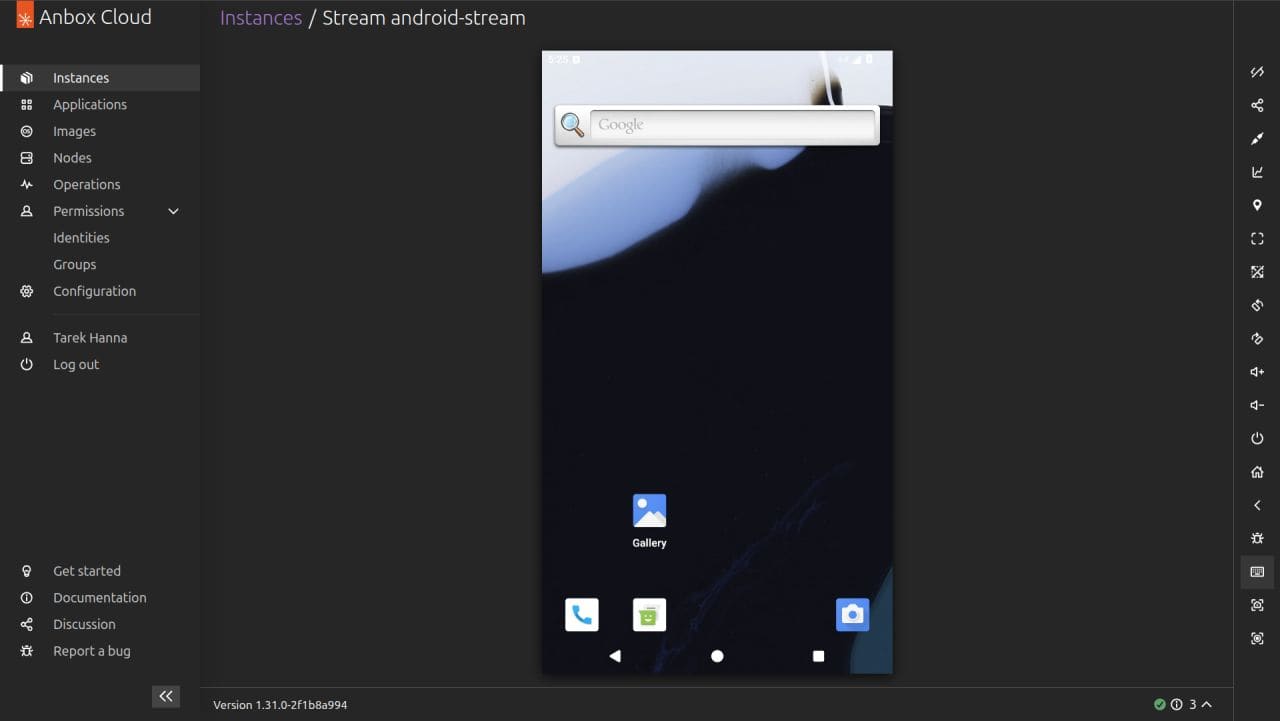
Anbox Cloud is Canonical’s platform for running Android at scale in cloud environments. It was built to manage, scale, and stream large numbers of Android instances reliably, whether for testing, CI/CD integration, automation, or interactive remote access.

On C4A metal, Anbox Cloud can run and orchestrate large fleets of Android systems directly on Arm hardware. There’s nothing special to configure, no alternative workflows to learn. You provision C4A metal, deploy Anbox Cloud, and Android workloads run exactly as you would expect, only now with native performance and cloud elasticity.

“Anbox Cloud’s support for fully virtualized Android provides an execution environment that closely matches the assumptions of AOSP and reference platforms such as Cuttlefish,” says Alistair Delva from Google’s Cloud Android team. “By allowing full Android system images, including the kernel, to run unmodified on scalable cloud and bare-metal infrastructure, such as C4A metal, Anbox Cloud enables system-level Android development, validation, and compliance workflows to move to the cloud with a level of fidelity that has traditionally required physical device labs. This combination of platform fidelity and cloud-scale operation represents a meaningful step forward for how Android systems can be built, tested, and operated.” 

From a developer’s point of view, this is where things get interesting. Android instances start quickly, can be scaled up and down programmatically and effortlessly, and can be accessed remotely through streaming when needed. From a platform point of view, everything is automated, observable, and reproducible.

It just works.

Scalable Cuttlefish environments, finally done right

One of the most compelling use cases for C4A metal is running large-scale Cuttlefish environments.

Android Cuttlefish is widely used for Android platform development and system validation, but it has traditionally been difficult to scale. Physical labs don’t grow on demand, and running virtual devices on top of virtual machines quickly becomes inefficient and non-representative.

C4A metal removes that bottleneck. Anbox Cloud can launch and manage many Cuttlefish-based Android systems directly on bare metal, with no nested virtualization. The result is a cloud-native Cuttlefish farm that behaves like real hardware but scales like cloud infrastructure.

For Android platform teams, automotive OEMs, and system developers, this means faster feedback cycles, higher parallelism, and far less operational overhead.

Not just bare metal: one platform across C4A and N4A

Bare metal is powerful, but it’s not the whole story.

Thanks to our close collaboration with Google Cloud, Anbox Cloud is designed to run across the Axion portfolio. Teams can use C4A metal for high-fidelity system testing while running build pipelines, orchestration services, and supporting infrastructure on C4A or N4A instances. The same Anbox Cloud deployment can span all of these environments without changing tools or workflows.

This flexibility is the real value. You don’t need to choose between realism and efficiency up front. You can place each part of your Android workflow on the infrastructure that fits it best, and still operate everything as a single, coherent platform.

A natural fit for modern Android development

Android was built for Arm. C4A metal brings Arm-native bare metal into the cloud. Anbox Cloud connects the two with a platform that knows how to run, scale, and stream Android reliably.

Together, they make Android development simpler, faster, and more scalable, without asking teams to compromise on performance or fidelity.

As Android workloads continue to grow beyond apps into full systems and platforms, having infrastructure that matches Android’s assumptions matters. With C4A metal and Anbox Cloud, that infrastructure is finally available as an on-demand cloud service.

Try Anbox Cloud on C4A metal now and stay tuned for further developments in our upcoming releases. For detailed instructions on how to upgrade your existing deployment, please refer to the Anbox Cloud documentation.

Further reading

Learn more about Anbox Cloud or contact our team to discuss your use case


Android is a trademark of Google LLC.

Anbox Cloud uses assets available through the Android Open Source Project.

The Android robot is reproduced or modified from work created and shared by Google and used according to terms described in the Creative Commons 3.0 Attribution License.