



惯性聚合 高效追踪和阅读你感兴趣的博客、新闻、科技资讯
阅读原文 在惯性聚合中打开

推荐订阅源

Microsoft Azure Blog
Google Online Security Blog
D
Darknet – Hacking Tools, Hacker News & Cyber Security
Threat Intelligence Blog | Flashpoint
Simon Willison's Weblog
T
Threat Research - Cisco Blogs
C
CXSECURITY Database RSS Feed - CXSecurity.com
L
Lohrmann on Cybersecurity
www.infosecurity-magazine.com
Forbes - Security
Forbes - Security
P
Palo Alto Networks Blog
Schneier on Security
S
Schneier on Security
T
Tor Project blog
cs.CL updates on arXiv.org
WordPress大学
WordPress大学
The Hacker News
The Hacker News
Hacker News - Newest:
Hacker News - Newest: "LLM"
罗磊的独立博客
Application and Cybersecurity Blog
F
Fortinet All Blogs
博客园 - 三生石上(FineUI控件)
小众软件
小众软件
C
Check Point Blog
Stack Overflow Blog
Stack Overflow Blog
Blog — PlanetScale
Blog — PlanetScale
雷峰网
雷峰网
S
Security @ Cisco Blogs
PCI Perspectives
PCI Perspectives
Spread Privacy
Spread Privacy
W
WeLiveSecurity
SecWiki News
SecWiki News
A
About on SuperTechFans
H
Help Net Security
博客园 - 司徒正美
Recent Commits to openclaw:main
爱范儿
爱范儿
S
Securelist
M
MIT News - Artificial intelligence
云风的 BLOG
云风的 BLOG
月光博客
月光博客
Jina AI
Jina AI
博客园 - 叶小钗
Vercel News
Vercel News
阮一峰的网络日志
阮一峰的网络日志
Recent Announcements
S
Secure Thoughts
The Cloudflare Blog
美团技术团队
freeCodeCamp Programming Tutorials: Python, JavaScript, Git & More

Ubuntu blog

Tracing a memory leak bug in PID 1 and contributing an upstream fix: a Linux support story | Ubuntu MAAS installation: bare metal provisioning is easier than ever | Ubuntu Januscape vulnerability CVE-2026-53359 mitigations available | Ubuntu Managing Ubuntu on bare metal at scale Ubuntu Server: a platform made for enterprise scale | Ubuntu Building an open source chain of trust: new research uncovers key blockers and ways forward | Ubuntu Beyond safety and security: Why automotive open source demands dependability  | Ubuntu DirtyClone Linux kernel local privilege escalation vulnerability fixes available | Ubuntu pedit COW kernel local privilege escalation vulnerability mitigations | Ubuntu Canonical becomes Gold Sponsor of Trifecta Tech Foundation | Ubuntu Challenges designers face in open source (and how to fix them) | Ubuntu Hunting a 16-year-old SQLite bug with TLA+: is dqlite affected? | Ubuntu Anbox Cloud on C4A metal: Android, at scale, without friction | Ubuntu Canonical announces live kernel patching for Arm64 | Ubuntu How to use RISC-V custom instructions with Ubuntu | Ubuntu Ubuntu Summit 26.04: connected by open source | Ubuntu So you need to add microcontrollers to your fleet: now what? | Ubuntu Validating real-world skills through Canonical Academy | Ubuntu Virtualized Android comes to Anbox Cloud | Ubuntu Template: Streamlining open source design contributions | Ubuntu Beyond Mythos: responding to a new threat landscape | Ubuntu A look into Ubuntu Core 26: Building a local AI inference appliance in a virtual machine | Ubuntu AI at the edge: simplifying infrastructure with Cisco and Canonical | Ubuntu The next era of telco clouds: get open infrastructure choice with Sylva and Canonical Kubernetes | Ubuntu What is RDMA over Converged Ethernet (RoCE)? | Ubuntu Beyond tokens per watt – using Ubuntu 26.04 LTS for AI | Ubuntu A look into Ubuntu Core 26: Deploying AI models on Renesas RZ/V series for production | Ubuntu RISC-V profiles – why is RVA23 significant? | Ubuntu AI with AMD ROCm on Ubuntu: your questions answered | Ubuntu Ubuntu and Ubuntu Pro on Azure Cobalt 200 VMs | Ubuntu What is InfiniBand? | Ubuntu How Canonical Support solves hard Linux performance bugs  – even in 12-year old code | Ubuntu Securing AI agent workflows on Ubuntu with the new NVIDIA OpenShell snap | Ubuntu Canonical announces optimized Ubuntu images for TPU virtual machines by Google Cloud | Ubuntu VMware hypervisor deployment using MAAS | Ubuntu Migrating from Apache Spark 3 to Spark 4 | Ubuntu Introducing Workshop: launch sandboxed development environments on Ubuntu with a single command | Ubuntu Run agentic workloads on Arm and Ubuntu | Ubuntu Decoding design: How design and engineering thrive together in open source | Ubuntu Developing web apps with local LLM inference | Ubuntu PinTheft Linux kernel vulnerability mitigation | Ubuntu Canonical announces fully Managed Kubeflow AI operations platform on the Microsoft Azure Marketplace | Ubuntu A look into Ubuntu Core 26: Cloud-powered edge computing with AWS IoT Greengrass and Azure IoT Edge | Ubuntu CVE-2026-46333 (ssh-keysign-pwn) Linux kernel vulnerability mitigations | Ubuntu Finding the blind spot: How Canonical hunts logic flaws with AI | Ubuntu Fragnesia Linux kernel local privilege escalation vulnerability mitigations | Ubuntu Rethinking BYOD security: protecting data without trusting devices | Ubuntu Dirty Frag Linux kernel local privilege escalation vulnerability mitigations | Ubuntu Three weeks to go: A sneak peek of the Ubuntu Summit 26.04 experience | Ubuntu How to use Ubuntu on Windows | Ubuntu Fixes available for CVE-2026-31431 (Copy Fail) Linux Kernel Local Privilege Escalation Vulnerability | Ubuntu Run NVIDIA Nemotron 3 Nano Omni locally in a single command | Ubuntu Why Web Engineering is great | Ubuntu Ubuntu 16.04 LTS has reached the end of standard Expanded Security Maintenance with Ubuntu Pro. Here are your options. | Ubuntu Understanding disaggregated GenAI model serving with llm-d | Ubuntu From Jammy to Resolute: how Ubuntu’s toolchains have evolved | Ubuntu Hybrid search and reranking: a deeper look at RAG | Ubuntu Canonical expands Ubuntu support to next-generation MediaTek Genio 520 and 720 platforms | Ubuntu Intentional leadership at Canonical | Ubuntu Ubuntu Pro comes to Nutanix bare-metal Kubernetes | Ubuntu RISC-V 101 – what is it and what does it mean for Canonical? | Ubuntu Ubuntu Summit 26.04 is coming: Save the date and share your story! | Ubuntu How to manage Ubuntu fleets using on-premises Active Directory and ADSys | Ubuntu Simplify bare metal operations for sovereign clouds | Ubuntu How to Harden Ubuntu SSH: From static keys to cloud identity | Ubuntu The “scanner report has to be green” trap | Ubuntu Modern Linux identity management: from local auth to the cloud with Ubuntu | Ubuntu Canonical welcomes NVIDIA’s donation of the GPU DRA driver to CNCF | Ubuntu Hot code burns: the supply chain case for letting your containers cool before you ship | Ubuntu
A decade of Ubuntu on IBM Z and IBM LinuxONE | Ubuntu
Pedro Lazzar · 2026-06-13 · via Ubuntu blog

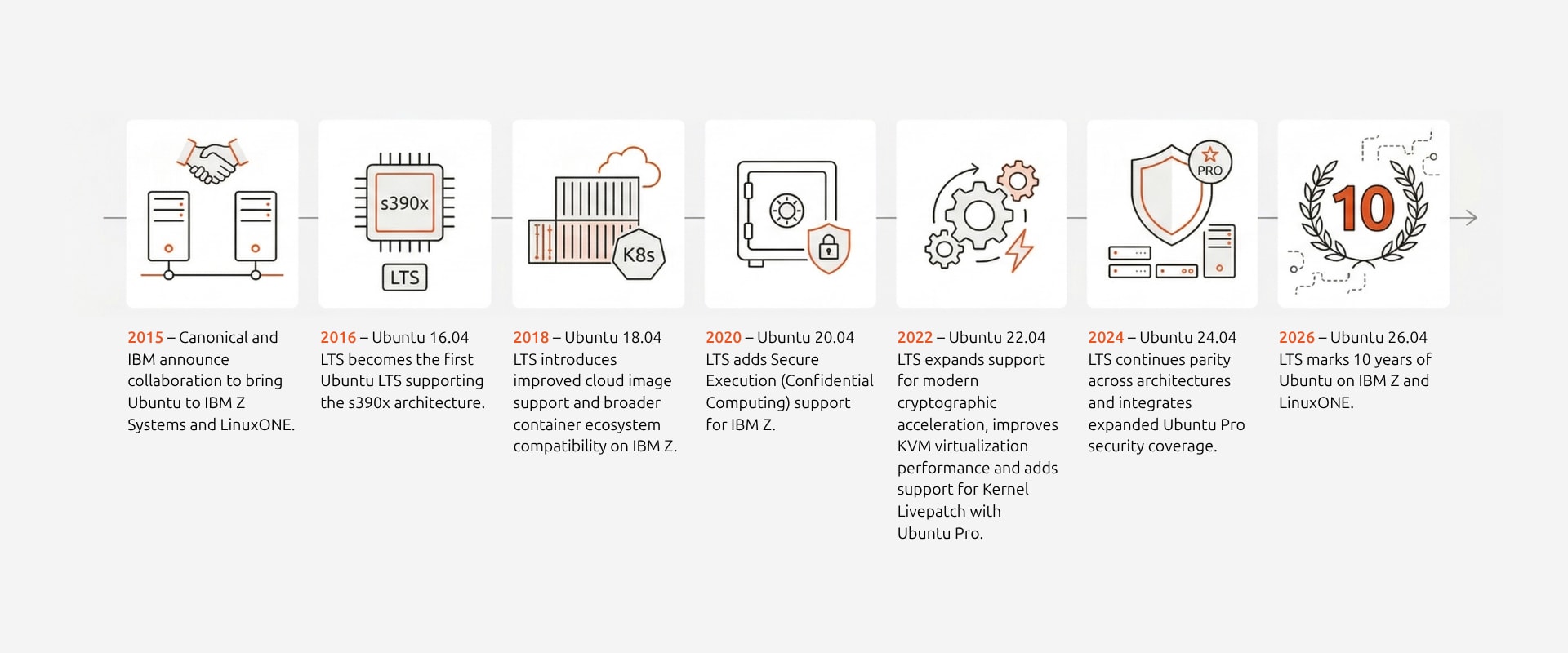
This year we celebrate a decade of Ubuntu Server support on the s390x architecture: marking a long-standing collaboration between Canonical and IBM that began at LinuxCon 2015. The first release happened on April 21, 2016, bringing Ubuntu 16.04 LTS (Xenial Xerus) to IBM Z and IBM LinuxONE platforms. 

A first for Ubuntu on IBM

That release was a significant milestone: for the first time, enterprises could deploy the vast Ubuntu ecosystem directly on IBM hardware. IBM Z and IBM LinuxONE platforms handle a significant portion of the world’s financial transactions, and power critical banking and healthcare systems. Native support ensured Ubuntu’s availability and long term sustainability for development and production workloads from day one, in environments that have some of the strictest security requirements.

Engineering for architecture parity

Canonical’s partnership with IBM allows organizations to modernize their mission-critical systems by bringing the Ubuntu developer ecosystem and Canonical’s enterprise support to IBM mainframes. 

Through this collaboration, large enterprises can freely adopt open source tools and technologies. For example, Canonical provides Ubuntu Server images for traditional installations, cloud images for KVM, OpenStack, LXD, and other virtualized environments, as well as OCI images for cloud native environments. This makes it easier for developers and organizations to develop applications on a different architecture, porting them to the IBM platform once it’s time to go to production.

Ubuntu supports multiple deployment modes on IBM Z and IBM LinuxONE, including:

  • LPAR (logical partitions)
  • z/VM virtualization
  • KVM
  • LXD and OCI containers

These deployment models enable enterprises to efficiently run a large number of isolated Linux workloads on the same physical system, a core advantage of IBM’s scale-up architecture. In environments where servers are often underutilized, this improves resource utilization, addressing common challenges such as data center sprawl, rising power costs and server consolidation needs.

How we partner to bring Ubuntu to more architectures

Ensuring a consistent Ubuntu experience in new systems, hardware and architectures requires dedication. To achieve this, our engineers work closely with both IBM and upstream developers to avoid forks and maintain high software quality. Some of the key highlights from our decade of collaboration include:

  • Maintaining s390-tools from version 1.34.0 to 2.41.0
  • Delivering early support for Secure Boot on IBM Z and LinuxONE
  • Enabling IBM Secure Execution (TEE) to protect data in use

At the same time, Canonical:

  • Ships a new version of Ubuntu every 6 months, and an LTS version every 2 years
  • Provides up to 15 years of support for LTS releases, one of the longest support life cycles in the market
  • Maintains thousands of open source packages in a constantly growing ecosystem

Why should you use Ubuntu in your enterprise?

Ubuntu brings world-class open source software and enterprise-grade security and stability for the widest range of applications, use cases and industries. Through this partnership, IBM integrates Ubuntu as a strategic part of it’s ecosystem, providing a high-performance, secure, and efficient foundation for mission-critical workloads on IBM Z and IBM LinuxONE.

Here are some core reasons why Ubuntu excels in enterprise environments:

  • Pervasive security: complements IBM hardware with support for Secure Execution (TEE) and end-to-end encryption for data at rest and in use
  • Maximum uptime: supports features like Kernel Livepatch allowing critical updates to be applied between maintenance windows, eliminating disruptive downtime
  • Streamlined compliance: simplifies regulatory requirements for the public sector through built-in support for FIPS and other industry certifications
  • Future-proof cryptography: integrates quantum-safe algorithms (ML-KEM and ML-DSA) via the Crypto Express 8S module to protect against evolving digital threats
  • Expanded security maintenance: with Ubuntu Pro, organizations get long-term stability with security patches for thousands of open source packages.

AI future-ready

Canonical is also working with IBM to ensure Ubuntu Server fully leverages the latest hardware technologies from IBM, including the IBM Telum® II processor and the IBM Spyre™ Accelerator. In that context, Ubuntu serves as the foundational ecosystem for modern AI development on IBM Z and IBM LinuxONE, bridging the gap between raw compute, multi-platform support, enterprise scale, and production-ready AI workloads. With a consistent environment across workstations and clouds, engineers and researchers can quickly transition from development to large-scale training and inferencing. 

What the future holds

It has been a successful 10 years with significant technical advancements, and we look forward to the next decade, and more. This collaboration has established a reliable path for enterprises to run Linux and Ubuntu on IBM infrastructure.

Today, Ubuntu continues to be fully certified across multiple generations of IBM Z and IBM LinuxONE systems, including IBM z17 and IBM LinuxONE 5, ensuring compatibility with modern enterprise hardware and cryptographic capabilities. As enterprise needs shift toward AI workloads, hybrid cloud architectures, and quantum-safe security, our unified stack provides the foundation required for the next decade of mission-critical computing.

Download Ubuntu Server for IBM Z and LinuxONE

Visit the IBM LinuxONE page

Or if you have any questions, contact us directly.