


惯性聚合 高效追踪和阅读你感兴趣的博客、新闻、科技资讯
阅读原文 在惯性聚合中打开

推荐订阅源

小众软件
小众软件
博客园 - Franky
罗磊的独立博客
G
Google Developers Blog
The GitHub Blog
The GitHub Blog
P
Proofpoint News Feed
Recent Announcements
V
V2EX
F
Fortinet All Blogs
阮一峰的网络日志
阮一峰的网络日志
Blog — PlanetScale
Blog — PlanetScale
月光博客
月光博客
U
Unit 42
GbyAI
GbyAI
A
About on SuperTechFans
WordPress大学
WordPress大学
Engineering at Meta
Engineering at Meta
雷峰网
雷峰网
Microsoft Azure Blog
Martin Fowler
Martin Fowler
D
DataBreaches.Net
The Cloudflare Blog
H
Hackread – Cybersecurity News, Data Breaches, AI and More
MongoDB | Blog
MongoDB | Blog

Engineering at Meta

ZGateway: Learnings from Putting a Proxy in Front of ZippyDB An Organizational Second Brain: Building an AI That Learns From Experts MetaRoCE: A New RDMA Transport Built for AI-Scale Ethernet MTIA 300: Meta’s First Training Chip with Built-in NICs and Communication-Offloading Engines How We’re Building Scam Alert on WhatsApp With End-to-End Encryption and Verifiability Guarantees From User Sequences to Scaling Laws: A Multi-Stage Architecture for Meta’s Ads Ranking GEM Training: How Meta Doubled the Efficiency of Its LLM-Scale Ads Foundation Model Exploring Hierarchical Interest Representation For Meta Ads Deep Funnel Optimization Modernizing the Meta Ads Service With an Open-Source Kernel Scheduler Meta’s AI Storage Blueprint at Scale 10 Years of Meta’s Commitment to Python Privacy-Aware Infrastructure in the AI-Native Era: An Asset Classification Case Study How Meta Engineered Ultra-Narrow Batteries for AI Glasses Adopting AV1 for Real-Time Communication (RTC) at Scale Lights Out, Systems On: Validating Instant Power Loss Readiness SilverTorch: Index as Model — A New Retrieval Paradigm for Recommendation Systems Migrating Data Ingestion Systems at Meta Scale Labyrinth 1.1: Making End-to-End Encrypted Backups Even More Reliable How Meta Is Strengthening End-to-End Encrypted Backups Modernizing the Facebook Groups Search to Unlock the Power of Community Knowledge Capacity Efficiency at Meta: How Unified AI Agents Optimize Performance at Hyperscale Post-Quantum Cryptography Migration at Meta: Framework, Lessons, and Takeaways Escaping the Fork: How Meta Modernized WebRTC Across 50+ Use Cases Trust But Canary: Configuration Safety at Scale How Meta Used AI to Map Tribal Knowledge in Large-Scale Data Pipelines KernelEvolve: How Meta’s Ranking Engineer Agent Optimizes AI Infrastructure Meta Adaptive Ranking Model: Bending the Inference Scaling Curve to Serve LLM-Scale Models for Ads AI for American-Produced Cement and Concrete Friend Bubbles: Enhancing Social Discovery on Facebook Reels Ranking Engineer Agent (REA): The Autonomous AI Agent Accelerating Meta’s Ads Ranking Innovation
Reel Friends: Building Social Discovery that Scales to Bi...
By Pascal Hartig · 2026-05-13 · via Engineering at Meta

On its face the new Friend Bubbles feature looks simple enough. It highlights Reels your friends have watched and reacted to. But sometimes the features that seem the most straightforward require the deepest engineering work.

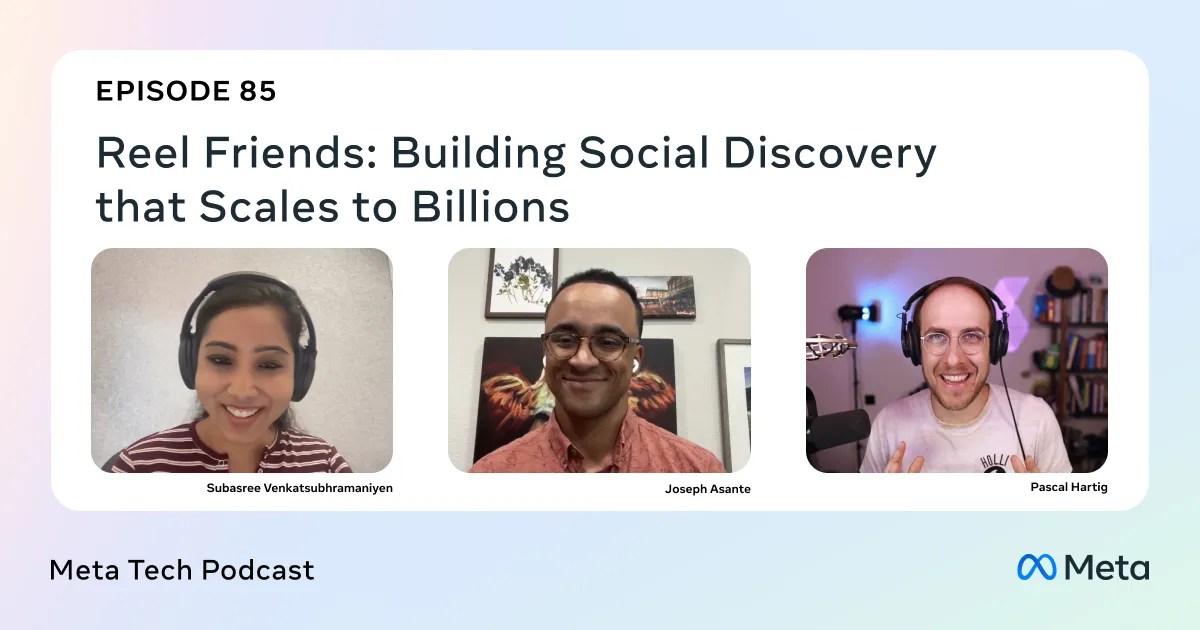
On this episode of the Meta Tech Podcast, Pascal Hartig chats with Subasree and Joseph, two software engineers from the Facebook Reels team, about what it took to bring Friend Bubbles to life. They discuss the evolution of the ‘ machine learning model behind the feature, the different behaviors between iOS and Android users, and the surprising discovery that finally made the whole feature click.

If you’ve ever underestimated a “simple” feature, this one’s for you.

Download or listen to the episode below:

You can also find the episode wherever you get your podcasts, including:

The Meta Tech Podcast is a podcast, brought to you by Meta, where we highlight the work Meta’s engineers are doing at every level – from low-level frameworks to end-user features.

Send us feedback on InstagramThreads, or X.

And if you’re interested in learning more about career opportunities at Meta visit the Meta Careers page.