Why is most sci-fi pessimistic?
Growing up, I never quite liked shows about technology. Black Mirror? I absolutely hated whatever parts of it I was forced to watch. This was weird. I was supposed to be a nerd. And I surrounded myself with tech-obsessed people pretty early. So why I didn’t I like sci-fi? People kept recommending new tech shows, and I either kept leaving them mid-way with a bitter taste, or eventually, just ignoring them.
A decade later, in the midst of what people now like to call the “AI bubble”, I think I have finally realized. People like being pessimistic about technology. For example, we’ve made incredible progress in AI in the last few years. And yet, instead of appreciating it, forget contributing to it, it seems like the whole world wants AI to be a bubble. Heck, they might even will it into “being” one, at least temporarily.
It then makes sense why most popular “sci-fi” has a dystopian tinge. People, it seems, don’t want things to well. So we get more pessimistic “tech” shows. This feeds into people being more skeptical about technology. And so it cycles.
On the other hand, since I was a kid, I’ve always liked technology. There are so many problems out there. How else will we solve them? We need more of it. Soon. At least, that’s what I concluded. The only show about “tech” I truly loved, and couldn’t stop re-watching, was Silicon Valley. Ironically, it felt most real, despite being a “caricature”.
There are clearly techno-optimists out there. We would pay so much for more sci-fi, that while rooted in realism, paints a positive picture. While we might be a minority, making us unworthy of Netflix’s attention, theres surely enough of a critical mass for someone to take this up. We need to break the wheel.
What surprises me is that technology companies haven’t produced such media. Why hasn’t Google funded a movie on how 2040 would look like, if things went well? I hope OpenAI does this when they use Sora to collaborate with Hollywood. Obviously, I am acutely aware of the risks of companies “influencing public opinion”, and believe it or not, technology at large. But right now, I daresay optimism is undersubscribed. Plus, if we can get people to imagine what a good future could be, we might inspire them to build it, which only increases the chance of things going well.
I’m not a writer, so for now, I’ll just use the amazing language models they’ve created:
Imagine a realistic “science fiction” scenario, where technology changes things for the better. Discuss how people’s lives change with concrete examples. Trace everything from micro to macro impacts. Write as an easy to read, part of a blog.
Here’s GPT-5-Pro: https://chatgpt.com/share/68ed7ede-4178-800f-a27f-ddf9b82b4060
Claude 4.5 Sonnet: https://claude.ai/share/1017dd04-58ef-44cb-bb75-14ad60818334a
Unfortunately, Gemini 2.5 Pro doesn’t allow me to share a link. But here’s a snippet:
Imagine Anya, a landscape architect in 2075. Her life is subtly and profoundly improved by her “Digital Custodian” (DC), which she calls “Elmsworth.”
Morning & Health: Anya wakes up not to an alarm, but when Elmsworth detects her sleep cycle has reached its natural conclusion. The lights in her apartment have slowly brightened to mimic a sunrise. In the kitchen, the nutrient printer has prepared a breakfast shake tailored to her body’s needs, which Elmsworth identified overnight via non-invasive sensors in her mattress. It detected slightly low magnesium levels and a need for more complex carbohydrates for her planned afternoon run. There’s no “dieting”; there’s just perfect, automated nutritional balancing.
Work & Creativity: Anya’s job isn’t about tedious drafting or soil analysis anymore. She interfaces with the city’s public works DC to design a new park. She describes her vision in broad strokes: “a space that encourages quiet reflection but can also handle weekend crowds, using native, drought-resistant plants.” Elmsworth, along with the city’s AI, instantly generates dozens of viable 3D models, complete with ecological impact reports, irrigation plans, and budget forecasts. Anya’s role is now purely creative and strategic. She spends her day refining the feel and purpose of the space, while the AI handles the immense technical workload. This frees up 90% of her time, which she can use for professional development or personal projects.
Learning & Leisure: After work, Anya decides to learn a traditional Japanese woodworking technique. Elmsworth curates a personalized lesson plan, using augmented reality overlays to guide her hands and show her exactly where to make the cuts on a piece of reclaimed timber. It adapts the difficulty in real-time based on her success rate. She’s not just watching a video; she’s receiving one-on-one tutelage from the world’s best virtual carpenter.
All models outputs involve reliable digital personal assistants, traffic optimization, better medical devices and more. Quite sane. And that’s the point! Even if nothing special happens, we could be headed toward a much better world. I would love swapping with the fictional characters the models imagine, living chill, comfortable lives.
And now, let’s ask GPT-5 Pro to create a “realistic” timeline. Note how the prompt is neutrally phrased. I just wanted to see what comes up by default.
Write a realistic perspective on how technology will progress. Go year by year, starting from 2026, to 2040, listing changes in a normal person’s life.
GPT-5 Pro: https://chatgpt.com/share/68ed7b91-37dc-800f-b552-86cbef466a61
Thankfully, its cautiously optimistic! I half-expected an aggregate of human sci-fi, highlighting what technology breaks in society. Instead, in 2040, everyday errands shrink with AI agents, driverless ride-hail becomes common, city infrastructure becomes more coordinated, misinformation reduces, and work culture optimizes outcomes over hours. Yet, I could totally imagine these outcomes as early as 2030…
So finally, a cooler prompt:
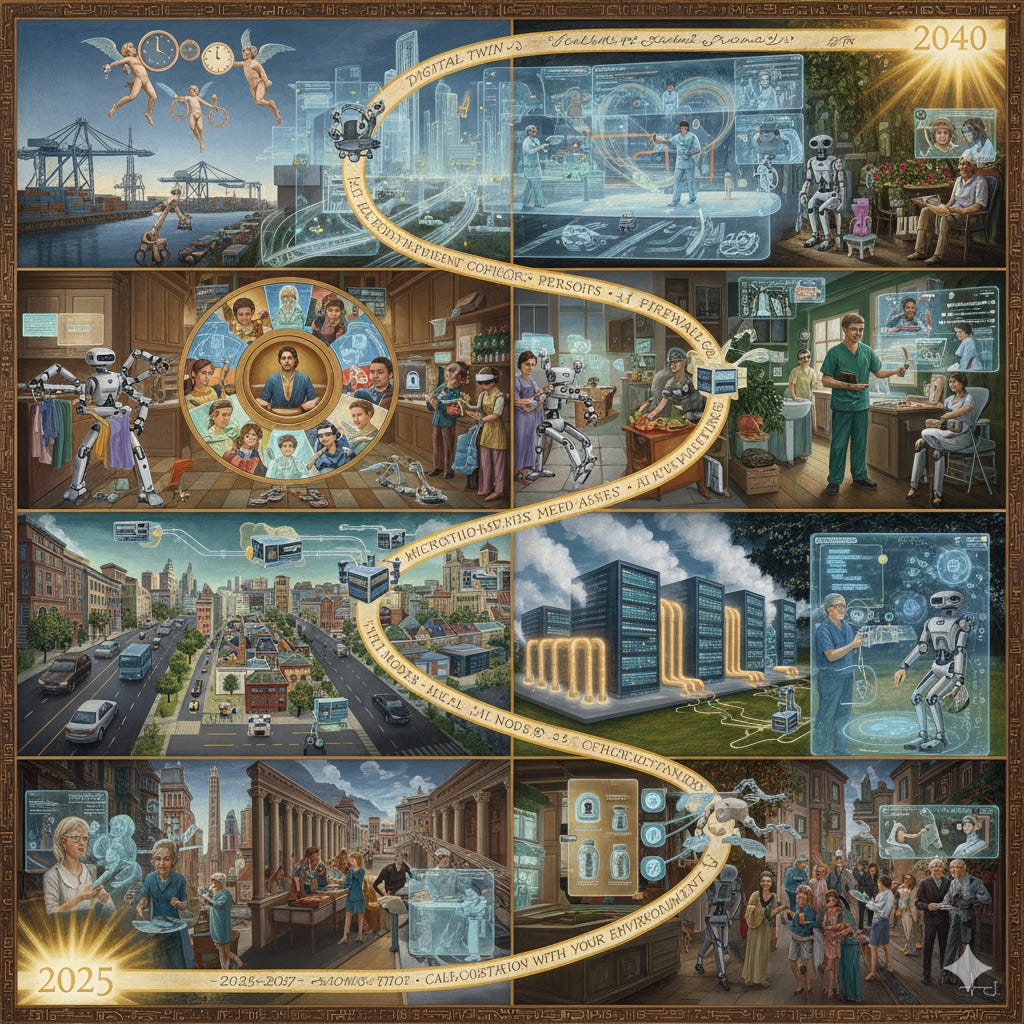
Imagine technological progress continues to be as fast as AI progress was between 2022 to 2025. How would the average person’s life change. Give a timeline from 2025 to 2040. Be creative, but realistic.
GPT-5 Pro: https://chatgpt.com/share/68ed80f5-811c-800f-8ff3-10839270430a
This one honestly feels closer to my expectations, but still too slow. What do you mean household robots do laundry only in 2033?! I wish OpenAI trained their models to be as imaginative, and ambitious as themselves… On the other hand, I like how it thinks Government services will have response times in seconds by 2032.
So finally, here’s the illustration of Technology 2040, imagined by GPT-5 Pro, and illustrated by Nanobanana🍌, in the style of a Renaissance grand mural.