



惯性聚合 高效追踪和阅读你感兴趣的博客、新闻、科技资讯
阅读原文 在惯性聚合中打开

推荐订阅源

The Hacker News
The Hacker News
C
Cisco Blogs
P
Privacy & Cybersecurity Law Blog
Cloudbric
Cloudbric
S
Security Affairs
PCI Perspectives
PCI Perspectives
The Last Watchdog
The Last Watchdog
AWS News Blog
AWS News Blog
Threat Intelligence Blog | Flashpoint
N
News and Events Feed by Topic
W
WeLiveSecurity
T
Tenable Blog
L
LINUX DO - 最新话题
T
Tor Project blog
Help Net Security
Help Net Security
cs.AI updates on arXiv.org
P
Proofpoint News Feed
爱范儿
爱范儿
O
OpenAI News
Hacker News - Newest:
Hacker News - Newest: "LLM"
Y
Y Combinator Blog
I
Intezer
C
Check Point Blog
Stack Overflow Blog
Stack Overflow Blog
Recent Announcements
Google DeepMind News
S
Securelist
P
Privacy International News Feed
cs.CL updates on arXiv.org
V
Vulnerabilities – Threatpost
Schneier on Security
量子位
SecWiki News
SecWiki News
L
Lohrmann on Cybersecurity
T
Threat Research - Cisco Blogs
Recent Commits to openclaw:main
M
MIT News - Artificial intelligence
H
Hackread – Cybersecurity News, Data Breaches, AI and More
Scott Helme
Scott Helme
H
Help Net Security
Vercel News
Vercel News
云风的 BLOG
云风的 BLOG
Spread Privacy
Spread Privacy
Know Your Adversary
Know Your Adversary
I
InfoQ
TaoSecurity Blog
TaoSecurity Blog
Blog — PlanetScale
Blog — PlanetScale
N
News | PayPal Newsroom
小众软件
小众软件
C
CERT Recently Published Vulnerability Notes

Google Developers Blog

Expanding Choice in Gemini Enterprise Agent Platform: Introducing Grounding with Parallel Web Search- Google Developers Blog Building scalable AI agents with modular prompt transpilation- Google Developers Blog Evolving Spec-Driven Development: Conductor Now Supports Antigravity- Google Developers Blog Systems Engineering Playbook: Optimizing Qwen 3.5-397B MoE on Ironwood (TPU7x)- Google Developers Blog Unlocking the Next Era of On-Device AI with Google Tensor and Pixel- Google Developers Blog LiteRT.js, Google's high performance Web AI Inference- Google Developers Blog Bridging the Domain Gap: AI Race Coach built with Antigravity and Gemini- Google Developers Blog We terminated a TPU mid-training and it recovered in seconds: Introduction to elastic training with MaxText- Google Developers Blog ML Development in VS Code with Google Cloud Power: Workbench Extension Now Available- Google Developers Blog Why we built ADK 2.0- Google Developers Blog Build agentic full-stack apps with Genkit- Google Developers Blog Driving the Agent Quality Flywheel from Your Coding Agent- Google Developers Blog Build reliable multi-agent applications with ADK Go 2.0. Discover our new graph-based workflow engine, built-in human-in-the-loop, and dynamic orchestration- Google Developers Blog Measuring What Matters with Jules- Google Developers Blog Build Cross-Language Multi-Agent Team with Google’s Agent Development Kit and A2A- Google Developers Blog How A2A is Building a World of Collaborative Agents- Google Developers Blog A2UI + MCP Apps: Combining the best of declarative and custom agentic UIs- Google Developers Blog Announcing the Agentic Resource Discovery specification- Google Developers Blog Enhance Security and Trust: New Session Metadata in Sign in with Google- Google Developers Blog Unlocking the Power of the TPU Stack: Introducing our new Developer Hub- Google Developers Blog DiffusionGemma: The Developer Guide Introducing the Google Colab CLI Gemma 4 12B: The Developer Guide Bringing Gemma 4 12B to your Laptop: Unlocking Local, Agentic Workflows with Google AI Edge Supercharge your integration workflow with the Google Pay & Wallet Developer MCP server How the community trained Gemma to "Think" with Tunix and TPUs The latest updates to Google Pay Enhancing Android Checkout with Dynamic Callbacks in Google Pay Empowering Service Providers and Hardware Partners with Gemini for Home Announcing ADK for Kotlin and ADK for Android 0.1.0: Building AI Agents on Android and Beyond Blazing fast on-device GenAI with LiteRT-LM One Year of Innovation: Celebrating 100k Members in the Google Cloud x NVIDIA Developer Community All the news from the Google I/O 2026 Developer keynote Google Tensor SDK Beta with LiteRT An important update: Transitioning Gemini CLI to Antigravity CLI Accelerating on-device AI: A look at Arm and Google AI Edge optimization Announcing Genkit Middleware: Intercept, extend, and harden your agentic apps Build Long-running AI agents that pause, resume, and never lose context with ADK Supercharging LLM inference on Google TPUs: Achieving 3X speedups with diffusion-style speculative decoding Building with Gemini Embedding 2: Agentic multimodal RAG and beyond Speeding Up AI: Bringing Google Colossus to PyTorch via GCSFS and Rapid Bucket Building real-world on-device AI with LiteRT and NPU Agents CLI in Agent Platform: create to production in one CLI
A Smarter Google AI Edge Gallery: MCP integration, notifications, and session continuity
Yishuang Pang, Jing Jin, Zichuan Wei, Alice Zheng · 2026-05-19 · via Google Developers Blog

Google AI Edge Gallery now supports the Model Context Protocol (MCP), notifications reminders, and persistent chat history—providing developers with a showcase to build connected, automated, on-device agentic experiences.


Google AI Edge Gallery (Android / iOS) is an on-device AI showcase app allowing users and developers to interact and build with Gemma and other open models. Last month, we introduced the capability to deploy agentic workflows directly on mobile devices using Gemma 4. Today, we are expanding the core capabilities of the app to bring more connected, proactive, and persistent interactions. By supporting the open-source Model Context Protocol (MCP), local notification reminders, and chat history, we are making the app a more useful place to experience and chat with models locally, giving you a playground to explore how you can coordinate tasks across your data and routines.

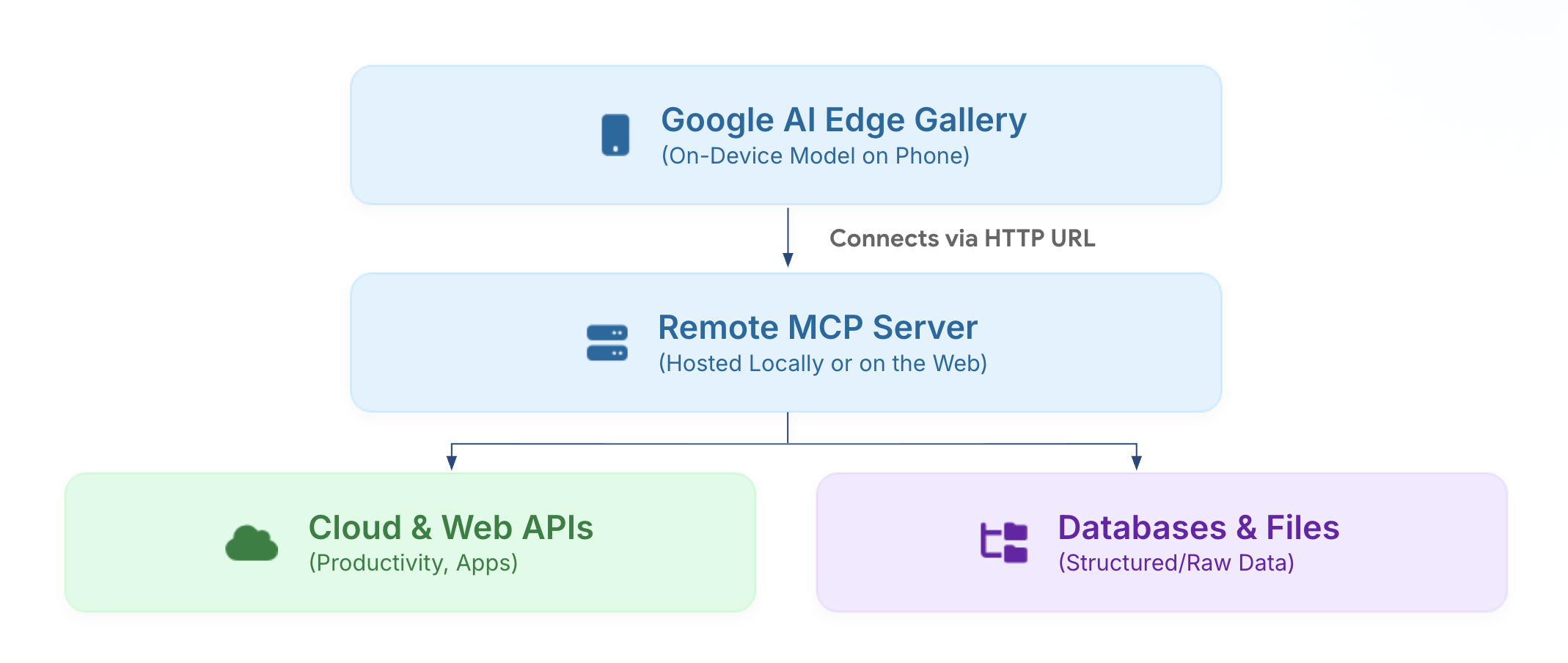
To augment an LLMs on-device capability, they need a standardized way to interact with the world outside the app sandbox. Based on developer interest in more flexible agent architectures, Google AI Edge Gallery now supports the open-source Model Context Protocol (MCP) over Streamable HTTP as an experimental feature in the Android app. The update to the iOS app is coming soon.
2

By registering a valid MCP URL inside the app, the app dynamically imports tool definitions and resource schemas directly into the on-device model’s system prompt. The reasoning and decision-making then happen entirely on your phone. When you ask a question, Gemma 4 automatically determines which tool is needed and generates the call locally; the request is then executed by the MCP server, which can be running on your home computer or a secure cloud endpoint.

This architecture allows the mobile device to coordinate complex tasks across various data sources and functional tools. For example:

  • Productivity boost: Connect to Google Workspace MCP to let your mobile agent query your calendar for upcoming events or check your inbox for bills and tickets information.
  • Navigation support: Use the Google Maps MCP to ask about nearby spots or travel times using natural language, making your agent a more capable travel companion.
  • Web Retrieval: Connect to web fetch MCP to allow your agent to retrieve and parse content from any URL. This enables the model to reason over real-time information—such as news or documentation—providing quick summarization or answers on the go.

Tips for developers:

Because on-device models operate within a smaller context window than large server-side models, we recommend keeping your MCP tool descriptions short. When returning data, sending back bite-sized snippets is preferred over long text to keep the experience fast and responsive.

Technical documentation and example configurations are available in our GitHub repository.

Scheduling routines with notification reminders

So far, AI interactions in the app have been reactive—the user opens the app and types a prompt to start a session. To enable more automated use cases, such as scheduled interactions, we’ve built a new "Schedule Notification" skill that makes it easy to set up manual routines.

If you tell the agent, "Remind me to log my mood every night at 10 PM," it schedules a local notification. When you tap that notification, the app opens directly to the right tool and starts a session with Gemma 4, ready to help.

Here are a few examples of how these proactive routines change the experience:

  • Mood tracking and insights: A daily nudge asks how you’re feeling. Over time, your agent can securely look back at your mood log history to spot trends and offer wellness insights.
  • "Learn something new": A daily notification invites you to learn a new concept. Tapping it launches the agent to summarize a random or chosen topic into a visually polished, shareable infographic card.
  • Calendar briefings: Get a morning alert that summarizes your day. The model quickly reads your local calendar and gives you a concise briefing on your schedule and any gaps in your day before you even leave the house.

More app enhancements: Continuity and control

In addition to new agent skills, we are addressing your top community feedback by introducing every-day app enhancements that provide more flexibility when experimenting with on-device models.

Using the fast prefill capability of the LiteRT-LM backend, we’ve added support for persistent chat history, allowing you to resume sessions while maintaining the state of text, images, and audio inputs. On modern phone GPUs, prefill speeds can exceed 3,000 tokens per second, allowing the model to restore long session contexts almost instantly.

Alongside session continuity, we’ve introduced the ability to edit the custom system prompt directly within the chat settings. This provides developers with the control to experiment with prompt engineering techniques, define specific model personas, or enforce strict output constraints for their on-device agents.

The Google AI Edge Gallery ecosystem is built on an open-source toolkit. While the skills we design provide inspiration, the true power of innovation resides within our developer community.

On our official GitHub Skills Discussion page, the community is using on-device models and edge hardware to build highly-tailored, utility-focused workflows across many categories:

  • Extend knowledge base: Lightweight web search integrations that can provide up-to-date information, such as weather and currency exchange rate.
  • Agentic prompting: Instructional building blocks that provide context management and allow models to interact in a more personalized way based on user preferences.
  • Useful parsers: Parsers that turn multimedia such as image, audio, and html into structured information, allowing users to conduct semantic search on useful personal information, such as expense or bookmarks.
  • Fun and learning: Card generators that turn text into shareable visual infographics, quiz, language translator, offline puzzle games, and even skills designed for pets.

Download the latest version of the app from the Play Store and App Store, try out different skills, and upvote your favorites! For builders—whether you are bridging your data ecosystem with custom MCP configurations, creating skills for different workflows, or building your own app—head over to our repository, share your ideas, and let us know what you’d like to see next in the app.

Acknowledgements

We'd like to extend a special thanks to our significant contributors for their work on this project: Ashley Lin, Cormac Brick, Eric Yang, Geonsun Lee, Glenn Cameron, Hriday Chhabria, Ian Ballantyne, Jenn Lee, Matthias Grundmann, Sachin Kotwani, Na Li, Olivier Lacombe, Omar Sanseviero, Rishika Sinha

Innovation in the app experience is also driven by our developer community. We are deeply appreciative for their work in developing and contributing new agent workflows and skills: GitHub Discussions.

Explore this announcement and all Google I/O 2026 updates on io.google.