


惯性聚合 高效追踪和阅读你感兴趣的博客、新闻、科技资讯
阅读原文 在惯性聚合中打开

推荐订阅源

aimingoo的专栏
aimingoo的专栏
WordPress大学
WordPress大学
阮一峰的网络日志
阮一峰的网络日志
博客园 - 司徒正美
月光博客
月光博客
宝玉的分享
宝玉的分享
Recent Announcements
小众软件
小众软件
H
Hackread – Cybersecurity News, Data Breaches, AI and More
美团技术团队
博客园 - 三生石上(FineUI控件)
A
About on SuperTechFans
J
Java Code Geeks
云风的 BLOG
云风的 BLOG
罗磊的独立博客
大猫的无限游戏
大猫的无限游戏
IT之家
IT之家
Vercel News
Vercel News
量子位
Martin Fowler
Martin Fowler
OSCHINA 社区最新新闻
OSCHINA 社区最新新闻
V
Visual Studio Blog
腾讯CDC
有赞技术团队
有赞技术团队

Google Developers Blog

Autonomous LLM post-training with Tunix on TPUs- Google Developers Blog The Anatomy of Harness Engineering: How to Evaluate, Iterate, and Guard AI Coding Agents- Google Developers Blog Announcing ADK for Kotlin 1.0: Building Production-Ready AI Agents in Kotlin, Android, and Beyond- Google Developers Blog Driving Developer Excellence: Inside the Program Sprints- Google Developers Blog 4 engineering patterns behind the strongest AI Agents Challenge submissions- Google Developers Blog Decoding cosmic signals with deep learning and Keras- Google Developers Blog Enterprise-Grade Precision for Long-Context Multimodal Embedding Inference on Cloud TPU- Google Developers Blog How to Evaluate Live & Voice Agents in ADK- Google Developers Blog Build zero-trust AI agents with Google's Agent Development Kit- Google Developers Blog Introducing Credentio: Open Source C++ Library for C2PA Content Credentials from Google- Google Developers Blog HeyGen x Google Cloud: Bringing Avatar IV to TPUs- Google Developers Blog Why Go is an Ideal Language for AI-Assisted Software Engineering- Google Developers Blog Mastering Edge AI on Raspberry Pi with LiteRT and Gemma- Google Developers Blog Agent Plugins package your skills, tools, and more- Google Developers Blog Scaling AI Agent Infrastructure with the MCP Stateless updates- Google Developers Blog A unified API for AI model routing- Google Developers Blog Scaling real-time AI agents with session-aware load balancing- Google Developers Blog Agent and Model Evaluations in Gemini Enterprise Agent Platform are now GA- Google Developers Blog Enable on-demand expertise with Agent Skills in Genkit Go- Google Developers Blog How to use Google microbenchmarks for evaluating TPU performance- Google Developers Blog Run Ray on TPU, Part 2: Ray AI libraries- Google Developers Blog Scaling Agentic RL: High-Throughput Agentic Training with Tunix- Google Developers Blog Run Ray on TPU, Part 1: The foundations- Google Developers Blog Expanding Choice in Gemini Enterprise Agent Platform: Introducing Grounding with Parallel Web Search- Google Developers Blog Building scalable AI agents with modular prompt transpilation- Google Developers Blog Evolving Spec-Driven Development: Conductor Now Supports Antigravity- Google Developers Blog Systems Engineering Playbook: Optimizing Qwen 3.5-397B MoE on Ironwood (TPU7x)- Google Developers Blog Unlocking the Next Era of On-Device AI with Google Tensor and Pixel- Google Developers Blog LiteRT.js, Google's high performance Web AI Inference- Google Developers Blog Bridging the Domain Gap: AI Race Coach built with Antigravity and Gemini- Google Developers Blog
How A2A is Building a World of Collaborative Agents- Goog...
Alan Blount · 2026-06-18 · via Google Developers Blog

If you've built with AI agents, you know the pain of treating them like simple, stateless tools. True agents need to be conversational and dynamic, but to unlock their real potential, they need a common language to collaborate and hand off tasks securely. That was our vision exactly one year ago when we launched the Agent-to-Agent (A2A) protocol. Today, as we celebrate A2A's 1st birthday, the vision of a collaborative agentic ecosystem is becoming a reality—and it's growing faster than you think.

Why A2A? The Architecture of Collaboration

Before we look at A2A in action, it's important to understand why we need a new protocol. Why not just connect agents via standard REST APIs?

APIs are rigid and deterministic; agents are fluid and autonomous. Treating an agent like an API severely limits its potential. The A2A protocol was designed specifically for the era of generative AI, offering several critical architectural advantages:
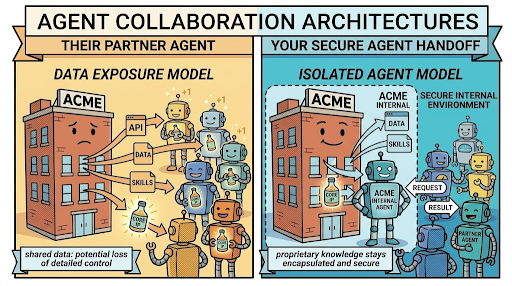
  • The Secure Boundary (Protecting the "Secret Sauce"): In enterprise scenarios, agents need to leverage sensitive data or bespoke internal processes that cannot be exposed to a public LLM or a third-party system. A2A facilitates a "black box" handoff: you assign a task to a specialized internal agent that maintains its own secure environment. The requesting agent gets the high-value output it needs, while your proprietary data and "how-to" logic remain encapsulated and strictly private.
  • Zero Context Pollution: LLMs have finite context windows. If you force a primary agent to handle complex, multi-step dependencies, its context window fills up, leading to hallucinations and degraded performance. By interacting via A2A, specialized peer agents handle their own massive dependencies and internal state without cluttering your primary agent's memory.
  • Dynamic Autonomy: When you call an API, it simply returns data or fails. When an agent calls an A2A peer, it initiates a collaboration. The receiving agent can understand intent, refine the plan, push back on incomplete requests, and ask clarifying questions if something is off.
  • Workload Distribution: Instead of a single person or team building an entire agentic solution from scratch, A2A allows for the distribution of specialized workloads. Different parts of a solution can be built and managed by other colleagues, teams, vendors, or managed agentic services who are domain experts and continuously improving their components. This modularity simplifies overall app design and makes it significantly easier to manage in the long run.

Agent Collaboration Architecuture image

Spotlight: FoldRun—Science at Scale Without the Stack

To see this architecture in action, we need to look no further than life sciences. Predicting a protein's 3D structure is the "Holy Grail" of biology, but for a developer, it's an infrastructure nightmare. Between petabyte-scale genetic databases, specialized GPU requirements, and the multi-step lifecycle of models like AlphaFold, OpenFold, and Boltz, recreating this functionality from scratch is a massive "complexity cliff."

Foldrun isn't just a tool or a script; it is a standalone, agentic interface.

In the old world, you'd have to pipe together a fragile workflow of APIs, or build your own agent, inject specialized skills, secure the environment, and hope you didn't break anything. In the A2A world, you simply add the Foldrun agent to Gemini Enterprise, the Gemini CLI, or any A2A-compliant environment.

Foldrun manages the long-running, autonomous tasks that require dynamic decision-making—like adjusting parameters based on prediction confidence and choosing between AlphaFold 2, OpenFold 3, or Boltz-2 depending on the molecule. You ask for the work, assign the task, and Foldrun delivers the output as a specialized peer.

Foldrun at home Quick-Start To see Foldrun in action within an A2A workflow:

  1. Pull the Image: Grab the Foldrun agentic interface from the Google Cloud Life Sciences GitHub.
  2. Connect via A2A: Register the agent in your A2A-supported environment.
  3. Delegate: Start assigning structure prediction tasks using natural language—no custom glue code required.

Developer Pro-Tip: Use the Gemini CLI to "hand off" a protein sequence to Foldrun. Gemini CLI supports any A2A agent, including Foldrun. While it handles the heavy lifting of the 3D modeling, your primary agent remains free to manage the rest of your research pipeline.
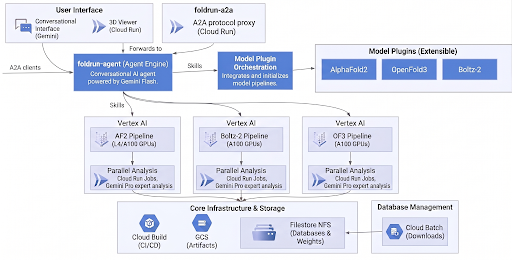
Foldrun architecture

Customer Testimonial:

“To ensure FoldRun meets the complex demands of real-world environments, we partnered closely with BicycleTx as a core design partner. Their team has been actively evaluating the solution, providing crucial feedback that has directly shaped the feature's development.

"We’ve been looking at ways of getting the power of co-folding models into the hands of our scientists from various teams. Having a solution that allows them to do this with an agentic interface, one which our organization is embracing through Gemini Enterprise, has made testing and integration with workflows much easier,"
— Richard Hughes, BicycleTx
By exploring FoldRun within their processes, BicycleTx is unlocking new ways to optimize workflows and scale their agent-driven operations. We are incredibly grateful for their ongoing partnership and are excited to bring these capabilities to the broader community soon.”

What Else Can You Do With A2A?

If A2A can orchestrate petabyte-scale biological modeling, what else can it unlock? By standardizing how agents communicate, we are seeing incredible innovation across every sector of the industry:

  • Agentic Commerce & Autonomous Payments: This is where the autonomous economy becomes real. Developers are leveraging A2A for transactional integrity, allowing AI agents to securely negotiate deals, verify inventory, and execute B2B purchases seamlessly on behalf of their users.
  • Enterprise Data & Real-Time Streaming: Agents are being deployed to securely monitor real-time event streams and enterprise databases. Instead of exposing raw data pipelines to a central LLM, specialized A2A agents sit at the edge of the data, pulling insights and triggering downstream workflows only when specific, compliant conditions are met.
  • Cross-Platform IT & DevOps: Operational silos are breaking down. Imagine a primary HR agent coordinating with a specialized DevOps agent via A2A. The HR agent securely hands off the required role parameters, and the DevOps agent autonomously provisions software licenses, repository access, and secure environments across multiple disconnected SaaS platforms.
  • Secure Telecom & Regulated Networks: In highly regulated sectors, security is paramount. A2A is being utilized to guarantee quantum-safe, end-to-end Message Layer Security (MLS) for autonomous systems, ensuring that agents can collaborate on sensitive data without ever exposing the underlying information.

Get Started & Join the Celebration

The easiest way to join the ecosystem is through our official SDKs. Whether you are building from scratch or extending the spec, the path to interoperability has never been clearer.

  • Build: Download the Official A2A SDKsPython and Go are 1.0 GA, Java (Beta) and .NET (Preview) are tracking the 1.0 spec and on track for GA, and JavaScript/TypeScript ships on the stable v0.3 line with 1.0 work in progress.

It’s our 1st Birthday, but you get the gifts. We want to see what you’ve built! Post a photo of yourself (or your agent's avatar!) and tag us on social media, we’ll be featuring our favorite community projects,