








After its spectacular market debut, SpaceX stock is coming back down to Earth: shares in Elon Musk’s space company fell for a third consecutive trading day on Monday. Shortly after the open, the stock was down more than 5 percent, a drop of around $10 to roughly $175 per share. The week before, the stock had already lost more than 8 percent over Wednesday and Thursday combined.
SpaceX has lost considerable ground in the ranking of the world’s most valuable companies, slipping to “only” seventh place, behind TSMC and Amazon. Even so, the space company built around an AI core still commands a hefty valuation of 2.2 trillion dollars:
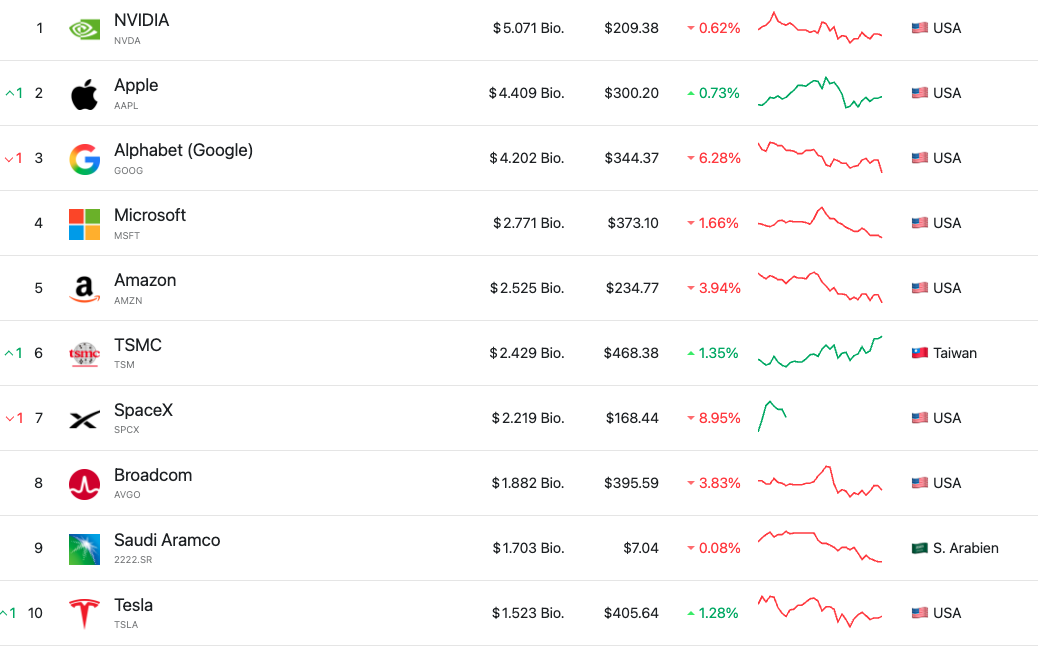
The pullback follows an extraordinary rally that had briefly pushed SpaceX to a valuation of nearly 3 trillion dollars the previous week. At that peak, the company overtook Amazon and Microsoft to become, for a time, the fourth-most valuable company in the world. By Thursday’s close, its market capitalization was already back down to 2.4 trillion dollars – several hundred billion dollars below the all-time high. With Monday’s renewed losses, the correction is continuing.
Despite the recent decline, the stock still trades well above its offering price: measured against the IPO price of 135 dollars, the shares are still up around 30 percent.
In its IPO on June 19 – the largest in history – the stock rose 19 percent on its first day of trading. Musk thereby became the first-ever trillionaire. Even beforehand, some analysts had questioned the lofty valuation. For 2025, SpaceX reported a loss of 4.9 billion dollars on revenue of 18.7 billion dollars.
Right after its record-breaking IPO, SpaceX already wants to raise additional capital – this time through the debt market. In a regulatory filing on Monday, the company announced that it intends to issue senior unsecured notes to qualified institutional investors. Beforehand, Moody’s, Fitch and S&P Global had assigned the company investment-grade ratings.
SpaceX did not disclose the exact size or terms of the offering. The proceeds, however, are intended to help repay a 20-billion-dollar bridge loan, which accounts for most of its total liabilities of around 29 billion dollars. The loan, due in September 2027, had been used to pay off debt from xAI – Musk’s AI startup, which SpaceX acquired in February. Further long-term liabilities are tied to AI infrastructure, according to the IPO documents.
In its IPO just days ago, SpaceX raised 85.7 billion dollars – more than any other offering before it. As of June 19, the company said it held 100.8 billion dollars in liquid assets. Much of that is earmarked for capital-intensive projects, including data centers in space, the development of the Starship heavy-lift rocket, and the build-out of the “Terafab” chip facility in Texas. Analysts at Oppenheimer expect SpaceX to raise additional capital primarily through debt – following the template set by Tesla.
Analyst assessments are mixed. KeyBanc initiated coverage of the stock on Monday with a “Sector Weight” rating, arguing that the share price already largely prices in the company’s growth potential. SpaceX does possess “significant disruptive growth avenues,” it said, but these are already reflected in the current valuation. Based on KeyBanc’s models, the stock trades at roughly 29 times estimated 2027 sales and around 71 times expected EBITDA – a substantial premium over most of its peers.
Other firms are more optimistic: Zephirin initiated coverage with a “Buy” rating and a price target of 310 dollars, while Oppenheimer puts the stock at 250 dollars. Franco Granda of Pitchbook, by contrast, cautioned that investors should be skeptical of the company’s timelines.

Aus Datenschutz-Gründen ist dieser Inhalt ausgeblendet. Die Einbettung von externen Inhalten kann in den Datenschutz-Einstellungen aktiviert werden:
此内容由惯性聚合(RSS阅读器)自动聚合整理,仅供阅读参考。 原文来自 — 版权归原作者所有。