


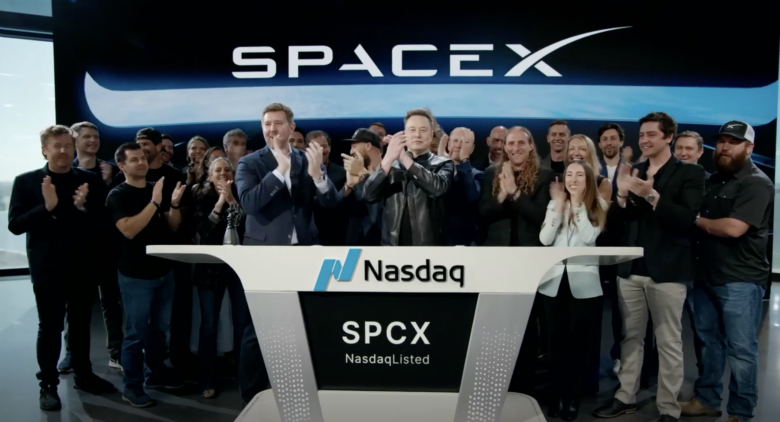
Elon Musk’s space company SpaceX pulled off the largest stock-market debut in history on June 12, 2026 — and it didn’t just make the founder rich. According to an analysis by the pre-IPO trading platform Hill.com (formerly Hill Markets), roughly 4,400 current and former employees are set to become millionaires, with about 400 of them holding stakes worth more than $100 million. Hill.com founder Andrew Benson notes that it is highly unusual for an IPO to push not just the founders but hundreds of staff past that threshold.
The record IPO in numbers
SpaceX raised $85.7 billion — more than 3x the previous record (Saudi Aramco, 2019, around $29 billion). Trading under the ticker SPCX, the stock opened at $150 and closed its first day at $160.95 (+19%). The company is now valued at roughly $2.2 trillion, equivalent to a share price of about $168. The listing made Musk the first trillionaire in history.
The biggest individual winners
Beyond Musk, the S-1 filed with the SEC shows where the largest fortunes land (calculated at the current $2.2 trillion valuation):
- Antonio Gracias (board member and head of the private equity firm Valor) holds 503.4 million disclosed Class A shares through his Valor entities — about $85 billion at roughly $168 per share. CNBC puts Valor’s total position across multiple funds even higher, at more than $160 billion.
- Bret Johnsen (CFO since 2011) sits on 9.6 million shares worth around $1.6 billion.
- Luke Nosek (board member and Founders Fund partner) turned $20 million from 2008 into roughly $5.6 billion.
The major investors
Early institutional backers are booking some of the largest paper gains in venture-capital history:
- Alphabet/Google invested around $900 million in 2015 (alongside Fidelity) at a $10 billion valuation and holds about 6–7% today. The position is worth more than $75 billion (some estimates run considerably higher).
- Founders Fund (Peter Thiel) came in with $20 million in 2008 after three failed launches and now sits on a paper gain of likewise more than $75 billion — one of the largest single returns in venture-capital history.
- Fidelity joined in 2015, holds about 2%, and reaches roughly $44 billion — a more than 100x return.
- Sequoia Capital invested a total of about $2 billion for roughly 1.5% — a paper gain of more than $25 billion.
- D1 Capital (entered in 2020) holds shares worth around $25 billion (a more than 33x return).
- Andreessen Horowitz led a $750 million round in 2023; other beneficiaries include Ark Invest (Cathie Wood), star investor Ron Baron, Coatue, Thrive Capital, and Baillie Gifford.
Important: these are largely paper gains, and the estimates vary depending on dilution assumptions. Many VC funds are legally obliged to return capital to their limited partners once the lock-up period ends — so a portion of these shares is likely to reach the market over time.
From welder to millionaire
How far the wealth reaches is shown by Juan Hernandez: the Mexican-born family man hired on as a welder at SpaceX in 2015 without knowing the company, and received stock there as part of his compensation for the first time in the US. His 6,500 shares are worth around $1.09 million at the current valuation. He has no intention of stopping work despite the sudden windfall — though he now works for rival Blue Origin.
Not everyone believed in the value of their paper: according to the New York Times, some employees traded their shares over the years for restaurant vouchers — a move they are likely to regret today.
What does a pre-IPO trading platform do?
Platforms like Hill.com let investors buy and sell stakes in still-private companies such as SpaceX, OpenAI, or Anthropic — that is, before they go public. Technically, you usually don’t invest in shares directly but in a single-asset fund that holds the shares (or an interest in them); one fund unit corresponds economically to one share of the target company. The appeal lies in access and speed: conventional pre-IPO deals often take weeks, while Hill promises to close in seconds.
The catch: such investments are high-risk, illiquid, and opaque, which is why they are aimed primarily at accredited investors. There is no guaranteed return — an announced IPO can be delayed, fall through, or come in lower than hoped.
Aus Datenschutz-Gründen ist dieser Inhalt ausgeblendet. Die Einbettung von externen Inhalten kann in den Datenschutz-Einstellungen aktiviert werden: