







Editor’s note: Faig Mahmudov is a journalist based in Azerbaijan covering regional security, foreign policy, and geopolitical developments. The views expressed in this article are his own and do not necessarily reflect the official position or editorial stance of News.Az.
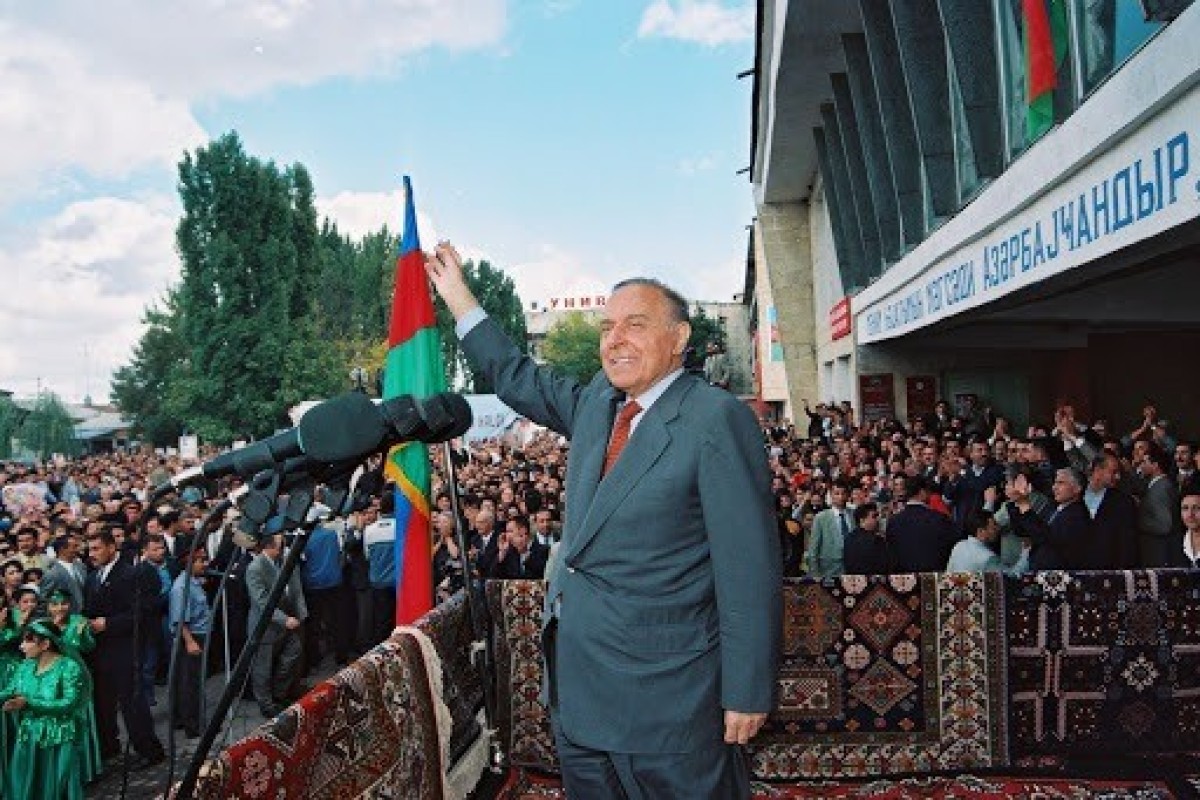
In Azerbaijan’s modern political history, 15 June 1993 is commonly commemorated as National Salvation Day. However, viewing this date merely as a public holiday or political symbol does not fully capture its significance. In reality, it marks Azerbaijani state's transition from the brink of disintegration to a model of stable governance, laying the foundations for the country’s transformation into a regional power in the decades that followed.
Today, Azerbaijan has the largest economy in the South Caucasus, the strongest military capability in the region, and considerable geopolitical influence. Yet in the early 1990s, the situation was dramatically different. The country faced military setbacks, political turmoil, economic collapse, and a very real threat of fragmentation.
This is why understanding the political significance of 15 June requires recalling the circumstances Azerbaijan faced during that critical period.
Source: AzerTAG
Following the collapse of the Soviet Union in 1991, Azerbaijan formally gained independence. However, declaring independence and establishing a functioning state are two very different processes.
The newly independent republic was effectively attempting to operate on the remnants of a collapsing Soviet administrative system. Economic ties had been severed, industrial production had largely ground to a halt, inflation was rising rapidly, and living standards were deteriorating.
At the same time, Armenia’s military offensive against Azerbaijan was expanding. The occupation of Shusha in 1992, followed by the loss of Lachin, marked major turning points in the First Karabakh War. In 1993, the occupation of Kalbajar further intensified the crisis and prompted the United Nations Security Council to adopt its first resolution on the conflict.
Azerbaijan was not only losing territory; its state institutions were also facing a profound governance crisis.
The Popular Front–Musavat administration, which came to power in 1992, initially enjoyed significant public support and high expectations. However, it soon became clear that political idealism alone was insufficient to govern a country at war.
Internal rivalries within the government intensified. State institutions weakened, security structures lacked coordination, and the military operated without a unified chain of command.
Many armed formations functioned independently, outside effective state control. The central government struggled to exercise authority across the country.
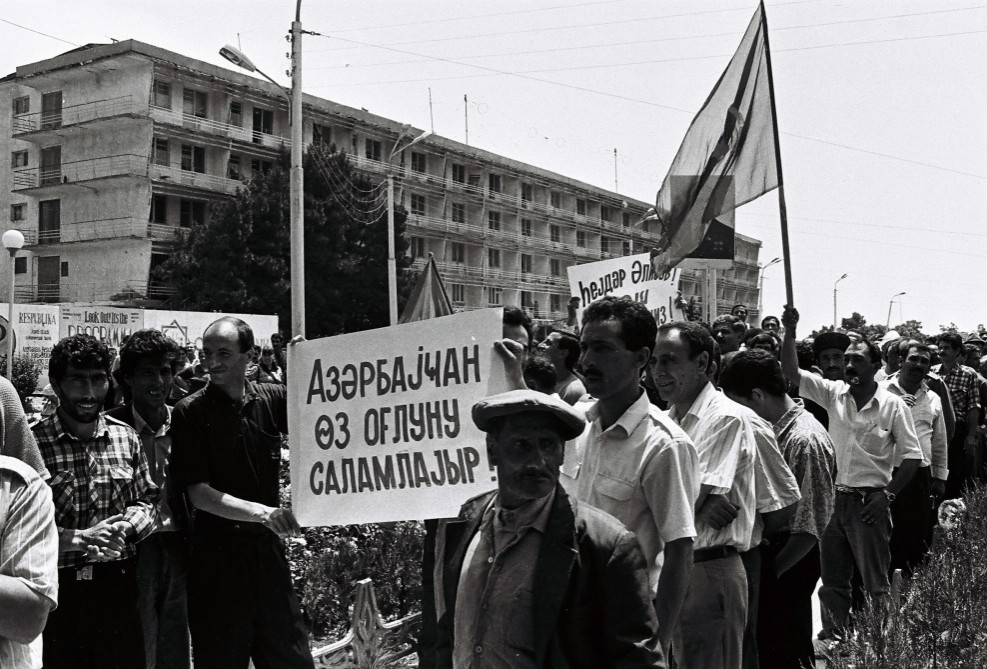
The events in Ganja in the summer of 1993 demonstrated just how critical the situation had become. The issue was no longer simply political competition; Azerbaijan was facing the risk of civil war.
Separatist tendencies were becoming increasingly visible in different parts of the country. In the south, the self-proclaimed “Talysh-Mugan Republic” emerged, while various autonomy movements appeared in the north, posing direct challenges to Azerbaijan’s territorial integrity.
Many Azerbaijani historians and political analysts describe this period as one of the most severe tests of statehood in the country’s modern history.
Source: AzerTAG
The return of Heydar Aliyev to power in June 1993 is often presented as a political development. In reality, the central challenge at the time was restoring governability and preventing state collapse.
Upon assuming leadership, Aliyev identified three immediate priorities:
The prevention of coup attempts in October 1994 and March 1995 became key milestones in strengthening central authority.
These developments demonstrated that Azerbaijan was gradually transforming from a country influenced by competing armed groups and regional power centres into a state with a functioning governance system.
The 1994 ceasefire with Armenia has been the subject of political debate for years.
However, when viewed in the context of the realities of that period, its strategic rationale becomes clearer. Azerbaijan was militarily weak, economically exhausted, and politically unstable.
The ceasefire provided two crucial opportunities.
First, it gave the government time to build functioning state institutions.
Second, it created conditions for implementing a long-term economic development strategy.
Subsequent events demonstrated that this was not merely a tactical decision, but a strategic one.

Source: AZTV
Commissioned in 2006, the Baku–Tbilisi–Ceyhan oil pipeline remains one of the most significant geoeconomic projects in Azerbaijan’s history.
For the first time, Azerbaijan gained a direct export route to global markets that bypassed Russia.
The project did far more than increase energy exports.
It transformed Azerbaijan into a key partner in Western energy security.
Subsequent projects, including Baku–Tbilisi–Erzurum, TANAP, and TAP, followed the same strategic logic.
Following the energy disruptions of recent years, Azerbaijan’s role in Europe’s energy security architecture has become even more significant, underscoring the long-term success of that strategy.
Beginning in the mid-2000s, Azerbaijan’s financial resources expanded considerably.
Funds accumulated in the State Oil Fund were invested in infrastructure, social development programmes, and defence modernisation.
One of the most important priorities was military reform.
Azerbaijan expanded defence cooperation with Türkiye, Israel, Pakistan, and other countries.
Modern weapons systems were acquired, special operations forces were strengthened, and military training programmes were intensified.
By 2020, a military that had been considered one of the weakest in the region in the early 1990s had become the strongest armed force in the South Caucasus.
The 44-day Patriotic War is often viewed primarily through a military lens.
However, its political and geopolitical dimensions are equally significant.
The outcome in 2020 was not solely the result of battlefield success.
It reflected the cumulative impact of the economic model, foreign policy strategy, energy diplomacy, and military modernisation pursued since 1994.
For the first time, Azerbaijan fundamentally altered the trajectory of the conflict and restored control over a substantial portion of its internationally recognised territories.
The local anti-terror measures conducted in September 2023 led to the dissolution of separatist structures in Karabakh.
As a result, Azerbaijan restored constitutional order and sovereign authority across its entire territory.
This development should be viewed not only as a military achievement, but also as the final stage of a long state-building process that began decades earlier.

Source: APA
Today, Azerbaijan has the largest economy in the South Caucasus.
The country serves as one of the key pillars of the Middle Corridor connecting Europe and Asia.
It plays an increasingly important role in Europe’s energy security.
At the same time, Azerbaijan maintains strategic partnerships with Türkiye, Central Asian states, the European Union, China, and countries across the Middle East.
This status did not emerge by chance.
It is rooted in the political stability, energy strategy, economic development model, and institutional strengthening pursued since 1993.
When viewed through a political rather than an emotional lens, the principal lesson of 15 June becomes clear.
The greatest threat facing Azerbaijan in 1993 was not only external aggression. It was the weakening of state institutions, the breakdown of governance, and the risk of national fragmentation.
The following three decades demonstrated that statehood, economic development, military strength, and geopolitical influence are deeply interconnected.
The foundations of Azerbaijan’s emergence as a regional power were laid precisely at that moment, when the country succeeded in preserving and rebuilding its statehood in 1993.
(If you possess specialized knowledge and wish to contribute, please reach out to us at opinions@news.az).
此内容由惯性聚合(RSS阅读器)自动聚合整理,仅供阅读参考。 原文来自 — 版权归原作者所有。