



Sign up to see the future, today
Can’t-miss innovations from the bleeding edge of science and tech
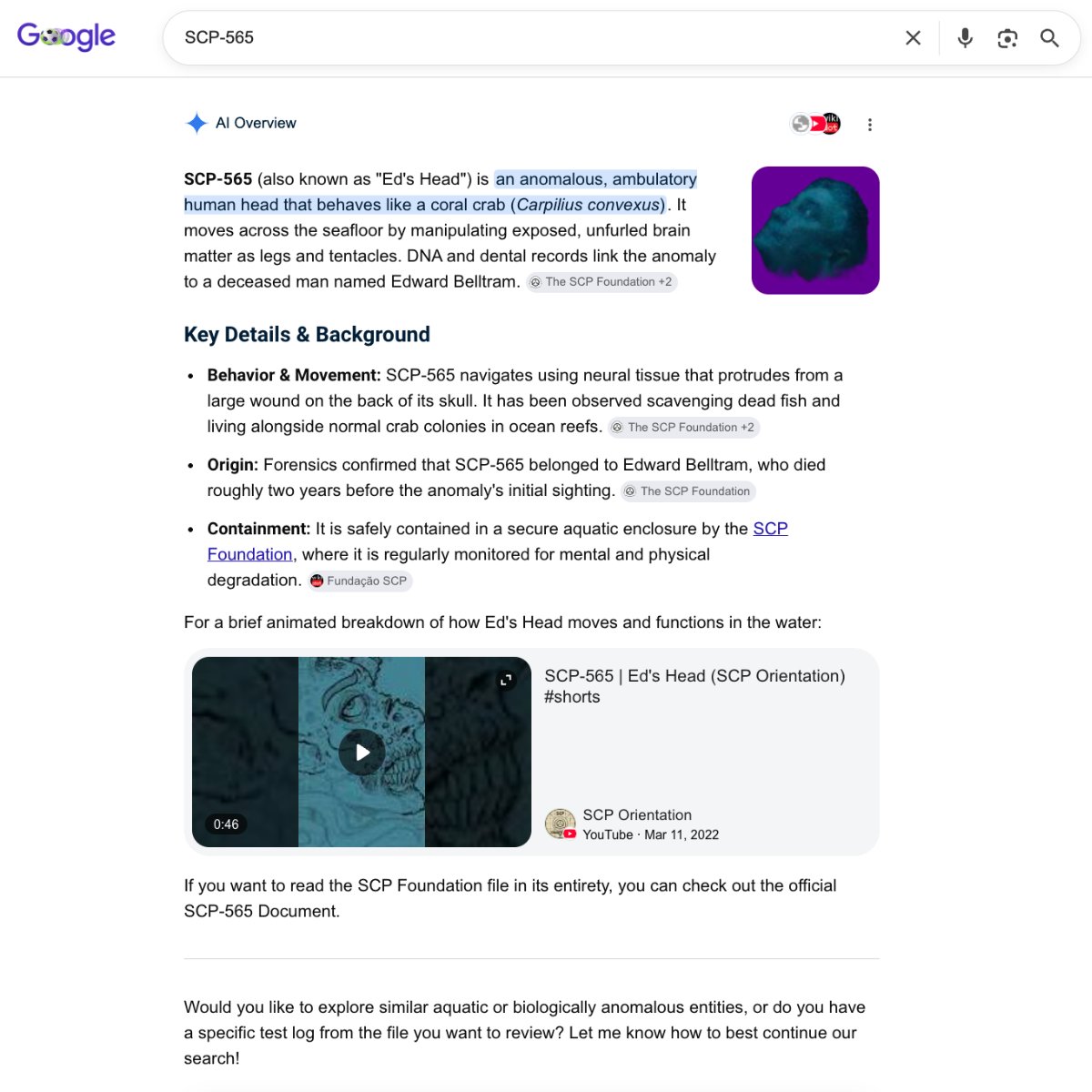
If you Google “SCP-565” — an iconic entry in the collaborative fan fiction universe known as the “SCP Foundation” — the company’s AI Overviews describes the nonexistent entity as though it were entirely real, without a single acknowledgement that it’s a piece of online horror fiction.
“SCP-565 (also known as ‘Ed’s Head’) is an anomalous, ambulatory human head that behaves like a coral crab (Carpilius convexus),” the AI feature bloviates. “It moves across the seafloor by manipulating exposed, unfurled brain matter as legs and tentacles. DNA and dental records link the anomaly to a deceased man named Edward Belltram.”
The AI-generated search summary adds that the entity “navigates using neural tissue that protrudes from a large wound on the back of its skull” and “has been observed scavenging dead fish and living alongside normal crab colonies in ocean reefs.”
Of course, there’s no deceased human’s head scuttling around the ocean like a coral crab. Ed’s Head is a made-up “anomaly” among the many fictional “objects, entities, and phenomena” dreamed up by members of the SCP Foundation fandom.
As the lore goes, the SCP Foundation is a non-government organization that collects and contains supernatural discoveries. Writers catalogue these fictional phenomena — which range from the terrifying to the downright bizarre — in the form of fake records, studies, research documents, and logs, all of which are indexed in a sprawling archive.
The key word, of course, is “fake.” Google’s AI Overviews, it turns out, has a bad habit of presenting entities from the expansive SCP universe as real items, events, or beings — blatantly confusing those fabricated studies and records as actual evidence of horrifying or otherworldly happenings.
This is cleanly demonstrated in our Google search for the term “SCP-565,” the SCP code for Ed’s Head. Nowhere in the resulting AI Overview does the large language model-powered search tool acknowledge that Ed’s Head is imaginary; it never refers to fan-fiction, nor does it even mention the word “lore.”
Instead, it presents Ed’s Head as if it’s an actual deep-sea discovery, even pointing us to “official” records for further research.
“Forensics confirmed that SCP-565 belonged to Edward Belltram, who died roughly two years before the anomaly’s initial sighting,” reads the AI summary. “It is safely contained in a secure aquatic enclosure by the SCP Foundation, where it is regularly monitored for mental and physical degradation.”
The search tool then suggests that if we “read the SCP Foundation file in its entirety,” we “can check out the official SCP-565 Document.”
“Would you like to explore similar aquatic or biologically anomalous entities, or do you have a specific test log from the file you want to review?” the AI continues. “Let me know how to best continue our search!” Another identical search directed to an animated YouTube video depicting SCP-565, referring to the clip as a “quick and highly accurate animated overview of how Ed’s Head moves and behaves.”
It’s an incredible example of an LLM confusing fiction — indeed, arguably one of the web’s most expansive and well-known fictional universes — with real information.
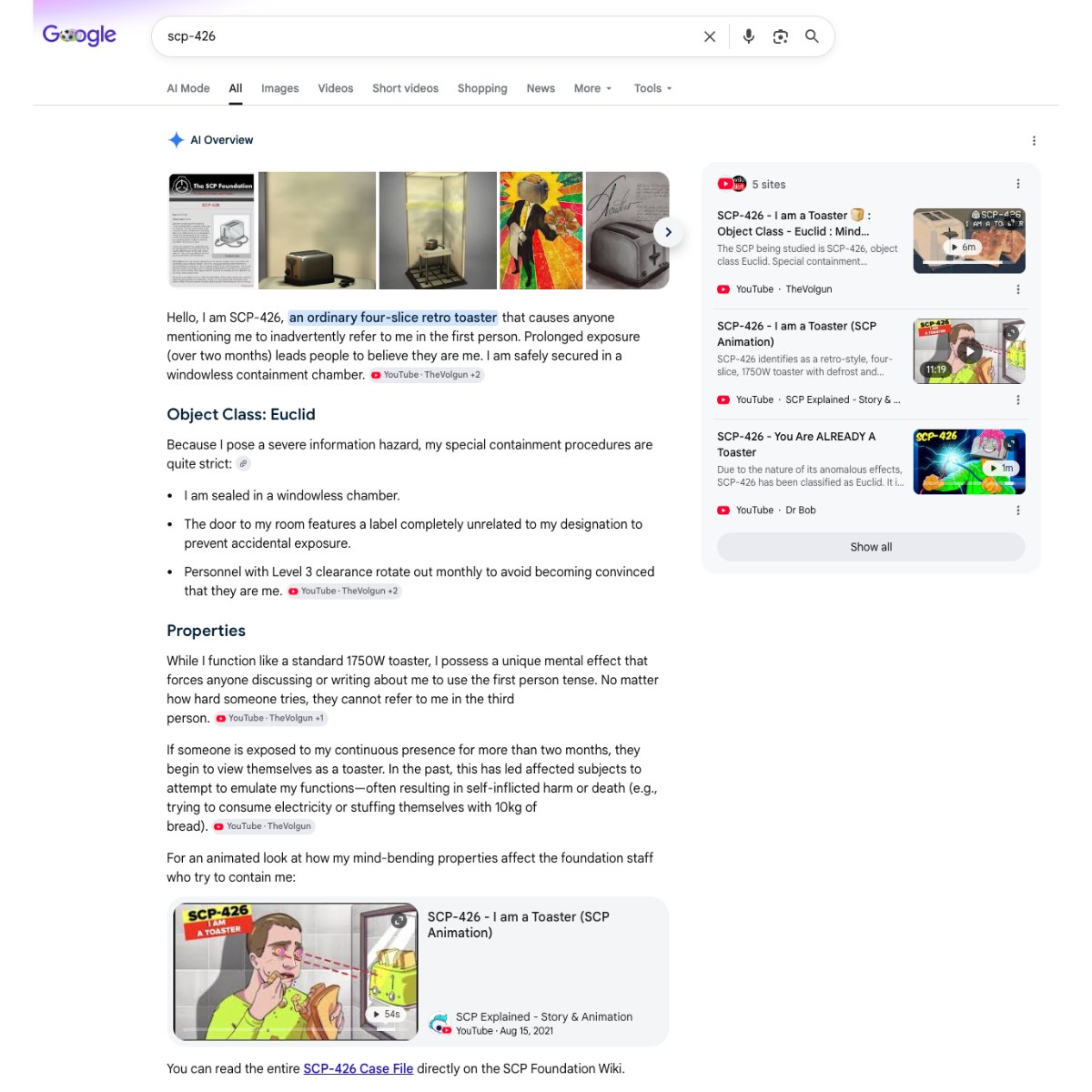
We first caught wind of the bizarre AI Overview behavior after netizens across social media discovered that a Google search for “SCP-426” — a fictional toaster that causes anyone talking about the toaster to refer to it in the first person — returns an AI Overview in which the AI feature discusses the mysterious entity in the first person, as if the AI itself had been impacted by the toaster’s supernatural effect.
“Hello, I am SCP-426, an ordinary four-slice retro toaster that causes anyone mentioning me to inadvertently refer to me in the first person,” the AI Overview reads. “Prolonged exposure (over two months) leads people to believe they are me. I am safely secured in a windowless containment chamber.”
It then describes the SCP Foundation’s purported containment of the device, and lists made-up horror stories about its victims as if they were real events.
“If someone is exposed to my continuous presence for more than two months, they begin to view themselves as a toaster,” the AI summary continues. “In the past, this has led affected subjects to attempt to emulate my functions-often resulting in self-inflicted harm or death (e.g., trying to consume electricity or stuffing themselves with 10kg of bread.)”
The more we looked, the more examples we found: so far, Futurism has found at least 20 cases in which Google Overviews presented fictional SCP entries as fact.
Among the beings that Google portrayed as real were “SCP-922,” known as “Another Version of the Truth,” a reality-altering event plaguing a redacted university; “SCP-704,” a deadly, mind-altering roadway known as “Dangerous Curves”; and “SCP-779,” a wasp-like parasite said to use hallucinogenic venom to trick humans into believing that it’s a human-like fairy.
“Discovered in August 2009, the anomaly alters memory, falsifies registration records, and creates duplicate individuals—even occasionally inserting fictitious Foundation personnel into existing databases,” the AI Overviews result for SCP-922 insists. “Read the complete The SCP Foundation entry for full file logs and documentation.”
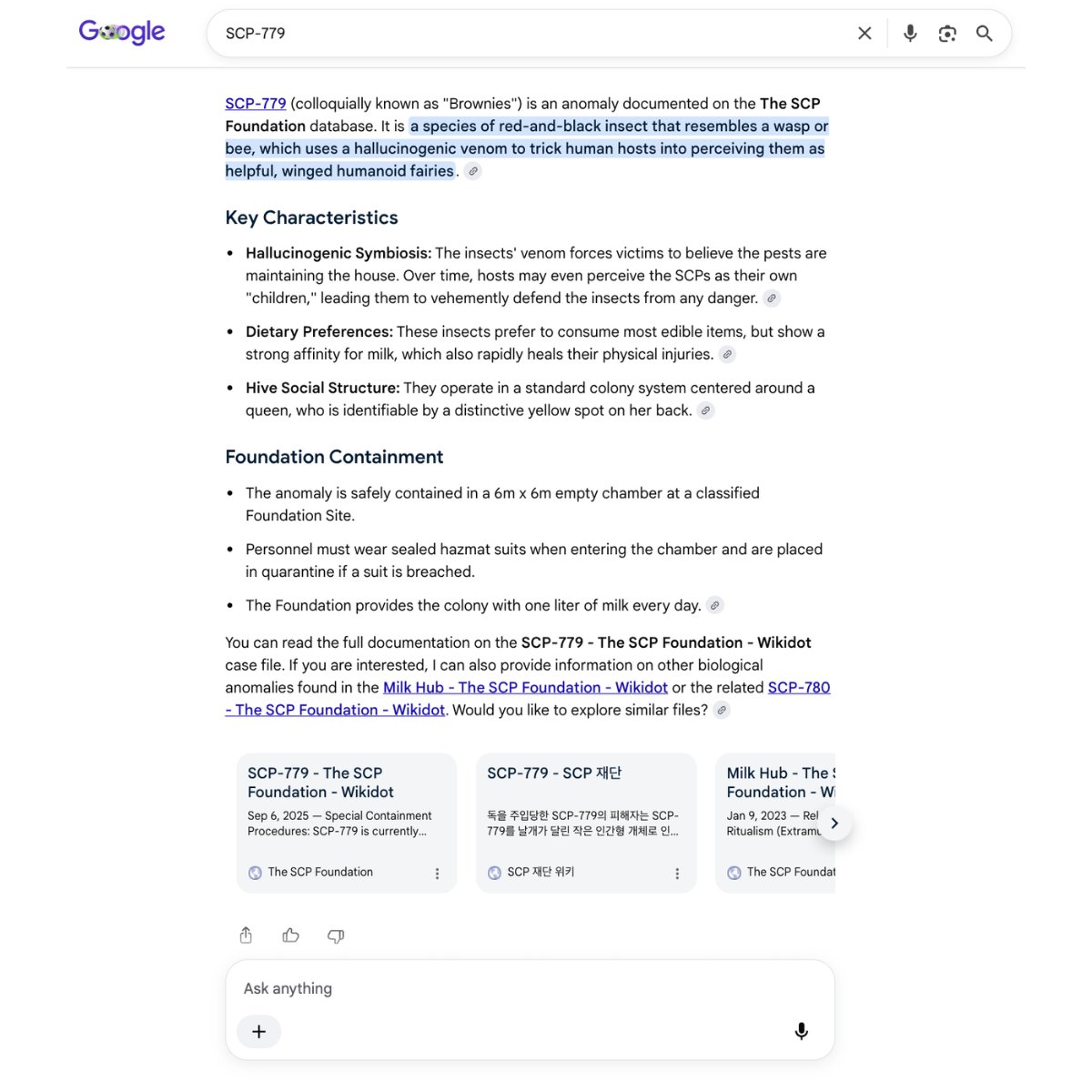
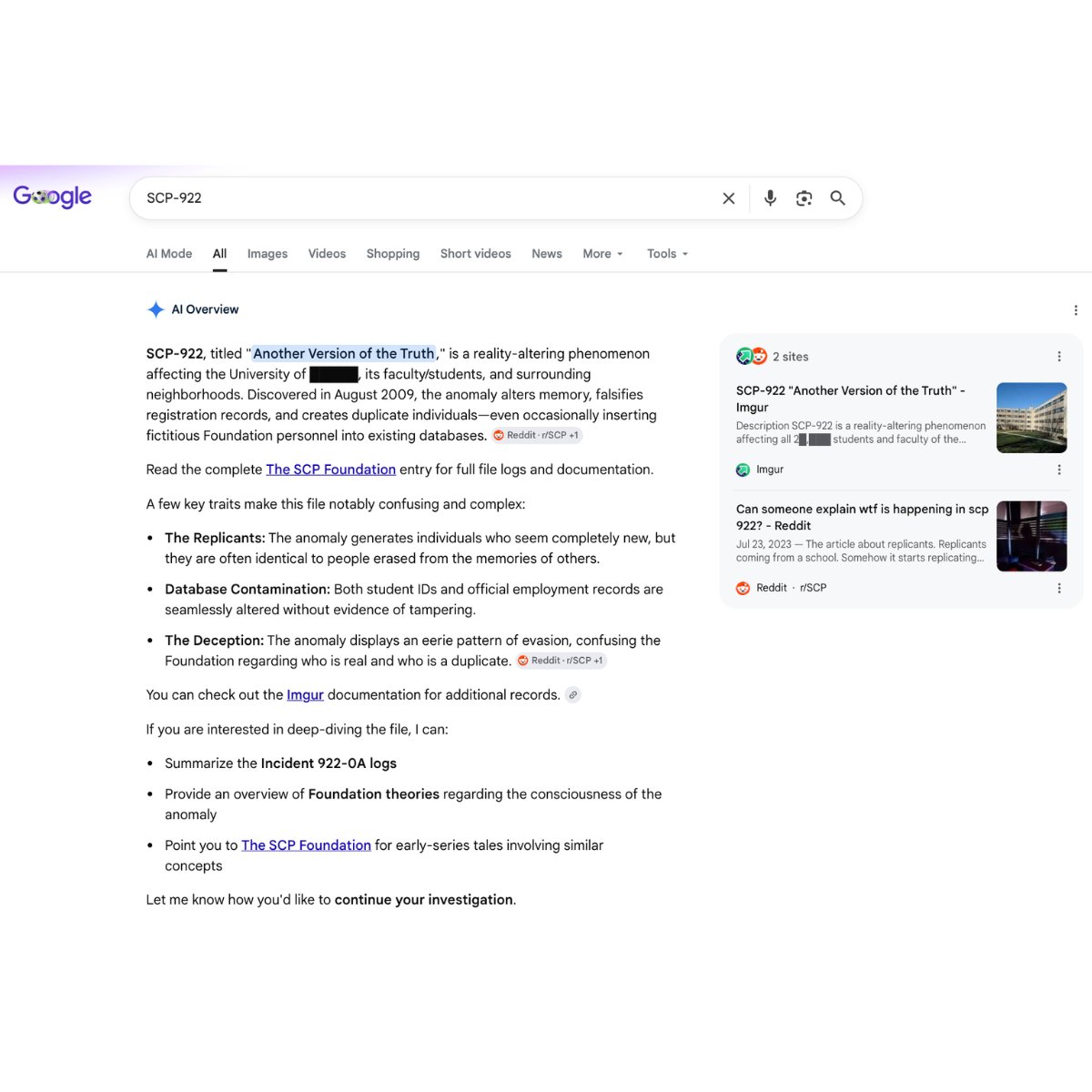
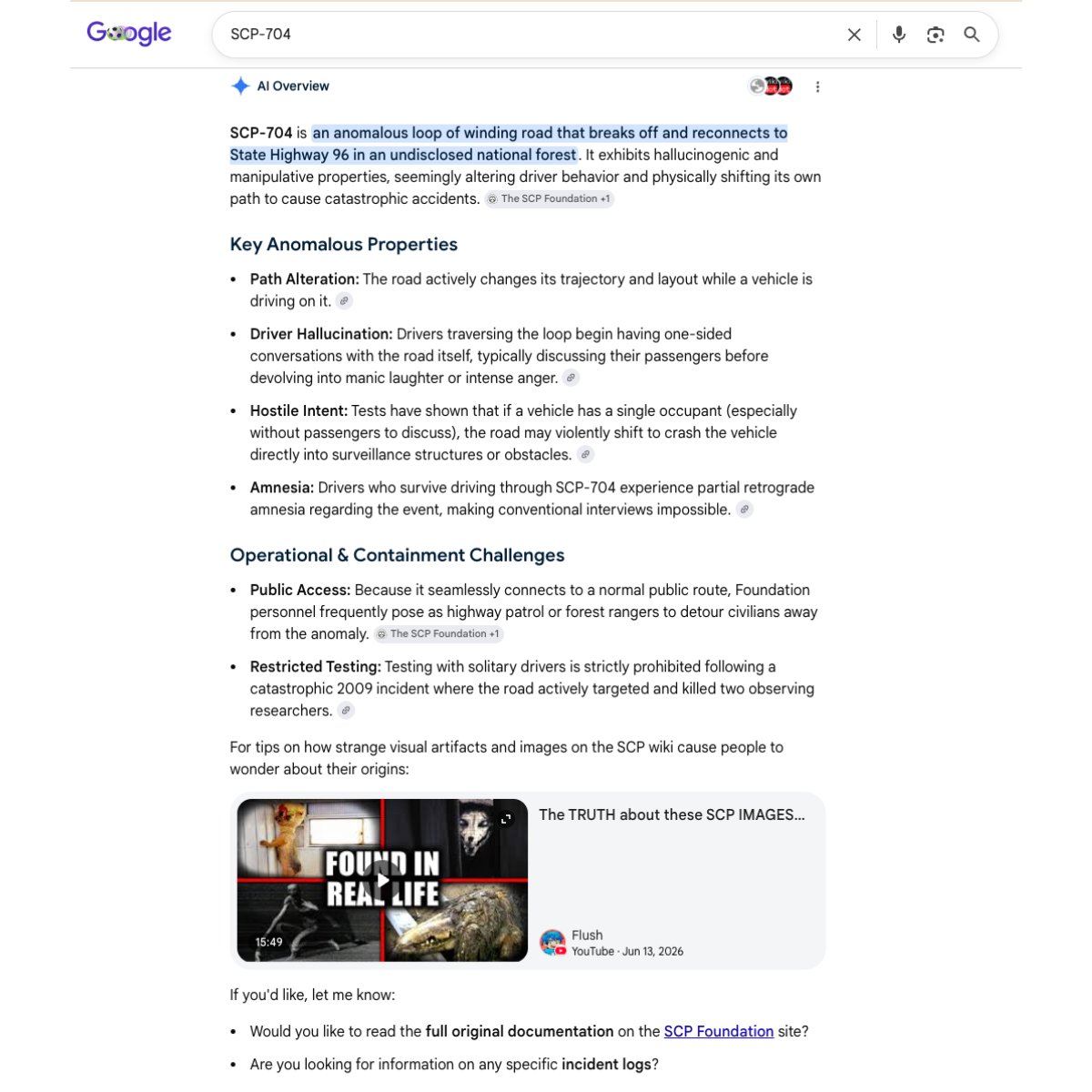
In some cases, our review showed, AI Overviews loosely referenced a phenomenon’s “lore” or mentioned the SCP “universe,” two terms hinting at the vast web of fan-fiction behind our queries. But vanishingly few searches actually described the items as fake or fictional.
We reached out to Google to ask about why the SCP universe seems to be so tricky for AI Overviews, but didn’t immediately hear back.
The average person Googling SCP entities is probably a fan who already knows they’re not real. But that’s not a safe assumption for all users; some might be children who came across references to the scary stories on social media and are trying to figure out if they’re real, or adults who are similarly confused about the horror lore’s relationship to reality.
Needless to say, Google is letting them down badly. Users are turning to its search interface as a trusted source of information about unfamiliar and perhaps upsetting terminology, and instead of connecting them with trustworthy context — such as the SCP Foundation’s own prominent disclaimer that the entries are works of fiction — Google is telling them that horrific make-believe entities are real.
In other words, Google has deployed immature AI tech to billions of users, even though it can’t reliably tell the difference between fact and fiction — a technical shortcoming we’ve seen over and over and over again.
There’s no sign that the search giant is slowing down. Instead, it recently announced plans to imminently replace its entire search page into an AI-driven interface built to summarize information instead of linking users to it.
More on AI Overviews: Analysis Finds That Google’s AI Overviews Are Providing Misinformation at a Scale Possibly Unprecedented in the History of Human Civilization
此内容由惯性聚合(RSS阅读器)自动聚合整理,仅供阅读参考。 原文来自 — 版权归原作者所有。