惯性聚合 高效追踪和阅读你感兴趣的博客、新闻、科技资讯
阅读原文 在惯性聚合中打开

推荐订阅源

Cloudbric
Cloudbric
Schneier on Security
V2EX - 技术
V2EX - 技术
cs.CV updates on arXiv.org
O
OpenAI News
S
Security @ Cisco Blogs
Scott Helme
Scott Helme
Security Archives - TechRepublic
Threat Intelligence Blog | Flashpoint
cs.CL updates on arXiv.org
WordPress大学
WordPress大学
云风的 BLOG
云风的 BLOG
T
Threatpost
Hacker News: Ask HN
Hacker News: Ask HN
Microsoft Azure Blog
Know Your Adversary
Know Your Adversary
博客园 - 三生石上(FineUI控件)
A
About on SuperTechFans
Forbes - Security
Forbes - Security
NISL@THU
NISL@THU
Security Latest
Security Latest
G
Google Developers Blog
D
Docker
T
Threat Research - Cisco Blogs
N
Netflix TechBlog - Medium
C
CERT Recently Published Vulnerability Notes
H
Help Net Security
B
Blog
Martin Fowler
Martin Fowler
N
News and Events Feed by Topic
Simon Willison's Weblog
Hacker News - Newest:
Hacker News - Newest: "LLM"
L
Lohrmann on Cybersecurity
Y
Y Combinator Blog
PCI Perspectives
PCI Perspectives
F
Fortinet All Blogs
MyScale Blog
MyScale Blog
Project Zero
Project Zero
爱范儿
爱范儿
Cisco Talos Blog
Cisco Talos Blog
博客园 - 聂微东
Hugging Face - Blog
Hugging Face - Blog
人人都是产品经理
人人都是产品经理
V
Vulnerabilities – Threatpost
P
Proofpoint News Feed
Cyberwarzone
Cyberwarzone
cs.AI updates on arXiv.org
TaoSecurity Blog
TaoSecurity Blog
N
News | PayPal Newsroom
Recorded Future
Recorded Future

Black Hills Information Security, Inc.

Bad Habits: An ANTISOC Operation Same Problem, Different Angles: When Red Team and Blue Team Actually Talk to Each Other How to Identify and Exploit New Vulnerabilities Swapper – A Pure Regex Match/Replace Burp Extension A Practical Guide to BloodHound Data Collection Network Engineering Basics Signed, Trusted, and Abused: Proxy Execution via WebView2 Getting Started In Pentesting – Advice From The BHIS Pentest Lead Cloud Security: Tips and Resources for Securing the Cloud Lessons From A Chatbot Incident How to Lead Effective Tabletops Understanding GRC: How to Navigate Risks and Compliance Standards The “P” in PAM is for Persistence: Linux Persistence Technique Malware Analysis: How to Analyze and Understand Malware OSINT: How to Find, Use, and Control Open-Source Intelligence What to Do with Your First Home Lab When the SOC Goes to Deadwood: A Night to Remember Social Engineering and Microsoft SSPR: The Road to Pwnage is Paved with Good Intentions Common Cyber Threats Finding the Right Penetration Testing Company Deceptive-Auditing: An Active Directory Honeypots Tool The Curious Case of the Comburglar How to Set Smart Goals (That Actually Work For You) Inside the BHIS SOC: A Conversation with Hayden Covington Abusing Delegation with Impacket (Part 3): Resource-Based Constrained Delegation Why You Got Hacked – 2025 Super Edition Abusing Delegation with Impacket (Part 2): Constrained Delegation Abusing Delegation with Impacket (Part 1): Unconstrained Delegation GoSpoof – Turning Attacks into Intel Model Context Protocol (MCP) Bypassing WAFs Using Oversized Requests Getting Started with AI Hacking Part 2: Prompt Injection Wrangling Windows Event Logs with Hayabusa & SOF-ELK (Part 2) DomCat: A Domain Categorization Tool Wrangling Windows Event Logs with Hayabusa & SOF-ELK (Part 1) Microsoft Store and WinGet: Security Risks for Corporate Environments Default Web Content MailFail Commonly Abused Administrative Utilities: A Hidden Risk to Enterprise Security Stop Spoofing Yourself! Disabling M365 Direct Send Bypassing CSP with JSONP: Introducing JSONPeek and CSP B Gone Offensive Tooling Cheatsheets: An Infosec Survival Guide Resource DNS Triage Cheatsheet GraphRunner Cheatsheet Burp Suite Cheatsheet Impacket Cheatsheet Wireshark Cheatsheet Hashcat Cheatsheet EyeWitness Cheatsheet Nmap Cheatsheet Netcat (nc) Cheatsheet Hunt for Weak Spots in Your Wireless Network with Airodump-ng from the Aircrack-ng Suite Detecting ADCS Privilege Escalation Vulnerability Scanning with Nmap Getting Started with NetExec: Streamlining Network Discovery and Access How to Use Dirsearch Augmenting Penetration Testing Methodology with Artificial Intelligence – Part 3: Arcanum Cyber Security Bot How to Design and Execute Effective Social Engineering Attacks by Phone Abusing S4U2Self for Active Directory Pivoting Why Use a Macro Pad? Espanso: Text Replacement, the Easy Way Caging Copilot: Lessons Learned in LLM Security Augmenting Penetration Testing Methodology with Artificial Intelligence – Part 2: Copilot Augmenting Penetration Testing Methodology with Artificial Intelligence – Part 1: Burpference Intercepting Traffic for Mobile Applications that Bypass the System Proxy How to Root Android Phones Communicating Security to the C-Suite: A Strategic Approach Offline Memory Forensics With Volatility Getting Started with AI Hacking: Part 1 Go-Spoof: A Tool for Cyber Deception How to Test Adversary-in-the-Middle Without Hacking Tools Canary in the Code: Alert()-ing on XSS Exploits How to Hack Wi-Fi with No Wi-Fi Why Your Org Needs a Penetration Test Program Burp Suite Extension: Copy For Light at the End of the Dark Web Wi-Fi Forge: Practice Wi-Fi Security Without Hardware Avoiding Dirty RAGs: Retrieval-Augmented Generation with Ollama and LangChain Gone Phishing: Installing GoPhish and Creating a Campaign 5 Things We Are Going to Continue to Ignore in 2025 John Strand’s 5 Phase Plan For Starting in Computer Security Questions From a Beginner Threat Hunter GRC for Security Managers: From Checklists to Influence AI Large Language Models and Supervised Fine Tuning Attack Tactics 9: Shadow Creds for PrivEsc w/ Kent & Jordan One Active Directory Account Can Be Your Best Early Warning Introduction to Zeek Log Analysis Indecent Exposure: Your Secrets are Showing Creating Burp Extensions: A Beginner’s Guide Pitting AI Against AI: Using PyRIT to Assess Large Language Models (LLMs) The Top Ten List of Why You Got Hacked This Year (2023/2024) ICS Hard Knocks: Mitigations to Scenarios Found in ICS/OT Backdoors & Breaches Intro to Data Analytics Using SQL Finding Access Control Vulnerabilities with Autorize The Detection Engineering Process Cyber Risk Lessons We Can Learn From Hurricane Preparedness Intro to Desktop Application Testing Methodology What Is Penetration Testing? Adversary in the Middle (AitM): Post-Exploitation Pentesting, Threat Hunting, and SOC: An Overview
For Web Content Discovery, Who You Gonna Call? Gobuster!
Kassie Kimball · 2022-06-15 · via Black Hills Information Security, Inc.

, , , ,

Melissa Bruno //

One of the best early steps to take when testing a network, especially a large one, is to run the tool EyeWitness to gain a quick understanding of what types of web applications are present in the environment.

In some cases, valuable information may be sitting in plain sight on the homepage of a poorly secured web application. Other times, you might glean the names and version numbers of vulnerable pieces of software from HTTP headers and source code, then leverage known exploits to your advantage. Sometimes gaining admin access to software is as simple as looking up the manual for a web content management service, then plugging in the default URL of the admin portal and default credentials.

But what about web applications that don’t give you much to work with? Maybe the root directory returns a blank page, or an HTTP 404 “Not Found” error, and the HTTP headers show up-to-date software version numbers or no useful information at all. This is where automated guesses can come into play.

Scripts and automated tools can be used to check for common files and directories that may be running on a web server.

One such tool is gobuster.

Installing Gobuster

Depending on your operating system, you may be able to install gobuster directly with a package manager. Otherwise, gobuster will run on any system that can run the latest version of the Go programming language. For the latter method, you will first need to download the latest version of Go here: https://golang.org/dl/ and then install it using the instructions here: https://golang.org/doc/install.

Once Go is set up, simply run the command go install github.com/OJ/gobuster/v3@latest to install the latest version of gobuster. The “go install” command will place the gobuster executable file in either the $GOPATH/bin or $HOME/go/bin directories.

Running Gobuster

To demonstrate the usage of gobuster, I set up a directory with a few files and hosted them locally using a simple HTTP server with Python 3, which you can do yourself by creating a directory with the files that you want to host, navigating to that directory, and then using the command:

python3 -m http.server 8000 --bind 127.0.0.1

Next, in the directory containing the gobuster executable file, create two more files — one with a list of filenames that you want to check for and one with a list of directory names. I used SecLists’ raft-medium-directories.txt and raft-medium-files.txt lists. Check if the server has any of the directories in your list with this command:

gobuster dir -u http://127.0.0.1:8000/ -w raft-medium-directories.txt
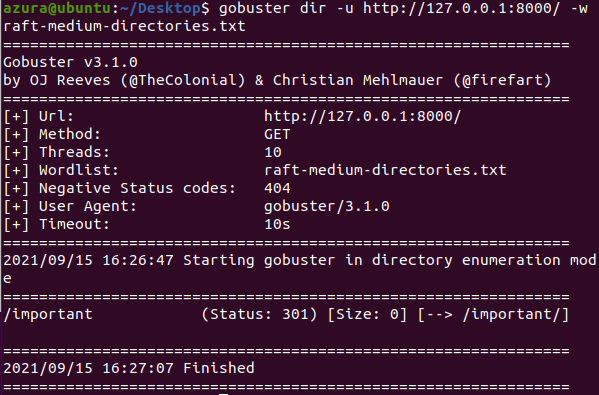
In the output section, we can see that gobuster picked up the /important directory. Now I’ll check that directory for the presence of any of the files in my other list:

gobuster dir -u http://127.0.0.1:8000/important/ -w raft-medium-files.txt
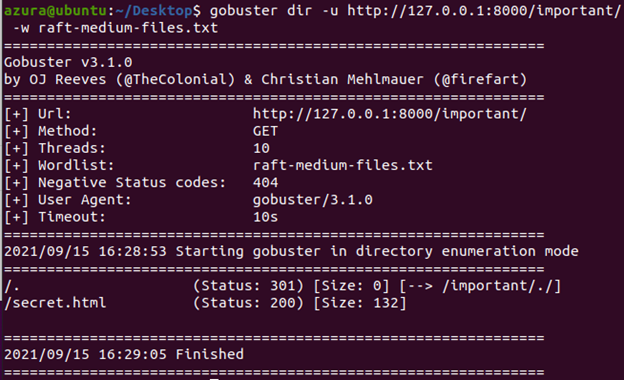
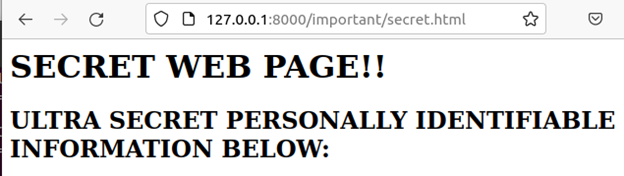
Now, gobuster has identified a file, /secret.html. Navigating to it returns an (admittedly low-effort) representation of a webpage containing confidential data.
Fine-Tuning Gobuster

Because the web server used in this example was bare-bones, the simplest possible gobuster commands returned interesting, easy-to-parse output. This will typically not be the case for production web servers. Some of the more commonly used Gobuster arguments include:

  • –user-agent: Increase the likelihood that the web server will return a valid response by using a browser’s user agent string.
  • –timeout: Increase the timeout duration to decrease the likelihood of missing pages hosted by slow-to-respond servers.
  • –no-tls-validation: Do not require validation of TLS.
  • –exclude-length: Do not show results for HTTP responses of a specified length.
  • –status-codes: Specify which HTTP response codes should be interpreted as the web application returning a valid file. This can reduce false negatives.
  • –status-codes-blacklist: Specify which HTTP response codes should not be interpreted as the web application returning a valid file. This can reduce false positives.
  • As always, make sure that you have permission to test the targeted web applications before running these tools!


Ready to learn more?

Level up your skills with affordable classes from Antisyphon!

Pay-What-You-Can Training

Available live/virtual and on-demand