


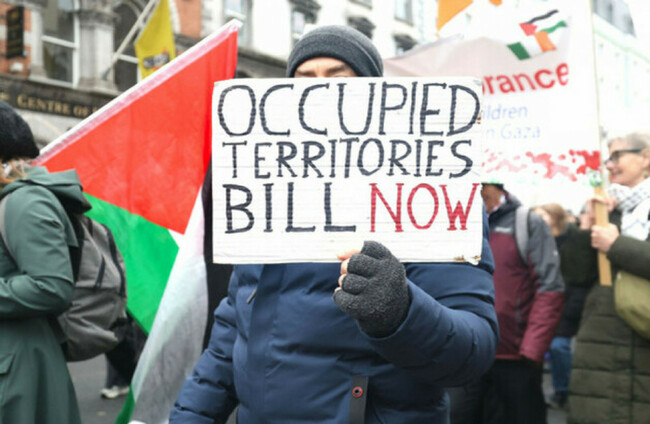
THE FOREIGN AFFAIRS minister has said an amendment that would have banned the importation and trade of goods “produced in whole or in part” in illegal Israeli settlements would have been “impossible to implement”.
The long-awaited Occupied Territories Bill was first proposed by senator Frances Black in 2018 and would ban trade from illegal Israeli settlements in the Occupied Palestinian Territories.
However, it will not ban services.
The Committee on Foreign Affairs and Trade is meeting today to discuss amendments to the bill.
The bill states that the legislation is for the “purpose to prohibit the importation of goods originating in certain Israeli settlements”.
One such amendment called for the word “originating” to be deleted and replaced with “produced in whole or in part”.
This amendment was in the name of Donnchadh Ó Laoghaire, Cathy Bennett, Duncan Smith, Sinéad Gibney, Richard Boyd Barrett, and Roderic O’Gorman.
Sinn Féin’s Donnchadh Ó Laoghaire told the Committee that the “objective is that goods that are produced in Israeli settlements, even partially, are covered by the ban”.
He noted that this wording is included in similar bills by the Belgian and Dutch governments, and is also the wording of the original bill first proposed by Black.
“Clearly it would be perverse if a product was finished in a settlement, having had components of it produced somewhere else, and somehow that’s avoided this good being subject to the provisions of this legislation,” said Ó Laoghaire.
“It’s important that we capture all goods that are produced, even partially, in the occupied territories.”
Foreign affairs minister Helen McEntee said she “understands the objective of this” but added: “My legal advice is that when we talk about goods that are produced in whole or in part, we’re talking about rules of origin.”
She said there are “very clearly defined legal rules around the rules of origin” and that they are “set in stone”.
An item typically must have 50% to 60% of its value-added in the origin country to determine its economic nationality.
“It would be very difficult, if not impossible, to implement this if you have a product that has, say, 500 parts in it, and one might be from Israel, or may have come in from Israel, that you would be able to identify that, and how you would implement that.”
She added that the legislation “takes into account the percentage of the product itself and where it has come from” and that the amendment would “leave the bill unworkable”.
Ó Laoghaire in response questioned if the rules of origin are “strong enough to capture an effort to pass off something created in a settlement as being produced in the state of Israel within its internationally recognised boundaries”.
McEntee then said: “I want to ensure that if I’m introducing legislation to ban goods, that it can be implemented as quickly as possible, but if we have elements of it that are not legally sound and can be challenged, we leave ourselves open to risk that this legislation can have legal action taken against it.”
People Before Profit’s Richard Boyd Barrett said the “spectre of possible legal action seems to be the reason for not doing a lot of things” and questioned if this “that spectre as an excuse is sufficient to not do everything we can to ensure that the restrictions will not be got around”.
“To be honest, they’re probably going to get around it anyway, as far as I’m concerned, because people who commit genocide won’t be too worried about rules of origin or spectres of legal action,” said Boyd Barrett.
“But I don’t see why we wouldn’t at least go the extra mile.”
McEntee replied that “it’s prudent to not introduce legislation knowing that there is a likelihood of legal action”.
“Any act can be challenged,” said McEntee, “but I want to make sure that everything I do means it’s not challenged.”
Meanwhile, Fianna Fáil TD Seán Ó Fearghaíl said he was “struck by the validity” of Boyd Barrett’s remarks that “people who can commit genocide won’t have much regard for this legislation” and that “we can take it for granted they will do everything they can to circumvent it”.
However, he said McEntee’s remarks highlighted to him the importance to ensure “this legislation is airtight and can withstand challenge”.
“If we enact legislation that is not robust, that will damage the cause rather than serve it, so for that reason, I would strongly support what the minister is saying to us,” said Ó Fearghaíl.
The amendment was then put to a vote and voted down.