








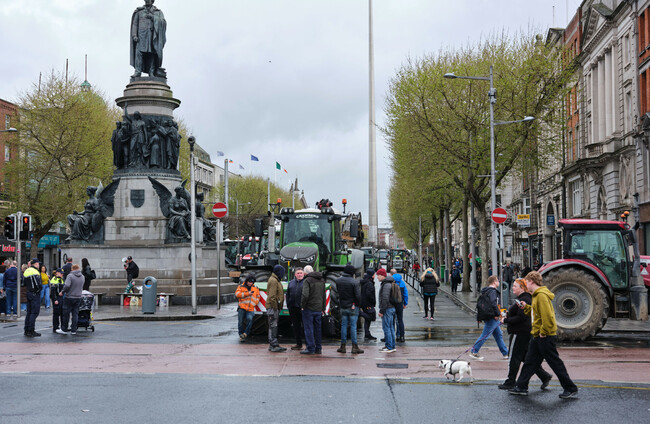

IRELAND IS STILL reeling from over a week of protests in response to the fuel crisis that paralysed the country. The scale of anger and frustration has been palpable.
The global backdrop for this crippling economic and political turmoil is stark: an ongoing blockade of one of the most crucial oil transport corridors in the world, spiking fuel prices, and governments scrambling to secure vital supplies to maintain their energy and transport systems.
 Fuel protesters gathered outside Leinster House after widespread unrest the week before. Alamy Stock Photo
Alamy Stock Photo
Fuel protesters gathered outside Leinster House after widespread unrest the week before. Alamy Stock Photo
Alamy Stock Photo
In the midst of this global turbulence, the devastating impact on people in Lebanon and Iran has been lost. Also lost is the most obvious solution to the crisis – a rapid end to fossil fuels, something that would end energy shocks like the one we are in, support the lives of people struggling every day, and make the planet more livable.
A rare chance to do this now presents itself. Together with over 50 countries, the Irish government will attend the First Conference on Transitioning Away from Fossil Fuels, starting today and taking place in the Colombian port city of Santa Marta. This crucial gathering is a serious effort at coordinated implementation of the fossil fuels phase-out.
Breaking with oil, coal and gas
Decades of UN summits led to the 2015 Paris Agreement, a framework for limiting the global temperature increase by 2030. But the international community has only recently agreed on the need to transition away from fossil fuels, the main culprit of the climate crisis.
During the COP28 meeting in the UAE, it belatedly caught up with science and public opinion that the burning of coal, oil and gas must be addressed.
The Santa Marta conference, driven by a breakaway group of willing member states and co-chaired by Colombia and the Netherlands, is working to break this deadline on global commitments to phase out of fossil fuels.
This will not be a space for climate deniers or fossil fuel companies that only care about profit. The Santa Marta conference should support the work of COP, setting out a concrete agreement on ending fossil fuels and how we make a greener and safer future happen.
The path for Ireland
Ireland imports over 70% of its energy, mostly in the form of oil and gas, one of the highest dependencies in the EU. The contrast with other EU countries like Denmark is telling. In 1973, the oil shock crisis hit Denmark, which at the time got around 90% of its energy from imported oil. The Danish government introduced car-free Sundays and pursued aggressive measures to suppress demand and carry out a state-led purchasing spree to re-stock its strategic reserves.
But then Denmark did what Ireland has failed to do so far in practice: it looked at the structural issues behind its energy dependency and made the right changes. Within two years of that crisis, it had established the regulatory architecture that paved the way for the world’s first wind industry, which now powers 60% of its electricity needs.
 Alamy Stock Photo
Alamy Stock Photo
Alamy Stock Photo
Short-term measures, without a complementary intervention that is forward-looking and willing to tackle head-on the nature of our fragile dependency on fossil fuels, do nothing to prevent our vulnerability to future crises.
People in Ireland are struggling with the cost of living, which is hitting those with the least the hardest. Around the globe, it also hits hard. In ActionAid’s work on women’s rights, we are already seeing women bear disproportionate impacts of climate change. The United Nations warns that by 2050, climate change could push up to 158 million more women and girls into poverty, while 232 million face deepening food insecurity. These are not abstract figures, but a stark measure of the human cost of inaction.
Meanwhile, the fossil fuel industry, which is at the centre of this crisis, is booming. Fuel shortages made for “exceptional” trading results for BP and Shell in this quarter, and a Greenpeace study calculated oil companies are making €81.4 million in extra profits every day since the start of the war in Iran.
 Alamy Stock Photo
Alamy Stock Photo
Alamy Stock Photo
It is no wonder that fossil fuel companies unleash their army of lobbyists every year at the UN climate negotiations to sabotage any significant chance of progress.
The potential of this moment
This is the moment for Ireland’s moral and political standing to make a difference. It must show up at the Santa Marta conference with commitments to put on the table.
ActionAid research found that 93% of countries most vulnerable to the climate crisis were in, or at significant risk of, debt distress in 2023, and this number was even higher in 2025, preventing countries from investing in climate action. In a tragic irony, the obligation to earn foreign currency in order to service debt repayments forces many countries to expand climate-destructive fossil fuels.
Ireland must use its voice at the Santa Marta conference to back the process to negotiate a UN Debt Convention that includes an automatic cancellation of sovereign debt for countries impacted by extreme weather events.
Without fair and sufficient funding, countries already on the frontline of the crisis cannot adapt, rebuild or transition to cleaner economies. Poorer countries cannot be reasonably asked to phase out fossil fuels without this funding, and it must be grants-based, not loans. Ireland must scale up grant-based public finance, committing to its fair share.
There is a lack of international instruments to regulate the production or phasing out of fossil fuels, in spite of scientific consensus that this is urgently needed to stabilise planetary temperatures. Ireland must also endorse the Fossil Fuel Non-Proliferation Treaty, which it is ideally placed to champion with its long-time relationship with fellow island states and membership of the Beyond Oil and Gas Alliance.
Decisive domestic action
Ireland needs to accelerate the transition to renewables and reduce our own emissions. Crucially, Ireland also needs to address the elephant in the room – our role as a fossil fuel finance hub.
As revealed in a Trócaire and ActionAid Ireland report last year, in 2024 Irish-based subsidiaries of investment companies held €31.76 billion in fossil fuel investments. This is facilitated by Ireland’s particular foreign direct investment model, generating more carbon emissions than those produced by the entire country.
If Ireland continues with its current strategy of encouraging FDI at all costs and relying on weak EU regulation, we are headed for catastrophe. The Intergovernmental Panel on Climate Change has repeatedly warned that every fraction of a degree beyond 1.5°C brings irreversible consequences. And yet, companies are developing oil and gas fields that could push global warming beyond 2°C.
Our research found that 91% of the investments made into fossil fuel companies by investment managers based in Ireland were to companies that have plans for fossil fuel expansion. Ireland cannot afford inaction on this issue.
At this moment of turmoil domestically and globally, we must set in motion the steps to eliminate fossil fuels. Every spike in the oil markets will start hurting less, and we can start building the infrastructure that will truly bring the energy security we’re looking for and make our lives better.
The Santa Marta conference is a key step on that path, and Ireland can’t afford inaction.
Karol Balfe is CEO of ActionAid Ireland.