





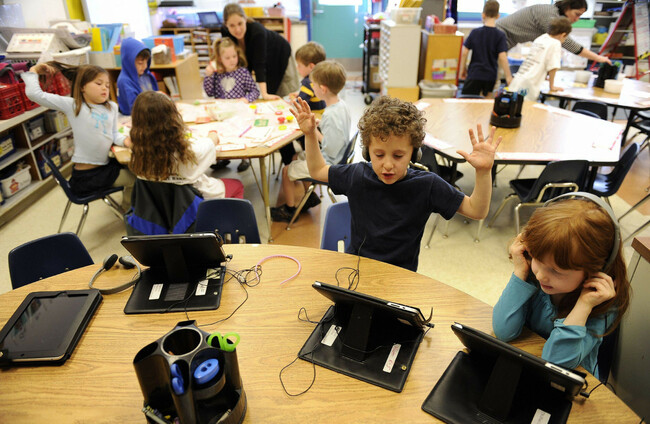

WHEN I AM showing prospective parents around our school, often the first question I am asked is “Is this really a screen free school?”
The answer is yes – children at our school don’t use tablets, or laptops, or interactive whiteboards, or any other screens. But the question is a relatively new one.
When we founded Dublin Waldorf School in 2017, parents mostly came to us because they were interested in sustainability and child-centred learning. But as our understanding of the impact of screens on children has developed, we have seen the issue come to the fore.
This has been driven by parents themselves, both in Ireland, such as those in Greystones who campaigned for a phone-free childhood, and around the world. And politicians are getting on board: as one TD told The Journal recently, “We’re seeing evidence from across Europe that this rush towards digital-first learning is being rolled back because of clear educational downsides.”
 Dublin Waldorf School / Aidan Oliver Photography
 / Aidan Oliver Photography
Dublin Waldorf School / Aidan Oliver Photography
Dublin Waldorf School / Aidan Oliver Photography / Aidan Oliver Photography
Increasing evidence of the negative impacts of excessive screen time among young children has, of course, also shaped the discussion. And as our society comes to recognise the potential impacts of AI, the issue has never felt so urgent. Perhaps it is not surprising that more and more parents are looking for screen-free learning in primary school.
Why the rush to tech?
As a mother myself and head of our school, I live with and witness the parental worry that comes with a world increasingly oriented towards technology. At a time when concern is rising over children’s safety online, and the evidence is building around the risks of early access to social media in particular, this concern should propel us adults – whether as parents, educators or policymakers – to take responsibility for our children’s best interests, rather than waiting for action at a national or international level. For schools, there is an opportunity here to ‘be the change’.
 No devices at Dublin Waldorf. Dublin Waldorf School / Aidan Oliver Photography
Dublin Waldorf School / Aidan Oliver Photography / Aidan Oliver Photography
No devices at Dublin Waldorf. Dublin Waldorf School / Aidan Oliver Photography
Dublin Waldorf School / Aidan Oliver Photography / Aidan Oliver Photography
My experience has been that increasing access to technology in all areas of children’s lives puts a huge amount of pressure on parents to “get it right” on their children’s screen use. How much is too much? What do I need to do to keep my child safe? Of course, these are questions that we all wrestle with. But our experience has been that a screen-free curriculum makes the school day a ‘safe space’ from these concerns, which in turn allows parents to make other decisions with greater confidence.
It is important to say that attending a Waldorf school, or any screen-free school, does not mean a complete rejection of technology. Of course, phones, tablets and TVs are part of our lives. Our students sometimes see me working on my laptop, just as they see me outside in the school garden. Our intention is not to bury our heads in the sand and pretend screens don’t exist, but to do two things.
The first is to preserve a space where children – the young people whose growing minds will shape our shared future – can learn and develop on their own terms, without every experience being mediated by a screen. We believe children deserve to own their education and, perhaps even more importantly, to feel ownership of their education
The second is to empower children, when they come to use technology, to use it on their own terms. To know that social media is not the same as lived experience; that ChatGPT is not a substitute for critical thinking; that your online presence does not have to define your personhood.
 No devices at Dublin Waldorf. Dublin Waldorf School / Aidan Oliver Photography
Dublin Waldorf School / Aidan Oliver Photography / Aidan Oliver Photography
No devices at Dublin Waldorf. Dublin Waldorf School / Aidan Oliver Photography
Dublin Waldorf School / Aidan Oliver Photography / Aidan Oliver Photography
As a modern Waldorf school, we aim to give our students the skills to succeed in today’s world: creativity, communication, critical thinking and collaborative problem-solving. (In this, we wholeheartedly agree with the World Economic Forum, the OECD, and the Irish Government). Students cover much of the same material contained in the national curriculum – literacy, numeracy, languages, music, sciences, from physics to botany. But they do so in a way which emphasises critical thinking and meaningful engagement, rather than rote memorisation of facts and figures. Part of this is enabled by keeping screens out of the learning environment and focusing instead on what we think of as active learning.
Learning without screens
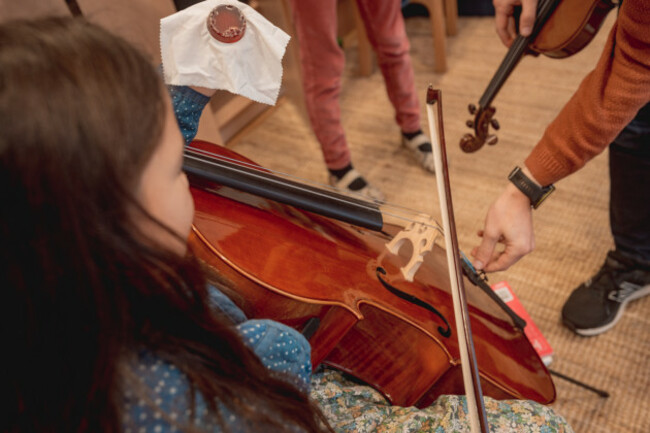
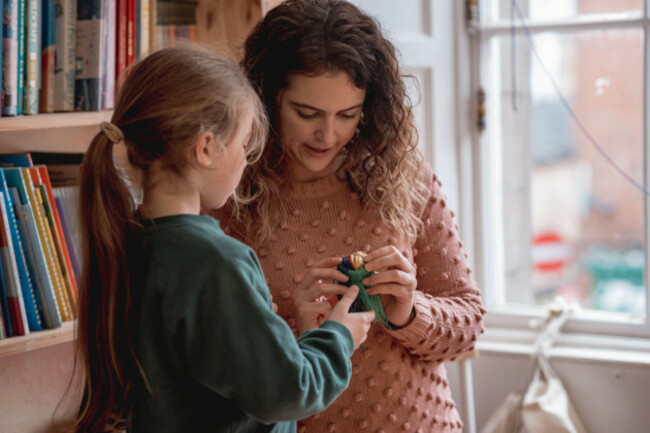
What does this active learning look like in practice? It is primarily an emphasis on learning first-hand: by doing, by exploring, by experiencing. Students write their own lesson books for literacy, numeracy and languages; they create their own learning resources within the structure of the curriculum. They also learn to use their hands, in everything from woodwork to gardening to painting and fine craft work, such as knitting.
 Dublin Waldorf School / Aidan Oliver Photography
 / Aidan Oliver Photography
Dublin Waldorf School / Aidan Oliver Photography
Dublin Waldorf School / Aidan Oliver Photography / Aidan Oliver Photography
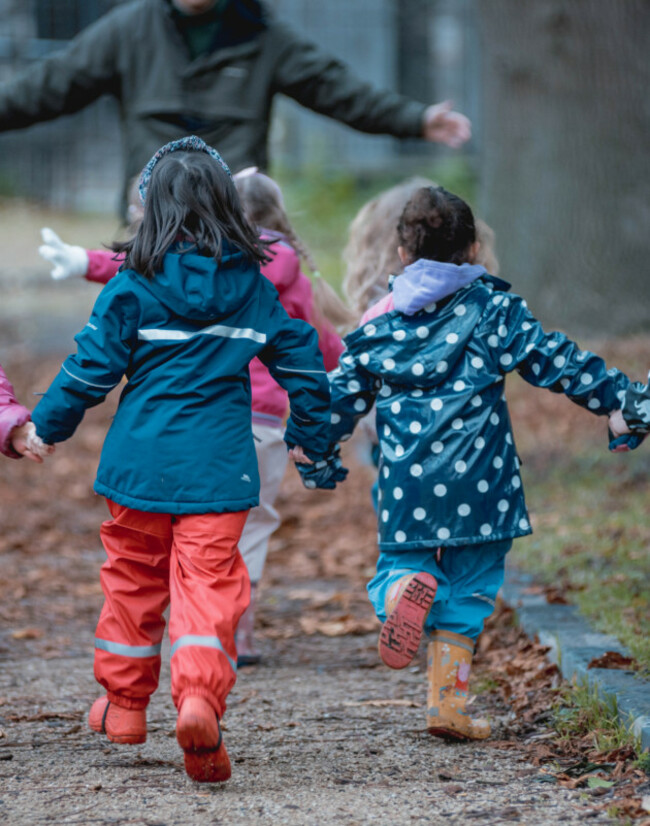
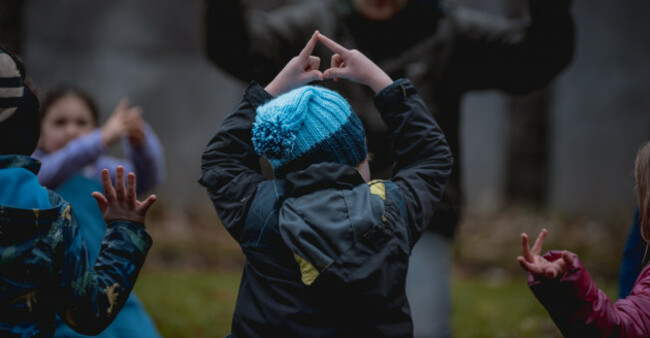
In fact, they use their whole bodies: our students spend at least an hour playing outside every day, whatever the weather, inventing games with natural and open-ended materials and negotiating their social world. The result of these acts of creation is that they feel a sense of ownership over their learning – they are not passive recipients, but agentic creators.
The impacts we see are manifold. Our students love to express themselves. They have confidence in their own voices and abilities; visiting teachers often tell us that they are used to teasing out answers from reluctant children, and are taken aback by how ready our kids are to answer questions.
Because they own their education, it feels accessible to them, and this extends to the world around them: they have the confidence to be players and participants, rather than passive consumers.
They are highly imaginative. They can work together or work independently. They can hold a conversation with a child or an adult, and they want to offer their opinions (oh boy, do they offer their opinions).
In short – and here I am showing my bias – they are wonderful, wonderful kids, and I am so proud of them all.
It is genuinely heartening to see the increase in discussion and debate around the role of screens in classrooms, with thoughtful contributions from different political viewpoints on how best to approach the issue.
In the meantime, we will be keeping screens out of the classroom, and sending children outside – well wrapped up! – whatever the weather.
Olivia Relova is head of Dublin Waldorf School, an independent primary school and kindergarten in the Liberties. More at dublinwaldorf.com.