









THE GOVERNMENT’S LATEST economic progress report signals a quiet but important shift that Ireland is no longer forecasting the future but is instead bracing for it.
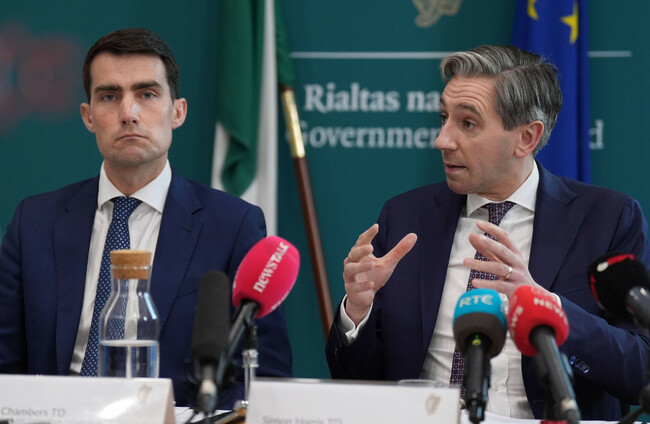
The three-scenario framework presented by Simon Harris and Jack Chambers is, on the surface, sensible, laying out a baseline, a deterioration and a worst-case outlook.
But the need for such an approach underscores a deeper truth that uncertainty now defines the economic landscape. And yet, for all its strengths, the report remains rooted in conventional thinking.
The most striking intervention came from Chambers’ warning on stagflation, a fundamentally different condition where slow growth, high inflation and rising unemployment collide.
It’s also something Ireland has limited modern experience navigating, as it was last seen in the early 1980s, but it is being experienced in our closest neighbours in the UK.
This raises a critical question: are three scenarios enough? Perhaps there needs to be a fourth, which is not simply a deeper downturn, but a structurally different future. One where inflation remains persistently high due to supply constraints, labour shortages, and geopolitical fragmentation, even as growth weakens. In that world, traditional policy tools may prove far less effective.
Planning for a changing world
The report’s reference to artificial intelligence feels underdeveloped. AI is unlikely to unfold evenly, and it could accelerate productivity in some sectors while displacing jobs in others, widening inequality and complicating fiscal planning in ways not captured in standard models.
There is also a broader question around the need for a spring statement at all. While it signals responsiveness, it risks reinforcing a more short-term approach to fiscal policy.
Stability matters, particularly for investment decisions. The renewed emphasis on spending discipline may be the most telling element. It suggests the real constraint ahead is not forecasting, but political will. If stagflation emerges, that tension will sharpen. Governments will face competing pressures to support households while avoiding policies that entrench inflation.
This is where the debate around income tax cuts becomes increasingly relevant. While politically attractive, broad-based tax reductions in an inflationary environment risk adding demand to an already constrained system. Without corresponding increases in supply, such measures can inadvertently sustain or even accelerate inflation. The challenge for policymakers will be balancing short-term relief for households with the longer-term objective of price stability.
At the same time, Ireland is not without options. The State has built up significant fiscal buffers in recent years, including sovereign wealth funds designed specifically for periods of economic shock. The question is not whether the capacity exists, but how it is deployed in a timely way. Short-term, broad measures may provide temporary relief, but more targeted and sustained supports aimed at those most affected by rising costs are likely to be more effective, particularly if energy-driven inflation persists.
Economic pressures
Look at recent events here. Fuel facility blockades, disruption to domestic distribution and growing pressure across logistics and transport sectors highlight how quickly a global shock can become a national one. The Government’s hand was forced, and they announced a 700-million-euro support package.
However, we need to ask whether reactive measures like this are sustainable. I think not, as it’s difficult to see how they would be.
Ireland’s reliance on imported energy leaves it particularly exposed. Even temporary interruptions or price spikes can have an outsized impact on inflation and business costs. This is, in many respects, an energy shock of a scale not seen since the 1970s. While the causes differ, the mechanism is the same.
A disruption to supply that feeds directly into inflation and economic stability. For an economy like Ireland, which imports the vast majority of its energy, the transmission is both immediate and unavoidable. Even if the initial shock is short-lived, the secondary effects can linger for far longer across prices, wages and expectations.
There is also a broader lesson here. Many of the risks currently materialising were not unforeseeable. Ireland’s structural exposure to energy shocks has been well documented, and the transmission of higher energy costs into inflation has been clearly flagged by domestic institutions. What is being tested now is not awareness, but readiness and the ability to respond with sufficient scale if conditions deteriorate further.
Ultimately, this is a competent assessment of risk. But the real challenge is not just preparing for different versions of the same future; it is recognising that the future itself may look fundamentally different.
Nick Charalambous is Managing Director of Alpha Wealth.