

惯性聚合 高效追踪和阅读你感兴趣的博客、新闻、科技资讯
阅读原文 在惯性聚合中打开

推荐订阅源

D
Docker
B
Blog RSS Feed
Microsoft Security Blog
Y
Y Combinator Blog
N
Netflix TechBlog - Medium
M
MIT News - Artificial intelligence
奇客Solidot–传递最新科技情报
奇客Solidot–传递最新科技情报
B
Blog
钛媒体:引领未来商业与生活新知
钛媒体:引领未来商业与生活新知
C
Check Point Blog
The GitHub Blog
The GitHub Blog
让小产品的独立变现更简单 - ezindie.com
P
Proofpoint News Feed
Martin Fowler
Martin Fowler
大猫的无限游戏
大猫的无限游戏
GbyAI
GbyAI
博客园_首页
A
About on SuperTechFans
Blog — PlanetScale
Blog — PlanetScale
人人都是产品经理
人人都是产品经理
T
Tailwind CSS Blog
aimingoo的专栏
aimingoo的专栏
T
The Blog of Author Tim Ferriss
The Cloudflare Blog

TheJournal.ie

Court told Eleanor Donaldson placed bugging device in her husband’s car over fears of affair TD says she's been left with 20cm scar after skin cancer diagnosis Homelessness: Record number in emergency accommodation, including new high for children Blue Origin rocket explodes during test launch John Gibbons: The planet is burning, but Ireland still isn't taking climate change seriously 'Truly devastating': Tributes paid to Masuma Sohrabi after stabbing in Clifden Mother and carer: You don't appreciate public services until your child needs them to survive Left or right? Sinn Féin's fence-sitting may be about playing the long game Gavan Reilly: Gerry Hutch and his 30% vote in Dublin Central's best-heeled area Gavan Reilly: The Gerry Hutch 37.1% share of the vote in the shadow of the IFSC Ebola on the rise: Why the latest outbreak should concern all of us Ireland's data centre energy drain: How Big Tech added €1.4bn to household electricity bills Living with myeloma: 'I chose not to fight this blood cancer, but to instead live alongside it' Alberta’s separation bid: How Canada’s next political crisis could come from within Kelly Earley: Militarism might be Ireland’s next economic disaster Raising them right: Ireland has a dog poo problem, and we parents are sick of stepping in it Money Diaries: A recently graduated digital journalist on €35K living in Dublin Global tech job losses: Is ‘AI-washing’ the new trend nobody wants to call out? Down on the farm with a difference: This is what happens when animals are allowed to feel safe Surrealing in the Years: Some shameful Irish attitudes take a leaf out of Israel's book Motoring: Should we trust self-driving cars? The physio is in: Ireland is growing older, but are we moving enough to age well? Tech dubbed 'creepy': AI smart glasses are here, but our privacy laws have not caught up Larry Donnelly: The polls point one way for Friday but byelections rarely follow the script The war on human thought: Educational institutions must take back control from AI The Bee Guy: World Bee Day won't save our little bee friends Kelly Earley: Could Mountjoy Square be Dublin’s most important park? Money Diaries: How is your spending and saving going? Would you like to keep a diary for us? Rearing them right: Should modern parents bring back ‘the man’? Ireland's energy future: What if the real failure here is that we stopped thinking bigger?
Energy Minister says data centres are good for Ireland as...
https://www.thejournal.ie/author/jane-matthews/ · 2026-06-17 · via TheJournal.ie

THE GOVERNMENT HAS refused to back a Labour Party motion calling for a levy on data centres to recover the high energy costs they are adding to household electricity bills. 

The motion was tabled in the Dáil this morning by Labour’s climate spokesperson Ciarán Ahern, who also called for a moratorium on building new data centres.

Ahern told the Dáil that because of the “massive” energy demand from data centres, gas is setting the wholesale price of energy rather than renewables, which makes everyone’s electricity bills higher. 

“This is only going to get worse if we continue to build more and more of them,” Ahern said.

Speaking on behalf of the government, Minister for Climate, Energy and the Environment Darragh O’Brien tabled a counter motion and said there were elements in the Labour motion that he “profoundly” disagreed with.

Wrapping up his contribution at the two-hour debate, O’Brien said:

“[I] thank the Labour Party colleagues for the motion, decent debate, won’t be accepting the motion but look forward to continue working with you on a constructive basis.” 

He said data centres are good for Ireland as a small open economy and likened them to Germany’s car manufacturing industry.

O’Brien suggested that retrofitting homes is a better way to “protect families and businesses”. 

In his contribution, Ahern noted that data centres currently consume 22% of electricity in Ireland and that this is projected to increase to 30% by 2030 and as much as 55% in the following years if their growth is not constrained.

“This is insane. More than every household, every school, every hospital, every small business, every farm and every factory combined.

“An entire energy system increasingly is organised around the demands of a small number of large corporate users and their interests,” Ahern said.

He said if data centres are contributing to higher costs across the electricity network, then it is reasonable that they should contribute more towards those costs.

“It’s not about punishing data centre operators or deterring investment. It’s simply about making sure that ordinary households aren’t left footing the bill, which is presently the case,” Ahern said.
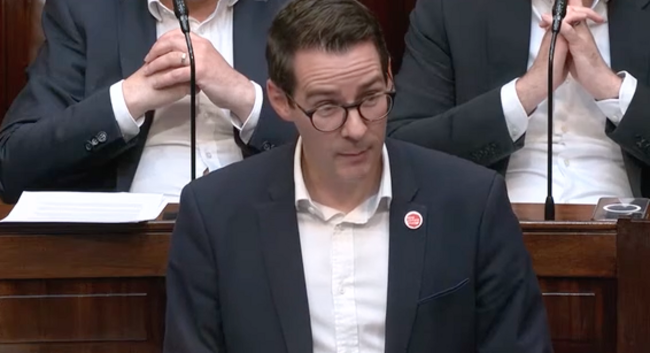
image (137) Labour's climate spokesperson Ciarán Ahern

Speaking ahead of the debate, Ahern called for an independent study to be commissioned on electricity prices, carbon emissions, water usage and grid stability.

“We cannot continue to blindly build data centres until we fully understand the impact these centres are having on our energy infrastructure,” he said. 

He told the Dáil: “This is not a question about whether or not data centres should or shouldn’t exist, and I hope the government don’t try to reduce the debate to those binary terms again. The debate has moved on.

“The question is whether we’re content to continue to allow unlimited expansion of these data centres without regard for the very real consequences on people and our environment.”

He said he hoped the fact that the United Nations recently described Ireland as a “cautionary tale”  when it comes to data centres would be a wake-up call for the government.  

Readers like you are keeping these stories free for everyone...

A mix of advertising and supporting contributions helps keep paywalls away from valuable information like this article. Over 5,000 readers like you have already stepped up and support us with a monthly payment or a once-off donation.