





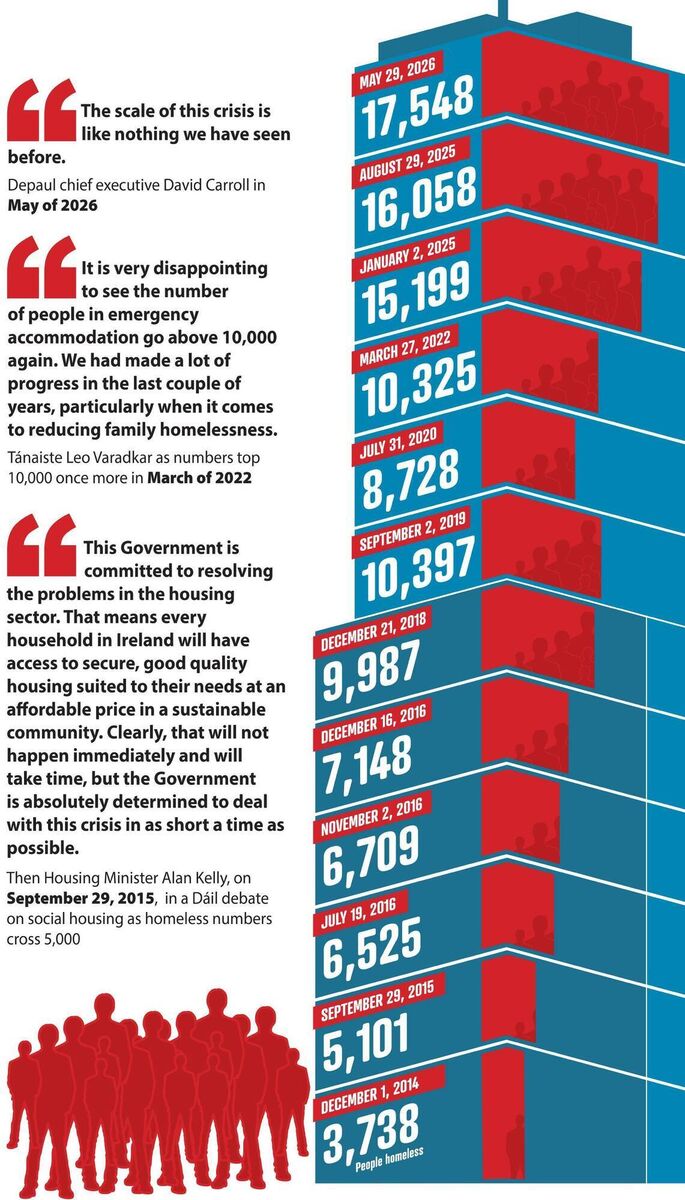
That figure, believe it or not, was an achievement, the lowest it had been for four full years.
All it took was a ban on evictions during a once-in-a-lifetime pandemic.
Today, five years later, an additional 10,000 people are homeless. The month-by-month figures have only dropped on two occasions, both in 2023, once by 12 and once by 150.
From a position where Ireland’s concept of housing was largely focused on rough sleeping and anything beyond was considered extraordinary, homelessness has become an entrenched social and economic problem — one which does not show any signs of abating.
The origins
Taoiseach Micheál Martin has, on a number of occasions, put the root of today’s crisis in the last decade.
He has pointed to the fact that, in 2006, the country saw around 88,000 homes completed. In the 2010s, the highest that figure would climb was 21,241 as the economy recovered from the property crash which accompanied a wider economic collapse.
In the first two full years of the Fine Gael and Labour coalition, which took the reins from Fianna Fáil in 2011, just over 16,000 homes were completed.
That lack of building activity and the faster-than-anticipated rebound in many parts of the economy caused a severe structural mismatch between housing supply and housing demand.
That — combined with rising rents, reduced social housing construction, and policy choices that increased dependence on the private rental market — set the basis for much of the problems we see today.
In his time as the leader of an opposition party, Mr Martin repeatedly blamed the rise in homeless on a government policy of the day.
During the crash, as social housing output began to collapse, the private sector was filling the gap, and changes to rent supplements of the day were called out by the now Taoiseach in a leaders’ questions debate in 2014.
“Deputies are meeting couples and single parents who are saying they cannot rent above the cap and must live in dingy, damp accommodation rather than elsewhere at a different price threshold,” he said at that point.
“It is something the government has not responded to.”
This situation, the effective privatisation through subvention of State housing, created what became known as the “HAP trap”, a catch-22 wherein those who received the Housing Assistance Payment (HAP) would have to bridge the gap between the upper limit of payments and rising rents.
On top of that, some find themselves removed from housing lists when they take HAP.
In 2012, a Focus Ireland report suggested that changes to rent supplement schemes at the time showed “evidence that these changes have contributed to a number of individuals becoming homeless, and have made it more difficult for people moving out of homelessness to secure appropriate accommodation in the private rented sector”.
In Cork City, for example, a couple with a child will be paid a maximum of €900 in HAP, while the average monthly rent of a two-bedroom apartment is €1,982.
The cost of HAP is now well over €1bn a year, having topped that mark for the first time in 2022. At the root of much of this is the near total wipeout of social housing building during the crash.
In 1975, local authorities built 8,794 social housing units — the highest on record until 2025.
However, during the crash, local authority builds were down from 158 in 2014 to just 75 in 2015. All of this combined with high unemployment in the wake of the crash to create a situation where, during the period 2013-2015, individual cases of homelessness were in the headlines and the political sphere in a way they had not been in previous times.
Go back to that session of leaders’ questions in 2014, which came in the days following the sad death of Jonathan Corrie just yards from Leinster House.
Micheál Martin raised the case of married couple Shane and Ciara Dwyer, which “clearly illustrates the dilemma” and whose plight had made national headlines in an Irish Times piece.
“This married couple had been sleeping rough in their car for over three weeks prior to the publication of the article. Their rent had increased by 50%. As a couple, they were entitled to €540 rent allowance per month and were allowed to pay rent capped at €750 per month,” Mr Martin said.
“The estate agent told them they had to sign a lease for €1,050, with the result that they had to hand back the keys and go. That is just one illustration from West Tallaght, but it is a national issue.”
The solutions
With the knock-on effects of all of those factors, work has been undertaken to tackle homelessness a number of times.
In February 2013, the minister of state with responsibility for housing and planning, Jan O’Sullivan, published the government’s homelessness policy statement in which the government’s aim to end long-term homelessness by the end of 2016 was outlined.
This document referred, for what appears to be the first time formally on the government side, to homeless as an “emergency crisis”.
It estimated that there were “at least” 2,663 homeless persons in Ireland at the time, with 2,400 or so in emergency accommodation.
The statement said that the issue of missed and partial rental payments in the private rented sector leading to rent arrears “is a recurring trigger event for families presenting to homeless accommodation”, but added that increasing supports was not being considered.
Instead, it proposed to build 900 homes for homeless people in the years 2014, 2015, and 2016.
A 2018 report, however, found that the number of families accessing emergency accommodation across the State rose by 90% and 55% in 2015 and 2016 respectively.
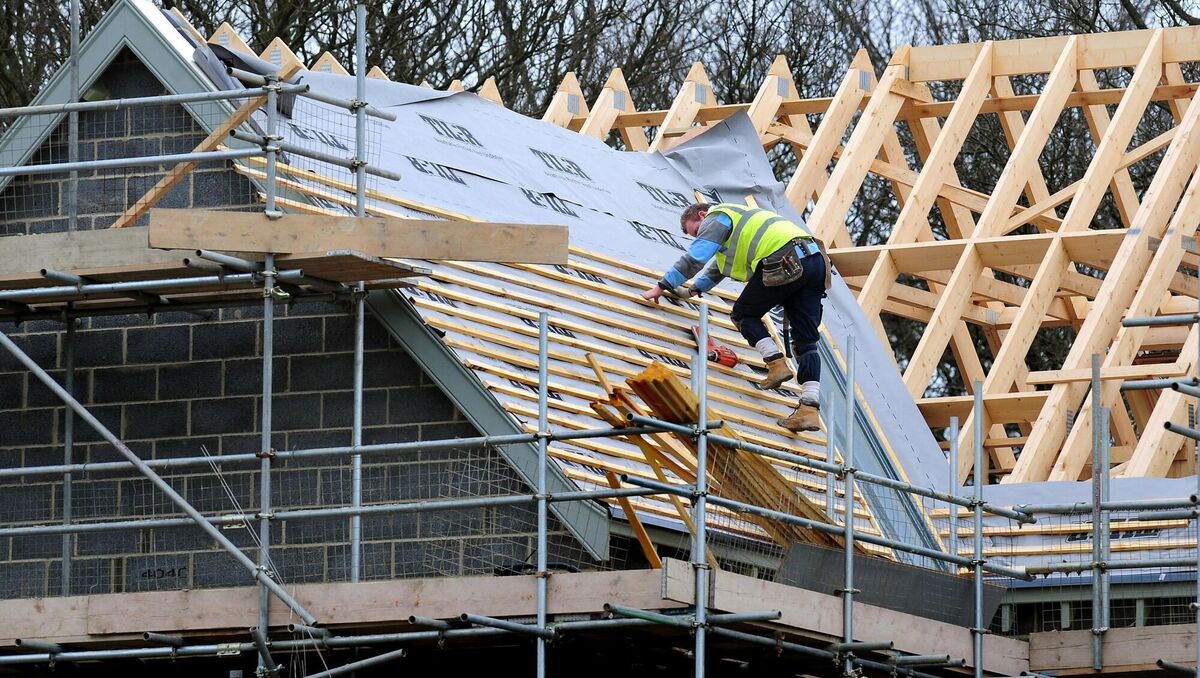
In 2014, the government announced Construction 2020 — a strategy to restart housebuilding after the crash.
Focused on planning reform, financing, construction activity, and increasing supply, it aimed to address shortages emerging after the financial catastrophe. That plan pointed to the 2013 strategy, but said that the government would “secure a ring-fenced supply of accommodation for homeless households within the next three years and mobilise the necessary supports”.
Allied to that document, the junior housing minister, Paudie Coffey, published a six-year social housing plan targeting about 35,000 additional social homes by 2020 through building, acquisitions, leasing, and HAP. The document marked the expansion of HAP as a core support mechanism, with it saying that, on top of 35,000 homes being built, the State would support up to 75,000 households “through an enhanced private rental sector”.
Assessing the success of those figures is somewhat difficult because of differing measures of counting.
The official government figures for 2016 to 2021 show that, while 34,210 homes had been targeted for building, the figure delivered was 28,158, while a target of 10,036 leases delivered just 7,932 homes.
Where the State has had much more success is in purchasing homes. From 2016 to 2021, the government had targeted 6,830 purchases of homes and bought 12,078. This includes local authorities and approved housing bodies’ purchases, which themselves have been subject to some criticism.
Critics say that, in these scenarios, the State is pitting itself against homebuyers.
Those State figures also show that while 48,168 homes had been bought, built, or rented in the period 2016 to 2021, some 99,813 tenancies using HAP and the rental accommodation scheme were supported. At the same time, homelessness rose from 5,715 in January 2016 to 8,914 in December 2021.
With the scale of the problem becoming unavoidable, housing became a standalone ministry when Simon Coveney was appointed to the role in May 2016.
Just weeks later, he unveiled his Rebuilding Ireland housing plan, the first major cross-government housing plan of the crisis era.
Built around the five pillars of homelessness, social housing, private rental, home ownership, and construction, the document had many plans for addressing homelessness, namely: Ensuring that by mid-2017, hotels were only used in limited circumstances for emergency accommodation for families by using the HAP and general housing allocations; and adding 3,000 homes between rapid builds and acquiring vacant homes. The plan was, generally, panned.
'Left in a deeper crisis'
Homelessness campaigner Fr Peter McVerry went as far to write in The Irish Times: “Any honest assessment of this policy will conclude that it has been an abject failure.
“The government’s approach has left the Irish housing system is in an even deeper crisis.”
Rebuilding Ireland was effectively scrapped when it was succeeded in 2021 by the housing for all programme, the flagship housing programme of the Fianna Fáil/Fine Gael/Green Party coalition.
That plan contained a notion of eradicating homelessness by 2030 as part of one of its pathways.
This would be done by again increasing social housing targets, additional rent supplement tenancies, and ramping up the housing first scheme.
It is targeted at vulnerable individuals using homeless services consistently or intermittently over long periods of time, those unable or resistant to accessing homeless services, and those who may then become habitual rough sleepers.
Between 2022 and 2026, more than 1,000 housing first tenancies have been created. It is seen by many as a success.
While the housing for all programme saw an upturn in overall housing completions, social housing targets were missed — 49,620 targeted rentals, purchases, and constructions to 43,295 delivered between 2022 and 2025 — and the rate of homelessness ballooned from 8,830 the month it was released to 16,966 the month its successor, the Action Plan for Housing and Homelessness, arrived.
That the title of the plan includes the word homelessness was praised at a cross-governmental stakeholders’ committee meeting in November, and the latest strategy includes €100m in 2026 for a “ground-breaking” acquisition programme for long-term homeless families. The text of the document calls homelessness “the single most pressing social issue that affects individuals and families in Ireland”, adding that €536m will be spent this year to support those experiencing homelessness.
Since the plan’s publication, the number of homeless people in Ireland has climbed 1,000. Some of the government language has shifted to not whether a person becomes homeless but for how long
While the government data released monthly is not clear on overall durations in emergency accommodation, a 2023 Focus Ireland study showed about 4,000 adults in Q3 of that year had been in State-provided accommodation for over six months.
As the number of people experiencing homelessness climbs, the number of social homes needed fell just 1.7%. This is according to a December 2025 report by the Parliamentary Budget Office which showed that the “ongoing need” for social housing in Ireland stood at 113,512 in 2024, down from 115,425 in 2023.
Whether the latest action plan can or will work remains to be seen. If it doesn’t, that 2021 figure will feel like a far off dream.
Outrage fatigue has set in with regular runaway figures
It’s very difficult to write about a crisis when the public is resigned to the fact that it may never be solved.
In Ireland, homelessness has almost become as accepted as a wet day.
Countless promises, a succession of action plans, and what have amounted to laughable government targets have come and gone as the number of families who drag suitcases in and out of emergency accommodation continues to spiral in one direction.
Repeat something enough times and, no matter how powerful the message or distressing the situation, it becomes normalised.
This was not always the case. Back in early December 2014, with 331 families in temporary accommodation, then housing minister Alan Kelly called an emergency homeless summit. It went on for over six hours and was attended by various government departments and agencies, local councillors, the heads of charities, opposition spokespeople, and even church leaders.
The death of Jonathan Corrie, who succumbed to hypothermia on a doorway just metres away from the entrance to Leinster House a few days prior, had sparked public outrage, dominated the Dáil agenda, and taken up endless column inches and airtime.
A number of measures were decided on out of the forum, including a direction that local authorities in Dublin put 50% of all new housing allocations towards vulnerable groups such as those long-term homeless and people with special needs.
The implementation plan on the State’s response to homelessness had been published the previous May, and it pledged to bring an end to involuntary long-term homelessness by the end of 2016. Leaving the meeting, then lord mayor Christy Burke had reason to be hopeful.
“It’s the first time in 30 years as a public representative that I’ve ever been to such a positive meeting in all those years,” he said, “it was a breath of fresh air.”
Then taoiseach Enda Kenny spent three hours in Dublin City that same week meeting homeless people and providing assistance to them.
It was a time when anger was mixed with a significant will to fix a situation. Of course, the 2016 deadline came and went.
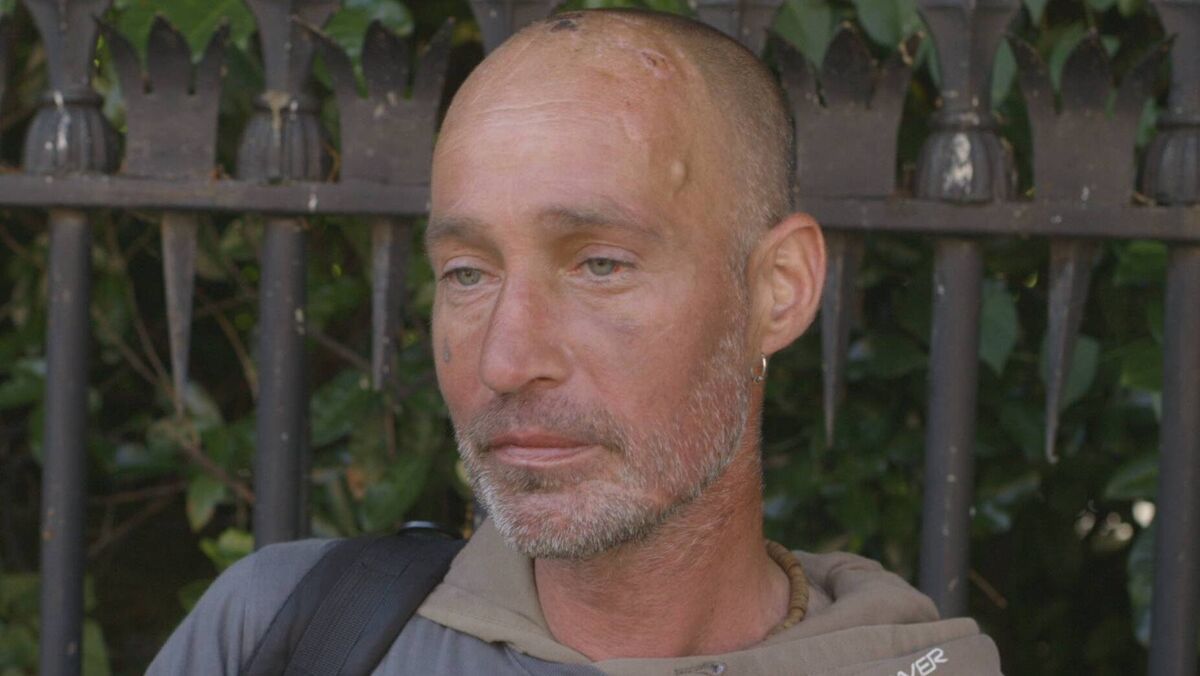
In the intervening period, ministers Simon Coveney, Eoghan Murphy, Darragh O’Brien, and now James Browne have all pledged to work towards a solution with very little, if any, improvement seen. A decade on, homelessness is represented by a runaway figure that is announced each month.
Akin to climate change, hospital waiting lists, or rising household costs, the public has collectively conceded that homelessness is a problem that may never be completely fixed. Outrage fatigue has set in.
Lasana Harris, a professor of social neuroscience at University College London who has investigated how the brain perceives marginalised groups, has found that being empathic to others takes its toll, and so our brains are “trained to disconnect” when we see a homeless person.
“We’ve developed this as a strategy to help us get through our social environment,” he said.
“Most people think, and rightly so, that homeless people are having very negative experiences and constantly suffering. We may not always want to resonate with that suffering.
Because of that, we lose sight of the fact that these are just regular people
Mr Harris has found that this process of dehumanisation is similar to that of medical professionals who, in order to do their job, must to a certain extent disassociate with the suffering of the patient under their care. To do otherwise would trigger an overwhelming emotional response.
As the uncontained crisis of homelessness continues, the public mood has shifted from a state of palpable frustration and fury at the injustice of having families cooped up in hotels, hubs, and emergency accommodation to one of apathy.
The real danger now is that sensing the issue is no longer top of the agenda for voters, politicians will treat homelessness as an ongoing annoyance that doesn’t require the full focus of Government.
Some might argue this has been the approach all along.
Solving homelessness starts with a home
Homelessness is not complex, despite some of the political narrative recently. Solving homelessness starts with a home.
At Simon Communities across Ireland, we see every day both the human reality of homelessness and the clear, evidence-based solutions that can end it.
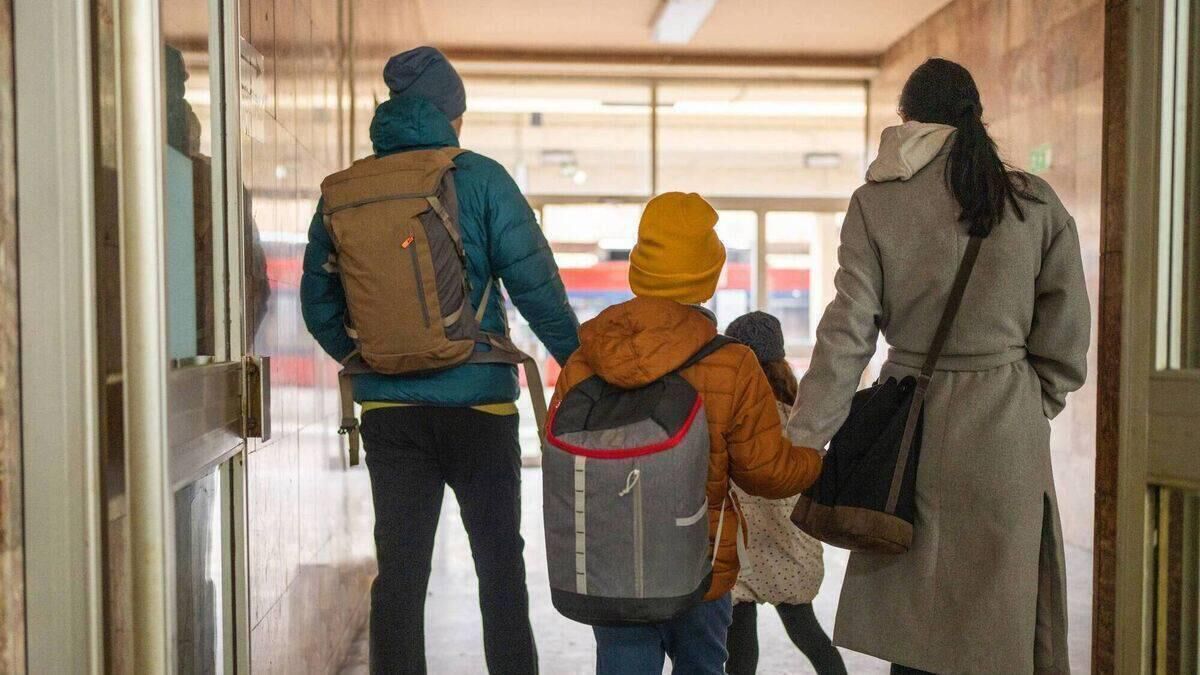
The faces of homelessness have been changing over the last decade of this crisis. We are seeing more young people, more families, more people who simply cannot afford the rent, more complex needs because of lack of access to addiction or mental health services, people sleeping in their cars throughout college, people unable to afford food, and, of course, pensioners being forced to retire into emergency homeless accommodation.
It is simply not good enough. Ireland is a rich country, with plenty of empty properties and land for building. In June 2021, when Ireland signed the Lisbon Declaration (an EU-wide commitment to end homelessness by 2030), there were 5,847 adults in emergency accommodation, and 932 families with 2,167 children.
Shamefully, the most recent report from April 2026 shows heartbreaking increases across all age groups and counties. In April of this year, there were 11,944 adults and 5,604 children in emergency accommodation (2,707 families).
It is important to note that the official homeless reports are just the tip of the iceberg.
Our hidden homelessness report shows that there are tens of thousands more people forced into sleeping on couches and other overcrowded situations
The official monthly numbers also don’t include the many women and children in domestic violence refuges, nor the thousands of people legally allowed to stay in the country but stuck in Ipas accommodation.
For decades, we have put forward policy solutions to the government. We take part in public consultations, any available fora, sit on the national homeless action committee, and try to play a productive and constructive part in ending homelessness.
The most effective way to end homelessness is to prevent it from occurring in the first place. Yet prevention has historically been underfunded and under-prioritised. We know that early intervention works. Homelessness can be avoidable if we act early enough.
That means reforming the private rental system, which is now the single biggest driver of homelessness. We need HAP rates that reflect real market rents, stronger protections to prevent evictions into homelessness, and easier access to supports when people are in difficulty.
We must scale up what we know works for those already experiencing homelessness. The housing first model has shown that providing a person with a permanent home, alongside intensive supports, is far more effective than expecting them to move through emergency systems. This has worked in Finland and is working in parts of Ireland.
We also need to significantly increase the supply of social and supported housing.
Long-term supported accommodation is essential for those who cannot live independently without ongoing assistance. Without this, people remain stuck in emergency accommodation that was never designed to be a long-term solution.
Ending homelessness will also require stronger accountability. We have called for clearer data collection, better sharing of information between agencies, and ultimately a legal duty on the State to prevent homelessness.
The Department of Housing alone cannot solve homelessness. Only a whole-of-government approach including health, social protection, and justice will bring about the change that’s needed. The solutions exist but they require co-ordination, political will, and sustained investment.
The scale of homelessness in Ireland today is deeply concerning. But it is not without hope. Every day, the incredible people working across Simon Communities see the difference that the right intervention at the right time can make. We know what works. The question now is whether those with the power to end homelessness choose to act on that knowledge.
此内容由惯性聚合(RSS阅读器)自动聚合整理,仅供阅读参考。 原文来自 — 版权归原作者所有。