



惯性聚合 高效追踪和阅读你感兴趣的博客、新闻、科技资讯
阅读原文 在惯性聚合中打开

推荐订阅源

G
Google Developers Blog
Google DeepMind News
Hugging Face - Blog
Hugging Face - Blog
D
Docker
F
Fortinet All Blogs
博客园 - 三生石上(FineUI控件)
Project Zero
Project Zero
Engineering at Meta
Engineering at Meta
J
Java Code Geeks
CTFtime.org: upcoming CTF events
Simon Willison's Weblog
S
Security Affairs
NISL@THU
NISL@THU
T
Tor Project blog
A
About on SuperTechFans
宝玉的分享
宝玉的分享
腾讯CDC
S
Schneier on Security
Cyber Security Advisories - MS-ISAC
P
Privacy & Cybersecurity Law Blog
cs.CL updates on arXiv.org
Stack Overflow Blog
Stack Overflow Blog
P
Privacy International News Feed
雷峰网
雷峰网
C
Cyber Attacks, Cyber Crime and Cyber Security
Vercel News
Vercel News
Cisco Talos Blog
Cisco Talos Blog
D
DataBreaches.Net
让小产品的独立变现更简单 - ezindie.com
Google Online Security Blog
Recorded Future
Recorded Future
L
LINUX DO - 热门话题
Microsoft Security Blog
Latest news
Latest news
C
Check Point Blog
有赞技术团队
有赞技术团队
T
The Exploit Database - CXSecurity.com
cs.AI updates on arXiv.org
云风的 BLOG
云风的 BLOG
SecWiki News
SecWiki News
Application and Cybersecurity Blog
爱范儿
爱范儿
月光博客
月光博客
V
Vulnerabilities – Threatpost
T
Threat Research - Cisco Blogs
P
Palo Alto Networks Blog
T
The Blog of Author Tim Ferriss
C
Cisco Blogs
Webroot Blog
Webroot Blog
S
Security @ Cisco Blogs

ImageKit.io Blog

Next.js Image Optimization with ImageKit Use Video as a Background in Your Next.js Project How to Fix Autoplay Video in Next.js How Durian Scaled a Visual-First Retail Experience to 350K Monthly Visitors Online How Matsmart accelerated image delivery across countries with ImageKit AI in Digital Asset Management: From Smart Workflows to Agentic Automation How Joseph Joseph unified and secured global video delivery with ImageKit How Modall powers fast, effortless media delivery across 40+ projects with ImageKit Digital Asset Management (DAM) Trends: 2026 Report How to add a poster image to Video.js player (and automate it) HLS streaming with Video.js + React Building the future of storytelling with fast, AI-powered video delivery How PushOwl delivers 100M+ image-rich notifications seamlessly with ImageKit How Homify delivers millions of interior design images seamlessly with ImageKit Better event discovery with lightning‑fast videos & images Adding video player in React Native Video player in Angular applications Crop and resize videos in React Next.js image and video upload React image and video upload React video optimization How we quadrupled our traffic to 625K monthly page views How Apollo 24|7 boosted performance & reduced costs with ImageKit Simplify your media workflows with ImageKit DAM integrations Extending Lighthouse for custom image and video optimization analysis Brand Asset Management: What is it? How does it work? WordPress Digital Asset Management Guide - Manage your WP media assets better Why Shopify retailers need a digital asset management solution DAM vs. SharePoint: Which is best for you? AI-powered Metadata and Tagging in Digital Asset Management How Hopscotch built India's largest online Kids' fashion brand with ImageKit Dropbox Vs. DAM: Which Is The Right Tool For Digital Asset Management Digital Asset Management for Photographers: A Complete Guide Why digital asset management for agencies is essential Helping both Top and Bottom Line: SaffronStays rapid, profitable growth with ImageKit How KreditBee simplified media experiences with ImageKit Google Drive alternatives for businesses (with fast-growing teams) Node.js image upload ImageKit: The Secret Ingredient in Swiggy’s Expansion Journey Streamlining the Design Approval Process: A Comprehensive Guide AV1 Codec - Complete guide for video application devs PHP image and video upload Angular image & video upload AV1 vs VP9: Which codec should you choose? Adding video player in Next.js React Video Player VP8 vs VP9 - In the context of online video delivery Exploring WebM vs MP4 7 Free Digital Asset Management Software that are not Open-Source Comparing 9 Top Digital Asset Management Tools in the Market What are Brand Standards and Why do they Matter? Boost Sales and Brand Appeal: Essential Tips for eCommerce Image Management Brand Recall: The Strategy to Create Unforgettable Brands How to upload files in HTML? Branding for Small Businesses (2025 Edition) Everything you need to know about VP9 codec Recent updates from ImageKit and what's next Best Ways to Write RFP For Digital Asset Management (+ with free RFP template) What is Brand Dilution? How to Avoid It? Explained with [Examples] The Importance of Brand Identity: Leveraging Digital Asset Management for Impact From Launch to Scale: How to Launch a Brand Campaign Digital Asset Management Requirements - What do You Need to Evaluate and How? Marketing Collateral Management: A Quick End-to-End Guide Video Content Management System: What Is It And How To Choose One? Dropbox vs. Google Drive vs. Onedrive: The Best Cloud Storage Solution How to Build Brand Trust: Get Started In 2025 Google Drive vs. Box: A Detailed Comparison How Digital Asset Management Solutions Help Protect Brand Equity A DAM Solution Can Safeguard Your Digital Intellectual Property - Here’s How WebP Vs. PNG: Which Image Format Should You Use and Why? How to Resize Images in Bootstrap Easily Progressive jpegs (PJPEG): the key to loading images faster on your website Dropbox vs. Google Drive: The Best Cloud Storage For Digital Assets Dropbox Pros & Cons In 2024: An In-Depth Analysis and Why A DAM Solution Stands Out Google Drive Vs OneDrive: The Better Storage Option For Digital Assets Manage your video assets better with video metadata Understanding DAM's Role in Strengthening Brand Identity Digital asset management strategy: What to know before creating one The Ultimate Guide To Marketing Agency Onboarding 6 Solutions To Simplify Large File Sharing Over The Web A Step-by-Step Breakdown of a Video Production Workflow 13 Digital Asset Management Use Cases You Should Know How to Conduct a Brand Audit and Manage Your Brand Assets Costly Consequences of Inconsistent Branding And How DAM Can Help Dynamic Asset Transformation: What It Is, Why You Need It, and How ImageKit Can Help Everything You Need to Know About HTML Video Autoplay How To Select Your DAM Vendor: A Complete Guide How to Boost User Experience with Smart Digital Asset Management React Image Optimization: A Guide for Web Developers Why Should DAM Be A Part Of Your MarTech Stack? Unleashing the Power of Content Repurposing with ImageKit MKV vs MP4: Which Video File Format Is Better for Your Needs? Digital Asset Management For Ecommerce: A Complete Guide How an Image Tagging Software can Transform Your Image Search How to Manage Your Content Lifecycle Effectively M4V vs MP4: Which Video Format Should You Use and Why? Why Every Business Needs An Image Management System All The Questions To Ask During A Dam Demo Which is the Best Image Format for Your Website? Uploading Multiple Files Using JavaScript: A Comprehensive Guide
The What, Why, And How of Brotli Compression
Deeksha Bahl · 2019-07-17 · via ImageKit.io Blog

Let's start from the start — What's Brotli?

In 2013, Brotli was launched for the offline compression of web fonts. Later, In 2015, Google released a version for generic lossless data compression, keeping in mind the use for HTTP compression in particular.

It's open source, it outperforms gzip, and it's supported by most browsers. And here's why you should be using it.

Brotli Compressions are Smaller

As found by CertSimple, Brotli performance when compared to gzip is:

  • 14% smaller for JavaScript
  • 21% smaller for HTML
  • 17% smaller for CSS

Significant difference, wouldn't you say?

Compresses Faster Than Gzip

A common misconception in the circuit is that Brotli is slower than gzip. That's just not true!

The following graph, which was generated from Squash benchmark results, paints a clearer picture.
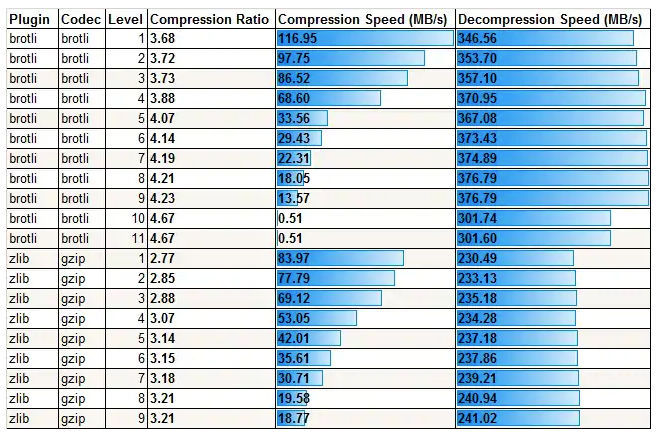
Source: http://bit.ly/2StLQbv

Gzip and Brotli, both have variable levels of compression. What makes the difference, and need your attention, are the default settings.

Brotli is set up to max by default. And that's what needs to be manipulated to optimize the compression speed. Leverage it.

Faster Page Load, Faster Website

When the data of a website gets compressed faster and to a much smaller size, it takes up less bandwidth to load. Reduced bandwidth consumption translates to a faster page load.

With its previously mentioned advantages, using Brotli for your data compressions would essentially lead to a significant reduction in the page load time of your website.

image result for brotli compression

And what does that translate to for your website? That's right, a faster website!

A faster website gets a better search ranking and reflects higher in search results.

Better User Experience

With the file sizes compressing faster, reducing the page load time and making for a speedier website, means a happy user.

An efficient and fast loading website performs better and provides a better user experience. Something every business out there is striving for.

Browser Support

In its initial phase, Brotli wasn't supported by most browsers. Now that that has changed and you can roll out Brotli compressions on most browsers, there's really no excuse not to give it a go.
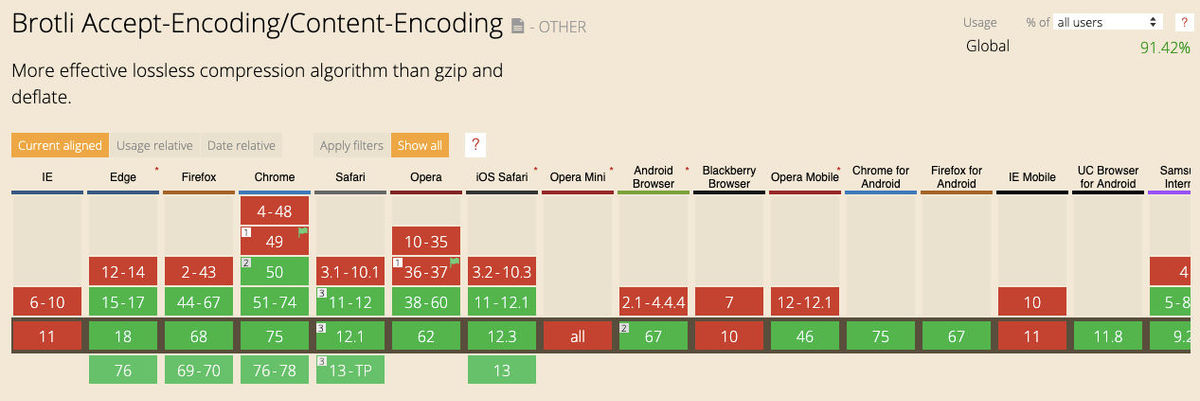
Brotli Compression Browser Support

If the browser in use supports Brotli, the Accept-Encoding response header would include "br".

If the resources on the website have been compressed using Brotli, the value for Content-Encoding response header will be "br",
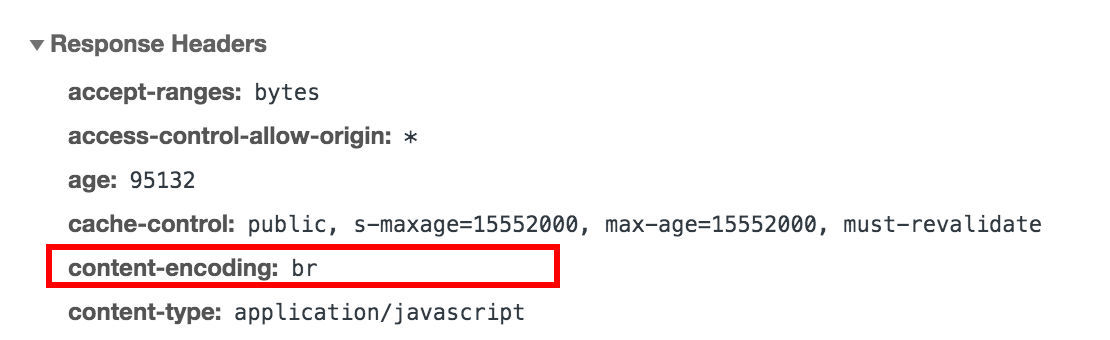
and not gzip.
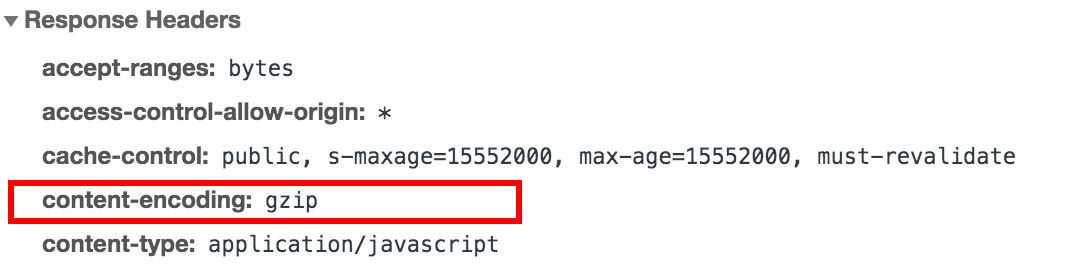
image result for brotli not supported

The server can be configured in the way that it automatically falls back on gzip for the rare cases where the browser doesn't support Brotli.

So Why Hasn't it Gained Momentum?

Developers spend hours building the perfect webpage. And usually within tight deadlines.

When enabling Brotli for static compressions, the assets need to be compressed with every build. In cases where higher compression levels are used, the build time taken can spike up significantly.

When enabling Brotli for dynamic compressions, as the assets get compressed on the fly as and when they are requested by the browser, the files being compressed at higher levels for better compression ratios will take longer, leading to a higher load time. This lag can affect website performance and user experience.

Setting Up Brotli

Let's take an instance where we use an nginx server with the Brotli compression module provided by Google.

It can be easily turned on selectively for particular file types by checking for the mime type value.

In the example below, we have selectively turned it on for Brotli compressions for JS (application/javascript) and CSS (text/css) file types while setting the Brotli compression level at 9.

image result for brotli compression for JS and CSS

Here is an excellent guide for cases where Brotli compression is to be used during the build process, and not real-time, using a tool like webpack.

Final Thoughts

While there are many formats to choose from, very few offer the kind of data quality post compression, while being supported by most browsers. Brotli may not be as popular yet, but with its list of pros, the teeny bit of effort it needs to be setup is well worth it.


Many CDNs do not support Brotli. ImageKit, with its global CDN, has rolled out Brotli data compressions served through its servers, and you can get started with it for free here.