

惯性聚合 高效追踪和阅读你感兴趣的博客、新闻、科技资讯
阅读原文 在惯性聚合中打开

推荐订阅源

MongoDB | Blog
MongoDB | Blog
AI
AI
B
Blog RSS Feed
CTFtime.org: upcoming CTF events
T
Threatpost
I
Intezer
P
Proofpoint News Feed
Cyber Security Advisories - MS-ISAC
Scott Helme
Scott Helme
Threat Intelligence Blog | Flashpoint
T
Threat Research - Cisco Blogs
Google DeepMind News
GbyAI
GbyAI
H
Hackread – Cybersecurity News, Data Breaches, AI and More
S
Schneier on Security
Webroot Blog
Webroot Blog
Recorded Future
Recorded Future
aimingoo的专栏
aimingoo的专栏
L
Lohrmann on Cybersecurity
Simon Willison's Weblog
MyScale Blog
MyScale Blog
Project Zero
Project Zero
L
LangChain Blog
B
Blog
D
DataBreaches.Net
Microsoft Security Blog
F
Fortinet All Blogs
美团技术团队
Engineering at Meta
Engineering at Meta
Cisco Talos Blog
Cisco Talos Blog
D
Docker
WordPress大学
WordPress大学
人人都是产品经理
人人都是产品经理
S
Security Affairs
Attack and Defense Labs
N
News | PayPal Newsroom
钛媒体:引领未来商业与生活新知
钛媒体:引领未来商业与生活新知
量子位
Exploit-DB.com RSS Feed
W
WeLiveSecurity
V2EX - 技术
V2EX - 技术
TaoSecurity Blog
TaoSecurity Blog
博客园 - Franky
P
Proofpoint News Feed
Jina AI
Jina AI
Google DeepMind News
OSCHINA 社区最新新闻
OSCHINA 社区最新新闻
雷峰网
雷峰网
The Hacker News
The Hacker News
G
GRAHAM CLULEY

Hugging Face - Blog

Waypoint-1.5: Higher-Fidelity Interactive Worlds for Everyday GPUs ALTK‑Evolve: On‑the‑Job Learning for AI Agents Safetensors is Joining the PyTorch Foundation Holo3: Breaking the Computer Use Frontier Any Custom Frontend with Gradio's Backend A New Framework for Evaluating Voice Agents (EVA) Bringing Robotics AI to Embedded Platforms: Dataset Recording, VLA Fine‑Tuning, and On‑Device Optimizations One-Shot Any Web App with Gradio's gr.HTML CUGA on Hugging Face: Democratizing Configurable AI Agents New in llama.cpp: Model Management Building Deep Research: How we Achieved State of the Art OVHcloud on Hugging Face Inference Providers 🔥 20x Faster TRL Fine-tuning with RapidFire AI Building for an Open Future - our new partnership with Google Cloud Aligning to What? Rethinking Agent Generalization in MiniMax M2 Building a Healthcare Robot from Simulation to Deployment with NVIDIA Isaac Sentence Transformers is joining Hugging Face! Unlock the power of images with AI Sheets Supercharge your OCR Pipelines with Open Models Google Cloud C4 Brings a 70% TCO improvement on GPT OSS with Intel and Hugging Face Get your VLM running in 3 simple steps on Intel CPUs Nemotron-Personas-India: Synthesized Data for Sovereign AI Introducing RTEB: A New Standard for Retrieval Evaluation Accelerating Qwen3-8B Agent on Intel® Core™ Ultra with Depth-Pruned Draft Models VibeGame: Exploring Vibe Coding Games Nemotron-Personas-Japan: ソブリン AI のための合成データセット Swift Transformers Reaches 1.0 – and Looks to the Future Smol2Operator: Post-Training GUI Agents for Computer Use SyGra: The One-Stop Framework for Building Data for LLMs and SLMs Gaia2 and ARE: Empowering the community to study agents Scaleway on Hugging Face Inference Providers 🔥 Democratizing AI Safety with RiskRubric.ai Public AI on Hugging Face Inference Providers 🔥 `LeRobotDataset:v3.0`: Bringing large-scale datasets to `lerobot` Visible Watermarking with Gradio Introducing the Palmyra-mini family: Powerful, lightweight, and ready to reason! Tricks from OpenAI gpt-oss YOU 🫵 can use with transformers Fine-tune Any LLM from the Hugging Face Hub with Together AI Jupyter Agents: training LLMs to reason with notebooks mmBERT: ModernBERT goes Multilingual Welcome EmbeddingGemma, Google's new efficient embedding model SAIR: Accelerating Pharma R&D with AI-Powered Structural Intelligence Make your ZeroGPU Spaces go brrr with ahead-of-time compilation NVIDIA Releases 6 Million Multi-Lingual Reasoning Dataset Generate Images with Claude and Hugging Face From Zero to GPU: A Guide to Building and Scaling Production-Ready CUDA Kernels MCP for Research: How to Connect AI to Research Tools Kimina-Prover-RL Arm & ExecuTorch 0.7: Bringing Generative AI to the masses Neural Super Sampling is here! TextQuests: How Good are LLMs at Text-Based Video Games? 🇵🇭 FilBench - Can LLMs Understand and Generate Filipino? Introducing AI Sheets: a tool to work with datasets using open AI models! Accelerate ND-Parallel: A guide to Efficient Multi-GPU Training Vision Language Model Alignment in TRL ⚡️ Welcome GPT OSS, the new open-source model family from OpenAI! Measuring Open-Source Llama Nemotron Models on DeepResearch Bench 📚 3LM: A Benchmark for Arabic LLMs in STEM and Code Implementing MCP Servers in Python: An AI Shopping Assistant with Gradio Introducing Trackio: A Lightweight Experiment Tracking Library from Hugging Face Say hello to `hf`: a faster, friendlier Hugging Face CLI ✨ Parquet Content-Defined Chunking TimeScope: How Long Can Your Video Large Multimodal Model Go? Fast LoRA inference for Flux with Diffusers and PEFT Accelerate a World of LLMs on Hugging Face with NVIDIA NIM Arc Virtual Cell Challenge: A Primer Consilium: When Multiple LLMs Collaborate Back to The Future: Evaluating AI Agents on Predicting Future Events Five Big Improvements to Gradio MCP Servers Ettin Suite: SoTA Paired Encoders and Decoders Migrating the Hub from Git LFS to Xet Kimina-Prover: Applying Test-time RL Search on Large Formal Reasoning Models Asynchronous Robot Inference: Decoupling Action Prediction and Execution ScreenEnv: Deploy your full stack Desktop Agent Building the Hugging Face MCP Server Reachy Mini - The Open-Source Robot for Today's and Tomorrow's AI Builders Creating custom kernels for the AMD MI300 Upskill your LLMs With Gradio MCP Servers SmolLM3: smol, multilingual, long-context reasoner Three Mighty Alerts Supporting Hugging Face’s Production Infrastructure Efficient MultiModal Data Pipeline Announcing NeurIPS 2025 E2LM Competition: Early Training Evaluation of Language Models Training and Finetuning Sparse Embedding Models with Sentence Transformers Welcome the NVIDIA Llama Nemotron Nano VLM to Hugging Face Hub Gemma 3n fully available in the open-source ecosystem! Transformers backend integration in SGLang (LoRA) Fine-Tuning FLUX.1-dev on Consumer Hardware Groq on Hugging Face Inference Providers 🔥 How Long Prompts Block Other Requests - Optimizing LLM Performance Learn the Hugging Face Kernel Hub in 5 Minutes Convert Transformers to ONNX with Hugging Face Optimum Intel and Hugging Face Partner to Democratize Machine Learning Hardware Acceleration Director of Machine Learning Insights [Part 3: Finance Edition] The Annotated Diffusion Model Deep Q-Learning with Space Invaders Graphcore and Hugging Face Launch New Lineup of IPU-Ready Transformers Introducing Pull Requests and Discussions 🥳 Efficient Table Pre-training without Real Data: An Introduction to TAPEX An Introduction to Q-Learning Part 2/2 How Sempre Health is leveraging the Expert Acceleration Program to accelerate their ML roadmap
Llama 2 on Amazon SageMaker a Benchmark
Philipp Schmid · 2023-09-26 · via Hugging Face - Blog

Back to Articles

Philipp Schmid's avatar

Latency

Deploying large language models (LLMs) and other generative AI models can be challenging due to their computational requirements and latency needs. To provide useful recommendations to companies looking to deploy Llama 2 on Amazon SageMaker with the Hugging Face LLM Inference Container, we created a comprehensive benchmark analyzing over 60 different deployment configurations for Llama 2.

In this benchmark, we evaluated varying sizes of Llama 2 on a range of Amazon EC2 instance types with different load levels. Our goal was to measure latency (ms per token), and throughput (tokens per second) to find the optimal deployment strategies for three common use cases:

  • Most Cost-Effective Deployment: For users looking for good performance at low cost
  • Best Latency Deployment: Minimizing latency for real-time services
  • Best Throughput Deployment: Maximizing tokens processed per second

To keep this benchmark fair, transparent, and reproducible, we share all of the assets, code, and data we used and collected:

We hope to enable customers to use LLMs and Llama 2 efficiently and optimally for their use case. Before we get into the benchmark and data, let's look at the technologies and methods we used.

What is the Hugging Face LLM Inference Container?

Hugging Face LLM DLC is a purpose-built Inference Container to easily deploy LLMs in a secure and managed environment. The DLC is powered by Text Generation Inference (TGI), an open-source, purpose-built solution for deploying and serving LLMs. TGI enables high-performance text generation using Tensor Parallelism and dynamic batching for the most popular open-source LLMs, including StarCoder, BLOOM, GPT-NeoX, Falcon, Llama, and T5. VMware, IBM, Grammarly, Open-Assistant, Uber, Scale AI, and many more already use Text Generation Inference.

What is Llama 2?

Llama 2 is a family of LLMs from Meta, trained on 2 trillion tokens. Llama 2 comes in three sizes - 7B, 13B, and 70B parameters - and introduces key improvements like longer context length, commercial licensing, and optimized chat abilities through reinforcement learning compared to Llama (1). If you want to learn more about Llama 2 check out this blog post.

What is GPTQ?

GPTQ is a post-training quantziation method to compress LLMs, like GPT. GPTQ compresses GPT (decoder) models by reducing the number of bits needed to store each weight in the model, from 32 bits down to just 3-4 bits. This means the model takes up much less memory and can run on less Hardware, e.g. Single GPU for 13B Llama2 models. GPTQ analyzes each layer of the model separately and approximates the weights to preserve the overall accuracy. If you want to learn more and how to use it, check out Optimize open LLMs using GPTQ and Hugging Face Optimum.

Benchmark

To benchmark the real-world performance of Llama 2, we tested 3 model sizes (7B, 13B, 70B parameters) on four different instance types with four different load levels, resulting in 60 different configurations:

  • Models: We evaluated all currently available model sizes, including 7B, 13B, and 70B.
  • Concurrent Requests: We tested configurations with 1, 5, 10, and 20 concurrent requests to determine the performance on different usage scenarios.
  • Instance Types: We evaluated different GPU instances, including g5.2xlarge, g5.12xlarge, g5.48xlarge powered by NVIDIA A10G GPUs, and p4d.24xlarge powered by NVIDIA A100 40GB GPU.
  • Quantization: We compared performance with and without quantization. We used GPTQ 4-bit as a quantization technique.

As metrics, we used Throughput and Latency defined as:

  • Throughput (tokens/sec): Number of tokens being generated per second.
  • Latency (ms/token): Time it takes to generate a single token

We used those to evaluate the performance of Llama across the different setups to understand the benefits and tradeoffs. If you want to run the benchmark yourself, we created a Github repository.

You can find the full data of the benchmark in the Amazon SageMaker Benchmark: TGI 1.0.3 Llama 2 sheet. The raw data is available on GitHub.

If you are interested in all of the details, we recommend you to dive deep into the provided raw data.

Recommendations & Insights

Based on the benchmark, we provide specific recommendations for optimal LLM deployment depending on your priorities between cost, throughput, and latency for all Llama 2 model sizes.

Note: The recommendations are based on the configuration we tested. In the future, other environments or hardware offerings, such as Inferentia2, may be even more cost-efficient.

Most Cost-Effective Deployment

The most cost-effective configuration focuses on the right balance between performance (latency and throughput) and cost. Maximizing the output per dollar spent is the goal. We looked at the performance during 5 concurrent requests. We can see that GPTQ offers the best cost-effectiveness, allowing customers to deploy Llama 2 13B on a single GPU.

Model Quantization Instance concurrent requests Latency (ms/token) median Throughput (tokens/second) On-demand cost ($/h) in us-west-2 Time to generate 1 M tokens (minutes) cost to generate 1M tokens ($)
Llama 2 7B GPTQ g5.2xlarge 5 34.245736 120.0941633 $1.52 138.78 $3.50
Llama 2 13B GPTQ g5.2xlarge 5 56.237484 71.70560104 $1.52 232.43 $5.87
Llama 2 70B GPTQ ml.g5.12xlarge 5 138.347928 33.33372399 $7.09 499.99 $59.08

Best Throughput Deployment

The Best Throughput configuration maximizes the number of tokens that are generated per second. This might come with some reduction in overall latency since you process more tokens simultaneously. We looked at the highest tokens per second performance during twenty concurrent requests, with some respect to the cost of the instance. The highest throughput was for Llama 2 13B on the ml.p4d.24xlarge instance with 688 tokens/sec.

Model Quantization Instance concurrent requests Latency (ms/token) median Throughput (tokens/second) On-demand cost ($/h) in us-west-2 Time to generate 1 M tokens (minutes) cost to generate 1M tokens ($)
Llama 2 7B None ml.g5.12xlarge 20 43.99524 449.9423027 $7.09 33.59 $3.97
Llama 2 13B None ml.p4d.12xlarge 20 67.4027465 668.0204881 $37.69 24.95 $15.67
Llama 2 70B None ml.p4d.24xlarge 20 59.798591 321.5369158 $37.69 51.83 $32.56

Best Latency Deployment

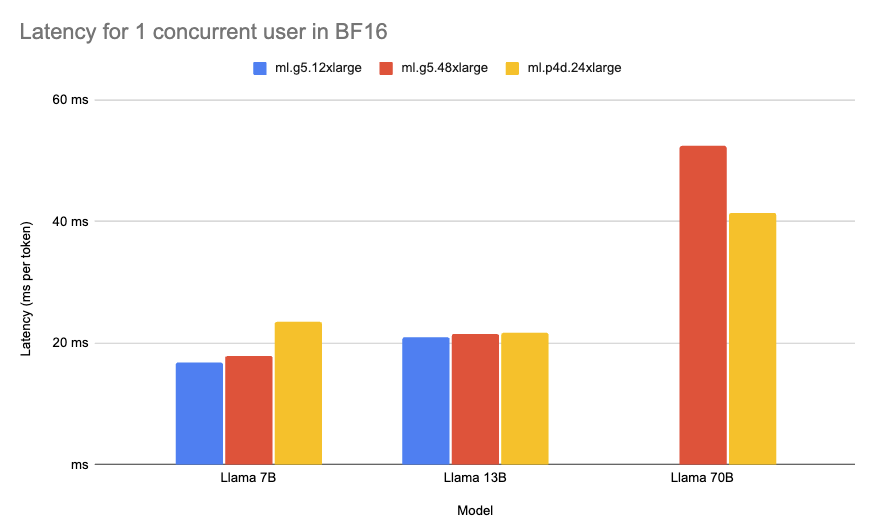
The Best Latency configuration minimizes the time it takes to generate one token. Low latency is important for real-time use cases and providing a good experience to the customer, e.g. Chat applications. We looked at the lowest median for milliseconds per token during 1 concurrent request. The lowest overall latency was for Llama 2 7B on the ml.g5.12xlarge instance with 16.8ms/token.

Model Quantization Instance concurrent requests Latency (ms/token) median Thorughput (tokens/second) On-demand cost ($/h) in us-west-2 Time to generate 1 M tokens (minutes) cost to generate 1M tokens ($)
Llama 2 7B None ml.g5.12xlarge 1 16.812526 61.45733054 $7.09 271.19 $32.05
Llama 2 13B None ml.g5.12xlarge 1 21.002715 47.15736567 $7.09 353.43 $41.76
Llama 2 70B None ml.p4d.24xlarge 1 41.348543 24.5142928 $37.69 679.88 $427.05

Conclusions

In this benchmark, we tested 60 configurations of Llama 2 on Amazon SageMaker. For cost-effective deployments, we found 13B Llama 2 with GPTQ on g5.2xlarge delivers 71 tokens/sec at an hourly cost of $1.55. For max throughput, 13B Llama 2 reached 296 tokens/sec on ml.g5.12xlarge at $2.21 per 1M tokens. And for minimum latency, 7B Llama 2 achieved 16ms per token on ml.g5.12xlarge.

We hope the benchmark will help companies deploy Llama 2 optimally based on their needs. If you want to get started deploying Llama 2 on Amazon SageMaker, check out Introducing the Hugging Face LLM Inference Container for Amazon SageMaker and Deploy Llama 2 7B/13B/70B on Amazon SageMaker blog posts.


Thanks for reading! If you have any questions, feel free to contact me on Twitter or LinkedIn.