



惯性聚合 高效追踪和阅读你感兴趣的博客、新闻、科技资讯
阅读原文 在惯性聚合中打开

推荐订阅源

B
Blog RSS Feed
D
Darknet – Hacking Tools, Hacker News & Cyber Security
让小产品的独立变现更简单 - ezindie.com
G
Google Developers Blog
MyScale Blog
MyScale Blog
Google DeepMind News
J
Java Code Geeks
奇客Solidot–传递最新科技情报
奇客Solidot–传递最新科技情报
C
Check Point Blog
Cyber Security Advisories - MS-ISAC
P
Proofpoint News Feed
D
Docker
Jina AI
Jina AI
博客园 - 三生石上(FineUI控件)
Threat Intelligence Blog | Flashpoint
Help Net Security
Help Net Security
Google DeepMind News
L
LINUX DO - 最新话题
T
Tailwind CSS Blog
N
Netflix TechBlog - Medium
Forbes - Security
Forbes - Security
MongoDB | Blog
MongoDB | Blog
Attack and Defense Labs
Webroot Blog
Webroot Blog
A
About on SuperTechFans
Schneier on Security
Hacker News - Newest:
Hacker News - Newest: "LLM"
Microsoft Azure Blog
F
Fortinet All Blogs
IT之家
IT之家
The Last Watchdog
The Last Watchdog
腾讯CDC
Microsoft Security Blog
Project Zero
Project Zero
B
Blog
Recorded Future
Recorded Future
博客园_首页
cs.AI updates on arXiv.org
S
SegmentFault 最新的问题
Security Archives - TechRepublic
钛媒体:引领未来商业与生活新知
钛媒体:引领未来商业与生活新知
H
Hacker News: Front Page
T
Threatpost
H
Heimdal Security Blog
Cloudbric
Cloudbric
Google Online Security Blog
OSCHINA 社区最新新闻
OSCHINA 社区最新新闻
V
V2EX
云风的 BLOG
云风的 BLOG
V
Visual Studio Blog

Hugging Face - Blog

Waypoint-1.5: Higher-Fidelity Interactive Worlds for Everyday GPUs ALTK‑Evolve: On‑the‑Job Learning for AI Agents Safetensors is Joining the PyTorch Foundation Holo3: Breaking the Computer Use Frontier Any Custom Frontend with Gradio's Backend A New Framework for Evaluating Voice Agents (EVA) Bringing Robotics AI to Embedded Platforms: Dataset Recording, VLA Fine‑Tuning, and On‑Device Optimizations One-Shot Any Web App with Gradio's gr.HTML CUGA on Hugging Face: Democratizing Configurable AI Agents New in llama.cpp: Model Management Building Deep Research: How we Achieved State of the Art OVHcloud on Hugging Face Inference Providers 🔥 20x Faster TRL Fine-tuning with RapidFire AI Building for an Open Future - our new partnership with Google Cloud Aligning to What? Rethinking Agent Generalization in MiniMax M2 Building a Healthcare Robot from Simulation to Deployment with NVIDIA Isaac Sentence Transformers is joining Hugging Face! Unlock the power of images with AI Sheets Supercharge your OCR Pipelines with Open Models Google Cloud C4 Brings a 70% TCO improvement on GPT OSS with Intel and Hugging Face Get your VLM running in 3 simple steps on Intel CPUs Nemotron-Personas-India: Synthesized Data for Sovereign AI Introducing RTEB: A New Standard for Retrieval Evaluation Accelerating Qwen3-8B Agent on Intel® Core™ Ultra with Depth-Pruned Draft Models VibeGame: Exploring Vibe Coding Games Nemotron-Personas-Japan: ソブリン AI のための合成データセット Swift Transformers Reaches 1.0 – and Looks to the Future Smol2Operator: Post-Training GUI Agents for Computer Use SyGra: The One-Stop Framework for Building Data for LLMs and SLMs Gaia2 and ARE: Empowering the community to study agents Scaleway on Hugging Face Inference Providers 🔥 Democratizing AI Safety with RiskRubric.ai Public AI on Hugging Face Inference Providers 🔥 `LeRobotDataset:v3.0`: Bringing large-scale datasets to `lerobot` Visible Watermarking with Gradio Introducing the Palmyra-mini family: Powerful, lightweight, and ready to reason! Tricks from OpenAI gpt-oss YOU 🫵 can use with transformers Fine-tune Any LLM from the Hugging Face Hub with Together AI Jupyter Agents: training LLMs to reason with notebooks mmBERT: ModernBERT goes Multilingual Welcome EmbeddingGemma, Google's new efficient embedding model SAIR: Accelerating Pharma R&D with AI-Powered Structural Intelligence Make your ZeroGPU Spaces go brrr with ahead-of-time compilation NVIDIA Releases 6 Million Multi-Lingual Reasoning Dataset Generate Images with Claude and Hugging Face From Zero to GPU: A Guide to Building and Scaling Production-Ready CUDA Kernels MCP for Research: How to Connect AI to Research Tools Kimina-Prover-RL Arm & ExecuTorch 0.7: Bringing Generative AI to the masses Neural Super Sampling is here! TextQuests: How Good are LLMs at Text-Based Video Games? 🇵🇭 FilBench - Can LLMs Understand and Generate Filipino? Introducing AI Sheets: a tool to work with datasets using open AI models! Accelerate ND-Parallel: A guide to Efficient Multi-GPU Training Vision Language Model Alignment in TRL ⚡️ Welcome GPT OSS, the new open-source model family from OpenAI! Measuring Open-Source Llama Nemotron Models on DeepResearch Bench 📚 3LM: A Benchmark for Arabic LLMs in STEM and Code Implementing MCP Servers in Python: An AI Shopping Assistant with Gradio Introducing Trackio: A Lightweight Experiment Tracking Library from Hugging Face Say hello to `hf`: a faster, friendlier Hugging Face CLI ✨ Parquet Content-Defined Chunking TimeScope: How Long Can Your Video Large Multimodal Model Go? Fast LoRA inference for Flux with Diffusers and PEFT Accelerate a World of LLMs on Hugging Face with NVIDIA NIM Arc Virtual Cell Challenge: A Primer Consilium: When Multiple LLMs Collaborate Back to The Future: Evaluating AI Agents on Predicting Future Events Five Big Improvements to Gradio MCP Servers Ettin Suite: SoTA Paired Encoders and Decoders Migrating the Hub from Git LFS to Xet Kimina-Prover: Applying Test-time RL Search on Large Formal Reasoning Models Asynchronous Robot Inference: Decoupling Action Prediction and Execution ScreenEnv: Deploy your full stack Desktop Agent Building the Hugging Face MCP Server Reachy Mini - The Open-Source Robot for Today's and Tomorrow's AI Builders Creating custom kernels for the AMD MI300 Upskill your LLMs With Gradio MCP Servers SmolLM3: smol, multilingual, long-context reasoner Three Mighty Alerts Supporting Hugging Face’s Production Infrastructure Efficient MultiModal Data Pipeline Announcing NeurIPS 2025 E2LM Competition: Early Training Evaluation of Language Models Training and Finetuning Sparse Embedding Models with Sentence Transformers Welcome the NVIDIA Llama Nemotron Nano VLM to Hugging Face Hub Gemma 3n fully available in the open-source ecosystem! Transformers backend integration in SGLang (LoRA) Fine-Tuning FLUX.1-dev on Consumer Hardware Groq on Hugging Face Inference Providers 🔥 How Long Prompts Block Other Requests - Optimizing LLM Performance Learn the Hugging Face Kernel Hub in 5 Minutes Convert Transformers to ONNX with Hugging Face Optimum Intel and Hugging Face Partner to Democratize Machine Learning Hardware Acceleration Director of Machine Learning Insights [Part 3: Finance Edition] The Annotated Diffusion Model Deep Q-Learning with Space Invaders Graphcore and Hugging Face Launch New Lineup of IPU-Ready Transformers Introducing Pull Requests and Discussions 🥳 Efficient Table Pre-training without Real Data: An Introduction to TAPEX An Introduction to Q-Learning Part 2/2 How Sempre Health is leveraging the Expert Acceleration Program to accelerate their ML roadmap
Few-shot learning in practice: GPT-Neo and the 🤗 Accelerated Inference API
2021-06-03 · via Hugging Face - Blog

Back to Articles

Philipp Schmid's avatar

In many Machine Learning applications, the amount of available labeled data is a barrier to producing a high-performing model. The latest developments in NLP show that you can overcome this limitation by providing a few examples at inference time with a large language model - a technique known as Few-Shot Learning. In this blog post, we'll explain what Few-Shot Learning is, and explore how a large language model called GPT-Neo, and the 🤗 Accelerated Inference API, can be used to generate your own predictions.

What is Few-Shot Learning?

Few-Shot Learning refers to the practice of feeding a machine learning model with a very small amount of training data to guide its predictions, like a few examples at inference time, as opposed to standard fine-tuning techniques which require a relatively large amount of training data for the pre-trained model to adapt to the desired task with accuracy.

This technique has been mostly used in computer vision, but with some of the latest Language Models, like EleutherAI GPT-Neo and OpenAI GPT-3, we can now use it in Natural Language Processing (NLP).

In NLP, Few-Shot Learning can be used with Large Language Models, which have learned to perform a wide number of tasks implicitly during their pre-training on large text datasets. This enables the model to generalize, that is to understand related but previously unseen tasks, with just a few examples.

Few-Shot NLP examples consist of three main components:
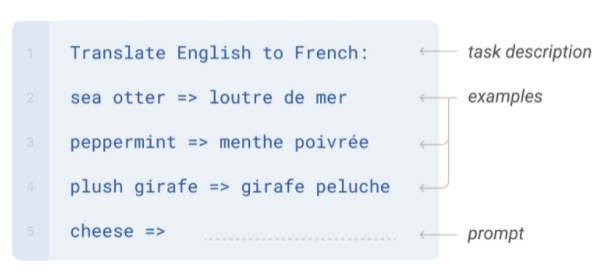
  • Task Description: A short description of what the model should do, e.g. "Translate English to French"
  • Examples: A few examples showing the model what it is expected to predict, e.g. "sea otter => loutre de mer"
  • Prompt: The beginning of a new example, which the model should complete by generating the missing text, e.g. "cheese => "

few-shot-prompt
Image from Language Models are Few-Shot Learners

Creating these few-shot examples can be tricky, since you need to articulate the “task” you want the model to perform through them. A common issue is that models, especially smaller ones, are very sensitive to the way the examples are written.

An approach to optimize Few-Shot Learning in production is to learn a common representation for a task and then train task-specific classifiers on top of this representation.

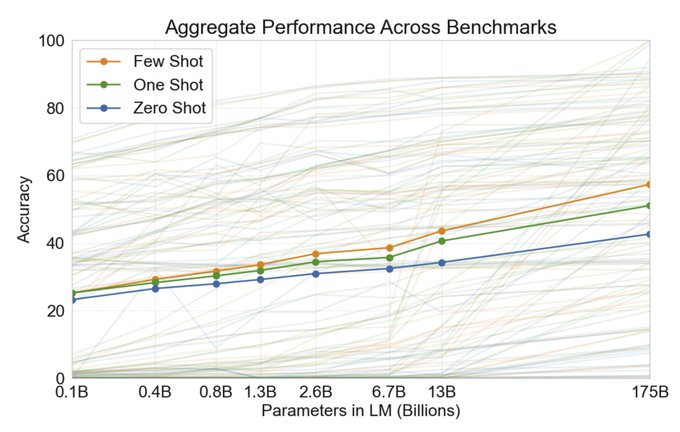
OpenAI showed in the GPT-3 Paper that the few-shot prompting ability improves with the number of language model parameters.
few-shot-performance
Image from Language Models are Few-Shot Learners

Let's now take a look at how at how GPT-Neo and the 🤗 Accelerated Inference API can be used to generate your own Few-Shot Learning predictions!


What is GPT-Neo?

GPT⁠-⁠Neo is a family of transformer-based language models from EleutherAI based on the GPT architecture. EleutherAI's primary goal is to train a model that is equivalent in size to GPT⁠-⁠3 and make it available to the public under an open license.

All of the currently available GPT-Neo checkpoints are trained with the Pile dataset, a large text corpus that is extensively documented in (Gao et al., 2021). As such, it is expected to function better on the text that matches the distribution of its training text; we recommend keeping this in mind when designing your examples.


🤗 Accelerated Inference API

The Accelerated Inference API is our hosted service to run inference on any of the 10,000+ models publicly available on the 🤗 Model Hub, or your own private models, via simple API calls. The API includes acceleration on CPU and GPU with up to 100x speedup compared to out of the box deployment of Transformers.

To integrate Few-Shot Learning predictions with GPT-Neo in your own apps, you can use the 🤗 Accelerated Inference API with the code snippet below. You can find your API Token here, if you don't have an account you can get started here.

import json
import requests

API_TOKEN = ""

def query(payload='',parameters=None,options={'use_cache': False}):
    API_URL = "https://api-inference.huggingface.co/models/EleutherAI/gpt-neo-2.7B"
        headers = {"Authorization": f"Bearer {API_TOKEN}"}
    body = {"inputs":payload,'parameters':parameters,'options':options}
    response = requests.request("POST", API_URL, headers=headers, data= json.dumps(body))
    try:
      response.raise_for_status()
    except requests.exceptions.HTTPError:
        return "Error:"+" ".join(response.json()['error'])
    else:
      return response.json()[0]['generated_text']

parameters = {
    'max_new_tokens':25,  # number of generated tokens
    'temperature': 0.5,   # controlling the randomness of generations
    'end_sequence': "###" # stopping sequence for generation
}

prompt="...."             # few-shot prompt

data = query(prompt,parameters,options)

Practical Insights

Here are some practical insights, which help you get started using GPT-Neo and the 🤗 Accelerated Inference API.

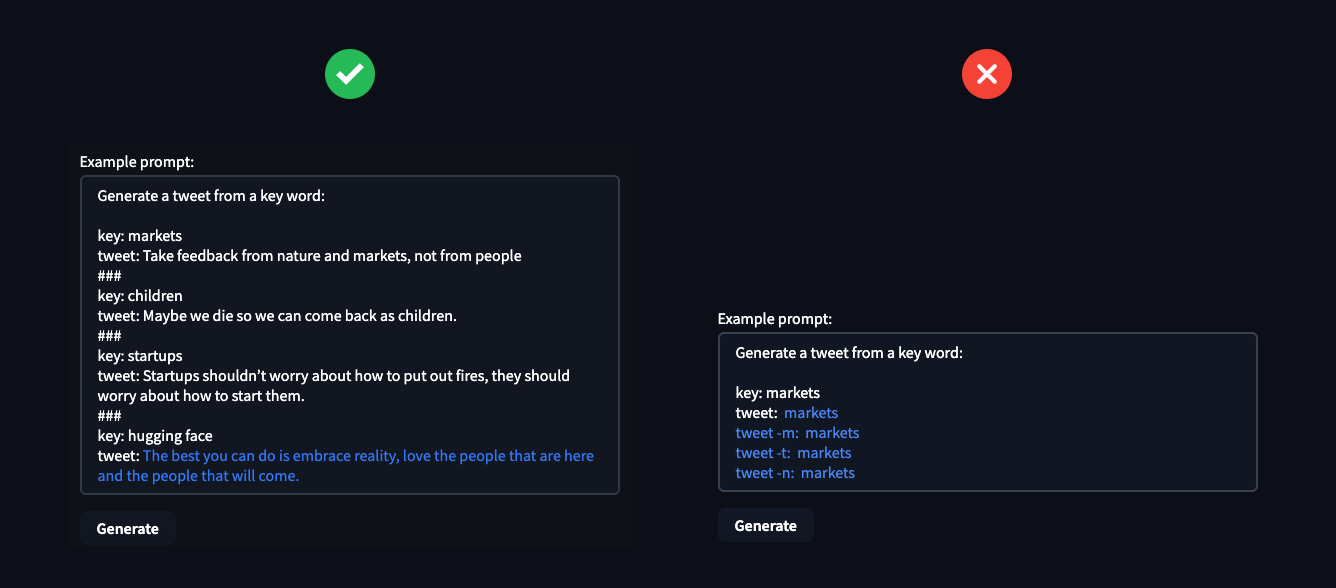
Since GPT-Neo (2.7B) is about 60x smaller than GPT-3 (175B), it does not generalize as well to zero-shot problems and needs 3-4 examples to achieve good results. When you provide more examples GPT-Neo understands the task and takes the end_sequence into account, which allows us to control the generated text pretty well.
insights-benefit-of-examples

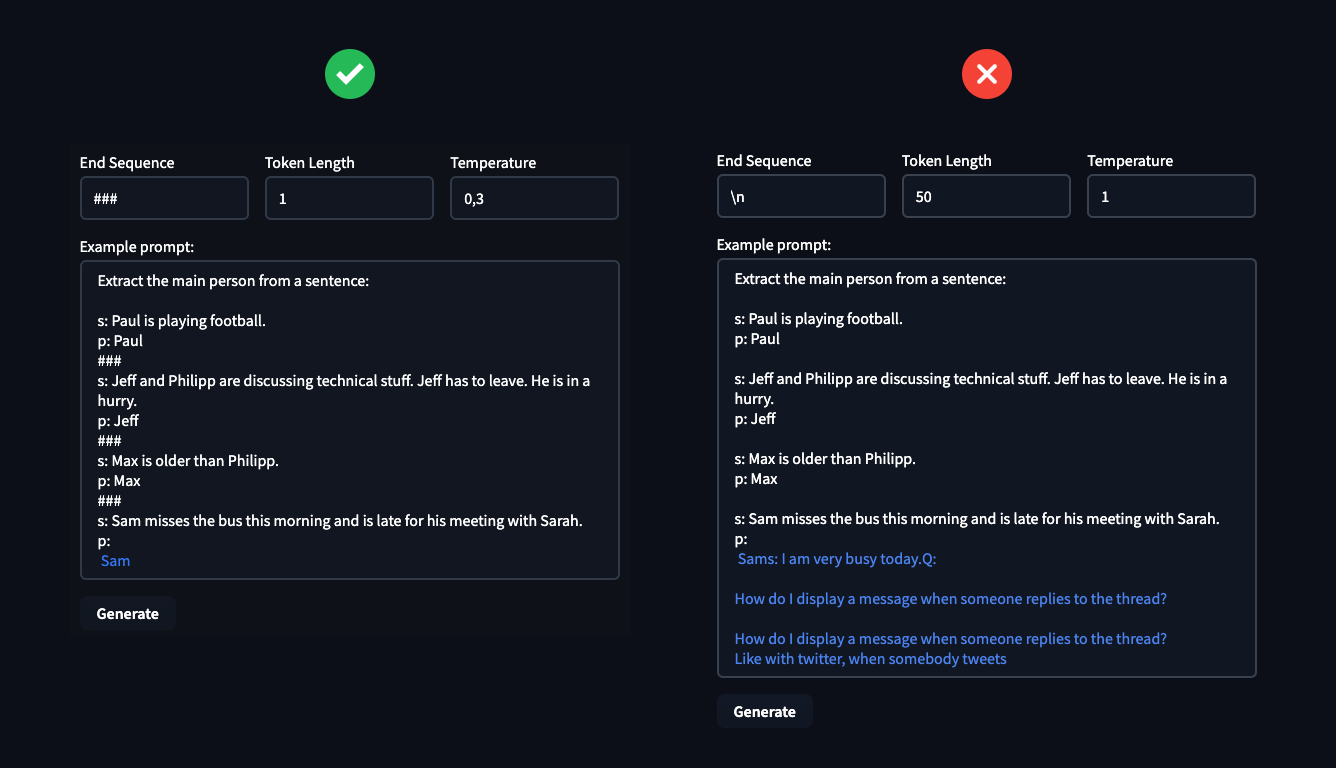
The hyperparameter End Sequence, Token Length & Temperature can be used to control the text-generation of the model and you can use this to your advantage to solve the task you need. The Temperature controlls the randomness of your generations, lower temperature results in less random generations and higher temperature results in more random generations.
insights-benefit-of-hyperparameter

In the example, you can see how important it is to define your hyperparameter. These can make the difference between solving your task or failing miserably.


Responsible Use

Few-Shot Learning is a powerful technique but also presents unique pitfalls that need to be taken into account when designing uses cases. To illustrate this, let's consider the default Sentiment Analysis setting provided in the widget. After seeing three examples of sentiment classification, the model makes the following predictions 4 times out of 5, with temperature set to 0.1:

Tweet: "I'm a disabled happy person"
Sentiment: Negative

What could go wrong? Imagine that you are using sentiment analysis to aggregate reviews of products on an online shopping website: a possible outcome could be that items useful to people with disabilities would be automatically down-ranked - a form of automated discrimination. For more on this specific issue, we recommend the ACL 2020 paper Social Biases in NLP Models as Barriers for Persons with Disabilities. Because Few-Shot Learning relies more directly on information and associations picked up from pre-training, it makes it more sensitive to this type of failures.

How to minimize the risk of harm? Here are some practical recommendations.

Best practices for responsible use

  • Make sure people know which parts of their user experience depend on the outputs of the ML system
  • If possible, give users the ability to opt-out
  • Provide a mechanism for users to give feedback on the model decision, and to override it
  • Monitor feedback, especially model failures, for groups of users that may be disproportionately affected

What needs most to be avoided is to use the model to automatically make decisions for, or about, a user, without opportunity for a human to provide input or correct the output. Several regulations, such as GDPR in Europe, require that users be provided an explanation for automatic decisions made about them.


To use GPT-Neo or any Hugging Face model in your own application, you can start a free trial of the 🤗 Accelerated Inference API. If you need help mitigating bias in models and AI systems, or leveraging Few-Shot Learning, the 🤗 Expert Acceleration Program can offer your team direct premium support from the Hugging Face team.