Simon Alibert and Rémi Cadène from the LeRobot team with Reachy 1 — Photo: Léa Crespi
Since Hugging Face started the LeRobot library in 2024, led by ex-Tesla lead Remi Cadene, the Hugging Face Hub has quickly become the most widely used hub and software platform for open robotics with models, datasets, spaces and libraries.
Today, we’re excited to take it a step further by welcoming Pollen Robotics to Hugging Face, a team that's spent the last 9 years building open-source robots and hardware.
We believe robotics could be the next frontier unlocked by AI — and it should be open, affordable, and private. Our vision: a future where everyone in the community, from hobbyists to enterprises, can build or use robot assistants or games, starting from open solutions instead of closed, remote controlled, hardware.
— Thomas Wolf, co-founder and chief scientist at Hugging Face
From the start, we built Pollen Robotics with open source at its core, driven by our belief that robots will play a profound role in our lives — serving as the interface between AI and the physical world. Hugging Face is a natural home for us to grow, as we share a common goal: putting AI and robotics in the hands of everyone.
— Matthieu Lapeyre, Pollen co-founder
This marks the fifth acquisition for Hugging Face, after notable additions like Gradio and XetHub.
According to Clem's 2025 prediction about robots, "at least 100k personal robots will be pre-ordered" this year, signaling massive growth in the space.
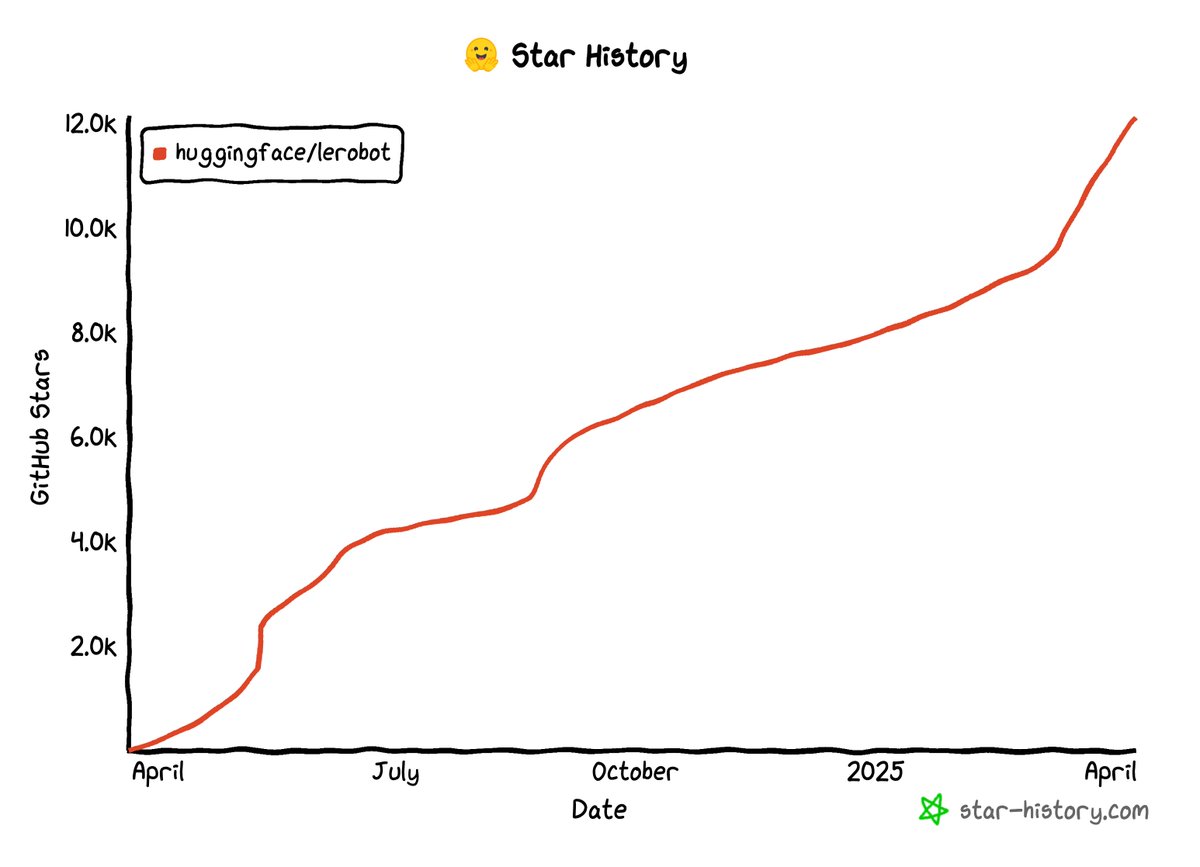
This month also celebrates one year since Hugging Face created LeRobot. The community of LeRobot-native DIY robot builders has flourished on YouTube and Discord, truly democratizing access to robotics technology. In just twelve months, the GitHub repository has grown from zero to over 12,000 stars, with dramatic growth continuing into 2025.
The first robot we’re offering is Reachy 2 — your friendly little lab partner for the AI era that is already in use in labs like Cornell or Carnegie Mellon. It’s a state-of-the-art humanoid robot that is open-source & VR-compatible, built for research, education, and embodied AI experiments. You can already order one for $70,000 by emailing sales@pollen-robotics.com.
2024
2025
Hugging Face is the most used platform for AI builders, with over 7 million users and a thriving community of researchers, developers, and organizations. Founded by Clément Delangue (CEO), Julien Chaumond (CTO), and Thomas Wolf (CSO), the company has become a central hub for AI, hosting the most popular open-source models and datasets, including Meta’s LLaMA 4, DeepSeek R1, Stable Diffusion, Black Forest Flux, Mistral, OpenAI Whisper and millions of others. Its AI app store features over 500,000 ready-to-use applications called spaces, making state-of-the-art AI accessible to all. Hugging Face has raised over $395 million to date from leading investors including Google, Amazon, Nvidia, Salesforce, Sequoia, Coatue, Lux Capital, and Addition.
Pollen Robotics, established in 2016, is a leading developer of open-source humanoid robots designed for advanced research and real-world applications. Founded by former researchers from Inria's Flowers team, including Matthieu Lapeyre and Pierre Rouanet, the company leverages years of experience at the intersection of robotics hardware and applied artificial intelligence, to develop innovative and user-friendly robotic platforms. Reachy 2 is the latest generation of Pollen Robotics’ flagship humanoid robot. Designed as a versatile platform for embodied AI, Reachy 2 combines advanced hardware with user-friendly software, enabling intuitive interactions and agile manipulation. With open-source hardware and software at its core, Reachy 2 provides researchers, and developers unprecedented freedom to explore human-robot interactions, machine learning applications, and practical AI-driven tasks.
Reachy has been adopted by esteemed institutions such as Accenture, CEA, CNRS, Cornell University, and Carnegie Mellon University, underscoring its versatility in fields ranging from advanced AI research to practical manipulation tasks. Pollen Robotics has won several awards including second place at the prestigious ANA Avatar XPRIZE in 2022, highlighting its innovative prowess in remote presence, dexterous manipulation and control technologies.
With hundreds of units deployed across more than 20 countries, Pollen Robotics has redefined the capabilities of open-source humanoid robots, fostering collaboration and customization in the global robotics community.
此内容由惯性聚合(RSS阅读器)自动聚合整理,仅供阅读参考。 原文来自 — 版权归原作者所有。