






惯性聚合 高效追踪和阅读你感兴趣的博客、新闻、科技资讯
阅读原文 在惯性聚合中打开

推荐订阅源

爱范儿
爱范儿
aimingoo的专栏
aimingoo的专栏
Y
Y Combinator Blog
Vercel News
Vercel News
Blog — PlanetScale
Blog — PlanetScale
有赞技术团队
有赞技术团队
P
Proofpoint News Feed
WordPress大学
WordPress大学
V
V2EX
The Register - Security
博客园 - 聂微东
酷 壳 – CoolShell
酷 壳 – CoolShell
博客园 - Franky
D
DataBreaches.Net
G
Google Developers Blog
O
OpenAI News
S
Schneier on Security
Simon Willison's Weblog
I
Intezer
Engineering at Meta
Engineering at Meta
Recorded Future
Recorded Future
T
Threatpost
The Hacker News
The Hacker News
Cisco Talos Blog
Cisco Talos Blog
D
Darknet – Hacking Tools, Hacker News & Cyber Security
B
Blog RSS Feed
Apple Machine Learning Research
T
The Exploit Database - CXSecurity.com
L
LINUX DO - 热门话题
G
GRAHAM CLULEY
博客园 - 叶小钗
V
Vulnerabilities – Threatpost
云风的 BLOG
云风的 BLOG
L
LINUX DO - 最新话题
MyScale Blog
MyScale Blog
L
LangChain Blog
Scott Helme
Scott Helme
大猫的无限游戏
大猫的无限游戏
让小产品的独立变现更简单 - ezindie.com
雷峰网
雷峰网
Google Online Security Blog
cs.CL updates on arXiv.org
N
News | PayPal Newsroom
NISL@THU
NISL@THU
M
MIT News - Artificial intelligence
Cloudbric
Cloudbric
Threat Intelligence Blog | Flashpoint
奇客Solidot–传递最新科技情报
奇客Solidot–传递最新科技情报
The Cloudflare Blog
Recent Announcements

Hugging Face - Blog

Waypoint-1.5: Higher-Fidelity Interactive Worlds for Everyday GPUs ALTK‑Evolve: On‑the‑Job Learning for AI Agents Safetensors is Joining the PyTorch Foundation Holo3: Breaking the Computer Use Frontier Any Custom Frontend with Gradio's Backend A New Framework for Evaluating Voice Agents (EVA) Bringing Robotics AI to Embedded Platforms: Dataset Recording, VLA Fine‑Tuning, and On‑Device Optimizations One-Shot Any Web App with Gradio's gr.HTML CUGA on Hugging Face: Democratizing Configurable AI Agents New in llama.cpp: Model Management Building Deep Research: How we Achieved State of the Art OVHcloud on Hugging Face Inference Providers 🔥 20x Faster TRL Fine-tuning with RapidFire AI Building for an Open Future - our new partnership with Google Cloud Aligning to What? Rethinking Agent Generalization in MiniMax M2 Building a Healthcare Robot from Simulation to Deployment with NVIDIA Isaac Sentence Transformers is joining Hugging Face! Unlock the power of images with AI Sheets Supercharge your OCR Pipelines with Open Models Google Cloud C4 Brings a 70% TCO improvement on GPT OSS with Intel and Hugging Face Get your VLM running in 3 simple steps on Intel CPUs Nemotron-Personas-India: Synthesized Data for Sovereign AI Introducing RTEB: A New Standard for Retrieval Evaluation Accelerating Qwen3-8B Agent on Intel® Core™ Ultra with Depth-Pruned Draft Models VibeGame: Exploring Vibe Coding Games Nemotron-Personas-Japan: ソブリン AI のための合成データセット Swift Transformers Reaches 1.0 – and Looks to the Future Smol2Operator: Post-Training GUI Agents for Computer Use SyGra: The One-Stop Framework for Building Data for LLMs and SLMs Gaia2 and ARE: Empowering the community to study agents Scaleway on Hugging Face Inference Providers 🔥 Democratizing AI Safety with RiskRubric.ai Public AI on Hugging Face Inference Providers 🔥 `LeRobotDataset:v3.0`: Bringing large-scale datasets to `lerobot` Visible Watermarking with Gradio Introducing the Palmyra-mini family: Powerful, lightweight, and ready to reason! Tricks from OpenAI gpt-oss YOU 🫵 can use with transformers Fine-tune Any LLM from the Hugging Face Hub with Together AI Jupyter Agents: training LLMs to reason with notebooks mmBERT: ModernBERT goes Multilingual Welcome EmbeddingGemma, Google's new efficient embedding model SAIR: Accelerating Pharma R&D with AI-Powered Structural Intelligence Make your ZeroGPU Spaces go brrr with ahead-of-time compilation NVIDIA Releases 6 Million Multi-Lingual Reasoning Dataset Generate Images with Claude and Hugging Face From Zero to GPU: A Guide to Building and Scaling Production-Ready CUDA Kernels MCP for Research: How to Connect AI to Research Tools Kimina-Prover-RL Arm & ExecuTorch 0.7: Bringing Generative AI to the masses Neural Super Sampling is here! TextQuests: How Good are LLMs at Text-Based Video Games? 🇵🇭 FilBench - Can LLMs Understand and Generate Filipino? Introducing AI Sheets: a tool to work with datasets using open AI models! Accelerate ND-Parallel: A guide to Efficient Multi-GPU Training Vision Language Model Alignment in TRL ⚡️ Welcome GPT OSS, the new open-source model family from OpenAI! Measuring Open-Source Llama Nemotron Models on DeepResearch Bench 📚 3LM: A Benchmark for Arabic LLMs in STEM and Code Implementing MCP Servers in Python: An AI Shopping Assistant with Gradio Introducing Trackio: A Lightweight Experiment Tracking Library from Hugging Face Say hello to `hf`: a faster, friendlier Hugging Face CLI ✨ Parquet Content-Defined Chunking TimeScope: How Long Can Your Video Large Multimodal Model Go? Fast LoRA inference for Flux with Diffusers and PEFT Accelerate a World of LLMs on Hugging Face with NVIDIA NIM Arc Virtual Cell Challenge: A Primer Consilium: When Multiple LLMs Collaborate Back to The Future: Evaluating AI Agents on Predicting Future Events Five Big Improvements to Gradio MCP Servers Ettin Suite: SoTA Paired Encoders and Decoders Migrating the Hub from Git LFS to Xet Kimina-Prover: Applying Test-time RL Search on Large Formal Reasoning Models Asynchronous Robot Inference: Decoupling Action Prediction and Execution ScreenEnv: Deploy your full stack Desktop Agent Building the Hugging Face MCP Server Reachy Mini - The Open-Source Robot for Today's and Tomorrow's AI Builders Creating custom kernels for the AMD MI300 Upskill your LLMs With Gradio MCP Servers SmolLM3: smol, multilingual, long-context reasoner Three Mighty Alerts Supporting Hugging Face’s Production Infrastructure Efficient MultiModal Data Pipeline Announcing NeurIPS 2025 E2LM Competition: Early Training Evaluation of Language Models Training and Finetuning Sparse Embedding Models with Sentence Transformers Welcome the NVIDIA Llama Nemotron Nano VLM to Hugging Face Hub Gemma 3n fully available in the open-source ecosystem! Transformers backend integration in SGLang (LoRA) Fine-Tuning FLUX.1-dev on Consumer Hardware Groq on Hugging Face Inference Providers 🔥 How Long Prompts Block Other Requests - Optimizing LLM Performance Learn the Hugging Face Kernel Hub in 5 Minutes Convert Transformers to ONNX with Hugging Face Optimum Intel and Hugging Face Partner to Democratize Machine Learning Hardware Acceleration Director of Machine Learning Insights [Part 3: Finance Edition] The Annotated Diffusion Model Deep Q-Learning with Space Invaders Graphcore and Hugging Face Launch New Lineup of IPU-Ready Transformers Introducing Pull Requests and Discussions 🥳 Efficient Table Pre-training without Real Data: An Introduction to TAPEX An Introduction to Q-Learning Part 2/2 How Sempre Health is leveraging the Expert Acceleration Program to accelerate their ML roadmap
How Hugging Face Accelerated Development of Witty Works Writing Assistant
Julien Simon, Violette, Florent Gbelidji, Elena Nazarenko, Lukas · 2023-03-01 · via Hugging Face - Blog

Back to Articles

Julien Simon's avatar

Violette's avatar

Florent Gbelidji's avatar

Elena Nazarenko's avatar

Lukas Kahwe Smith's avatar

The Success Story of Witty Works with the Hugging Face Expert Acceleration Program.

If you're interested in building ML solutions faster, visit the Expert Acceleration Program landing page and contact us here!

Business Context

As IT continues to evolve and reshape our world, creating a more diverse and inclusive environment within the industry is imperative. Witty Works was built in 2018 to address this challenge. Starting as a consulting company advising organizations on becoming more diverse, Witty Works first helped them write job ads using inclusive language. To scale this effort, in 2019, they built a web app to assist users in writing inclusive job ads in English, French and German. They enlarged the scope rapidly with a writing assistant working as a browser extension that automatically fixes and explains potential bias in emails, Linkedin posts, job ads, etc. The aim was to offer a solution for internal and external communication that fosters a cultural change by providing micro-learning bites that explain the underlying bias of highlighted words and phrases.
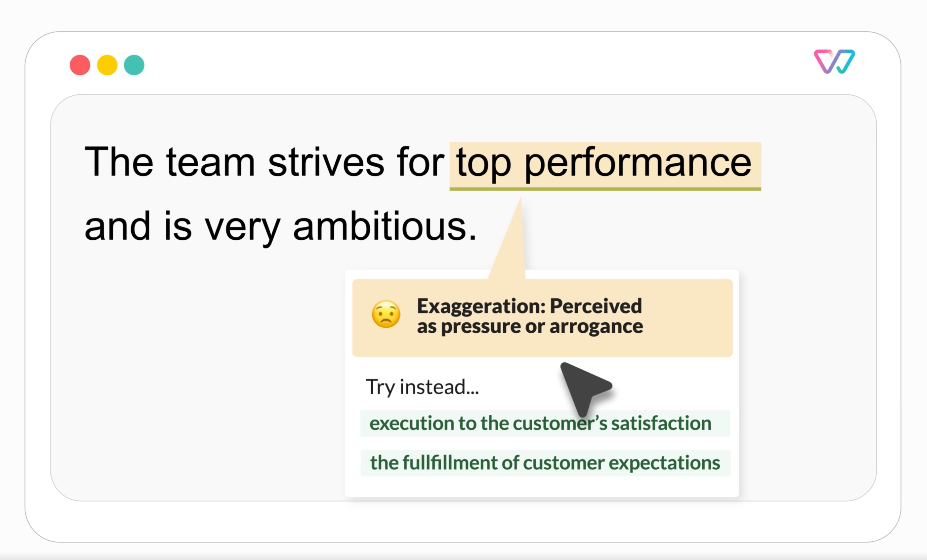

Example of suggestions by the writing assistant

First experiments

Witty Works first chose a basic machine learning approach to build their assistant from scratch. Using transfer learning with pre-trained spaCy models, the assistant was able to:

  • Analyze text and transform words into lemmas,
  • Perform a linguistic analysis,
  • Extract the linguistic features from the text (plural and singular forms, gender), part-of-speech tags (pronouns, verbs, nouns, adjectives, etc.), word dependencies labels, named entity recognition, etc.

By detecting and filtering words according to a specific knowledge base using linguistic features, the assistant could highlight non-inclusive words and suggest alternatives in real-time.

Challenge

The vocabulary had around 2300 non-inclusive words and idioms in German and English correspondingly. And the above described basic approach worked well for 85% of the vocabulary but failed for context-dependent words. Therefore the task was to build a context-dependent classifier of non-inclusive words. Such a challenge (understanding the context rather than recognizing linguistic features) led to using Hugging Face transformers.

Example of context dependent non-inclusive words: 
Fossil fuels are not renewable resources. Vs He is an old fossil
You will have a flexible schedule. Vs You should keep your schedule flexible.

Solutions provided by the Hugging Face Experts

  • Get guidance for deciding on the right ML approach.

The initial chosen approach was vanilla transformers (used to extract token embeddings of specific non-inclusive words). The Hugging Face Expert recommended switching from contextualized word embeddings to contextualized sentence embeddings. In this approach, the representation of each word in a sentence depends on its surrounding context.

Hugging Face Experts suggested the use of a Sentence Transformers architecture. This architecture generates embeddings for sentences as a whole. The distance between semantically similar sentences is minimized and maximized for distant sentences.

In this approach, Sentence Transformers use Siamese networks and triplet network structures to modify the pre-trained transformer models to generate “semantically meaningful” sentence embeddings.

The resulting sentence embedding serves as input for a classical classifier based on KNN or logistic regression to build a context-dependent classifier of non-inclusive words.

Elena Nazarenko, Lead Data Scientist at Witty Works: 
“We generate contextualized embedding vectors for every word depending on its 
sentence (BERT embedding). Then, we keep only the embedding for the “problem” 
word’s token, and calculate the smallest angle (cosine similarity)”  

To fine-tune a vanilla transformers-based classifier, such as a simple BERT model, Witty Works would have needed a substantial amount of annotated data. Hundreds of samples for each category of flagged words would have been necessary. However, such an annotation process would have been costly and time-consuming, which Witty Works couldn’t afford.

  • Get guidance on selecting the right ML library.

The Hugging Face Expert suggested using the Sentence Transformers Fine-tuning library (aka SetFit), an efficient framework for few-shot fine-tuning of Sentence Transformers models. Combining contrastive learning and semantic sentence similarity, SetFit achieves high accuracy on text classification tasks with very little labeled data.

Julien Simon, Chief Evangelist at Hugging Face: 
“SetFit for text classification tasks is a great tool to add to the ML toolbox” 

The Witty Works team found the performance was adequate with as little as 15-20 labeled sentences per specific word.

Elena Nazarenko, Lead Data Scientist at Witty Works: 
“At the end of the day, we saved time and money by not creating this large data set”

Reducing the number of sentences was essential to ensure that model training remained fast and that running the model was efficient. However, it was also necessary for another reason: Witty explicitly takes a highly supervised/rule-based approach to actively manage bias. Reducing the number of sentences is very important to reduce the effort in manually reviewing the training sentences.

  • Get guidance on selecting the right ML models.

One major challenge for Witty Works was deploying a model with low latency. No one expects to wait 3 minutes to get suggestions to improve one’s text! Both Hugging Face and Witty Works experimented with a few sentence transformers models and settled for mpnet-base-v2 combined with logistic regression and KNN.

After a first test on Google Colab, the Hugging Face experts guided Witty Works on deploying the model on Azure. No optimization was necessary as the model was fast enough.

Elena Nazarenko, Lead Data Scientist at Witty Works: 
“Working with Hugging Face saved us a lot of time and money. 
One can feel lost when implementing complex text classification use cases. 
As it is one of the most popular tasks, there are a lot of models on the Hub. 
The Hugging Face experts guided me through the massive amount of transformer-based 
models to choose the best possible approach. 
Plus, I felt very well supported during the model deployment”

Results and conclusion

The number of training sentences dropped from 100-200 per word to 15-20 per word. Witty Works achieved an accuracy of 0.92 and successfully deployed a custom model on Azure with minimal DevOps effort!

Lukas Kahwe Smith CTO & Co-founder of Witty Works: 
“Working on an IT project by oneself can be challenging and even if 
the EAP is a significant investment for a startup, it is the cheaper 
and most meaningful way to get a sparring partner“

With the guidance of the Hugging Face experts, Witty Works saved time and money by implementing a new ML workflow in the Hugging Face way.

Julien Simon, Chief Evangelist at Hugging Face: 
“The Hugging way to build workflows: 
find open-source pre-trained models, 
evaluate them right away, 
see what works, see what does not. 
By iterating, you start learning  things immediately” 

🤗 If you or your team are interested in accelerating your ML roadmap with Hugging Face Experts, please visit hf.co/support to learn more.