

惯性聚合 高效追踪和阅读你感兴趣的博客、新闻、科技资讯
阅读原文 在惯性聚合中打开

推荐订阅源

T
Threatpost
奇客Solidot–传递最新科技情报
奇客Solidot–传递最新科技情报
V
Visual Studio Blog
Application and Cybersecurity Blog
Forbes - Security
Forbes - Security
人人都是产品经理
人人都是产品经理
N
Netflix TechBlog - Medium
Recent Commits to openclaw:main
WordPress大学
WordPress大学
Webroot Blog
Webroot Blog
Jina AI
Jina AI
H
Hacker News: Front Page
Attack and Defense Labs
T
Troy Hunt's Blog
TaoSecurity Blog
TaoSecurity Blog
AI
AI
Hacker News - Newest:
Hacker News - Newest: "LLM"
Google Online Security Blog
钛媒体:引领未来商业与生活新知
钛媒体:引领未来商业与生活新知
Help Net Security
Help Net Security
美团技术团队
freeCodeCamp Programming Tutorials: Python, JavaScript, Git & More
博客园 - 叶小钗
P
Privacy International News Feed
A
Arctic Wolf
IT之家
IT之家
云风的 BLOG
云风的 BLOG
S
Security Affairs
Simon Willison's Weblog
The Cloudflare Blog
博客园 - 司徒正美
Vercel News
Vercel News
C
Cyber Attacks, Cyber Crime and Cyber Security
SecWiki News
SecWiki News
K
Kaspersky official blog
cs.CV updates on arXiv.org
N
News and Events Feed by Topic
S
Schneier on Security
OSCHINA 社区最新新闻
OSCHINA 社区最新新闻
有赞技术团队
有赞技术团队
PCI Perspectives
PCI Perspectives
F
Fortinet All Blogs
T
Tenable Blog
Spread Privacy
Spread Privacy
T
The Blog of Author Tim Ferriss
S
Securelist
L
LangChain Blog
Latest news
Latest news
Cloudbric
Cloudbric
博客园 - 三生石上(FineUI控件)

Hugging Face - Blog

Waypoint-1.5: Higher-Fidelity Interactive Worlds for Everyday GPUs ALTK‑Evolve: On‑the‑Job Learning for AI Agents Safetensors is Joining the PyTorch Foundation Holo3: Breaking the Computer Use Frontier Any Custom Frontend with Gradio's Backend A New Framework for Evaluating Voice Agents (EVA) Bringing Robotics AI to Embedded Platforms: Dataset Recording, VLA Fine‑Tuning, and On‑Device Optimizations One-Shot Any Web App with Gradio's gr.HTML CUGA on Hugging Face: Democratizing Configurable AI Agents New in llama.cpp: Model Management Building Deep Research: How we Achieved State of the Art OVHcloud on Hugging Face Inference Providers 🔥 20x Faster TRL Fine-tuning with RapidFire AI Building for an Open Future - our new partnership with Google Cloud Aligning to What? Rethinking Agent Generalization in MiniMax M2 Building a Healthcare Robot from Simulation to Deployment with NVIDIA Isaac Sentence Transformers is joining Hugging Face! Unlock the power of images with AI Sheets Supercharge your OCR Pipelines with Open Models Google Cloud C4 Brings a 70% TCO improvement on GPT OSS with Intel and Hugging Face Get your VLM running in 3 simple steps on Intel CPUs Nemotron-Personas-India: Synthesized Data for Sovereign AI Introducing RTEB: A New Standard for Retrieval Evaluation Accelerating Qwen3-8B Agent on Intel® Core™ Ultra with Depth-Pruned Draft Models VibeGame: Exploring Vibe Coding Games Nemotron-Personas-Japan: ソブリン AI のための合成データセット Swift Transformers Reaches 1.0 – and Looks to the Future Smol2Operator: Post-Training GUI Agents for Computer Use SyGra: The One-Stop Framework for Building Data for LLMs and SLMs Gaia2 and ARE: Empowering the community to study agents Scaleway on Hugging Face Inference Providers 🔥 Democratizing AI Safety with RiskRubric.ai Public AI on Hugging Face Inference Providers 🔥 `LeRobotDataset:v3.0`: Bringing large-scale datasets to `lerobot` Visible Watermarking with Gradio Introducing the Palmyra-mini family: Powerful, lightweight, and ready to reason! Tricks from OpenAI gpt-oss YOU 🫵 can use with transformers Fine-tune Any LLM from the Hugging Face Hub with Together AI Jupyter Agents: training LLMs to reason with notebooks mmBERT: ModernBERT goes Multilingual Welcome EmbeddingGemma, Google's new efficient embedding model SAIR: Accelerating Pharma R&D with AI-Powered Structural Intelligence Make your ZeroGPU Spaces go brrr with ahead-of-time compilation NVIDIA Releases 6 Million Multi-Lingual Reasoning Dataset Generate Images with Claude and Hugging Face From Zero to GPU: A Guide to Building and Scaling Production-Ready CUDA Kernels MCP for Research: How to Connect AI to Research Tools Kimina-Prover-RL Arm & ExecuTorch 0.7: Bringing Generative AI to the masses Neural Super Sampling is here! TextQuests: How Good are LLMs at Text-Based Video Games? 🇵🇭 FilBench - Can LLMs Understand and Generate Filipino? Introducing AI Sheets: a tool to work with datasets using open AI models! Accelerate ND-Parallel: A guide to Efficient Multi-GPU Training Vision Language Model Alignment in TRL ⚡️ Welcome GPT OSS, the new open-source model family from OpenAI! Measuring Open-Source Llama Nemotron Models on DeepResearch Bench 📚 3LM: A Benchmark for Arabic LLMs in STEM and Code Implementing MCP Servers in Python: An AI Shopping Assistant with Gradio Introducing Trackio: A Lightweight Experiment Tracking Library from Hugging Face Say hello to `hf`: a faster, friendlier Hugging Face CLI ✨ Parquet Content-Defined Chunking TimeScope: How Long Can Your Video Large Multimodal Model Go? Fast LoRA inference for Flux with Diffusers and PEFT Accelerate a World of LLMs on Hugging Face with NVIDIA NIM Arc Virtual Cell Challenge: A Primer Consilium: When Multiple LLMs Collaborate Back to The Future: Evaluating AI Agents on Predicting Future Events Five Big Improvements to Gradio MCP Servers Ettin Suite: SoTA Paired Encoders and Decoders Migrating the Hub from Git LFS to Xet Kimina-Prover: Applying Test-time RL Search on Large Formal Reasoning Models Asynchronous Robot Inference: Decoupling Action Prediction and Execution ScreenEnv: Deploy your full stack Desktop Agent Building the Hugging Face MCP Server Reachy Mini - The Open-Source Robot for Today's and Tomorrow's AI Builders Creating custom kernels for the AMD MI300 Upskill your LLMs With Gradio MCP Servers SmolLM3: smol, multilingual, long-context reasoner Three Mighty Alerts Supporting Hugging Face’s Production Infrastructure Efficient MultiModal Data Pipeline Announcing NeurIPS 2025 E2LM Competition: Early Training Evaluation of Language Models Training and Finetuning Sparse Embedding Models with Sentence Transformers Welcome the NVIDIA Llama Nemotron Nano VLM to Hugging Face Hub Gemma 3n fully available in the open-source ecosystem! Transformers backend integration in SGLang (LoRA) Fine-Tuning FLUX.1-dev on Consumer Hardware Groq on Hugging Face Inference Providers 🔥 How Long Prompts Block Other Requests - Optimizing LLM Performance Learn the Hugging Face Kernel Hub in 5 Minutes Convert Transformers to ONNX with Hugging Face Optimum Intel and Hugging Face Partner to Democratize Machine Learning Hardware Acceleration Director of Machine Learning Insights [Part 3: Finance Edition] The Annotated Diffusion Model Deep Q-Learning with Space Invaders Graphcore and Hugging Face Launch New Lineup of IPU-Ready Transformers Introducing Pull Requests and Discussions 🥳 Efficient Table Pre-training without Real Data: An Introduction to TAPEX An Introduction to Q-Learning Part 2/2 How Sempre Health is leveraging the Expert Acceleration Program to accelerate their ML roadmap
Unlocking the conversion of Web Screenshots into HTML Code with the WebSight Dataset
Hugo Laurençon, Leo Tronchon, Victor Sanh · 2024-03-15 · via Hugging Face - Blog

Back to Articles

From screenshots to HTML code: Introducing the WebSight dataset

In the world of web development, turning designs into functional websites usually involves a lot of coding and careful testing. What if we could simplify this process, making it possible to convert web designs into working websites more easily and quickly? WebSight is a new dataset that aims at building AI systems capable of transforming screenshots to HTML code.

The challenge

Turning a website design or screenshot into HTML code usually needs an experienced developer. But what if this could be more efficient? Motivated by this question, we investigated how vision-language models (VLMs) could be used in web development to create low-code solutions that improve efficiency.

Today, the main challenge towards that goal is the lack of high-quality datasets tailored for this task. WebSight aims to fill that gap.

WebSight: A large synthetic dataset of screenshot/HTML code pairs

In January 2024, we introduced WebSight-v0.1, a synthetic dataset that consists of 823,000 pairs of HTML codes and their corresponding screenshots. This dataset is designed to train AI models to process and translate visual web designs into functional HTML code. By focusing on synthetic data, we've managed to bypass the noise and complexity often found in real-world HTML, allowing AI models to learn efficiently.

Following our initial release and building on top of the community’s feedback, we've updated our dataset to WebSight-v0.2, introducing significant improvements. These enhancements feature using real images in the screenshots, and switching to Tailwind CSS (instead of traditional CSS). We further scaled the dataset to 2 million examples.
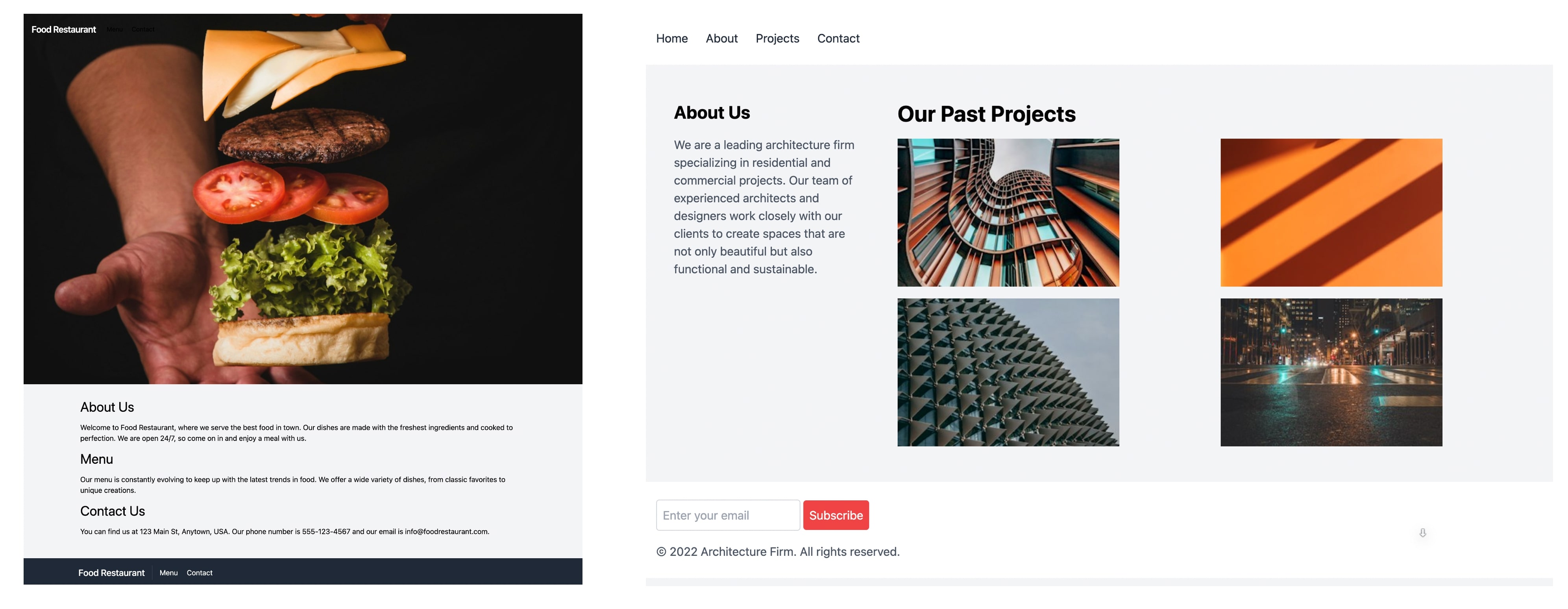
Examples of web pages included in WebSight
Examples of web pages included in WebSight.

Sightseer: A model fine-tuned on WebSight

Leveraging the WebSight dataset, we’ve fine-tuned our forthcoming foundation vision-language model to obtain Sightseer, a model capable of converting webpage screenshots into functional HTML code. Sightseer additionally demonstrates the capability to incorporate images into the generated HTML that closely resemble those in the original screenshots.
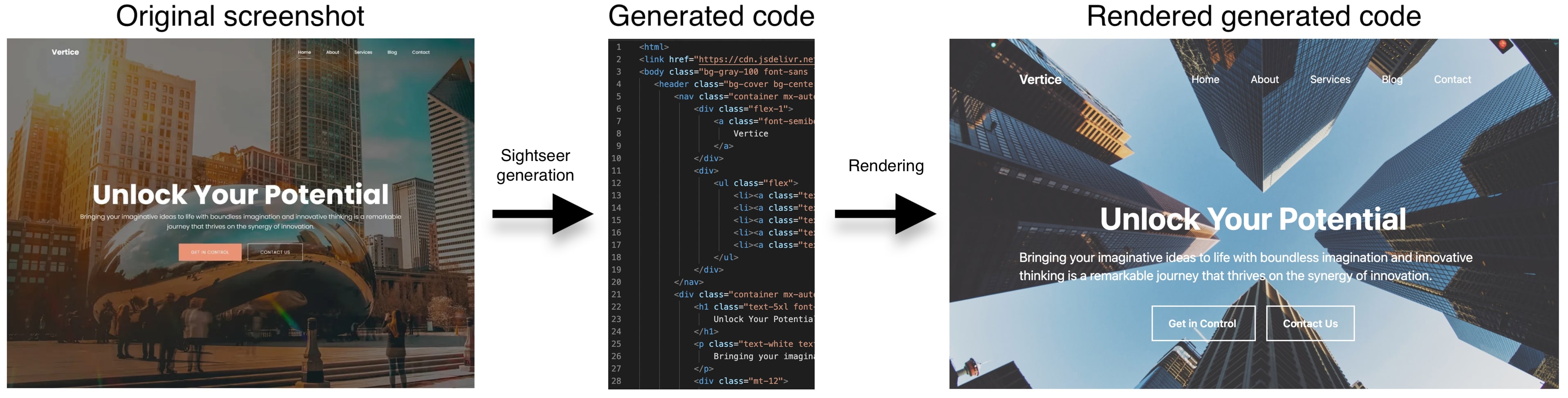
Comparison of an original web page (input) on the left, and the rendering of the code generated by our model, Sightseer, (output) on the right.

Towards more powerful tools unlocked by visual language models

By iterating over WebSight, our goal is to build more capable AI systems that simplify the process of turning UI designs into functional code. This could reduce iteration time for developers by transforming a paper UI sketch into functional code rapidly, while making this process more accessible for non-developers. This is one of the many real applications of visual language models.. By open-sourcing WebSight, we encourage the community to work with us toward building more powerful tools for UI development.

Resources