




惯性聚合 高效追踪和阅读你感兴趣的博客、新闻、科技资讯
阅读原文 在惯性聚合中打开

推荐订阅源

Exploit-DB.com RSS Feed
A
About on SuperTechFans
IT之家
IT之家
让小产品的独立变现更简单 - ezindie.com
Blog — PlanetScale
Blog — PlanetScale
aimingoo的专栏
aimingoo的专栏
云风的 BLOG
云风的 BLOG
The GitHub Blog
The GitHub Blog
Vercel News
Vercel News
G
Google Developers Blog
J
Java Code Geeks
宝玉的分享
宝玉的分享
T
Tailwind CSS Blog
Cloudbric
Cloudbric
L
LINUX DO - 最新话题
MyScale Blog
MyScale Blog
H
Heimdal Security Blog
PCI Perspectives
PCI Perspectives
Attack and Defense Labs
S
Security @ Cisco Blogs
Latest news
Latest news
I
Intezer
L
Lohrmann on Cybersecurity
C
CXSECURITY Database RSS Feed - CXSecurity.com
月光博客
月光博客
T
Threatpost
博客园 - 【当耐特】
S
Schneier on Security
P
Privacy International News Feed
G
GRAHAM CLULEY
T
Tenable Blog
AWS News Blog
AWS News Blog
Threat Intelligence Blog | Flashpoint
雷峰网
雷峰网
博客园 - Franky
Engineering at Meta
Engineering at Meta
美团技术团队
S
Secure Thoughts
T
Troy Hunt's Blog
Microsoft Security Blog
SecWiki News
SecWiki News
V
Visual Studio Blog
人人都是产品经理
人人都是产品经理
Application and Cybersecurity Blog
Cisco Talos Blog
Cisco Talos Blog
奇客Solidot–传递最新科技情报
奇客Solidot–传递最新科技情报
Martin Fowler
Martin Fowler
Webroot Blog
Webroot Blog
Google DeepMind News
H
Hackread – Cybersecurity News, Data Breaches, AI and More

Hugging Face - Blog

Waypoint-1.5: Higher-Fidelity Interactive Worlds for Everyday GPUs ALTK‑Evolve: On‑the‑Job Learning for AI Agents Safetensors is Joining the PyTorch Foundation Holo3: Breaking the Computer Use Frontier Any Custom Frontend with Gradio's Backend A New Framework for Evaluating Voice Agents (EVA) Bringing Robotics AI to Embedded Platforms: Dataset Recording, VLA Fine‑Tuning, and On‑Device Optimizations One-Shot Any Web App with Gradio's gr.HTML CUGA on Hugging Face: Democratizing Configurable AI Agents New in llama.cpp: Model Management Building Deep Research: How we Achieved State of the Art OVHcloud on Hugging Face Inference Providers 🔥 20x Faster TRL Fine-tuning with RapidFire AI Building for an Open Future - our new partnership with Google Cloud Aligning to What? Rethinking Agent Generalization in MiniMax M2 Building a Healthcare Robot from Simulation to Deployment with NVIDIA Isaac Sentence Transformers is joining Hugging Face! Unlock the power of images with AI Sheets Supercharge your OCR Pipelines with Open Models Google Cloud C4 Brings a 70% TCO improvement on GPT OSS with Intel and Hugging Face Get your VLM running in 3 simple steps on Intel CPUs Nemotron-Personas-India: Synthesized Data for Sovereign AI Introducing RTEB: A New Standard for Retrieval Evaluation Accelerating Qwen3-8B Agent on Intel® Core™ Ultra with Depth-Pruned Draft Models VibeGame: Exploring Vibe Coding Games Nemotron-Personas-Japan: ソブリン AI のための合成データセット Swift Transformers Reaches 1.0 – and Looks to the Future Smol2Operator: Post-Training GUI Agents for Computer Use SyGra: The One-Stop Framework for Building Data for LLMs and SLMs Gaia2 and ARE: Empowering the community to study agents Scaleway on Hugging Face Inference Providers 🔥 Democratizing AI Safety with RiskRubric.ai Public AI on Hugging Face Inference Providers 🔥 `LeRobotDataset:v3.0`: Bringing large-scale datasets to `lerobot` Visible Watermarking with Gradio Introducing the Palmyra-mini family: Powerful, lightweight, and ready to reason! Tricks from OpenAI gpt-oss YOU 🫵 can use with transformers Fine-tune Any LLM from the Hugging Face Hub with Together AI Jupyter Agents: training LLMs to reason with notebooks mmBERT: ModernBERT goes Multilingual Welcome EmbeddingGemma, Google's new efficient embedding model SAIR: Accelerating Pharma R&D with AI-Powered Structural Intelligence Make your ZeroGPU Spaces go brrr with ahead-of-time compilation NVIDIA Releases 6 Million Multi-Lingual Reasoning Dataset Generate Images with Claude and Hugging Face From Zero to GPU: A Guide to Building and Scaling Production-Ready CUDA Kernels MCP for Research: How to Connect AI to Research Tools Kimina-Prover-RL Arm & ExecuTorch 0.7: Bringing Generative AI to the masses Neural Super Sampling is here! TextQuests: How Good are LLMs at Text-Based Video Games? 🇵🇭 FilBench - Can LLMs Understand and Generate Filipino? Introducing AI Sheets: a tool to work with datasets using open AI models! Accelerate ND-Parallel: A guide to Efficient Multi-GPU Training Vision Language Model Alignment in TRL ⚡️ Welcome GPT OSS, the new open-source model family from OpenAI! Measuring Open-Source Llama Nemotron Models on DeepResearch Bench 📚 3LM: A Benchmark for Arabic LLMs in STEM and Code Implementing MCP Servers in Python: An AI Shopping Assistant with Gradio Introducing Trackio: A Lightweight Experiment Tracking Library from Hugging Face Say hello to `hf`: a faster, friendlier Hugging Face CLI ✨ Parquet Content-Defined Chunking TimeScope: How Long Can Your Video Large Multimodal Model Go? Fast LoRA inference for Flux with Diffusers and PEFT Accelerate a World of LLMs on Hugging Face with NVIDIA NIM Arc Virtual Cell Challenge: A Primer Consilium: When Multiple LLMs Collaborate Back to The Future: Evaluating AI Agents on Predicting Future Events Five Big Improvements to Gradio MCP Servers Ettin Suite: SoTA Paired Encoders and Decoders Migrating the Hub from Git LFS to Xet Kimina-Prover: Applying Test-time RL Search on Large Formal Reasoning Models Asynchronous Robot Inference: Decoupling Action Prediction and Execution ScreenEnv: Deploy your full stack Desktop Agent Building the Hugging Face MCP Server Reachy Mini - The Open-Source Robot for Today's and Tomorrow's AI Builders Creating custom kernels for the AMD MI300 Upskill your LLMs With Gradio MCP Servers SmolLM3: smol, multilingual, long-context reasoner Three Mighty Alerts Supporting Hugging Face’s Production Infrastructure Efficient MultiModal Data Pipeline Announcing NeurIPS 2025 E2LM Competition: Early Training Evaluation of Language Models Training and Finetuning Sparse Embedding Models with Sentence Transformers Welcome the NVIDIA Llama Nemotron Nano VLM to Hugging Face Hub Gemma 3n fully available in the open-source ecosystem! Transformers backend integration in SGLang (LoRA) Fine-Tuning FLUX.1-dev on Consumer Hardware Groq on Hugging Face Inference Providers 🔥 How Long Prompts Block Other Requests - Optimizing LLM Performance Learn the Hugging Face Kernel Hub in 5 Minutes Convert Transformers to ONNX with Hugging Face Optimum Intel and Hugging Face Partner to Democratize Machine Learning Hardware Acceleration Director of Machine Learning Insights [Part 3: Finance Edition] The Annotated Diffusion Model Deep Q-Learning with Space Invaders Graphcore and Hugging Face Launch New Lineup of IPU-Ready Transformers Introducing Pull Requests and Discussions 🥳 Efficient Table Pre-training without Real Data: An Introduction to TAPEX An Introduction to Q-Learning Part 2/2 How Sempre Health is leveraging the Expert Acceleration Program to accelerate their ML roadmap
Introducing ⚔️ AI vs. AI ⚔️ a deep reinforcement learning multi-agents competition system
Carl Cochet, Thomas Simonini · 2023-02-07 · via Hugging Face - Blog

Back to Articles

Carl Cochet's avatar

Thomas Simonini's avatar

This article is also available in Chinese 简体中文.
Thumbnail

We’re excited to introduce a new tool we created: ⚔️ AI vs. AI ⚔️, a deep reinforcement learning multi-agents competition system.

This tool, hosted on Spaces, allows us to create multi-agent competitions. It is composed of three elements:

  • A Space with a matchmaking algorithm that runs the model fights using a background task.
  • A Dataset containing the results.
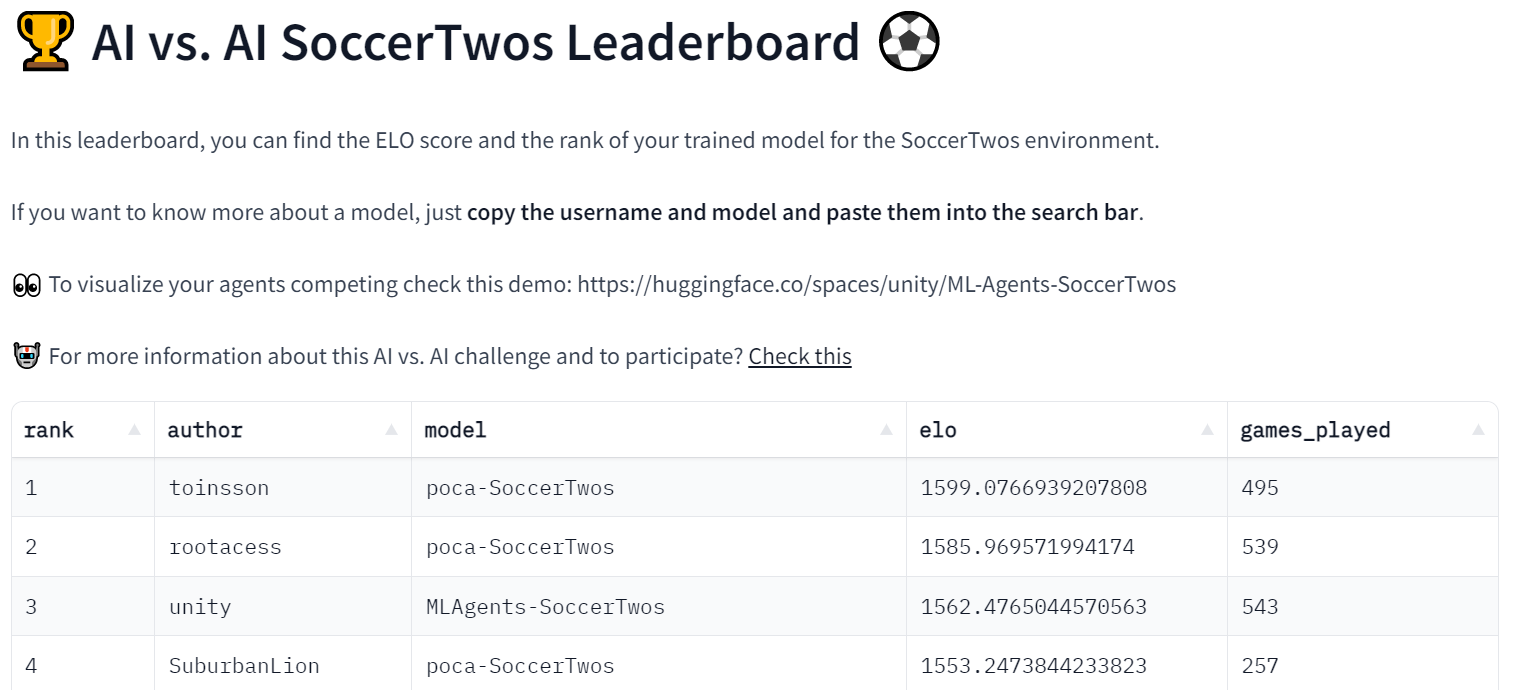
  • A Leaderboard that gets the match history results and displays the models’ ELO.

Then, when a user pushes a trained model to the Hub, it gets evaluated and ranked against others. Thanks to that, we can evaluate your agents against other’s agents in a multi-agent setting.

In addition to being a useful tool for hosting multi-agent competitions, we think this tool can also be a robust evaluation technique in multi-agent settings. By playing against a lot of policies, your agents are evaluated against a wide range of behaviors. This should give you a good idea of the quality of your policy.

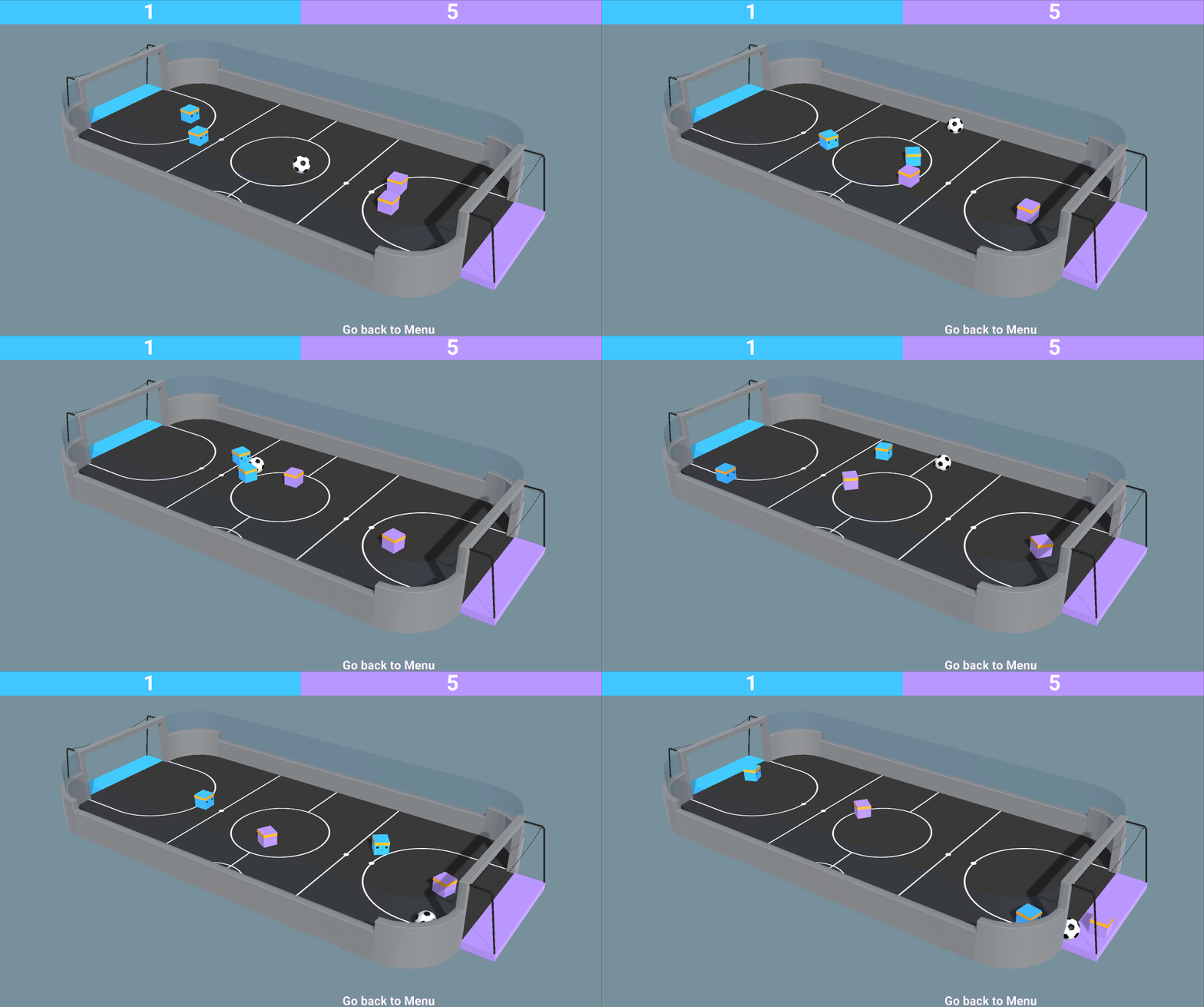
Let’s see how it works with our first competition host: SoccerTwos Challenge.
SoccerTwos example

How does AI vs. AI works?

AI vs. AI is an open-source tool developed at Hugging Face to rank the strength of reinforcement learning models in a multi-agent setting.

The idea is to get a relative measure of skill rather than an objective one by making the models play against each other continuously and use the matches results to assess their performance compared to all the other models and consequently get a view of the quality of their policy without requiring classic metrics.

The more agents are submitted for a given task or environment, the more representative the rating becomes.

To generate a rating based on match results in a competitive environment, we decided to base the rankings on the ELO rating system.

The core concept is that after a match ends, the rating of both players are updated based on the result and the ratings they had before the game. When a user with a high rating beats one with a low ranking, they won't get many points. Likewise, the loser would not lose many points in this case.

Conversely, if a low-rated player wins in an upset against a high-rated player, it will cause a more significant effect on both of their ratings.

In our context, we kept the system as simple as possible by not adding any alteration to the quantities gained or lost based on the starting ratings of the player. As such, gain and loss will always be the perfect opposite (+10 / -10, for instance), and the average ELO rating will stay constant at the starting rating. The choice of a 1200 ELO rating start is entirely arbitrary.

If you want to learn more about ELO and see some calculation example, we wrote an explanation in our Deep Reinforcement Learning Course here

Using this rating, it is possible to generate matches between models with comparable strengths automatically. There are several ways you can go about creating a matchmaking system, but here we decided to keep it fairly simple while guaranteeing a minimum amount of diversity in the matchups and also keeping most matches with fairly close opposing ratings.
AI vs AI Process

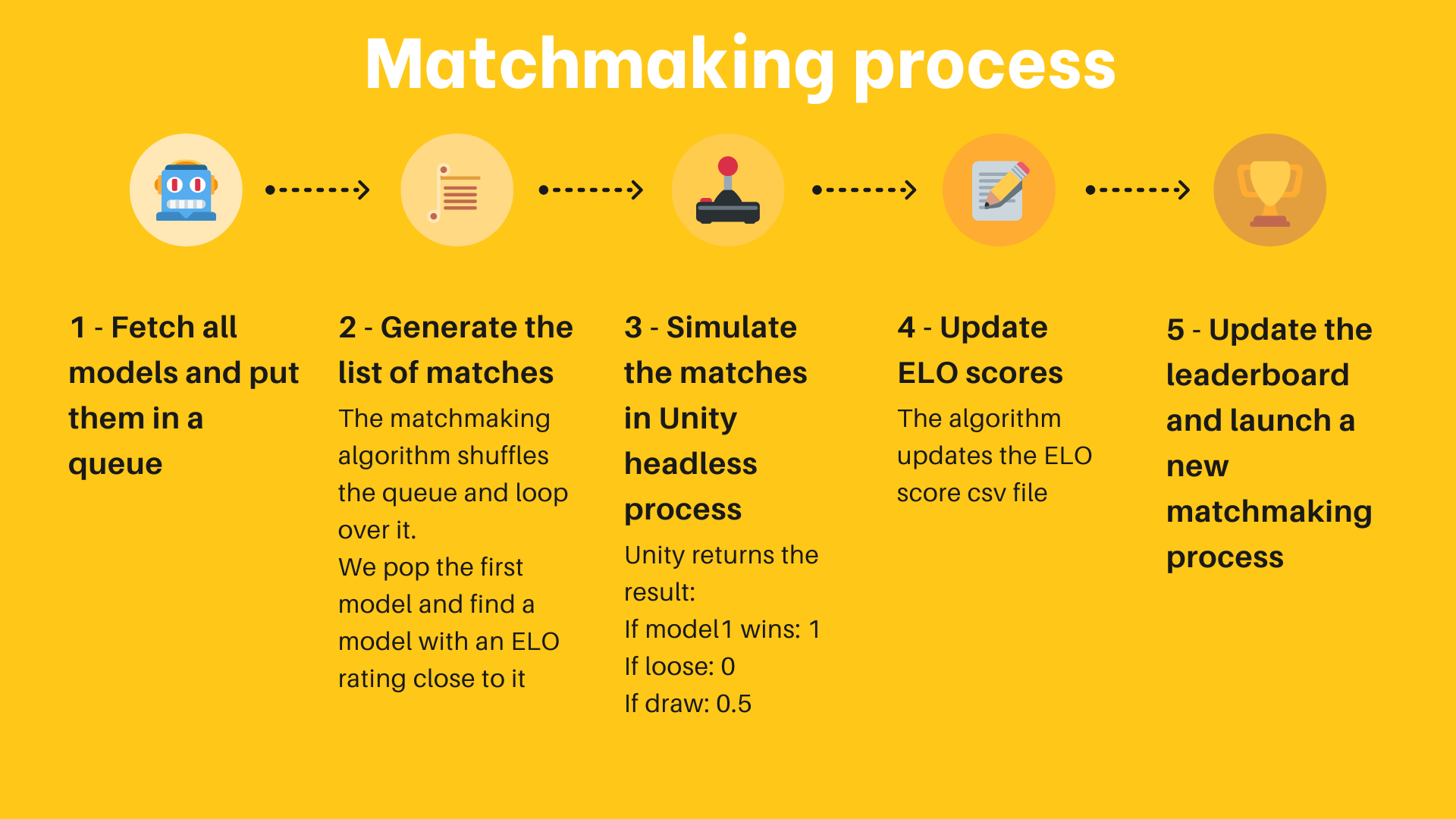
Here's how works the algorithm:

  1. Gather all the available models on the Hub. New models get a starting rating of 1200, while others keep the rating they have gained/lost through their previous matches.
  2. Create a queue from all these models.
  3. Pop the first element (model) from the queue, and then pop another random model in this queue from the n models with the closest ratings to the first model.
  4. Simulate this match by loading both models in the environment (a Unity executable, for instance) and gathering the results. For this implementation, we sent the results to a Hugging Face Dataset on the Hub.
  5. Compute the new rating of both models based on the received result and the ELO formula.
  6. Continue popping models two by two and simulating the matches until only one or zero models are in the queue.
  7. Save the resulting ratings and go back to step 1

To run this matchmaking process continuously, we use free Hugging Face Spaces hardware with a Scheduler to keep running the matchmaking process as a background task.

The Spaces is also used to fetch the ELO ratings of each model that have already been played and, from it display a leaderboard from which everyone can check the progress of the models.
Leaderboard

The process generally uses several Hugging Face Datasets to provide data persistence (here, matches history and model ratings).

Since the process also saves the matches' history, it is possible to see precisely the results of any given model. This can, for instance, allow you to check why your model struggles with another one, most notably using another demo Space to visualize matches like this one.

For now, this experiment is running with the MLAgent environment SoccerTwos for the Hugging Face Deep RL Course, however, the process and implementation, in general, are very much environment agnostic and could be used to evaluate for free a wide range of adversarial multi-agent settings.

Of course, it is important to remind again that this evaluation is a relative rating between the strengths of the submitted agents, and the ratings by themselves have no objective meaning contrary to other metrics. It only represents how good or bad a model performs compared to the other models in the pool. Still, given a large and varied enough pool of models (and enough matches played), this evaluation becomes a very solid way to represent the general performance of a model.

Our first AI vs. AI challenge experimentation: SoccerTwos Challenge ⚽

This challenge is Unit 7 of our free Deep Reinforcement Learning Course. It started on February 1st and will end on April 30th.

If you’re interested, you don’t need to participate in the course to be able to participate in the competition. You can start here 👉 https://huggingface.co/deep-rl-course/unit7/introduction

In this Unit, readers learned the basics of multi-agent reinforcement learning (MARL)by training a 2vs2 soccer team.

The environment used was made by the Unity ML-Agents team. The goal is simple: your team needs to score a goal. To do that, they need to beat the opponent's team and collaborate with their teammate.

SoccerTwos example

In addition to the leaderboard, we created a Space demo where people can choose two teams and visualize them playing 👉https://huggingface.co/spaces/unity/SoccerTwos

This experimentation is going well since we already have 48 models on the leaderboard Leaderboard

We also created a discord channel called ai-vs-ai-competition so that people can exchange with others and share advice.

Conclusion and what’s next?

Since the tool we developed is environment agnostic, we want to host more challenges in the future with PettingZoo and other multi-agent environments. If you have some environments or challenges you want to do, don’t hesitate to reach out to us.

In the future, we will host multiple multi-agent competitions with this tool and environments we created, such as SnowballFight.
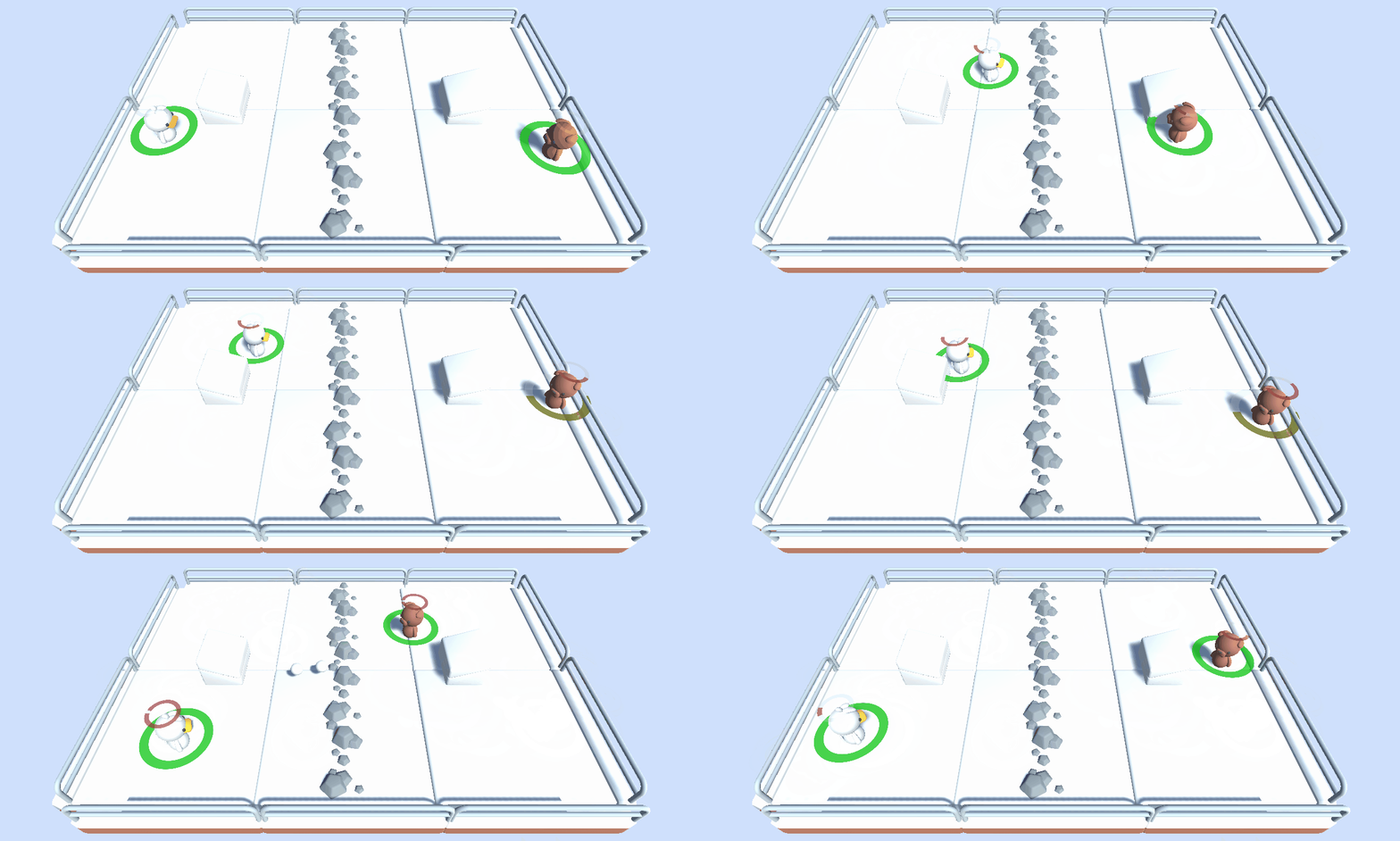
Snowballfight gif

In addition to being a useful tool for hosting multi-agent competitions, we think that this tool can also be a robust evaluation technique in multi-agent settings: by playing against a lot of policies, your agents are evaluated against a wide range of behaviors, and you’ll get a good idea of the quality of your policy.

The best way to keep in touch is to join our discord server to exchange with us and with the community.

Citation

Citation: If you found this useful for your academic work, please consider citing our work, in text:

Cochet, Simonini, "Introducing AI vs. AI a deep reinforcement learning multi-agents competition system", Hugging Face Blog, 2023.

BibTeX citation:

@article{cochet-simonini2023,
  author = {Cochet, Carl and Simonini, Thomas},
  title = {Introducing AI vs. AI a deep reinforcement learning multi-agents competition system},
  journal = {Hugging Face Blog},
  year = {2023},
  note = {https://huggingface.co/blog/aivsai},
}