




惯性聚合 高效追踪和阅读你感兴趣的博客、新闻、科技资讯
阅读原文 在惯性聚合中打开

推荐订阅源

Application and Cybersecurity Blog
L
LINUX DO - 热门话题
V
Vulnerabilities – Threatpost
S
Secure Thoughts
The GitHub Blog
The GitHub Blog
Security Latest
Security Latest
钛媒体:引领未来商业与生活新知
钛媒体:引领未来商业与生活新知
P
Palo Alto Networks Blog
O
OpenAI News
L
LINUX DO - 最新话题
C
Cyber Attacks, Cyber Crime and Cyber Security
K
KPMG report finds enterprise disconnect between AI and its ROI | CIO
P
Privacy & Cybersecurity Law Blog
AWS News Blog
AWS News Blog
S
Security @ Cisco Blogs
www.infosecurity-magazine.com
Y
Y Combinator Blog
Cloudbric
Cloudbric
H
Heimdal Security Blog
Microsoft Security Blog
V2EX - 技术
V2EX - 技术
博客园_首页
Cisco Talos Blog
Cisco Talos Blog
D
DataBreaches.Net
T
Troy Hunt's Blog
博客园 - 叶小钗
M
MIT News - Artificial intelligence
Latest news
Latest news
Webroot Blog
Webroot Blog
S
Security Affairs
Martin Fowler
Martin Fowler
T
Tailwind CSS Blog
C
Check Point Blog
The Last Watchdog
The Last Watchdog
Microsoft Azure Blog
V
Visual Studio Blog
OSCHINA 社区最新新闻
OSCHINA 社区最新新闻
云风的 BLOG
云风的 BLOG
aimingoo的专栏
aimingoo的专栏
爱范儿
爱范儿
Vercel News
Vercel News
The Register - Security
阮一峰的网络日志
阮一峰的网络日志
L
Lohrmann on Cybersecurity
J
Java Code Geeks
L
LangChain Blog
腾讯CDC
I
InfoQ
博客园 - 三生石上(FineUI控件)
C
CERT Recently Published Vulnerability Notes

Hugging Face - Blog

Waypoint-1.5: Higher-Fidelity Interactive Worlds for Everyday GPUs ALTK‑Evolve: On‑the‑Job Learning for AI Agents Safetensors is Joining the PyTorch Foundation Holo3: Breaking the Computer Use Frontier Any Custom Frontend with Gradio's Backend A New Framework for Evaluating Voice Agents (EVA) Bringing Robotics AI to Embedded Platforms: Dataset Recording, VLA Fine‑Tuning, and On‑Device Optimizations One-Shot Any Web App with Gradio's gr.HTML CUGA on Hugging Face: Democratizing Configurable AI Agents New in llama.cpp: Model Management Building Deep Research: How we Achieved State of the Art OVHcloud on Hugging Face Inference Providers 🔥 20x Faster TRL Fine-tuning with RapidFire AI Building for an Open Future - our new partnership with Google Cloud Aligning to What? Rethinking Agent Generalization in MiniMax M2 Building a Healthcare Robot from Simulation to Deployment with NVIDIA Isaac Sentence Transformers is joining Hugging Face! Unlock the power of images with AI Sheets Supercharge your OCR Pipelines with Open Models Google Cloud C4 Brings a 70% TCO improvement on GPT OSS with Intel and Hugging Face Get your VLM running in 3 simple steps on Intel CPUs Nemotron-Personas-India: Synthesized Data for Sovereign AI Introducing RTEB: A New Standard for Retrieval Evaluation Accelerating Qwen3-8B Agent on Intel® Core™ Ultra with Depth-Pruned Draft Models VibeGame: Exploring Vibe Coding Games Nemotron-Personas-Japan: ソブリン AI のための合成データセット Swift Transformers Reaches 1.0 – and Looks to the Future Smol2Operator: Post-Training GUI Agents for Computer Use SyGra: The One-Stop Framework for Building Data for LLMs and SLMs Gaia2 and ARE: Empowering the community to study agents Scaleway on Hugging Face Inference Providers 🔥 Democratizing AI Safety with RiskRubric.ai Public AI on Hugging Face Inference Providers 🔥 `LeRobotDataset:v3.0`: Bringing large-scale datasets to `lerobot` Visible Watermarking with Gradio Introducing the Palmyra-mini family: Powerful, lightweight, and ready to reason! Tricks from OpenAI gpt-oss YOU 🫵 can use with transformers Fine-tune Any LLM from the Hugging Face Hub with Together AI Jupyter Agents: training LLMs to reason with notebooks mmBERT: ModernBERT goes Multilingual Welcome EmbeddingGemma, Google's new efficient embedding model SAIR: Accelerating Pharma R&D with AI-Powered Structural Intelligence Make your ZeroGPU Spaces go brrr with ahead-of-time compilation NVIDIA Releases 6 Million Multi-Lingual Reasoning Dataset Generate Images with Claude and Hugging Face From Zero to GPU: A Guide to Building and Scaling Production-Ready CUDA Kernels MCP for Research: How to Connect AI to Research Tools Kimina-Prover-RL Arm & ExecuTorch 0.7: Bringing Generative AI to the masses Neural Super Sampling is here! TextQuests: How Good are LLMs at Text-Based Video Games? 🇵🇭 FilBench - Can LLMs Understand and Generate Filipino? Introducing AI Sheets: a tool to work with datasets using open AI models! Accelerate ND-Parallel: A guide to Efficient Multi-GPU Training Vision Language Model Alignment in TRL ⚡️ Welcome GPT OSS, the new open-source model family from OpenAI! Measuring Open-Source Llama Nemotron Models on DeepResearch Bench 📚 3LM: A Benchmark for Arabic LLMs in STEM and Code Implementing MCP Servers in Python: An AI Shopping Assistant with Gradio Introducing Trackio: A Lightweight Experiment Tracking Library from Hugging Face Say hello to `hf`: a faster, friendlier Hugging Face CLI ✨ Parquet Content-Defined Chunking TimeScope: How Long Can Your Video Large Multimodal Model Go? Fast LoRA inference for Flux with Diffusers and PEFT Accelerate a World of LLMs on Hugging Face with NVIDIA NIM Arc Virtual Cell Challenge: A Primer Consilium: When Multiple LLMs Collaborate Back to The Future: Evaluating AI Agents on Predicting Future Events Five Big Improvements to Gradio MCP Servers Ettin Suite: SoTA Paired Encoders and Decoders Migrating the Hub from Git LFS to Xet Kimina-Prover: Applying Test-time RL Search on Large Formal Reasoning Models Asynchronous Robot Inference: Decoupling Action Prediction and Execution ScreenEnv: Deploy your full stack Desktop Agent Building the Hugging Face MCP Server Reachy Mini - The Open-Source Robot for Today's and Tomorrow's AI Builders Creating custom kernels for the AMD MI300 Upskill your LLMs With Gradio MCP Servers SmolLM3: smol, multilingual, long-context reasoner Three Mighty Alerts Supporting Hugging Face’s Production Infrastructure Efficient MultiModal Data Pipeline Announcing NeurIPS 2025 E2LM Competition: Early Training Evaluation of Language Models Training and Finetuning Sparse Embedding Models with Sentence Transformers Welcome the NVIDIA Llama Nemotron Nano VLM to Hugging Face Hub Gemma 3n fully available in the open-source ecosystem! Transformers backend integration in SGLang (LoRA) Fine-Tuning FLUX.1-dev on Consumer Hardware Groq on Hugging Face Inference Providers 🔥 How Long Prompts Block Other Requests - Optimizing LLM Performance Learn the Hugging Face Kernel Hub in 5 Minutes Convert Transformers to ONNX with Hugging Face Optimum Intel and Hugging Face Partner to Democratize Machine Learning Hardware Acceleration Director of Machine Learning Insights [Part 3: Finance Edition] The Annotated Diffusion Model Deep Q-Learning with Space Invaders Graphcore and Hugging Face Launch New Lineup of IPU-Ready Transformers Introducing Pull Requests and Discussions 🥳 Efficient Table Pre-training without Real Data: An Introduction to TAPEX An Introduction to Q-Learning Part 2/2 How Sempre Health is leveraging the Expert Acceleration Program to accelerate their ML roadmap
Policy Gradient with PyTorch
Thomas Simonini · 2022-06-30 · via Hugging Face - Blog

Back to Articles

Thomas Simonini's avatar

Unit 5, of the Deep Reinforcement Learning Class with Hugging Face 🤗

⚠️ A new updated version of this article is available here 👉 https://huggingface.co/deep-rl-course/unit1/introduction

This article is part of the Deep Reinforcement Learning Class. A free course from beginner to expert. Check the syllabus here. Thumbnail

⚠️ A new updated version of this article is available here 👉 https://huggingface.co/deep-rl-course/unit1/introduction

This article is part of the Deep Reinforcement Learning Class. A free course from beginner to expert. Check the syllabus here.

In the last unit, we learned about Deep Q-Learning. In this value-based Deep Reinforcement Learning algorithm, we used a deep neural network to approximate the different Q-values for each possible action at a state.

Indeed, since the beginning of the course, we only studied value-based methods, where we estimate a value function as an intermediate step towards finding an optimal policy.
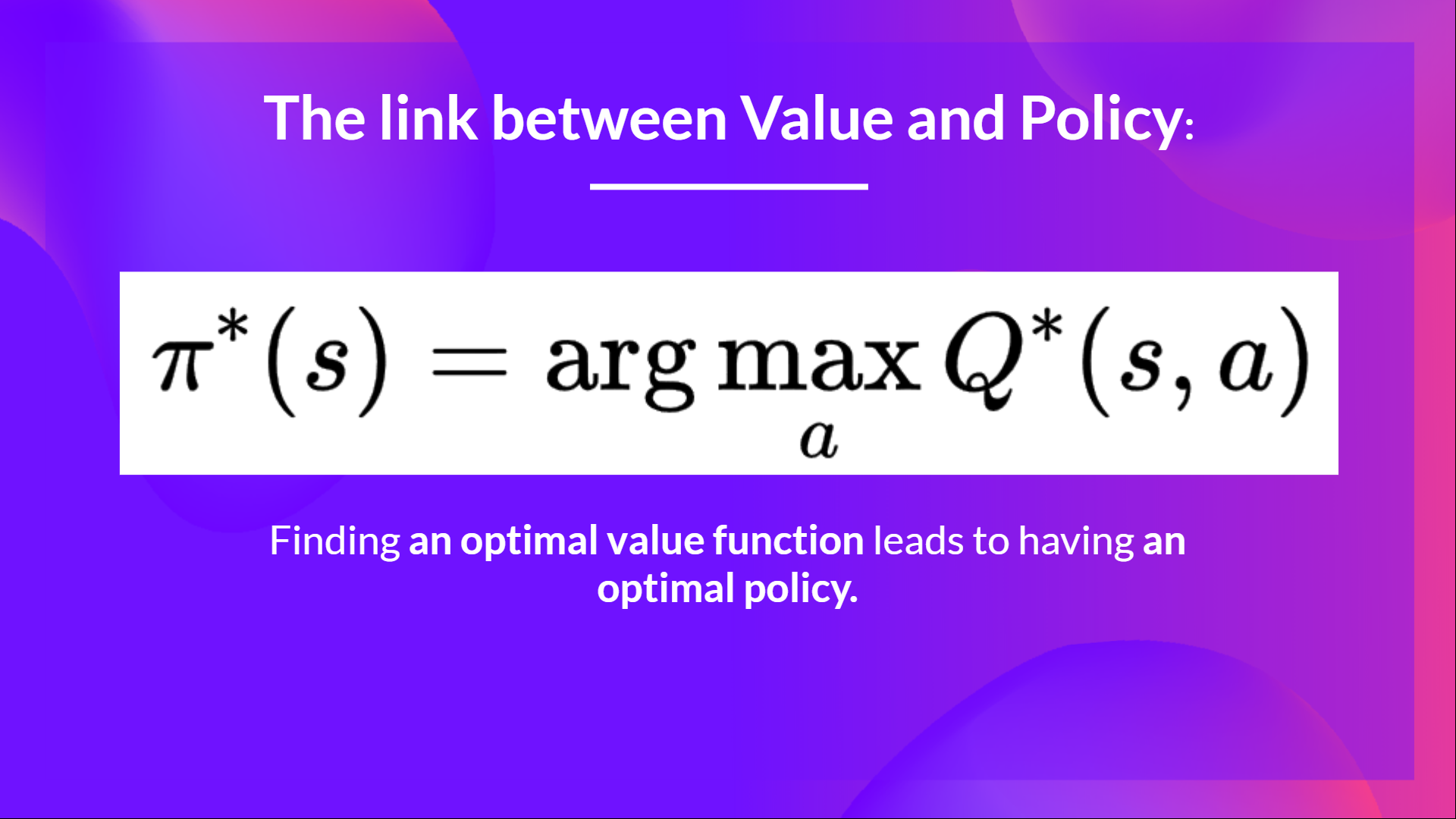
Link value policy

Because, in value-based, π exists only because of the action value estimates, since policy is just a function (for instance, greedy-policy) that will select the action with the highest value given a state.

But, with policy-based methods, we want to optimize the policy directly without having an intermediate step of learning a value function.

So today, we'll study our first Policy-Based method: Reinforce. And we'll implement it from scratch using PyTorch. Before testing its robustness using CartPole-v1, PixelCopter, and Pong.

Environments

Let's get started,

What are Policy-Gradient Methods?

Policy-Gradient is a subclass of Policy-Based Methods, a category of algorithms that aims to optimize the policy directly without using a value function using different techniques. The difference with Policy-Based Methods is that Policy-Gradient methods are a series of algorithms that aim to optimize the policy directly by estimating the weights of the optimal policy using Gradient Ascent.

An Overview of Policy Gradients

Why do we optimize the policy directly by estimating the weights of an optimal policy using Gradient Ascent in Policy Gradients Methods?

Remember that reinforcement learning aims to find an optimal behavior strategy (policy) to maximize its expected cumulative reward.

We also need to remember that a policy is a function that given a state, outputs, a distribution over actions (in our case using a stochastic policy).
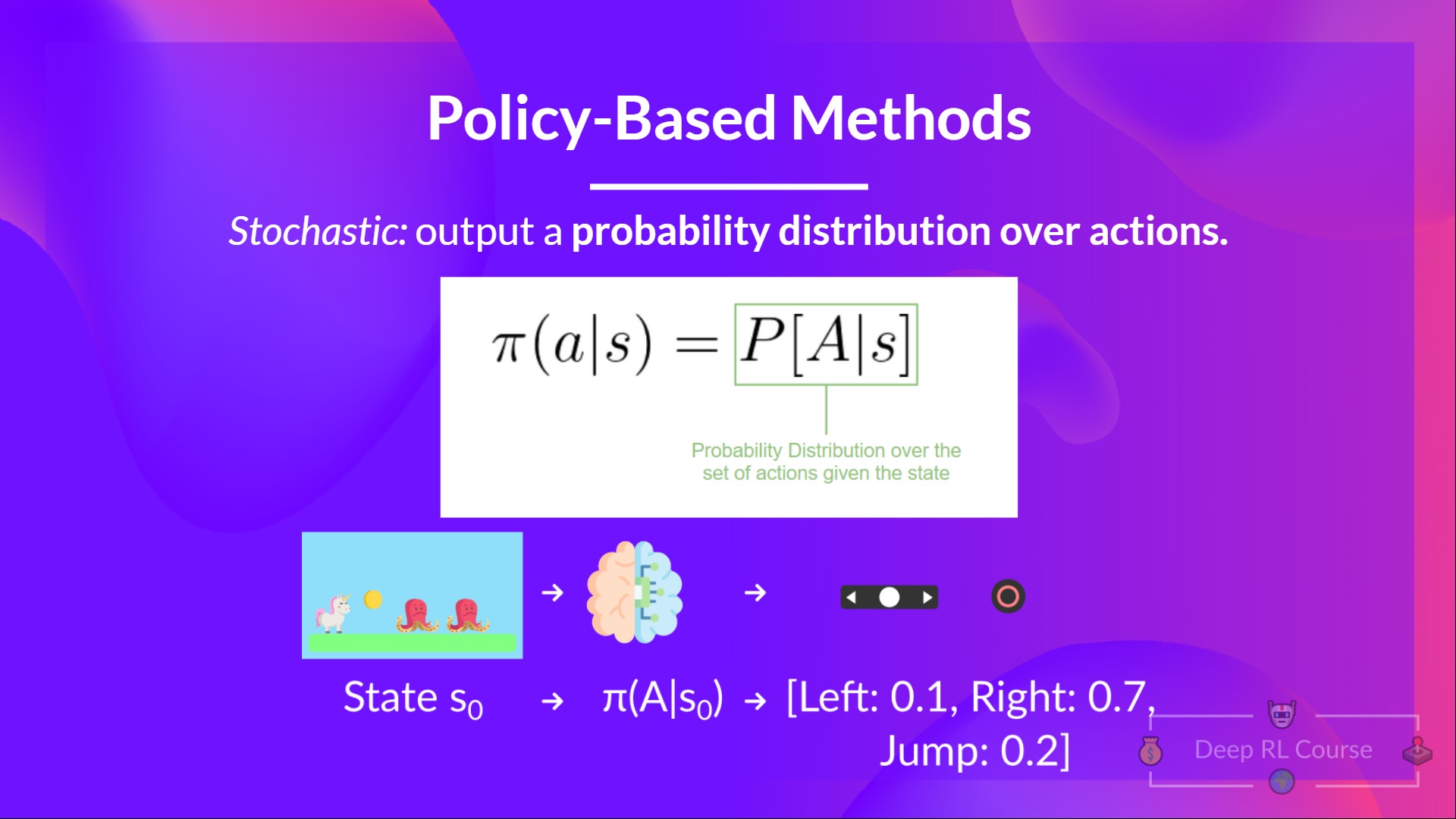
Stochastic Policy

Our goal with Policy-Gradients is to control the probability distribution of actions by tuning the policy such that good actions (that maximize the return) are sampled more frequently in the future.

Let’s take a simple example:

  • We collect an episode by letting our policy interact with its environment.

  • We then look at the sum of rewards of the episode (expected return). If this sum is positive, we consider that the actions taken during the episodes were good: Therefore, we want to increase the P(a|s) (probability of taking that action at that state) for each state-action pair.

The Policy Gradient algorithm (simplified) looks like this:
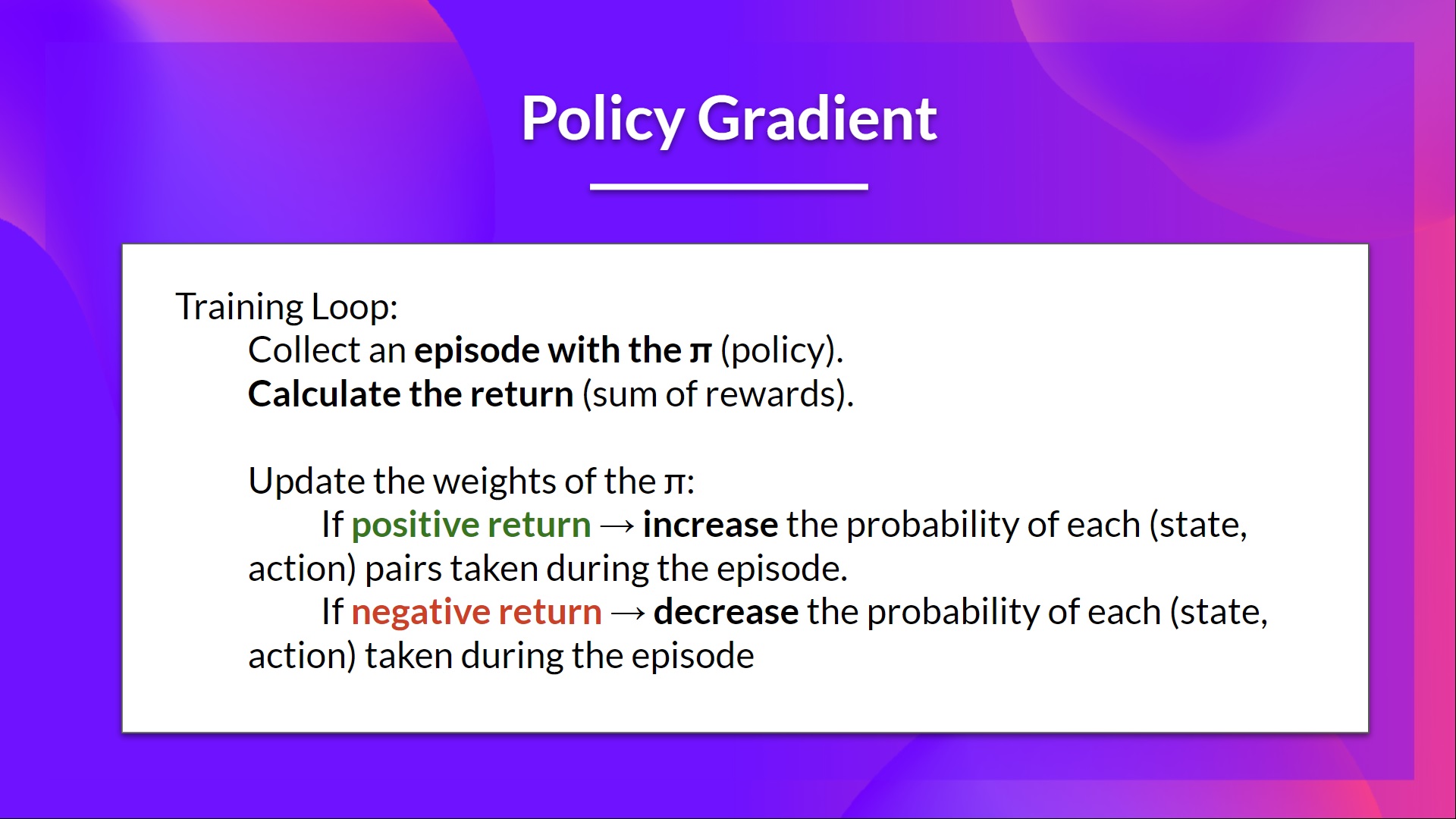
Policy Gradient Big Picture

But Deep Q-Learning is excellent! Why use policy gradient methods?

The Advantages of Policy-Gradient Methods

There are multiple advantages over Deep Q-Learning methods. Let's see some of them:

  1. The simplicity of the integration: we can estimate the policy directly without storing additional data (action values).

  2. Policy gradient methods can learn a stochastic policy while value functions can't.

This has two consequences:

a. We don't need to implement an exploration/exploitation trade-off by hand. Since we output a probability distribution over actions, the agent explores the state space without always taking the same trajectory.

b. We also get rid of the problem of perceptual aliasing. Perceptual aliasing is when two states seem (or are) the same but need different actions.

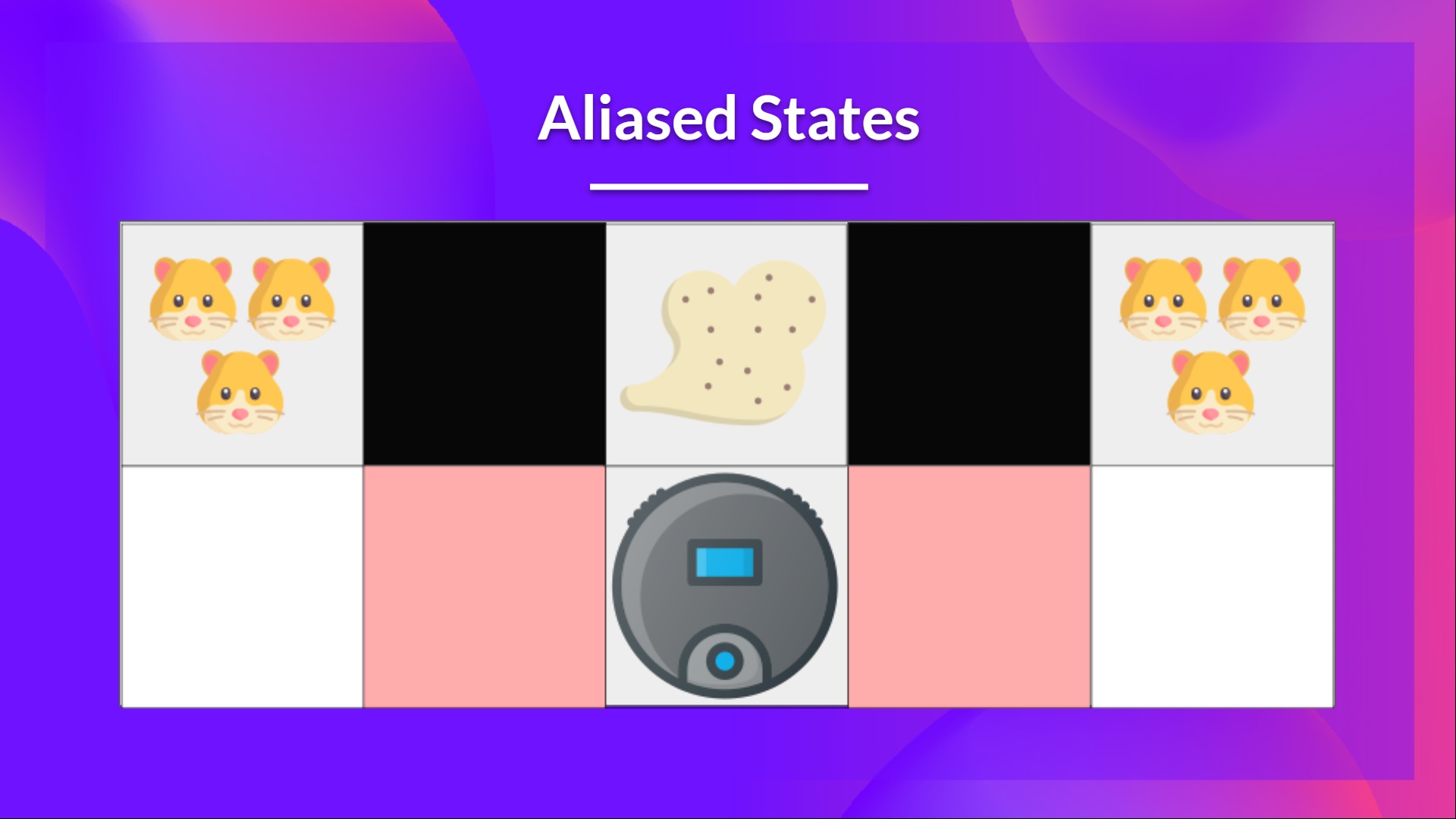
Let's take an example: we have an intelligent vacuum cleaner whose goal is to suck the dust and avoid killing the hamsters.
Hamster 1

Our vacuum cleaner can only perceive where the walls are.

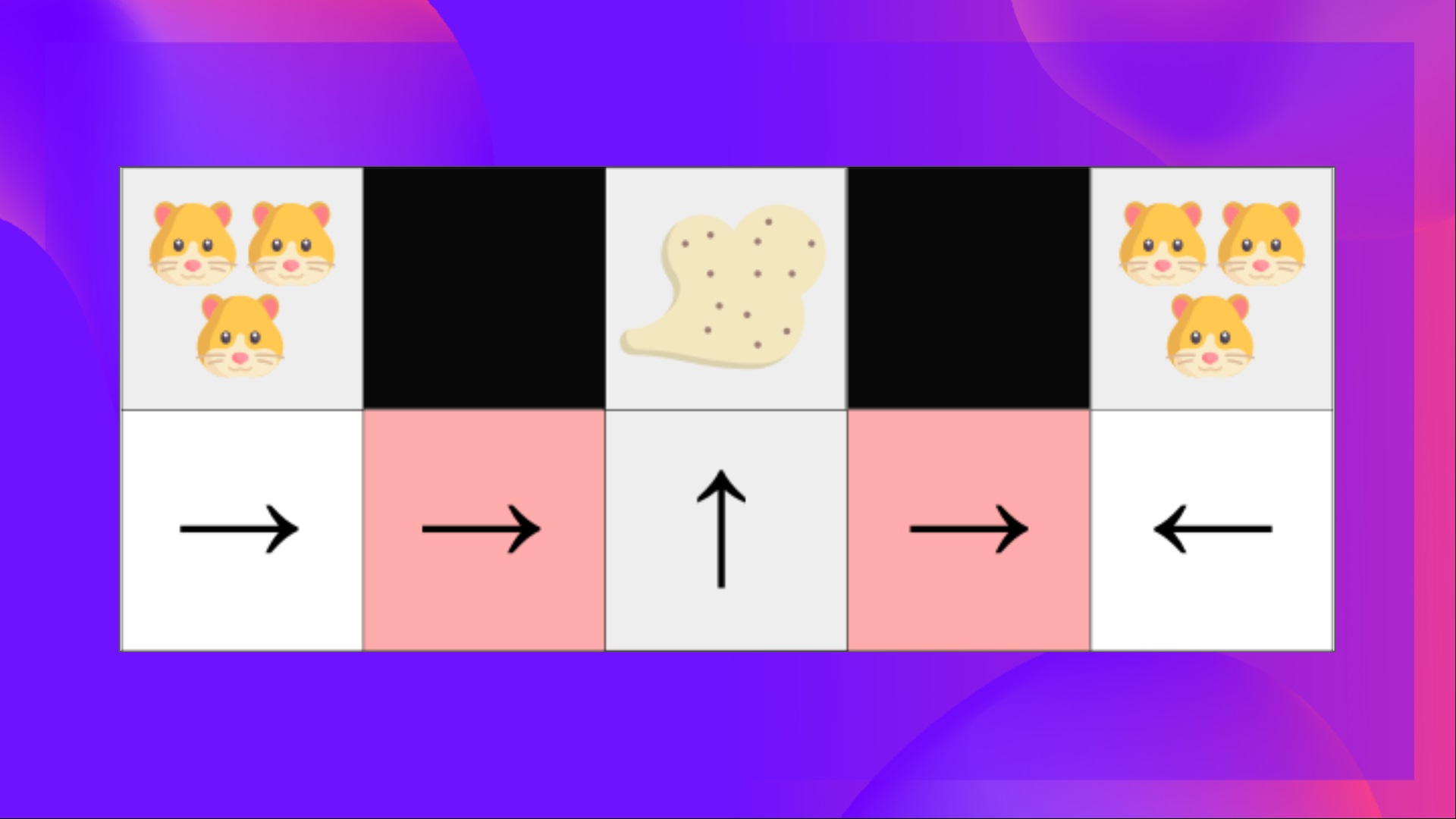
The problem is that the two red cases are aliased states because the agent perceives an upper and lower wall for each.
Hamster 1

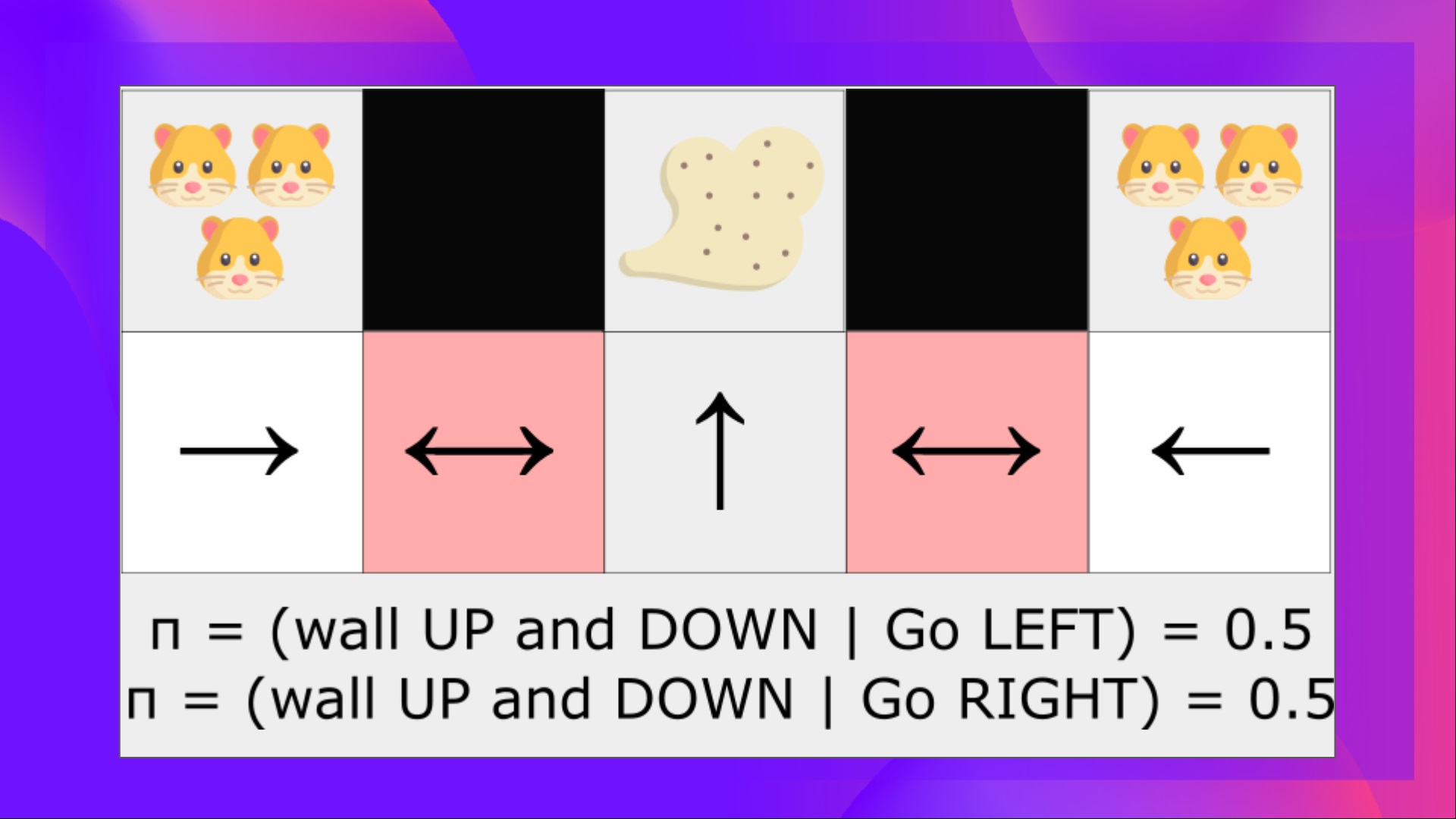
Under a deterministic policy, the policy will either move right when in a red state or move left. Either case will cause our agent to get stuck and never suck the dust.

Under a value-based RL algorithm, we learn a quasi-deterministic policy ("greedy epsilon strategy"). Consequently, our agent can spend a lot of time before finding the dust.

On the other hand, an optimal stochastic policy will randomly move left or right in grey states. Consequently, it will not be stuck and will reach the goal state with a high probability.
Hamster 1
  1. Policy gradients are more effective in high-dimensional action spaces and continuous actions spaces

Indeed, the problem with Deep Q-learning is that their predictions assign a score (maximum expected future reward) for each possible action, at each time step, given the current state.

But what if we have an infinite possibility of actions?

For instance, with a self-driving car, at each state, you can have a (near) infinite choice of actions (turning the wheel at 15°, 17.2°, 19,4°, honking, etc.). We'll need to output a Q-value for each possible action! And taking the max action of a continuous output is an optimization problem itself!

Instead, with a policy gradient, we output a probability distribution over actions.

The Disadvantages of Policy-Gradient Methods

Naturally, Policy Gradient methods have also some disadvantages:

  • Policy gradients converge a lot of time on a local maximum instead of a global optimum.
  • Policy gradient goes faster, step by step: it can take longer to train (inefficient).
  • Policy gradient can have high variance (solution baseline).

👉 If you want to go deeper on the why the advantages and disadvantages of Policy Gradients methods, you can check this video.

Now that we have seen the big picture of Policy-Gradient and its advantages and disadvantages, let's study and implement one of them: Reinforce.

Reinforce (Monte Carlo Policy Gradient)

Reinforce, also called Monte-Carlo Policy Gradient, uses an estimated return from an entire episode to update the policy parameter θ\theta.

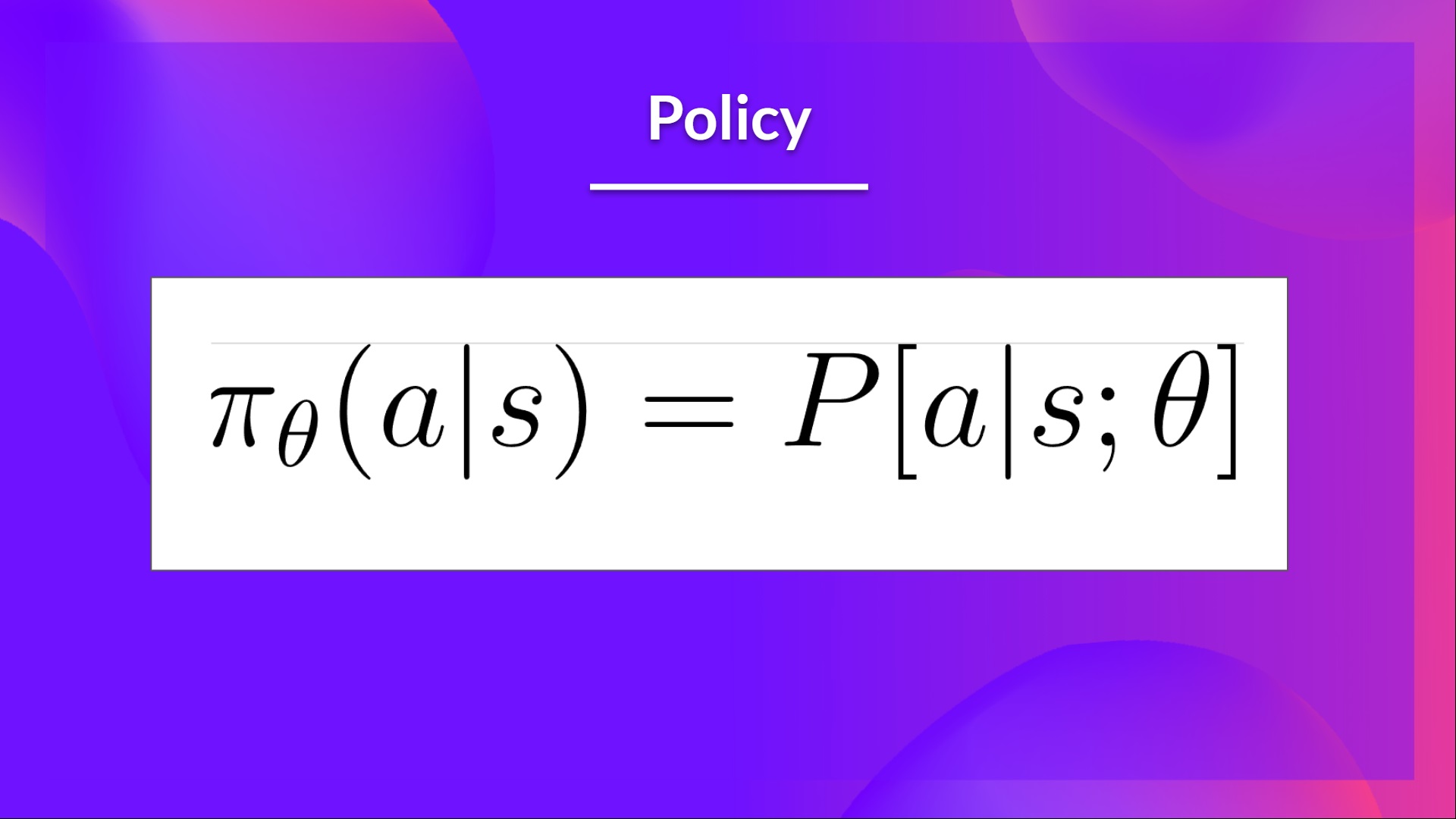
We have our policy π which has a parameter θ. This π, given a state, outputs a probability distribution of actions.
Policy

Where πθ(atst)\pi_\theta(a_t|s_t) is the probability of the agent selecting action at from state st, given our policy.

But how do we know if our policy is good? We need to have a way to measure it. To know that we define a score/objective function called J(θ)J(\theta).

The score function J is the expected return:
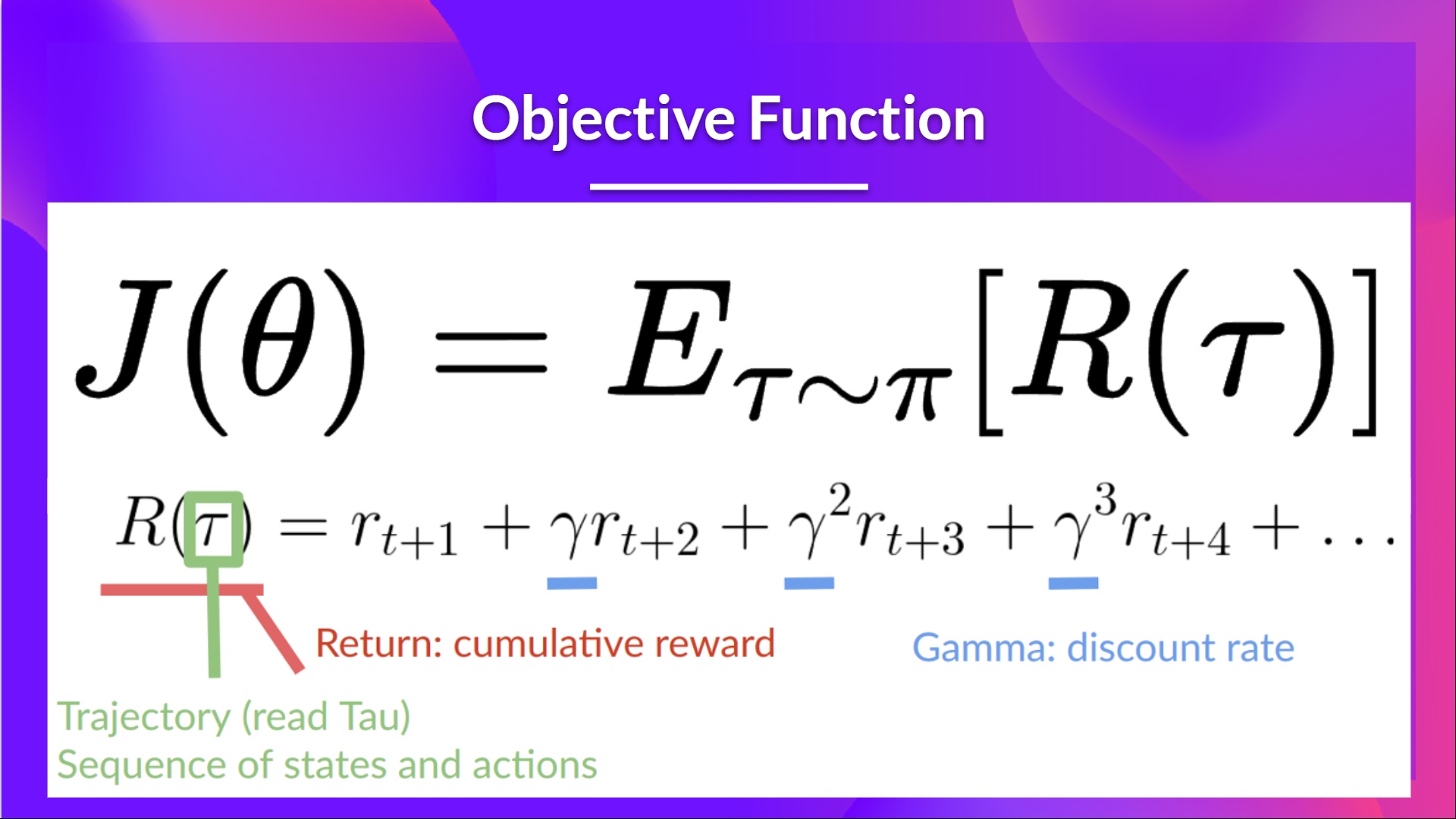
Return

Remember that policy gradient can be seen as an optimization problem. So we must find the best parameters (θ) to maximize the score function, J(θ).

To do that we’re going to use the Policy Gradient Theorem. I’m not going to dive on the mathematical details but if you’re interested check this video

The Reinforce algorithm works like this: Loop:
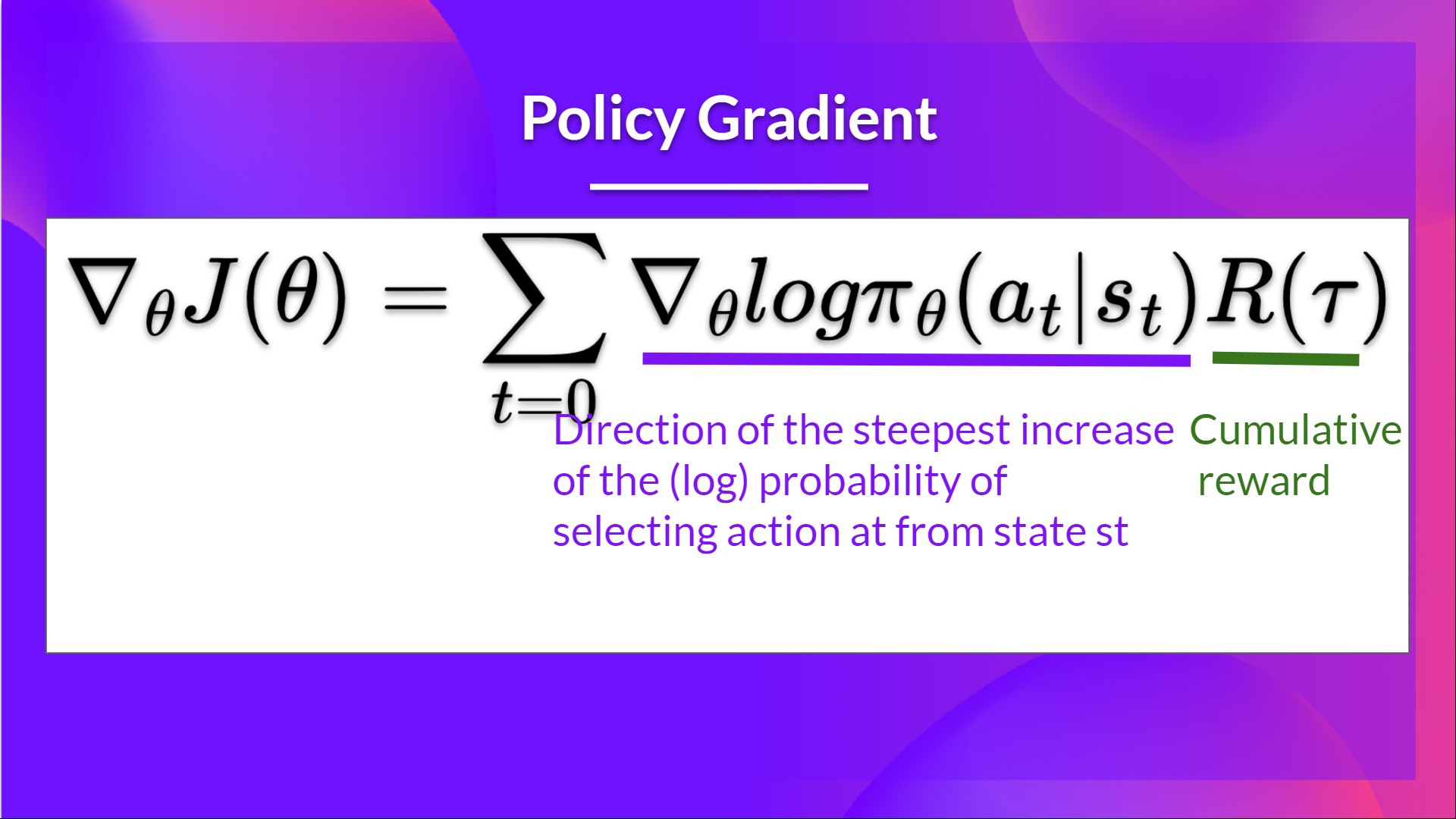
  • Use the policy πθ\pi_\theta to collect an episode τ\tau
  • Use the episode to estimate the gradient g^=θJ(θ)\hat{g} = \nabla_\theta J(\theta)
Policy Gradient
  • Update the weights of the policy: θθ+αg^\theta \leftarrow \theta + \alpha \hat{g}

The interpretation we can make is this one:

  • θlogπθ(atst)\nabla_\theta log \pi_\theta(a_t|s_t) is the direction of steepest increase of the (log) probability of selecting action at from state st. => This tells use how we should change the weights of policy if we want to increase/decrease the log probability of selecting action at at state st.
  • R(τ)R(\tau): is the scoring function:
    • If the return is high, it will push up the probabilities of the (state, action) combinations.
    • Else, if the return is low, it will push down the probabilities of the (state, action) combinations.

Now that we studied the theory behind Reinforce, you’re ready to code your Reinforce agent with PyTorch. And you'll test its robustness using CartPole-v1, PixelCopter, and Pong.
Start the tutorial here 👉 https://colab.research.google.com/github/huggingface/deep-rl-class/blob/main/unit5/unit5.ipynb
The leaderboard to compare your results with your classmates 🏆 👉 https://huggingface.co/spaces/chrisjay/Deep-Reinforcement-Learning-Leaderboard
Environments

Congrats on finishing this chapter! There was a lot of information. And congrats on finishing the tutorial. You’ve just coded your first Deep Reinforcement Learning agent from scratch using PyTorch and shared it on the Hub 🥳.

It's normal if you still feel confused with all these elements. This was the same for me and for all people who studied RL.

Take time to really grasp the material before continuing.

Don't hesitate to train your agent in other environments. The best way to learn is to try things on your own!

We published additional readings in the syllabus if you want to go deeper 👉 https://github.com/huggingface/deep-rl-class/blob/main/unit5/README.md

In the next unit, we’re going to learn about a combination of Policy-Based and Value-based methods called Actor Critic Methods.

And don't forget to share with your friends who want to learn 🤗!

Finally, we want to improve and update the course iteratively with your feedback. If you have some, please fill this form 👉 https://forms.gle/3HgA7bEHwAmmLfwh9

Keep learning, stay awesome 🤗,