



惯性聚合 高效追踪和阅读你感兴趣的博客、新闻、科技资讯
阅读原文 在惯性聚合中打开

推荐订阅源

TaoSecurity Blog
TaoSecurity Blog
T
Troy Hunt's Blog
cs.AI updates on arXiv.org
Vercel News
Vercel News
T
Threatpost
G
Google Developers Blog
T
Threat Research - Cisco Blogs
Threat Intelligence Blog | Flashpoint
T
The Exploit Database - CXSecurity.com
H
Heimdal Security Blog
Google DeepMind News
Cyberwarzone
Cyberwarzone
T
The Blog of Author Tim Ferriss
Know Your Adversary
Know Your Adversary
Hacker News: Ask HN
Hacker News: Ask HN
www.infosecurity-magazine.com
S
Schneier on Security
B
Blog
V2EX - 技术
V2EX - 技术
NISL@THU
NISL@THU
C
CERT Recently Published Vulnerability Notes
W
WeLiveSecurity
C
Cybersecurity and Infrastructure Security Agency CISA
cs.CV updates on arXiv.org
Y
Y Combinator Blog
K
KPMG report finds enterprise disconnect between AI and its ROI | CIO
Spread Privacy
Spread Privacy
The Last Watchdog
The Last Watchdog
V
Vulnerabilities – Threatpost
N
Netflix TechBlog - Medium
Schneier on Security
F
Fortinet All Blogs
N
News | PayPal Newsroom
Attack and Defense Labs
Blog — PlanetScale
Blog — PlanetScale
OSCHINA 社区最新新闻
OSCHINA 社区最新新闻
Microsoft Security Blog
S
Security @ Cisco Blogs
人人都是产品经理
人人都是产品经理
爱范儿
爱范儿
P
Privacy & Cybersecurity Law Blog
P
Proofpoint News Feed
Project Zero
Project Zero
I
Intezer
罗磊的独立博客
H
Hackread – Cybersecurity News, Data Breaches, AI and More
酷 壳 – CoolShell
酷 壳 – CoolShell
博客园 - Franky
SecWiki News
SecWiki News
Martin Fowler
Martin Fowler

Hugging Face - Blog

Waypoint-1.5: Higher-Fidelity Interactive Worlds for Everyday GPUs ALTK‑Evolve: On‑the‑Job Learning for AI Agents Safetensors is Joining the PyTorch Foundation Holo3: Breaking the Computer Use Frontier Any Custom Frontend with Gradio's Backend A New Framework for Evaluating Voice Agents (EVA) Bringing Robotics AI to Embedded Platforms: Dataset Recording, VLA Fine‑Tuning, and On‑Device Optimizations One-Shot Any Web App with Gradio's gr.HTML CUGA on Hugging Face: Democratizing Configurable AI Agents New in llama.cpp: Model Management Building Deep Research: How we Achieved State of the Art OVHcloud on Hugging Face Inference Providers 🔥 20x Faster TRL Fine-tuning with RapidFire AI Building for an Open Future - our new partnership with Google Cloud Aligning to What? Rethinking Agent Generalization in MiniMax M2 Building a Healthcare Robot from Simulation to Deployment with NVIDIA Isaac Sentence Transformers is joining Hugging Face! Unlock the power of images with AI Sheets Supercharge your OCR Pipelines with Open Models Google Cloud C4 Brings a 70% TCO improvement on GPT OSS with Intel and Hugging Face Get your VLM running in 3 simple steps on Intel CPUs Nemotron-Personas-India: Synthesized Data for Sovereign AI Introducing RTEB: A New Standard for Retrieval Evaluation Accelerating Qwen3-8B Agent on Intel® Core™ Ultra with Depth-Pruned Draft Models VibeGame: Exploring Vibe Coding Games Nemotron-Personas-Japan: ソブリン AI のための合成データセット Swift Transformers Reaches 1.0 – and Looks to the Future Smol2Operator: Post-Training GUI Agents for Computer Use SyGra: The One-Stop Framework for Building Data for LLMs and SLMs Gaia2 and ARE: Empowering the community to study agents Scaleway on Hugging Face Inference Providers 🔥 Democratizing AI Safety with RiskRubric.ai Public AI on Hugging Face Inference Providers 🔥 `LeRobotDataset:v3.0`: Bringing large-scale datasets to `lerobot` Visible Watermarking with Gradio Introducing the Palmyra-mini family: Powerful, lightweight, and ready to reason! Tricks from OpenAI gpt-oss YOU 🫵 can use with transformers Fine-tune Any LLM from the Hugging Face Hub with Together AI Jupyter Agents: training LLMs to reason with notebooks mmBERT: ModernBERT goes Multilingual Welcome EmbeddingGemma, Google's new efficient embedding model SAIR: Accelerating Pharma R&D with AI-Powered Structural Intelligence Make your ZeroGPU Spaces go brrr with ahead-of-time compilation NVIDIA Releases 6 Million Multi-Lingual Reasoning Dataset Generate Images with Claude and Hugging Face From Zero to GPU: A Guide to Building and Scaling Production-Ready CUDA Kernels MCP for Research: How to Connect AI to Research Tools Kimina-Prover-RL Arm & ExecuTorch 0.7: Bringing Generative AI to the masses Neural Super Sampling is here! TextQuests: How Good are LLMs at Text-Based Video Games? 🇵🇭 FilBench - Can LLMs Understand and Generate Filipino? Introducing AI Sheets: a tool to work with datasets using open AI models! Accelerate ND-Parallel: A guide to Efficient Multi-GPU Training Vision Language Model Alignment in TRL ⚡️ Welcome GPT OSS, the new open-source model family from OpenAI! Measuring Open-Source Llama Nemotron Models on DeepResearch Bench 📚 3LM: A Benchmark for Arabic LLMs in STEM and Code Implementing MCP Servers in Python: An AI Shopping Assistant with Gradio Introducing Trackio: A Lightweight Experiment Tracking Library from Hugging Face Say hello to `hf`: a faster, friendlier Hugging Face CLI ✨ Parquet Content-Defined Chunking TimeScope: How Long Can Your Video Large Multimodal Model Go? Fast LoRA inference for Flux with Diffusers and PEFT Accelerate a World of LLMs on Hugging Face with NVIDIA NIM Arc Virtual Cell Challenge: A Primer Consilium: When Multiple LLMs Collaborate Back to The Future: Evaluating AI Agents on Predicting Future Events Five Big Improvements to Gradio MCP Servers Ettin Suite: SoTA Paired Encoders and Decoders Migrating the Hub from Git LFS to Xet Kimina-Prover: Applying Test-time RL Search on Large Formal Reasoning Models Asynchronous Robot Inference: Decoupling Action Prediction and Execution ScreenEnv: Deploy your full stack Desktop Agent Building the Hugging Face MCP Server Reachy Mini - The Open-Source Robot for Today's and Tomorrow's AI Builders Creating custom kernels for the AMD MI300 Upskill your LLMs With Gradio MCP Servers SmolLM3: smol, multilingual, long-context reasoner Three Mighty Alerts Supporting Hugging Face’s Production Infrastructure Efficient MultiModal Data Pipeline Announcing NeurIPS 2025 E2LM Competition: Early Training Evaluation of Language Models Training and Finetuning Sparse Embedding Models with Sentence Transformers Welcome the NVIDIA Llama Nemotron Nano VLM to Hugging Face Hub Gemma 3n fully available in the open-source ecosystem! Transformers backend integration in SGLang (LoRA) Fine-Tuning FLUX.1-dev on Consumer Hardware Groq on Hugging Face Inference Providers 🔥 How Long Prompts Block Other Requests - Optimizing LLM Performance Learn the Hugging Face Kernel Hub in 5 Minutes Convert Transformers to ONNX with Hugging Face Optimum Intel and Hugging Face Partner to Democratize Machine Learning Hardware Acceleration Director of Machine Learning Insights [Part 3: Finance Edition] The Annotated Diffusion Model Deep Q-Learning with Space Invaders Graphcore and Hugging Face Launch New Lineup of IPU-Ready Transformers Introducing Pull Requests and Discussions 🥳 Efficient Table Pre-training without Real Data: An Introduction to TAPEX An Introduction to Q-Learning Part 2/2 How Sempre Health is leveraging the Expert Acceleration Program to accelerate their ML roadmap
Ryght’s Journey to Empower Healthcare and Life Sciences with Expert Support from Hugging Face
Andrew Reed, Johnny Crupi · 2024-04-16 · via Hugging Face - Blog

Back to Articles

Andrew Reed's avatar

Johnny Crupi's avatar

This article is also available in Chinese 简体中文.

This is a guest blog post by the Ryght team.

Who is Ryght?

Ryght is building an enterprise-grade generative AI platform tailored for the healthcare and life sciences sectors. Today is their official launch of Ryght Preview, now publicly available for all.

Life science companies are amassing a wealth of data from diverse sources (lab data, EMR, genomics, claims, pharmacy, clinical, etc.), but analysis of that data is archaic, requiring large teams for everything from simple queries to developing useful ML models. There is huge demand for actionable knowledge to drive drug development, clinical trials, and commercial activity, and the rise of precision medicine is only accelerating this demand.
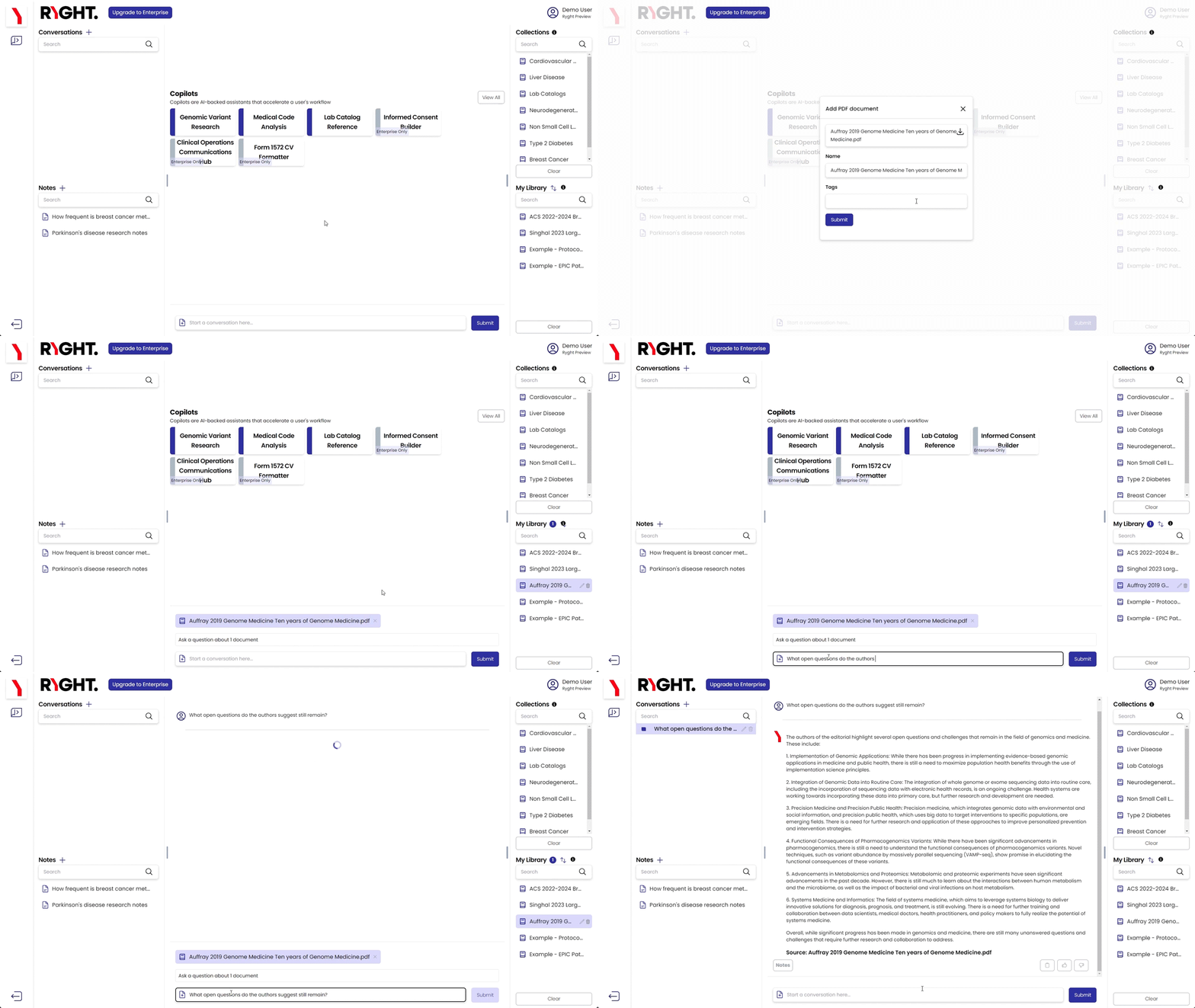
Ryght Laptop

Ryght’s goal is to empower life science professionals to get the insights they need swiftly and securely. To do so, they’re building a SaaS platform that offers industry-specific AI copilots and custom built solutions for professionals and organizations to accelerate their research, analysis, and documentation across a variety of complex data sources.

Recognizing how fast paced and ever changing the AI landscape is, Ryght sought out Hugging Face as a technical advisory partner early in their journey via the Expert Support Program.

Overcoming challenges, together

Our partnership with Hugging Face's expert support has played a crucial role in expediting the development of our generative AI platform. The rapidly evolving landscape of AI has the potential to revolutionize our industry, and Hugging Face’s highly performant and enterprise-ready Text Generation Inference (TGI) and Text Embeddings Inference (TEI) services are game changers in their own right. - Johnny Crupi, CTO at Ryght

Ryght faced several challenges as they set out to build their generative AI platform.

1. The need to quickly upskill a team and stay informed in a highly dynamic environment

With AI and ML technologies advancing so quickly, ensuring that the team remains abreast of the latest techniques, tools, and best practices is critical. This continuous learning curve is steep and requires a concerted effort to stay informed.

Having access to Hugging Face’s team of experts who operate at the center of the AI ecosystem helps Ryght keep up with the latest developments and models that are relevant to their domain. This is achieved through open, asynchronous channels of communication, regular advisory meetings, and dedicated technical workshops.

2. Identifying the most [cost] effective ML approaches amidst the noisy sea of options

The AI field is bustling with innovation, leading to an abundance of tools, libraries, models, and methodologies. For a startup like Ryght, it's imperative to cut through this noise and identify which ML strategies are most applicable to their unique use cases in the life sciences sector. This involves not just understanding the current state of the art, but also looking ahead to which technologies will remain relevant and scalable for the future.

Hugging Face serves as a partner to Ryght’s technical team – assisting in solution design, proof-of-concept development, and production workload optimization. This includes tailored recommendations on libraries, frameworks, and models best fit for Ryght’s specific needs, along with demonstrable examples of how to use them. This guidance ultimately streamlines the decision-making process and reduces the time to development.

3. Requirement to develop performant solutions that emphasize security, privacy, and flexibility

Given the focus on enterprise-level solutions, Ryght prioritizes security, privacy, and governance. This necessitates a flexible architecture capable of interfacing with various large language models (LLMs) in real-time, a crucial feature for their life science-specific content generation and query handling.

Understanding the rapid innovation within the open-source community, especially regarding medical LLMs, they embraced an architectural approach that supports "pluggable" LLMs. This design choice allows them to seamlessly evaluate and integrate new or specialized medical LLMs as they emerge.

In Ryght’s platform, each LLM is registered and linked to one or more, customer-specific inference endpoints. This setup not only secures the connections, but also provides the ability to switch between different LLMs, offering unparalleled flexibility – a design choice that is made possible by the adoption of Hugging Face’s Text Generation Inference (TGI) and Inference Endpoints.

In addition to TGI, Ryght has also integrated Text Embeddings Inference (TEI) into their ML platform. Serving open-source embedding models with TEI marks a significant improvement over relying solely on proprietary embeddings – enabling Ryght to benefit from faster inference speeds, the elimination of rate limit worries, and the flexibility to serve their own fine-tuned models, tailored to the unique requirements of the life sciences domain.

Catering to multiple customers simultaneously, their system is designed to handle high volumes of concurrent requests while maintaining low latency. Their embedding and inference services go beyond simple model invocation and encompass a suite of services adept at batching, queuing, and distributing model processing across GPUs. This infrastructure is critical to avoiding performance bottlenecks and ensuring users do not experience delays, thereby maintaining an optimal system response time.

Conclusion

Ryght's strategic partnership with and integration of Hugging Face's ML services underscores their commitment to delivering cutting-edge solutions in healthcare and life sciences. By embracing a flexible, secure, and scalable architecture, they ensure that their platform remains at the forefront of innovation, offering their clients unparalleled service and expertise in navigating the complexities of modern medical domains.

Sign up for Ryght Preview, now publicly available to life sciences knowledge workers as a free, secure platform with frictionless onboarding. Ryght’s copilot library consists of a diverse collection of tools to accelerate information retrieval, synthesis and structuring of complex unstructured data, and document builders, taking what might have taken weeks to complete down to days or hours. To inquire about custom building and collaborations, contact their team of AI experts to discuss Ryght for Enterprise.

If you’re interested to know more about Hugging Face Expert Support, please contact us here - our team will reach out to discuss your requirements!