


惯性聚合 高效追踪和阅读你感兴趣的博客、新闻、科技资讯
阅读原文 在惯性聚合中打开

推荐订阅源

Hacker News: Ask HN
Hacker News: Ask HN
WordPress大学
WordPress大学
T
The Blog of Author Tim Ferriss
The GitHub Blog
The GitHub Blog
OSCHINA 社区最新新闻
OSCHINA 社区最新新闻
博客园 - 聂微东
A
About on SuperTechFans
Stack Overflow Blog
Stack Overflow Blog
雷峰网
雷峰网
Microsoft Azure Blog
腾讯CDC
爱范儿
爱范儿
酷 壳 – CoolShell
酷 壳 – CoolShell
博客园 - 【当耐特】
V
Visual Studio Blog
有赞技术团队
有赞技术团队
U
Unit 42
D
Docker
小众软件
小众软件
F
Full Disclosure
I
Intezer
Scott Helme
Scott Helme
P
Privacy International News Feed
P
Proofpoint News Feed
Engineering at Meta
Engineering at Meta
Google DeepMind News
B
Blog
Martin Fowler
Martin Fowler
Threat Intelligence Blog | Flashpoint
Vercel News
Vercel News
奇客Solidot–传递最新科技情报
奇客Solidot–传递最新科技情报
Spread Privacy
Spread Privacy
宝玉的分享
宝玉的分享
S
Security Affairs
www.infosecurity-magazine.com
月光博客
月光博客
C
Cisco Blogs
云风的 BLOG
云风的 BLOG
Schneier on Security
钛媒体:引领未来商业与生活新知
钛媒体:引领未来商业与生活新知
T
Threat Research - Cisco Blogs
量子位
Hacker News - Newest:
Hacker News - Newest: "LLM"
H
Heimdal Security Blog
N
Netflix TechBlog - Medium
H
Hacker News: Front Page
P
Proofpoint News Feed
G
GRAHAM CLULEY
V
Vulnerabilities – Threatpost
S
Schneier on Security

Hugging Face - Blog

Waypoint-1.5: Higher-Fidelity Interactive Worlds for Everyday GPUs ALTK‑Evolve: On‑the‑Job Learning for AI Agents Safetensors is Joining the PyTorch Foundation Holo3: Breaking the Computer Use Frontier Any Custom Frontend with Gradio's Backend A New Framework for Evaluating Voice Agents (EVA) Bringing Robotics AI to Embedded Platforms: Dataset Recording, VLA Fine‑Tuning, and On‑Device Optimizations One-Shot Any Web App with Gradio's gr.HTML CUGA on Hugging Face: Democratizing Configurable AI Agents New in llama.cpp: Model Management Building Deep Research: How we Achieved State of the Art OVHcloud on Hugging Face Inference Providers 🔥 20x Faster TRL Fine-tuning with RapidFire AI Building for an Open Future - our new partnership with Google Cloud Aligning to What? Rethinking Agent Generalization in MiniMax M2 Building a Healthcare Robot from Simulation to Deployment with NVIDIA Isaac Sentence Transformers is joining Hugging Face! Unlock the power of images with AI Sheets Supercharge your OCR Pipelines with Open Models Google Cloud C4 Brings a 70% TCO improvement on GPT OSS with Intel and Hugging Face Get your VLM running in 3 simple steps on Intel CPUs Nemotron-Personas-India: Synthesized Data for Sovereign AI Introducing RTEB: A New Standard for Retrieval Evaluation Accelerating Qwen3-8B Agent on Intel® Core™ Ultra with Depth-Pruned Draft Models VibeGame: Exploring Vibe Coding Games Nemotron-Personas-Japan: ソブリン AI のための合成データセット Swift Transformers Reaches 1.0 – and Looks to the Future Smol2Operator: Post-Training GUI Agents for Computer Use SyGra: The One-Stop Framework for Building Data for LLMs and SLMs Gaia2 and ARE: Empowering the community to study agents Scaleway on Hugging Face Inference Providers 🔥 Democratizing AI Safety with RiskRubric.ai Public AI on Hugging Face Inference Providers 🔥 `LeRobotDataset:v3.0`: Bringing large-scale datasets to `lerobot` Visible Watermarking with Gradio Introducing the Palmyra-mini family: Powerful, lightweight, and ready to reason! Tricks from OpenAI gpt-oss YOU 🫵 can use with transformers Fine-tune Any LLM from the Hugging Face Hub with Together AI Jupyter Agents: training LLMs to reason with notebooks mmBERT: ModernBERT goes Multilingual Welcome EmbeddingGemma, Google's new efficient embedding model SAIR: Accelerating Pharma R&D with AI-Powered Structural Intelligence Make your ZeroGPU Spaces go brrr with ahead-of-time compilation NVIDIA Releases 6 Million Multi-Lingual Reasoning Dataset Generate Images with Claude and Hugging Face From Zero to GPU: A Guide to Building and Scaling Production-Ready CUDA Kernels MCP for Research: How to Connect AI to Research Tools Kimina-Prover-RL Arm & ExecuTorch 0.7: Bringing Generative AI to the masses Neural Super Sampling is here! TextQuests: How Good are LLMs at Text-Based Video Games? 🇵🇭 FilBench - Can LLMs Understand and Generate Filipino? Introducing AI Sheets: a tool to work with datasets using open AI models! Accelerate ND-Parallel: A guide to Efficient Multi-GPU Training Vision Language Model Alignment in TRL ⚡️ Welcome GPT OSS, the new open-source model family from OpenAI! Measuring Open-Source Llama Nemotron Models on DeepResearch Bench 📚 3LM: A Benchmark for Arabic LLMs in STEM and Code Implementing MCP Servers in Python: An AI Shopping Assistant with Gradio Introducing Trackio: A Lightweight Experiment Tracking Library from Hugging Face Say hello to `hf`: a faster, friendlier Hugging Face CLI ✨ Parquet Content-Defined Chunking TimeScope: How Long Can Your Video Large Multimodal Model Go? Fast LoRA inference for Flux with Diffusers and PEFT Accelerate a World of LLMs on Hugging Face with NVIDIA NIM Arc Virtual Cell Challenge: A Primer Consilium: When Multiple LLMs Collaborate Back to The Future: Evaluating AI Agents on Predicting Future Events Five Big Improvements to Gradio MCP Servers Ettin Suite: SoTA Paired Encoders and Decoders Migrating the Hub from Git LFS to Xet Kimina-Prover: Applying Test-time RL Search on Large Formal Reasoning Models Asynchronous Robot Inference: Decoupling Action Prediction and Execution ScreenEnv: Deploy your full stack Desktop Agent Building the Hugging Face MCP Server Reachy Mini - The Open-Source Robot for Today's and Tomorrow's AI Builders Creating custom kernels for the AMD MI300 Upskill your LLMs With Gradio MCP Servers SmolLM3: smol, multilingual, long-context reasoner Three Mighty Alerts Supporting Hugging Face’s Production Infrastructure Efficient MultiModal Data Pipeline Announcing NeurIPS 2025 E2LM Competition: Early Training Evaluation of Language Models Training and Finetuning Sparse Embedding Models with Sentence Transformers Welcome the NVIDIA Llama Nemotron Nano VLM to Hugging Face Hub Gemma 3n fully available in the open-source ecosystem! Transformers backend integration in SGLang (LoRA) Fine-Tuning FLUX.1-dev on Consumer Hardware Groq on Hugging Face Inference Providers 🔥 How Long Prompts Block Other Requests - Optimizing LLM Performance Learn the Hugging Face Kernel Hub in 5 Minutes Convert Transformers to ONNX with Hugging Face Optimum Intel and Hugging Face Partner to Democratize Machine Learning Hardware Acceleration Director of Machine Learning Insights [Part 3: Finance Edition] The Annotated Diffusion Model Deep Q-Learning with Space Invaders Graphcore and Hugging Face Launch New Lineup of IPU-Ready Transformers Introducing Pull Requests and Discussions 🥳 Efficient Table Pre-training without Real Data: An Introduction to TAPEX An Introduction to Q-Learning Part 2/2 How Sempre Health is leveraging the Expert Acceleration Program to accelerate their ML roadmap
Generating Stories: AI for Game Development #5
Dylan Ebert · 2023-02-07 · via Hugging Face - Blog

Back to Articles

Dylan Ebert's avatar

This article is also available in Chinese 简体中文.

Welcome to AI for Game Development! In this series, we'll be using AI tools to create a fully functional farming game in just 5 days. By the end of this series, you will have learned how you can incorporate a variety of AI tools into your game development workflow. I will show you how you can use AI tools for:

  1. Art Style
  2. Game Design
  3. 3D Assets
  4. 2D Assets
  5. Story

Want the quick video version? You can watch it here. Otherwise, if you want the technical details, keep reading!

Note: This post makes several references to Part 2, where we used ChatGPT for Game Design. Read Part 2 for additional context on how ChatGPT works, including a brief overview of language models and their limitations.

Day 5: Story

In Part 4 of this tutorial series, we talked about how you can use Stable Diffusion and Image2Image as a tool in your 2D Asset workflow.

In this final part, we'll be using AI for Story. First, I'll walk through my process for the farming game, calling attention to ⚠️ Limitations to watch out for. Then, I'll talk about relevant technologies and where we're headed in the context of game development. Finally, I'll conclude with the final game.

Process

Requirements: I'm using ChatGPT throughout this process. For more information on ChatGPT and language modeling in general, I recommend reading Part 2 of the series. ChatGPT isn't the only viable solution, with many emerging competitors, including open-source dialog agents. Read ahead to learn more about the emerging landscape of dialog agents.
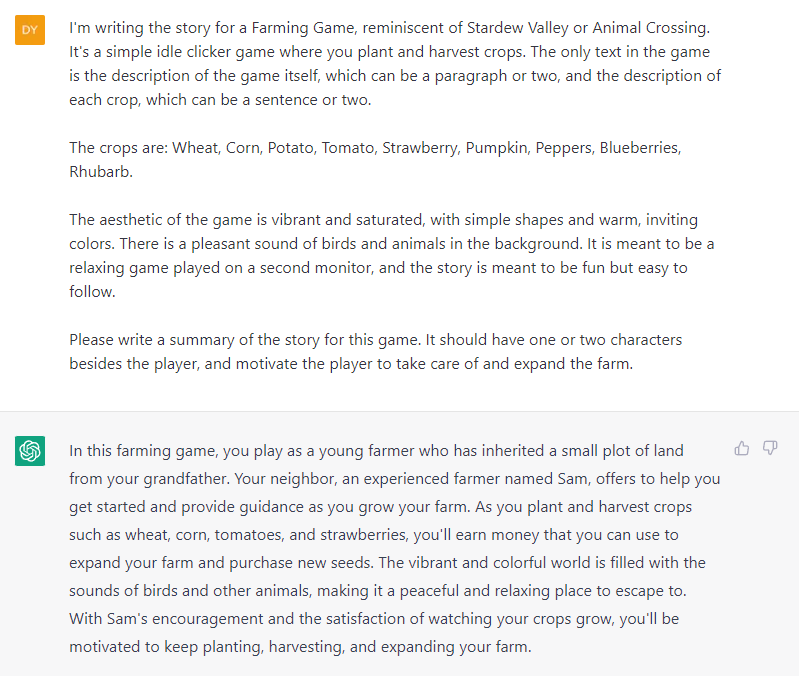
  1. Ask ChatGPT to write a story. I provide plenty of context about my game, then ask ChatGPT to write a story summary.

ChatGPT for Story #1

ChatGPT then responds with a story summary that is extremely similar to the story of the game Stardew Valley.

⚠️ Limitation: Language models are susceptible to reproducing existing stories.

This highlights the importance of using language models as a tool, rather than as a replacement for human creativity. In this case, relying solely on ChatGPT would result in a very unoriginal story.
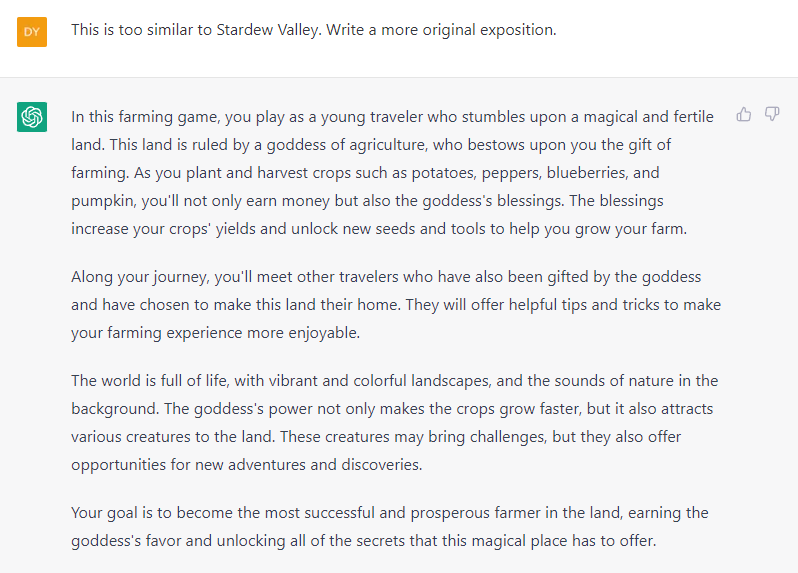
  1. Refine the results. As with Image2Image in Part 4, the real power of these tools comes from back-and-forth collaboration. So, I ask ChatGPT directly to be more original.

ChatGPT for Story #2

This is already much better. I continue to refine the result, such as asking to remove elements of magic since the game doesn't contain magic. After a few rounds of back-and-forth, I reach a description I'm happy with. Then, it's a matter of generating the actual content that tells this story.
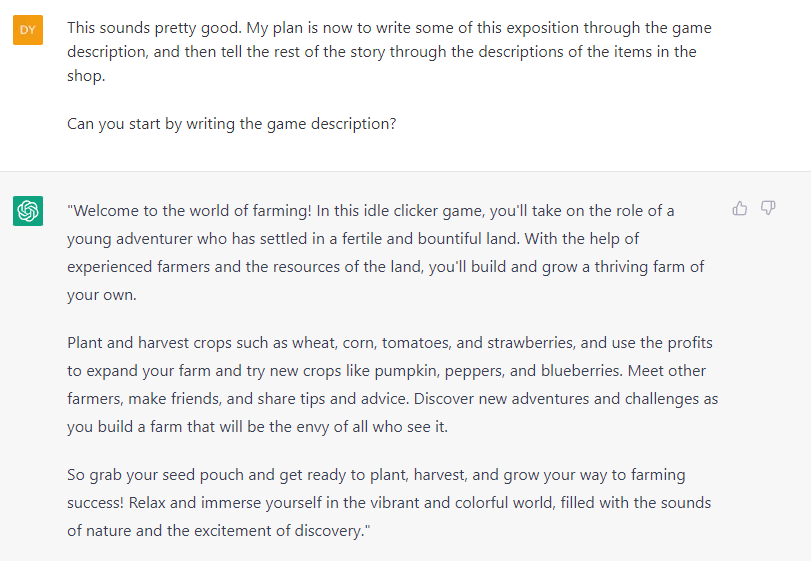
  1. Write the content. Once I'm happy with the story summary, I ask ChatGPT to write the in-game story content. In the case of this farming game, the only written content is the description of the game, and the description of the items in the shop.

ChatGPT for Story #3

Not bad. However, there is definitely no help from experienced farmers in the game, nor challenges or adventures to discover.
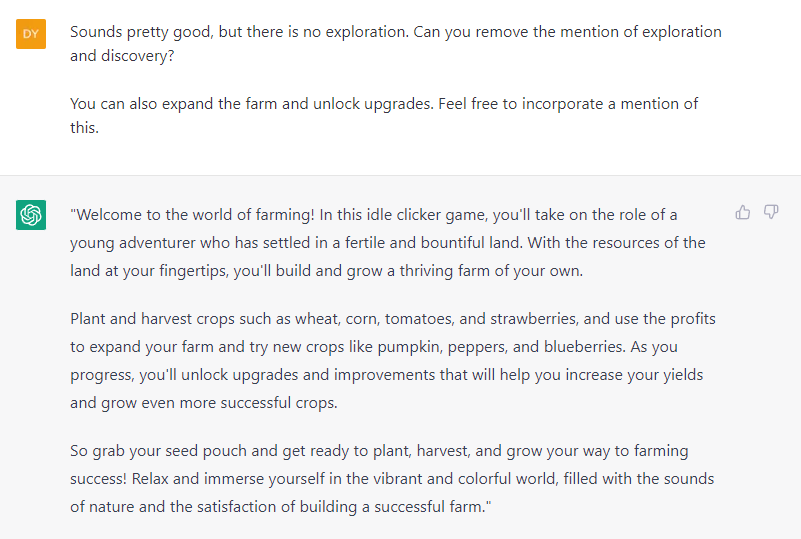
  1. Refine the content. I continue to refine the generated content to better fit the game.

ChatGPT for Story #4

I'm happy with this result. So, should I use it directly? Maybe. Since this is a free game being developed for an AI tutorial, probably. However, it may not be straightforward for commercial products, having potential unintended legal, ethical, and commercial ramifications.

⚠️ Limitation: Using outputs from language models directly may have unintended legal, ethical, and commercial ramifications.

Some potential unintended ramifications of using outputs directly are as follows:

  • Legal: The legal landscape surrounding Generative AI is currently very unclear, with several ongoing lawsuits.
  • Ethical: Language models can produce plagiarized or biased outputs. For more information, check out the Ethics and Society Newsletter.
  • Commercial: Some sources have stated that AI-generated content may be deprioritized by search engines. This may not be the case for most non-spam content, but is worth considering. Tools such as AI Content Detector can be used to check whether content may be detected as AI-generated. There is ongoing research on language model watermarking which may mark text as AI-generated.

Given these limitations, the safest approach may be to use language models like ChatGPT for brainstorming but write the final content by hand.
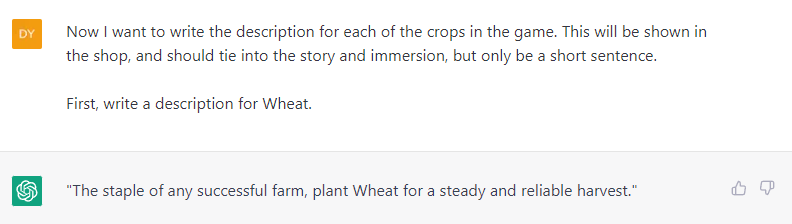
  1. Scale the content. I continue to use ChatGPT to flesh out descriptions for the items in the store.

ChatGPT for Story #5

For my simple farming game, this may be an effective approach to producing all the story content for the game. However, this may quickly run into scaling limitations. ChatGPT isn't well-suited to very long cohesive storytelling. Even after generating a few item descriptions for the farming game, the results begin to drift in quality and fall into repetition.

⚠️ Limitation: Language models are susceptible to repetition.

To wrap up this section, here are some tips from my own experience that may help with using AI for Story:

  • Ask for outlines. As mentioned, quality may deteriorate with long-form content. Developing high-level story outlines tends to work much better.
  • Brainstorm small ideas. Use language models to help flesh out ideas that don't require the full story context. For example, describe a character and use the AI to help brainstorm details about that character.
  • Refine content. Write your actual story content, and ask for suggestions on ways to improve that content. Even if you don't use the result, it may give you ideas on how to improve the content.

Despite the limitations I've discussed, dialog agents are an incredibly useful tool for game development, and it's only the beginning. Let's talk about the emerging landscape of dialog agents and their potential impact on game development.

Where We're Headed

The Emerging Landscape

My process focused on how ChatGPT can be used for story. However, ChatGPT isn't the only solution available. Character.AI provides access to dialog agents that are customized to characters with different personalities, including an agent that is specialized for creative writing.

There are many other models which are not yet publicly accessible. Check out this recent blog post on dialog agents, including a comparison with other existing models. These include:

While many prevalent contenders are closed-source, there are also open-source dialog agent efforts, such as LAION's OpenAssistant, reported efforts from CarperAI, and the open source release of Google's FLAN-T5 XXL. These can be combined with open-source tools like LangChain, which allow language model inputs and outputs to be chained, helping to work toward open dialog agents.

Just as the open-source release of Stable Diffusion has rapidly risen to a wide variety of innovations that have inspired this series, the open-source community will be key to exciting language-centric applications in game development that are yet to be seen. To keep up with these developments, feel free to follow me on Twitter. In the meantime, let's discuss some of these potential developments.

In-Game Development

NPCs: Aside from the clear uses of language models and dialog agents in the game development workflow, there is an exciting in-game potential for this technology that has not yet been realized. The most clear case of this is AI-powered NPCs. There are already startups built around the idea. Personally, I don't quite see how language models, as they currently are, can be applied to create compelling NPCs. However, I definitely don't think it's far off. I'll let you know.

Controls. What if you could control a game by talking to it? This is actually not too hard to do right now, though it hasn't been put into common practice. Would you be interested in learning how to do this? Stay tuned.

Conclusion

Want to play the final farming game? Check it out here or on itch.io.

Final Farming Game

Thank you for reading the AI for Game Development series! This series is only the beginning of AI for Game Development at Hugging Face, with more to come. Have questions? Want to get more involved? Join the Hugging Face Discord!