






惯性聚合 高效追踪和阅读你感兴趣的博客、新闻、科技资讯
阅读原文 在惯性聚合中打开

推荐订阅源

A
About on SuperTechFans
D
DataBreaches.Net
K
KPMG report finds enterprise disconnect between AI and its ROI | CIO
V
Visual Studio Blog
奇客Solidot–传递最新科技情报
奇客Solidot–传递最新科技情报
B
Blog RSS Feed
Recent Announcements
The Register - Security
S
Secure Thoughts
Y
Y Combinator Blog
The Last Watchdog
The Last Watchdog
L
LINUX DO - 最新话题
V2EX - 技术
V2EX - 技术
腾讯CDC
GbyAI
GbyAI
G
Google Developers Blog
博客园 - 司徒正美
博客园 - 三生石上(FineUI控件)
T
The Exploit Database - CXSecurity.com
T
Threat Research - Cisco Blogs
P
Proofpoint News Feed
Schneier on Security
Microsoft Security Blog
Jina AI
Jina AI
WordPress大学
WordPress大学
aimingoo的专栏
aimingoo的专栏
MyScale Blog
MyScale Blog
Help Net Security
Help Net Security
K
Kaspersky official blog
P
Privacy & Cybersecurity Law Blog
www.infosecurity-magazine.com
AI
AI
MongoDB | Blog
MongoDB | Blog
Scott Helme
Scott Helme
J
Java Code Geeks
Engineering at Meta
Engineering at Meta
H
Heimdal Security Blog
H
Help Net Security
D
Darknet – Hacking Tools, Hacker News & Cyber Security
云风的 BLOG
云风的 BLOG
Microsoft Azure Blog
S
Security Affairs
TaoSecurity Blog
TaoSecurity Blog
The GitHub Blog
The GitHub Blog
Hacker News: Ask HN
Hacker News: Ask HN
Martin Fowler
Martin Fowler
cs.AI updates on arXiv.org
Project Zero
Project Zero
T
The Blog of Author Tim Ferriss
Last Week in AI
Last Week in AI

Hugging Face - Blog

Waypoint-1.5: Higher-Fidelity Interactive Worlds for Everyday GPUs ALTK‑Evolve: On‑the‑Job Learning for AI Agents Safetensors is Joining the PyTorch Foundation Holo3: Breaking the Computer Use Frontier Any Custom Frontend with Gradio's Backend A New Framework for Evaluating Voice Agents (EVA) Bringing Robotics AI to Embedded Platforms: Dataset Recording, VLA Fine‑Tuning, and On‑Device Optimizations One-Shot Any Web App with Gradio's gr.HTML CUGA on Hugging Face: Democratizing Configurable AI Agents New in llama.cpp: Model Management Building Deep Research: How we Achieved State of the Art OVHcloud on Hugging Face Inference Providers 🔥 20x Faster TRL Fine-tuning with RapidFire AI Building for an Open Future - our new partnership with Google Cloud Aligning to What? Rethinking Agent Generalization in MiniMax M2 Building a Healthcare Robot from Simulation to Deployment with NVIDIA Isaac Sentence Transformers is joining Hugging Face! Unlock the power of images with AI Sheets Supercharge your OCR Pipelines with Open Models Google Cloud C4 Brings a 70% TCO improvement on GPT OSS with Intel and Hugging Face Get your VLM running in 3 simple steps on Intel CPUs Nemotron-Personas-India: Synthesized Data for Sovereign AI Introducing RTEB: A New Standard for Retrieval Evaluation Accelerating Qwen3-8B Agent on Intel® Core™ Ultra with Depth-Pruned Draft Models VibeGame: Exploring Vibe Coding Games Nemotron-Personas-Japan: ソブリン AI のための合成データセット Swift Transformers Reaches 1.0 – and Looks to the Future Smol2Operator: Post-Training GUI Agents for Computer Use SyGra: The One-Stop Framework for Building Data for LLMs and SLMs Gaia2 and ARE: Empowering the community to study agents Scaleway on Hugging Face Inference Providers 🔥 Democratizing AI Safety with RiskRubric.ai Public AI on Hugging Face Inference Providers 🔥 `LeRobotDataset:v3.0`: Bringing large-scale datasets to `lerobot` Visible Watermarking with Gradio Introducing the Palmyra-mini family: Powerful, lightweight, and ready to reason! Tricks from OpenAI gpt-oss YOU 🫵 can use with transformers Fine-tune Any LLM from the Hugging Face Hub with Together AI Jupyter Agents: training LLMs to reason with notebooks mmBERT: ModernBERT goes Multilingual Welcome EmbeddingGemma, Google's new efficient embedding model SAIR: Accelerating Pharma R&D with AI-Powered Structural Intelligence Make your ZeroGPU Spaces go brrr with ahead-of-time compilation NVIDIA Releases 6 Million Multi-Lingual Reasoning Dataset Generate Images with Claude and Hugging Face From Zero to GPU: A Guide to Building and Scaling Production-Ready CUDA Kernels MCP for Research: How to Connect AI to Research Tools Kimina-Prover-RL Arm & ExecuTorch 0.7: Bringing Generative AI to the masses Neural Super Sampling is here! TextQuests: How Good are LLMs at Text-Based Video Games? 🇵🇭 FilBench - Can LLMs Understand and Generate Filipino? Introducing AI Sheets: a tool to work with datasets using open AI models! Accelerate ND-Parallel: A guide to Efficient Multi-GPU Training Vision Language Model Alignment in TRL ⚡️ Welcome GPT OSS, the new open-source model family from OpenAI! Measuring Open-Source Llama Nemotron Models on DeepResearch Bench 📚 3LM: A Benchmark for Arabic LLMs in STEM and Code Implementing MCP Servers in Python: An AI Shopping Assistant with Gradio Introducing Trackio: A Lightweight Experiment Tracking Library from Hugging Face Say hello to `hf`: a faster, friendlier Hugging Face CLI ✨ Parquet Content-Defined Chunking TimeScope: How Long Can Your Video Large Multimodal Model Go? Fast LoRA inference for Flux with Diffusers and PEFT Accelerate a World of LLMs on Hugging Face with NVIDIA NIM Arc Virtual Cell Challenge: A Primer Consilium: When Multiple LLMs Collaborate Back to The Future: Evaluating AI Agents on Predicting Future Events Five Big Improvements to Gradio MCP Servers Ettin Suite: SoTA Paired Encoders and Decoders Migrating the Hub from Git LFS to Xet Kimina-Prover: Applying Test-time RL Search on Large Formal Reasoning Models Asynchronous Robot Inference: Decoupling Action Prediction and Execution ScreenEnv: Deploy your full stack Desktop Agent Building the Hugging Face MCP Server Reachy Mini - The Open-Source Robot for Today's and Tomorrow's AI Builders Creating custom kernels for the AMD MI300 Upskill your LLMs With Gradio MCP Servers SmolLM3: smol, multilingual, long-context reasoner Three Mighty Alerts Supporting Hugging Face’s Production Infrastructure Efficient MultiModal Data Pipeline Announcing NeurIPS 2025 E2LM Competition: Early Training Evaluation of Language Models Training and Finetuning Sparse Embedding Models with Sentence Transformers Welcome the NVIDIA Llama Nemotron Nano VLM to Hugging Face Hub Gemma 3n fully available in the open-source ecosystem! Transformers backend integration in SGLang (LoRA) Fine-Tuning FLUX.1-dev on Consumer Hardware Groq on Hugging Face Inference Providers 🔥 How Long Prompts Block Other Requests - Optimizing LLM Performance Learn the Hugging Face Kernel Hub in 5 Minutes Convert Transformers to ONNX with Hugging Face Optimum Intel and Hugging Face Partner to Democratize Machine Learning Hardware Acceleration Director of Machine Learning Insights [Part 3: Finance Edition] The Annotated Diffusion Model Deep Q-Learning with Space Invaders Graphcore and Hugging Face Launch New Lineup of IPU-Ready Transformers Introducing Pull Requests and Discussions 🥳 Efficient Table Pre-training without Real Data: An Introduction to TAPEX An Introduction to Q-Learning Part 2/2 How Sempre Health is leveraging the Expert Acceleration Program to accelerate their ML roadmap
Creating Privacy Preserving AI with Substra
Ali Imran, Katie Link, Nima Boscarino, Thibault Fouqueray · 2023-04-12 · via Hugging Face - Blog

Back to Articles

Ali Imran's avatar

Katie Link's avatar

Nima Boscarino's avatar

Thibault Fouqueray's avatar

With the recent rise of generative techniques, machine learning is at an incredibly exciting point in its history. The models powering this rise require even more data to produce impactful results, and thus it’s becoming increasingly important to explore new methods of ethically gathering data while ensuring that data privacy and security remain a top priority.

In many domains that deal with sensitive information, such as healthcare, there often isn’t enough high quality data accessible to train these data-hungry models. Datasets are siloed in different academic centers and medical institutions and are difficult to share openly due to privacy concerns about patient and proprietary information. Regulations that protect patient data such as HIPAA are essential to safeguard individuals’ private health information, but they can limit the progress of machine learning research as data scientists can’t access the volume of data required to effectively train their models. Technologies that work alongside existing regulations by proactively protecting patient data will be crucial to unlocking these silos and accelerating the pace of machine learning research and deployment in these domains.

This is where Federated Learning comes in. Check out the space we’ve created with Substra to learn more!

What is Federated Learning?

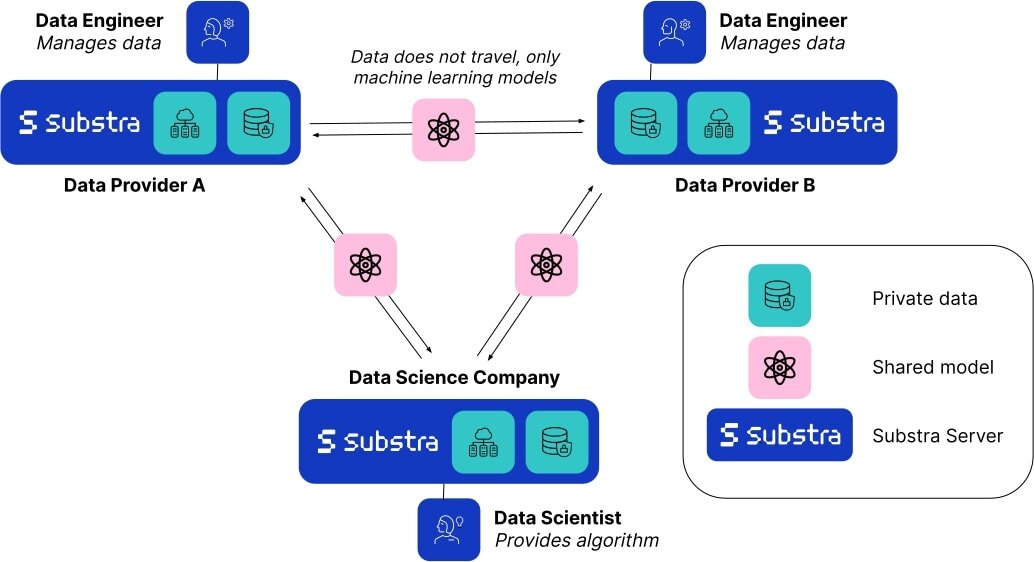
Federated learning (FL) is a decentralized machine learning technique that allows you to train models using multiple data providers. Instead of gathering data from all sources on a single server, data can remain on a local server as only the resulting model weights travel between servers.

As the data never leaves its source, federated learning is naturally a privacy-first approach. Not only does this technique improve data security and privacy, it also enables data scientists to build better models using data from different sources - increasing robustness and providing better representation as compared to models trained on data from a single source. This is valuable not only due to the increase in the quantity of data, but also to reduce the risk of bias due to variations of the underlying dataset, for example minor differences caused by the data capture techniques and equipment, or differences in demographic distributions of the patient population. With multiple sources of data, we can build more generalizable models that ultimately perform better in real world settings. For more information on federated learning, we recommend checking out this explanatory comic by Google.
Substra quote

Substra is an open source federated learning framework built for real world production environments. Although federated learning is a relatively new field and has only taken hold in the last decade, it has already enabled machine learning research to progress in ways previously unimaginable. For example, 10 competing biopharma companies that would traditionally never share data with each other set up a collaboration in the MELLODDY project by sharing the world’s largest collection of small molecules with known biochemical or cellular activity. This ultimately enabled all of the companies involved to build more accurate predictive models for drug discovery, a huge milestone in medical research.

Substra x HF

Research on the capabilities of federated learning is growing rapidly but the majority of recent work has been limited to simulated environments. Real world examples and implementations still remain limited due to the difficulty of deploying and architecting federated networks. As a leading open-source platform for federated learning deployment, Substra has been battle tested in many complex security environments and IT infrastructures, and has enabled medical breakthroughs in breast cancer research.
Substra diagram

Hugging Face collaborated with the folks managing Substra to create this space, which is meant to give you an idea of the real world challenges that researchers and scientists face - mainly, a lack of centralized, high quality data that is ‘ready for AI’. As you can control the distribution of these samples, you’ll be able to see how a simple model reacts to changes in data. You can then examine how a model trained with federated learning almost always performs better on validation data compared with models trained on data from a single source.

Conclusion

Although federated learning has been leading the charge, there are various other privacy enhancing technologies (PETs) such as secure enclaves and multi party computation that are enabling similar results and can be combined with federation to create multi layered privacy preserving environments. You can learn more here if you’re interested in how these are enabling collaborations in medicine.

Regardless of the methods used, it's important to stay vigilant of the fact that data privacy is a right for all of us. It’s critical that we move forward in this AI boom with privacy and ethics in mind.

If you’d like to play around with Substra and implement federated learning in a project, you can check out the docs here.