










惯性聚合 高效追踪和阅读你感兴趣的博客、新闻、科技资讯
阅读原文 在惯性聚合中打开

推荐订阅源

雷峰网
雷峰网
V
Visual Studio Blog
NISL@THU
NISL@THU
S
Security Affairs
Threat Intelligence Blog | Flashpoint
大猫的无限游戏
大猫的无限游戏
Microsoft Security Blog
云风的 BLOG
云风的 BLOG
The Register - Security
博客园_首页
月光博客
月光博客
aimingoo的专栏
aimingoo的专栏
I
InfoQ
Spread Privacy
Spread Privacy
P
Proofpoint News Feed
OSCHINA 社区最新新闻
OSCHINA 社区最新新闻
爱范儿
爱范儿
T
Tor Project blog
有赞技术团队
有赞技术团队
美团技术团队
cs.CV updates on arXiv.org
Hacker News: Ask HN
Hacker News: Ask HN
Google DeepMind News
WordPress大学
WordPress大学
Google Online Security Blog
Vercel News
Vercel News
Webroot Blog
Webroot Blog
S
Security @ Cisco Blogs
freeCodeCamp Programming Tutorials: Python, JavaScript, Git & More
奇客Solidot–传递最新科技情报
奇客Solidot–传递最新科技情报
Application and Cybersecurity Blog
D
DataBreaches.Net
J
Java Code Geeks
Cyber Security Advisories - MS-ISAC
腾讯CDC
博客园 - 司徒正美
Exploit-DB.com RSS Feed
Security Archives - TechRepublic
G
Google Developers Blog
The GitHub Blog
The GitHub Blog
小众软件
小众软件
www.infosecurity-magazine.com
N
News and Events Feed by Topic
Forbes - Security
Forbes - Security
T
Troy Hunt's Blog
C
Check Point Blog
D
Docker
Latest news
Latest news
Martin Fowler
Martin Fowler
T
Tenable Blog

Hugging Face - Blog

Waypoint-1.5: Higher-Fidelity Interactive Worlds for Everyday GPUs ALTK‑Evolve: On‑the‑Job Learning for AI Agents Safetensors is Joining the PyTorch Foundation Holo3: Breaking the Computer Use Frontier Any Custom Frontend with Gradio's Backend A New Framework for Evaluating Voice Agents (EVA) Bringing Robotics AI to Embedded Platforms: Dataset Recording, VLA Fine‑Tuning, and On‑Device Optimizations One-Shot Any Web App with Gradio's gr.HTML CUGA on Hugging Face: Democratizing Configurable AI Agents New in llama.cpp: Model Management Building Deep Research: How we Achieved State of the Art OVHcloud on Hugging Face Inference Providers 🔥 20x Faster TRL Fine-tuning with RapidFire AI Building for an Open Future - our new partnership with Google Cloud Aligning to What? Rethinking Agent Generalization in MiniMax M2 Building a Healthcare Robot from Simulation to Deployment with NVIDIA Isaac Sentence Transformers is joining Hugging Face! Unlock the power of images with AI Sheets Supercharge your OCR Pipelines with Open Models Google Cloud C4 Brings a 70% TCO improvement on GPT OSS with Intel and Hugging Face Get your VLM running in 3 simple steps on Intel CPUs Nemotron-Personas-India: Synthesized Data for Sovereign AI Introducing RTEB: A New Standard for Retrieval Evaluation Accelerating Qwen3-8B Agent on Intel® Core™ Ultra with Depth-Pruned Draft Models VibeGame: Exploring Vibe Coding Games Nemotron-Personas-Japan: ソブリン AI のための合成データセット Swift Transformers Reaches 1.0 – and Looks to the Future Smol2Operator: Post-Training GUI Agents for Computer Use SyGra: The One-Stop Framework for Building Data for LLMs and SLMs Gaia2 and ARE: Empowering the community to study agents Scaleway on Hugging Face Inference Providers 🔥 Democratizing AI Safety with RiskRubric.ai Public AI on Hugging Face Inference Providers 🔥 `LeRobotDataset:v3.0`: Bringing large-scale datasets to `lerobot` Visible Watermarking with Gradio Introducing the Palmyra-mini family: Powerful, lightweight, and ready to reason! Tricks from OpenAI gpt-oss YOU 🫵 can use with transformers Fine-tune Any LLM from the Hugging Face Hub with Together AI Jupyter Agents: training LLMs to reason with notebooks mmBERT: ModernBERT goes Multilingual Welcome EmbeddingGemma, Google's new efficient embedding model SAIR: Accelerating Pharma R&D with AI-Powered Structural Intelligence Make your ZeroGPU Spaces go brrr with ahead-of-time compilation NVIDIA Releases 6 Million Multi-Lingual Reasoning Dataset Generate Images with Claude and Hugging Face From Zero to GPU: A Guide to Building and Scaling Production-Ready CUDA Kernels MCP for Research: How to Connect AI to Research Tools Kimina-Prover-RL Arm & ExecuTorch 0.7: Bringing Generative AI to the masses Neural Super Sampling is here! TextQuests: How Good are LLMs at Text-Based Video Games? 🇵🇭 FilBench - Can LLMs Understand and Generate Filipino? Introducing AI Sheets: a tool to work with datasets using open AI models! Accelerate ND-Parallel: A guide to Efficient Multi-GPU Training Vision Language Model Alignment in TRL ⚡️ Welcome GPT OSS, the new open-source model family from OpenAI! Measuring Open-Source Llama Nemotron Models on DeepResearch Bench 📚 3LM: A Benchmark for Arabic LLMs in STEM and Code Implementing MCP Servers in Python: An AI Shopping Assistant with Gradio Introducing Trackio: A Lightweight Experiment Tracking Library from Hugging Face Say hello to `hf`: a faster, friendlier Hugging Face CLI ✨ Parquet Content-Defined Chunking TimeScope: How Long Can Your Video Large Multimodal Model Go? Fast LoRA inference for Flux with Diffusers and PEFT Accelerate a World of LLMs on Hugging Face with NVIDIA NIM Arc Virtual Cell Challenge: A Primer Consilium: When Multiple LLMs Collaborate Back to The Future: Evaluating AI Agents on Predicting Future Events Five Big Improvements to Gradio MCP Servers Ettin Suite: SoTA Paired Encoders and Decoders Migrating the Hub from Git LFS to Xet Kimina-Prover: Applying Test-time RL Search on Large Formal Reasoning Models Asynchronous Robot Inference: Decoupling Action Prediction and Execution ScreenEnv: Deploy your full stack Desktop Agent Building the Hugging Face MCP Server Reachy Mini - The Open-Source Robot for Today's and Tomorrow's AI Builders Creating custom kernels for the AMD MI300 Upskill your LLMs With Gradio MCP Servers SmolLM3: smol, multilingual, long-context reasoner Three Mighty Alerts Supporting Hugging Face’s Production Infrastructure Efficient MultiModal Data Pipeline Announcing NeurIPS 2025 E2LM Competition: Early Training Evaluation of Language Models Training and Finetuning Sparse Embedding Models with Sentence Transformers Welcome the NVIDIA Llama Nemotron Nano VLM to Hugging Face Hub Gemma 3n fully available in the open-source ecosystem! Transformers backend integration in SGLang (LoRA) Fine-Tuning FLUX.1-dev on Consumer Hardware Groq on Hugging Face Inference Providers 🔥 How Long Prompts Block Other Requests - Optimizing LLM Performance Learn the Hugging Face Kernel Hub in 5 Minutes Convert Transformers to ONNX with Hugging Face Optimum Intel and Hugging Face Partner to Democratize Machine Learning Hardware Acceleration Director of Machine Learning Insights [Part 3: Finance Edition] The Annotated Diffusion Model Deep Q-Learning with Space Invaders Graphcore and Hugging Face Launch New Lineup of IPU-Ready Transformers Introducing Pull Requests and Discussions 🥳 Efficient Table Pre-training without Real Data: An Introduction to TAPEX An Introduction to Q-Learning Part 2/2 How Sempre Health is leveraging the Expert Acceleration Program to accelerate their ML roadmap
Introducing IDEFICS: An Open Reproduction of State-of-the-art Visual Langage Model
Hugo Laurençon, Daniel van Strien, Stas Bekman, Leo Tronchon, Lu · 2023-08-22 · via Hugging Face - Blog

Back to Articles

Hugo Laurençon's avatar

Daniel van Strien's avatar

Stas Bekman's avatar

Leo Tronchon's avatar

Lucile Saulnier's avatar

Thomas Wang's avatar

Siddharth Karamcheti's avatar

Amanpreet Singh's avatar

Giada Pistilli's avatar

Yacine Jernite's avatar

Victor Sanh's avatar

This article is also available in Chinese 简体中文.

We are excited to release IDEFICS (Image-aware Decoder Enhanced à la Flamingo with Interleaved Cross-attentionS), an open-access visual language model. IDEFICS is based on Flamingo, a state-of-the-art visual language model initially developed by DeepMind, which has not been released publicly. Similarly to GPT-4, the model accepts arbitrary sequences of image and text inputs and produces text outputs. IDEFICS is built solely on publicly available data and models (LLaMA v1 and OpenCLIP) and comes in two variants—the base version and the instructed version. Each variant is available at the 9 billion and 80 billion parameter sizes.

The development of state-of-the-art AI models should be more transparent. Our goal with IDEFICS is to reproduce and provide the AI community with systems that match the capabilities of large proprietary models like Flamingo. As such, we took important steps contributing to bringing transparency to these AI systems: we used only publicly available data, we provided tooling to explore training datasets, we shared technical lessons and mistakes of building such artifacts and assessed the model’s harmfulness by adversarially prompting it before releasing it. We are hopeful that IDEFICS will serve as a solid foundation for more open research in multimodal AI systems, alongside models like OpenFlamingo-another open reproduction of Flamingo at the 9 billion parameter scale.

Try out the demo and the models on the Hub!
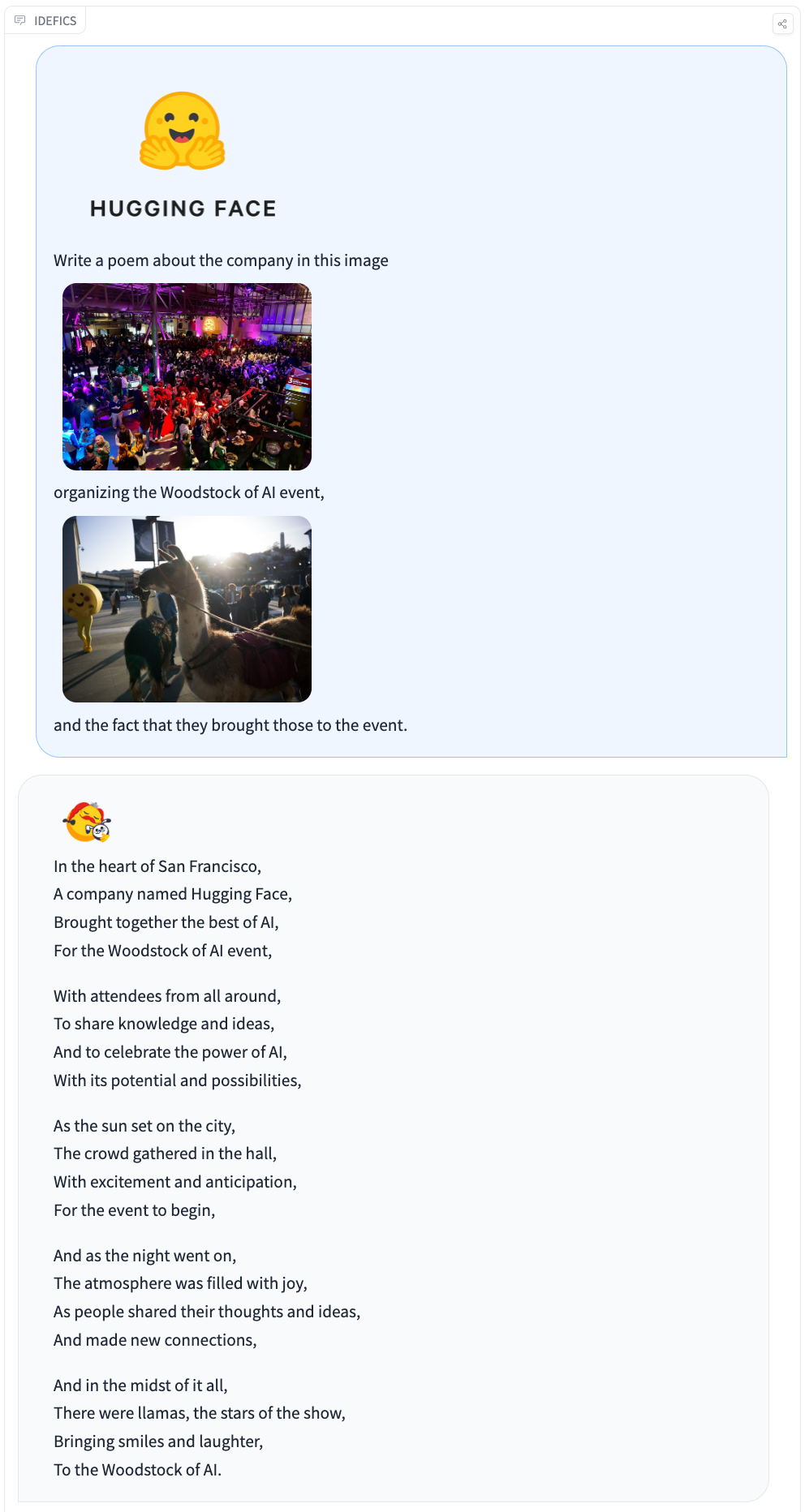
Screenshot of IDEFICS generation for HF Woodstock of AI

What is IDEFICS?

IDEFICS is an 80 billion parameters multimodal model that accepts sequences of images and texts as input and generates coherent text as output. It can answer questions about images, describe visual content, create stories grounded in multiple images, etc.

IDEFICS is an open-access reproduction of Flamingo and is comparable in performance with the original closed-source model across various image-text understanding benchmarks. It comes in two variants - 80 billion parameters and 9 billion parameters.
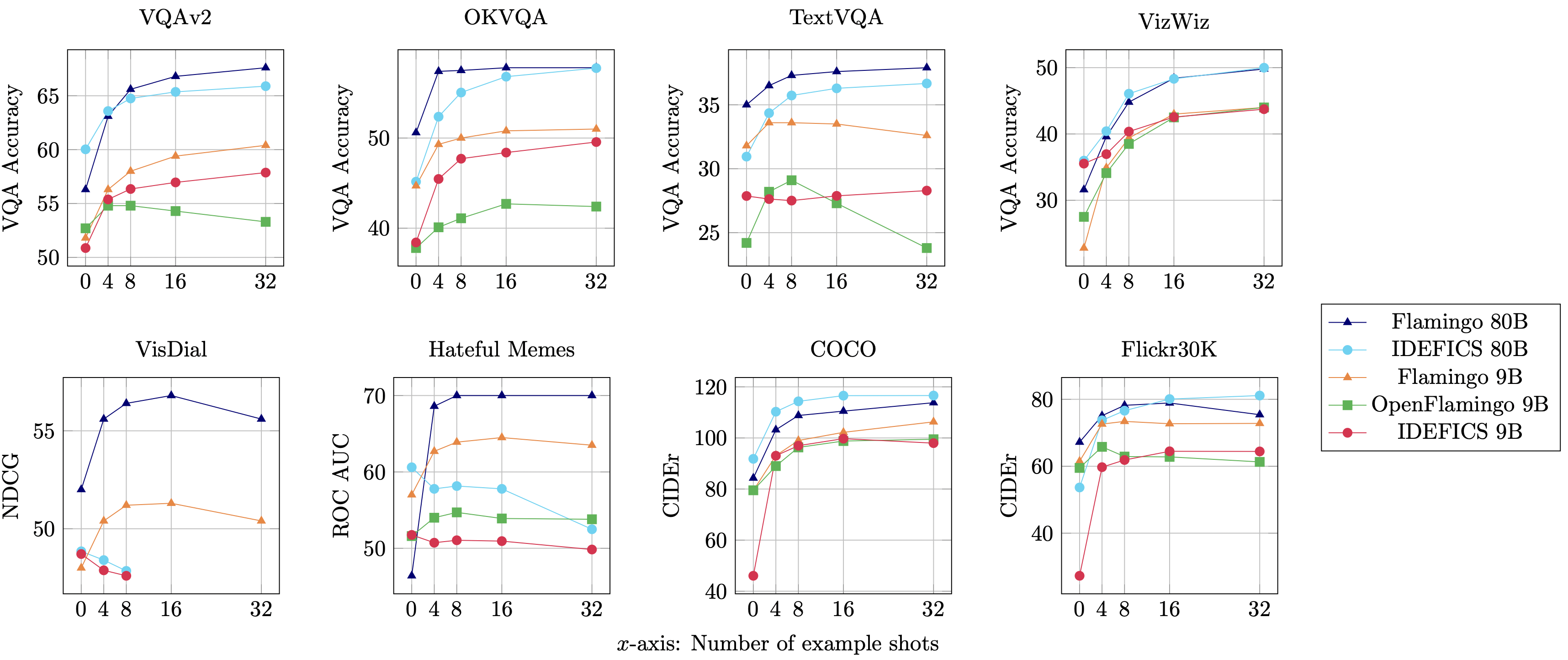
Plot comparing the performance of Flamingo, OpenFlamingo and IDEFICS

We also provide fine-tuned versions idefics-80B-instruct and idefics-9B-instruct adapted for conversational use cases.

Training Data

IDEFICS was trained on a mixture of openly available datasets: Wikipedia, Public Multimodal Dataset, and LAION, as well as a new 115B token dataset called OBELICS that we created. OBELICS consists of 141 million interleaved image-text documents scraped from the web and contains 353 million images.

We provide an interactive visualization of OBELICS that allows exploring the content of the dataset with Nomic AI.
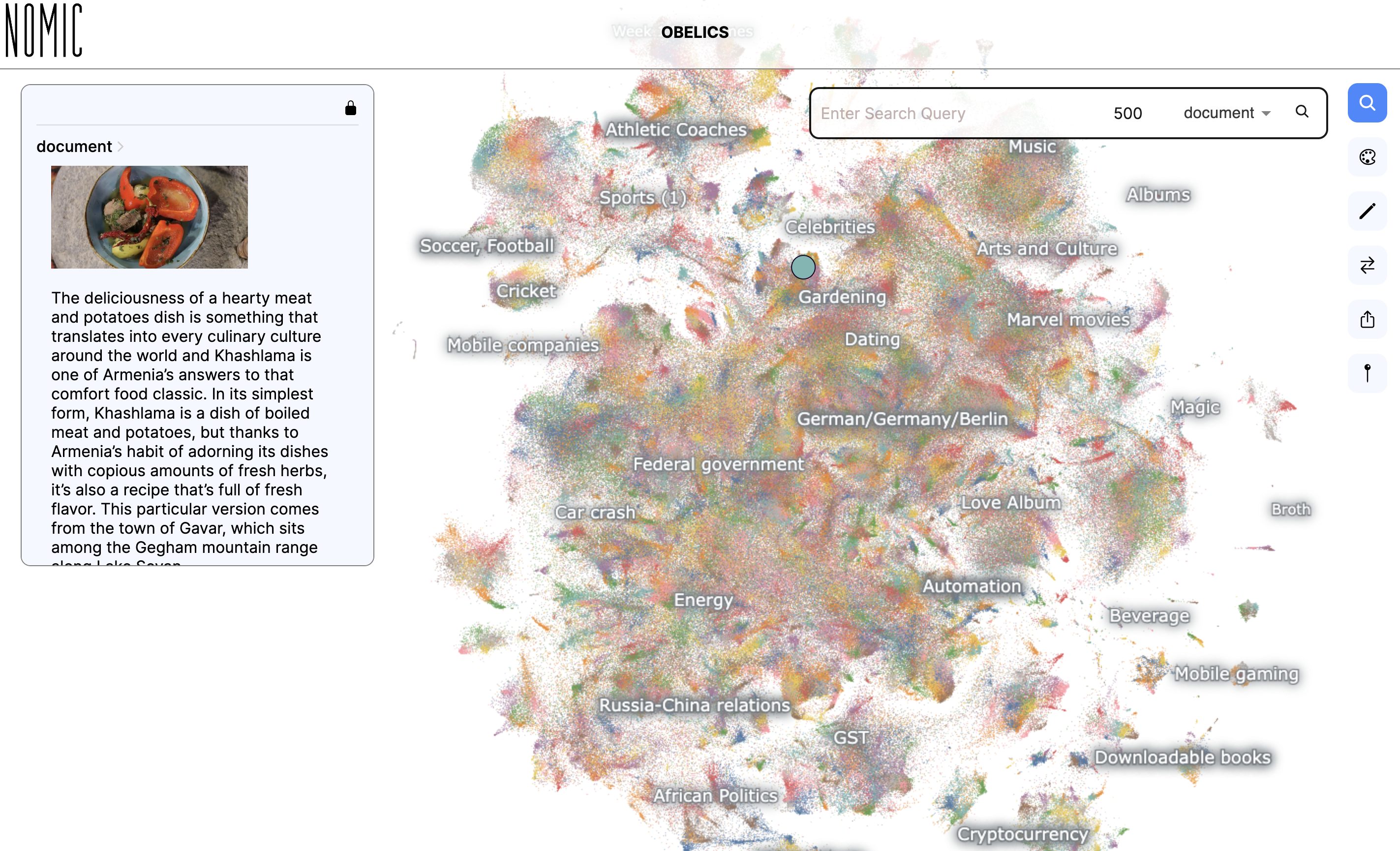
Interactive visualization of OBELICS

The details of IDEFICS' architecture, training methodology, and evaluations, as well as information about the dataset, are available in the model card and our research paper. Additionally, we have documented technical insights and learnings from the model's training, offering valuable perspective on IDEFICS' development.

Ethical evaluation

At the outset of this project, through a set of discussions, we developed an ethical charter that would help steer decisions made during the project. This charter sets out values, including being self-critical, transparent, and fair which we have sought to pursue in how we approached the project and the release of the models.

As part of the release process, we internally evaluated the model for potential biases by adversarially prompting the model with images and text that might elicit responses we do not want from the model (a process known as red teaming).

Please try out IDEFICS with the demo, check out the corresponding model cards and dataset card and let us know your feedback using the community tab! We are committed to improving these models and making large multimodal AI models accessible to the machine learning community.

License

The model is built on top of two pre-trained models: laion/CLIP-ViT-H-14-laion2B-s32B-b79K and huggyllama/llama-65b. The first was released under an MIT license, while the second was released under a specific non-commercial license focused on research purposes. As such, users should comply with that license by applying directly to Meta's form.

The two pre-trained models are connected to each other with newly initialized parameters that we train. These are not based on any of the two base frozen models forming the composite model. We release the additional weights we trained under an MIT license.

Getting Started with IDEFICS

IDEFICS models are available on the Hugging Face Hub and supported in the last transformers version. Here is a code sample to try it out:

import torch
from transformers import IdeficsForVisionText2Text, AutoProcessor

device = "cuda" if torch.cuda.is_available() else "cpu"

checkpoint = "HuggingFaceM4/idefics-9b-instruct"
model = IdeficsForVisionText2Text.from_pretrained(checkpoint, torch_dtype=torch.bfloat16).to(device)
processor = AutoProcessor.from_pretrained(checkpoint)

# We feed to the model an arbitrary sequence of text strings and images. Images can be either URLs or PIL Images.
prompts = [
    [
        "User: What is in this image?",
        "https://upload.wikimedia.org/wikipedia/commons/8/86/Id%C3%A9fix.JPG",
        "<end_of_utterance>",

        "\nAssistant: This picture depicts Idefix, the dog of Obelix in Asterix and Obelix. Idefix is running on the ground.<end_of_utterance>",

        "\nUser:",
        "https://static.wikia.nocookie.net/asterix/images/2/25/R22b.gif/revision/latest?cb=20110815073052",
        "And who is that?<end_of_utterance>",

        "\nAssistant:",
    ],
]

# --batched mode
inputs = processor(prompts, add_end_of_utterance_token=False, return_tensors="pt").to(device)
# --single sample mode
# inputs = processor(prompts[0], return_tensors="pt").to(device)

# Generation args
exit_condition = processor.tokenizer("<end_of_utterance>", add_special_tokens=False).input_ids
bad_words_ids = processor.tokenizer(["<image>", "<fake_token_around_image>"], add_special_tokens=False).input_ids

generated_ids = model.generate(**inputs, eos_token_id=exit_condition, bad_words_ids=bad_words_ids, max_length=100)
generated_text = processor.batch_decode(generated_ids, skip_special_tokens=True)
for i, t in enumerate(generated_text):
    print(f"{i}:\n{t}\n")